
Two euros forty-five for a liter of diesel, a record since records began, and in Switzerland, mandatory reserves have been tapped since September 8th. Anyone pointing the finger at Iran has grasped the most convenient part of the story. The other half is enshrined in law: Europe shut down its own refineries, made diesel more expensive by law, and celebrated its import dependency as progress. And because fertilizer depends on diesel, crops on fertilizer, and water rights on crops, this shortage doesn't end at the gas pump, but in the seeds, the wells, and the land registry. The shortage wasn't an accident; it was a deliberate policy.
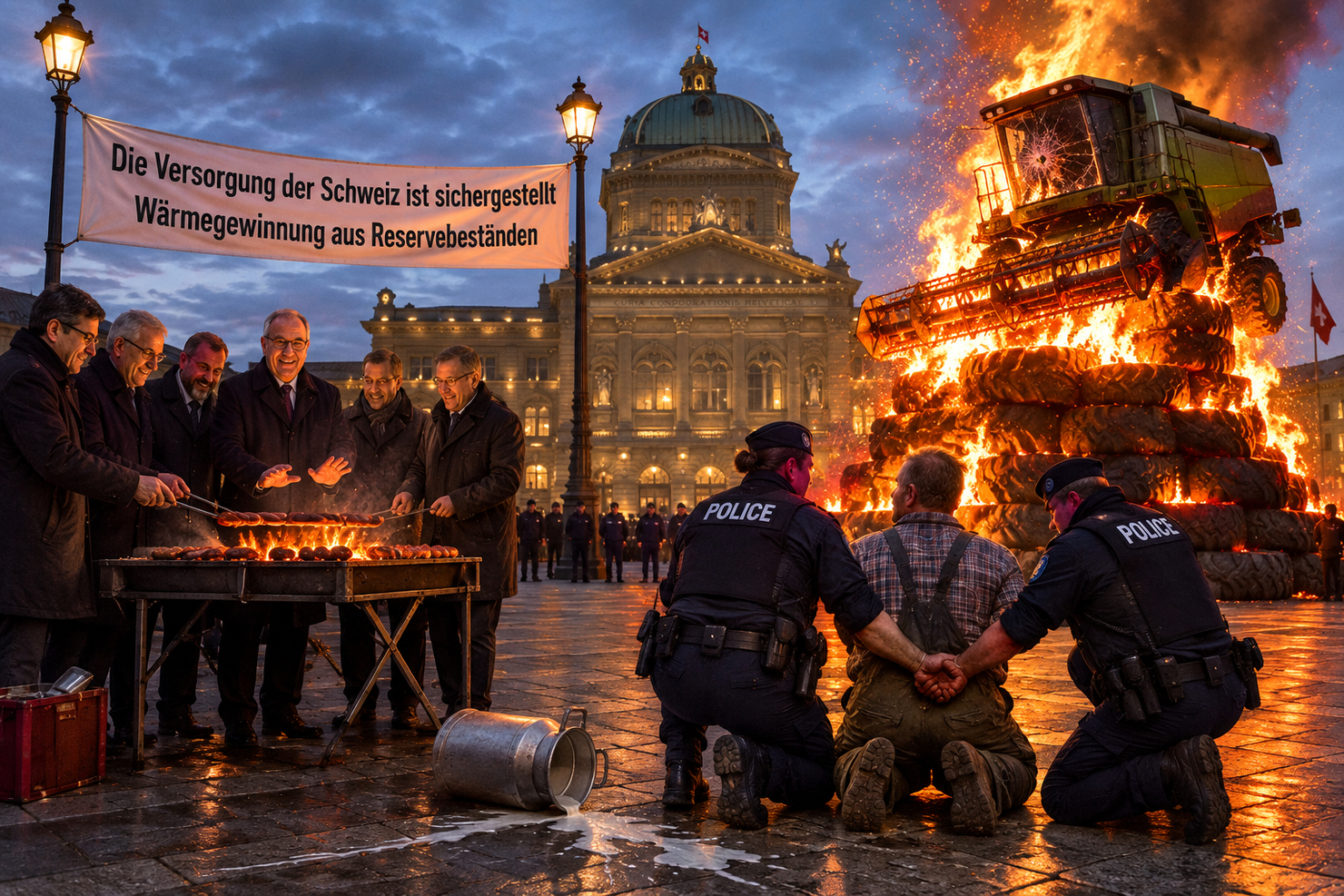
A war can paralyze a strait; that can happen. But for an entire continent to be left without a buffer zone afterward can only happen if someone had previously dismantled that buffer. And that's precisely what has been happening for years, documented in the files, with press releases and subsidies. The diesel shortage doesn't have backroom puppet masters. It has official case numbers.
The building plans were lying around in the open.
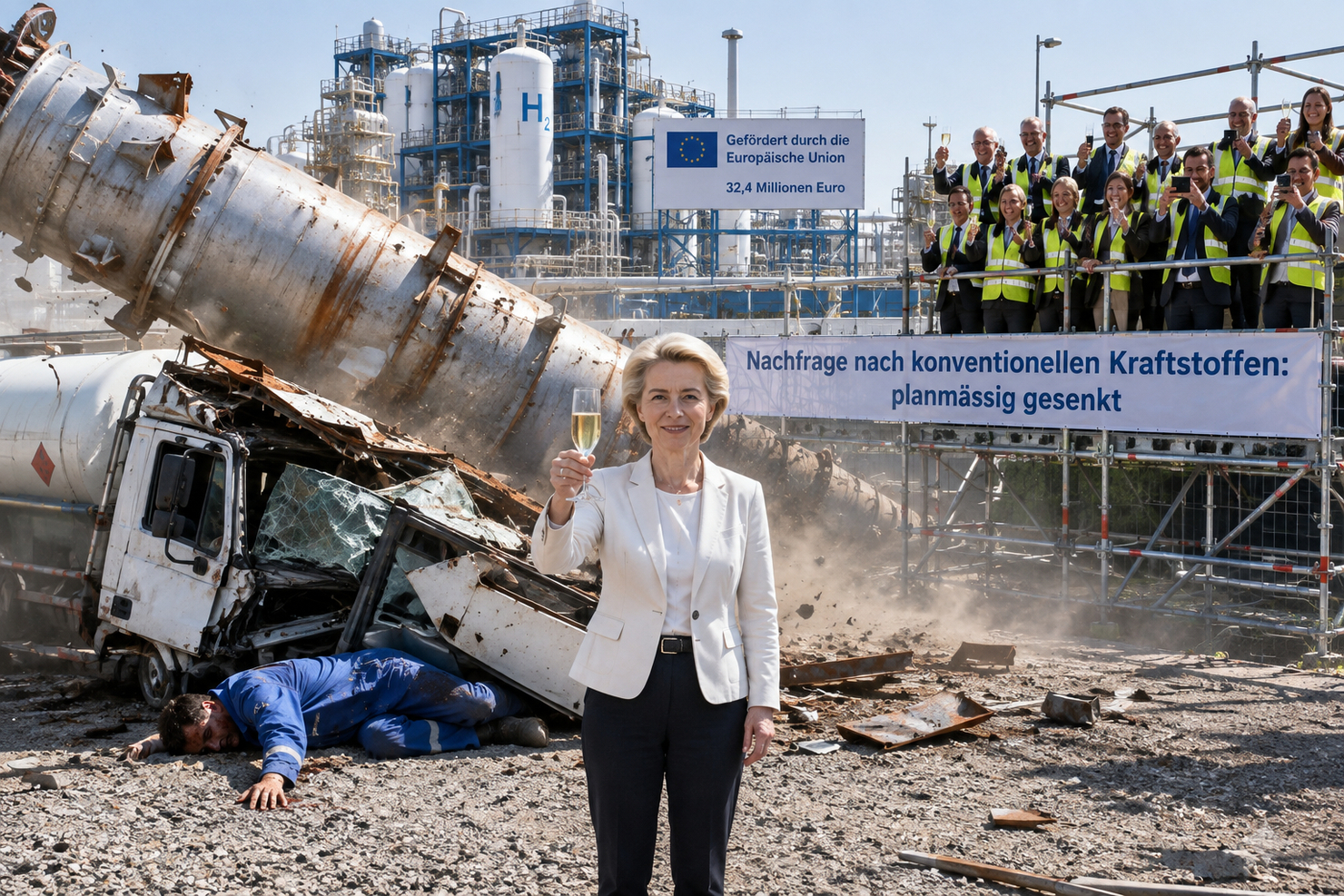
At the end of April 2025, Petroineos ceased processing at its Grangemouth refinery, which had a capacity of 150,000 barrels per day. The refinery was converted into an import terminal. The company provided its reasoning: the energy transition and declining demand for conventional fuels. In the same month, Shell ended crude oil processing at its Wesseling refinery in Germany , half of the country's largest refinery site, where the EU had already subsidized an electrolyzer with €32,4 million in 2021. BP has been seeking a buyer for its Gelsenkirchen refinery, with a capacity of 251,510 barrels per day, since February 2025. No buyer was found by the end of the year. According to the International Air Transport Association (IATA) , four European refineries ceased crude oil processing in 2025 alone, and S&P expects European capacity to decline from 13 million barrels per day to below 8 million. Add to that the CO₂ pricing, the second stage of which will impact transport and buildings in 2028, with forecasts between 100 and 250 euros per ton. No one tried to hide this. It was in the directive, in the official journal, in every fleet emission limit. Increased costs weren't a side effect; they were the instrument. The result was already visible in May, when, according to the Austrian energy minister's calculations, Europe was simply missing five percent of its diesel and fifteen percent of its kerosene.
The bill arrives in the field.
The EU average price for diesel fuel was €2,159 on September 14th, the highest level since the Commission began compiling statistics in 2005 , representing an increase of almost 40 percent since the beginning of the year. Energy inflation in the eurozone jumped to 14,3 percent in August. Of the €2,42 price at the German fuel pump, the state receives around €1,06, or about 44 percent, while the ECB expects the diesel margin to peak only in October.
A fifth of the diesel price is now pure refinery margin, a good 41 cents per liter, and Saudi Aramco has informed two European refineries that they will receive no oil in October despite long-term contracts. The situation was even worse in Switzerland: low water levels on the Rhine, coupled with an operational shutdown at Cressier, the country's only refinery, which supplies a good 30 percent of its needs. The delegate for national economic supply authorized withdrawals of 30,000 cubic meters each of diesel and gasoline from mandatory reserves , to be set aside within six months. The farmers' association calculates that the full agricultural diesel subsidy of 21,48 cents is insufficient to offset the losses, given that a liter cost €1,60 just a year ago, while Berlin is hammering out a 14-cent energy tax and a price cap until January 2027 at the latest , because elections are coming up. The consequences of this chain reaction were already evident during the global harvest , and the methodical creation of a supply crisis has long been established.
The emergency kit has been on the shelf since 2022.
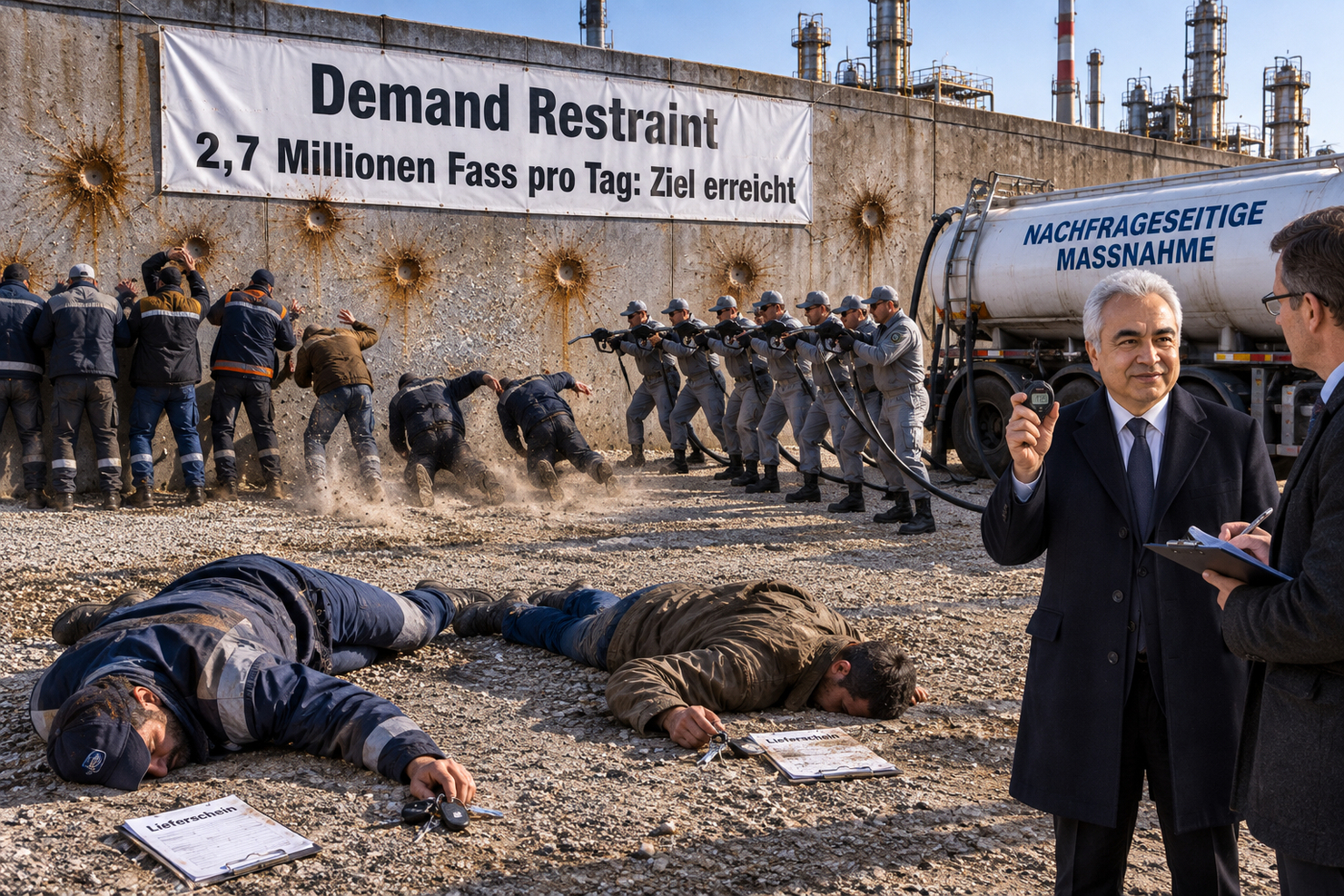
On March 11, the IEA released 400 million barrels from its emergency reserves, the largest coordinated release in its history, and nine days later, the ten-point plan "Sheltering from Oil Shocks" : reducing speed limits by at least ten kilometers per hour, working from home, car-free Sundays, and license plate-based access control. The goal: 2,7 million barrels less per day within four months. Anyone familiar with this figure has a good memory. It's the same plan with the same target amount that the IEA presented in March 2022. Four years on the shelf, label changed, done. In addition, the agency operates a crisis response tracker that lists which conservation measures have already been implemented in 109 countries. South Korea is considering taking every vehicle off the road on one of every five or ten days, and an energy lockdown has been announced.
Those who plan for scarcity also manage it.
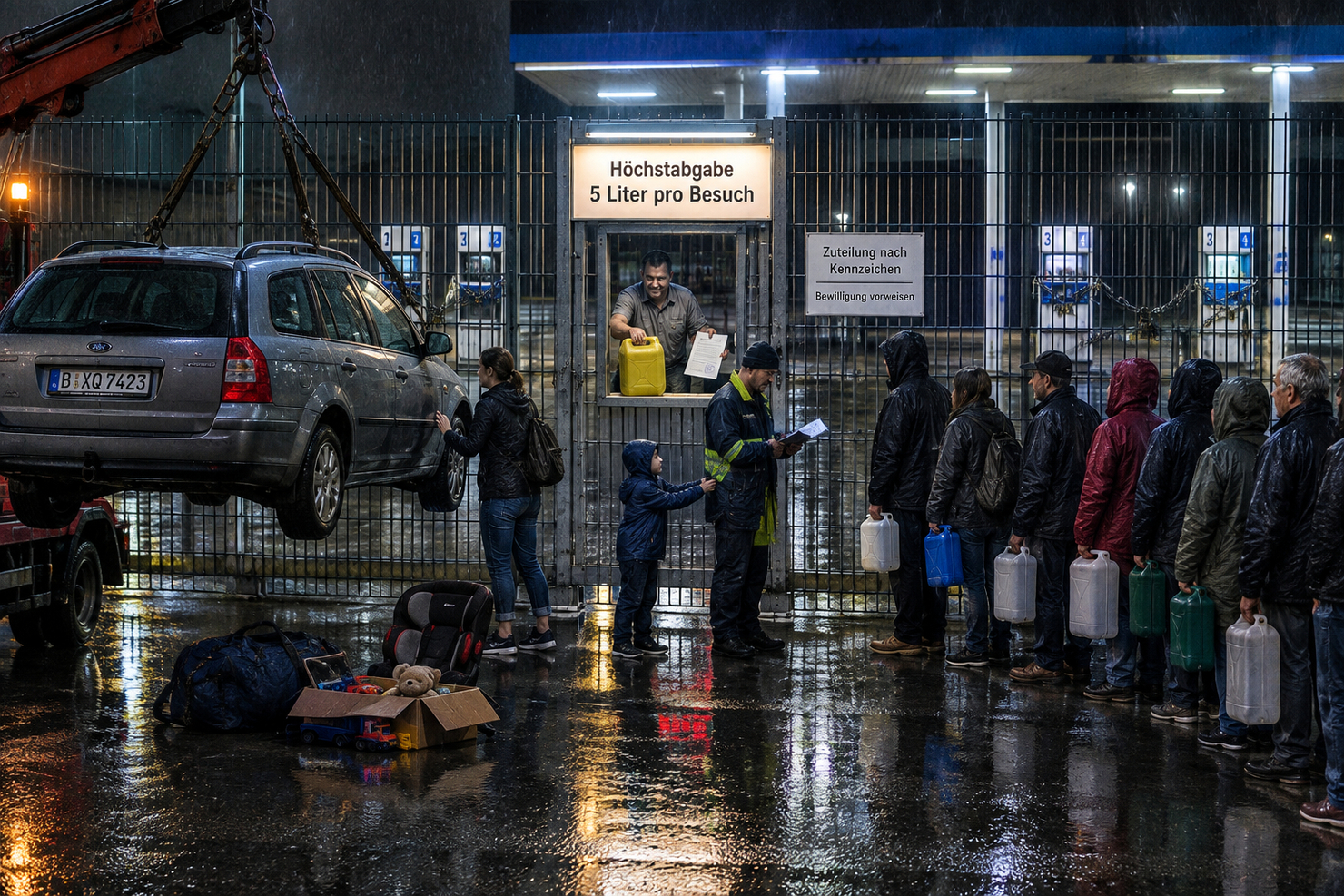
The UK's emergency fuel plan is being drafted by the Department for Energy Security and Net Zero, the very department whose purpose is to reduce fossil fuel consumption. Its toolkit includes a Maximum Purchase Scheme, which limits the amount of fuel sold per visit and station opening hours; a distribution scheme for preferred industries; and an allocation scheme, through which the government formally allocates crude oil and imported products, based on emergency powers granted by the Energy Act 1976. Those who have campaigned for decades for lower consumption are now deciding how much fuel goes into your tank.
From the tank to the ground
Diesel is the first domino to fall, but not the last. Before the Strait of Hormuz was closed, up to 30 percent of global fertilizer exports , along with sulfur used to produce phosphate fertilizer, passed through the Strait of Hormuz, according to calculations by the World Economic Forum. Urea prices rose by 20 to 60 percent. This assessment was written by Máximo Torero, chief economist of the UN Food and Agriculture Organization, and the recommendations are included in the same document. Blanket subsidies are expensive and regressive; instead, targeted programs, rapid access to credit for farms, and the replacement of diesel-powered irrigation with electric and solar systems are needed. One sentence stands out: The crisis also presents an opportunity to formalize informal farming through cooperatives and producer groups. In other words: Those who previously plowed without registration will now be officially recorded. The farmer who can no longer fill his tractor's tank won't receive diesel; he'll receive a loan, membership, and registration. How the sell-off of the farming community unfolds when it's driven by cash rather than legal means has been described here for some time. This is exactly what a takeover looks like when it's written in paragraphs with footnotes.
Water as bankruptcy assets, seeds without labels
Meanwhile, water is also a concern. On January 20th, the UN University declared a global water bankruptcy in a report and called for what is known in bureaucratic jargon as "bankruptcy management," namely comprehensive water accounting, enforceable withdrawal limits, and a restructuring of rights and claims to water. Agriculture consumes seventy to ninety percent of freshwater, making it the primary target for any limitations. Anyone with a well on their own property will no longer own a spring, but rather a concession.
For seeds, this process is already law. On June 17, the European Parliament adopted Regulation (EU) 2026/1388 on plants produced using new genomic techniques; it was published in the Official Journal on June 26 and will apply from July 17, 2028. For the NGT-1 category, risk assessment, traceability, and labeling of food and feed are no longer required. Nothing of this will be visible on the plate, and the result is patentable to boot. The food crisis, exacerbated by diesel prices, provides the justification for plants that can neither be identified nor replicated, and the business model behind it is as well-established as the practice of patenting life itself.
The ID card that has no purpose yet
The question remains: what is the key to all these allocations? By the end of 2026, according to the regulation on European digital identity, every EU member state must provide a digital wallet containing ID cards, driver's licenses, and other supporting documents. Its use is described as voluntary, and no link to fuel or food rationing has been stipulated anywhere. This is the honest version, and it's the more uncomfortable one: the allocation systems for energy, water, and food are currently being developed; the registration requirement for farmers is currently being established; and the corresponding identification tool will be delivered on schedule in the same year. Anyone wanting to read the blueprint for this data collection can find it in the UN Development Plan , and how the erosion of anonymity will actually occur is not a matter of prohibition, but rather a systemic requirement . It doesn't require a resolution to assemble three ready-made systems; it simply requires a sufficiently cold winter.
From goods to approval
In the end, the shift isn't about the price, but the relationship. Buying diesel means buying a commodity. Receiving a diesel allocation means submitting an application. Between these two statements lies the entire difference between a citizen and a supplicant, and it's being enacted right now at the gas pump, without a vote, without debate, with reference to a war no one here started. The same mechanism was at work with bread and property, where buying became renting until further notice . The refineries have been demolished, the tanks half-empty, the well becomes a concession, seeds lose their labels, and salvation consists of a fourteen-cent discount and a leaflet on fuel efficiency. First, they took away people's production, then their supplies, then their water, and now they're selling them rationing as solidarity. The plan worked, but no one voted for it. And when, in the end, every liter, every bucket, and every grain of grain requires a permit, they won't call it scarcity, they'll call it responsibility!
More for you:






 "Dravens Tales from the Crypt" has been enchanting for over 15 years with a tasteless mixture of humor, serious journalism - for current events and unbalanced reporting in the press politics - and zombies, garnished with lots of art, entertainment and punk rock. Draven has turned his hobby into a popular brand that cannot be classified.
My blog was never designed to spread news, let alone get political, but with current affairs I just can't help but capture information here that is otherwise censored on all other channels. I am aware that the design page may not seem "serious" to many in this regard, but I will not change this to please the "mainstream". Anyone who is open to non-state-compliant information sees the content and not the packaging. I've tried enough to provide people with information over the last 2 years, but quickly noticed that it never matters how it's "packaged", but what the other person's attitude towards it is. I don't want to put honey on anyone's mouth to meet expectations in any way, so I'll keep this design because hopefully at some point I'll be able to stop making these political statements, because it's not my goal to go on like this forever  I leave it up to everyone how they deal with it. However, you are welcome to simply copy and distribute the content, my blog has always been under the WTFPL license.
It's hard for me to describe what I'm actually doing here, DravensTales has become a culture blog, music blog, shock blog, tech blog, horror blog, fun blog, a blog about found items on the internet, internet bizarre, trash blog, art blog, water heater, zeitgeist blog over the years , Scrap blog and grab bag blog called. Everything that is right ... - and yet not. The main focus of the blog is contemporary art, in the broadest sense of the word.
To ensure the continued operation of this site, you are welcome to make a donation via credit card, PayPal, Google Pay, Apple Pay, or direct debit/bank account . Many thanks to all readers and supporters of this blog!








