Switzerland has granted privileges and immunities to 51 organizations , in addition to 186 permanent missions and some 29,000 international officials who pay not a single cent of direct tax to Switzerland. Not a single one of these agreements has ever been put to a vote: the Federal Council signs them under its own authority, and Parliament was subsequently allowed to retroactively approve the law in 2007 that legalized this practice. Anyone wishing to revoke one of these immunities must ask the organization that enjoys it. It's high time to put the entire system to the test.

The official justification reads like a prayer. Immunity, according to the message accompanying the Host State Act , protects the organizations from any influence by the host country, and the tax exemption ensures that the host state derives "no special advantages" from their presence. It is an "honor" to host an international organization. Switzerland pays for this honor.
Who is awarding: Seven people, zero ballot boxes
The Federal Council bases its authority on Article 184 of the Federal Constitution and concludes the headquarters agreements itself, since 1955 on the basis of a simple federal decree. When it granted a headquarters agreement to the ICRC in 1993, the Foreign Affairs Committees were "invited to comment on the principle" and they "had no objection" to the Federal Council signing the agreement "on its own authority." This is stated in the message, as if it were a compliment.
The Host State Act was only introduced in 2007. According to the official message, it was intended to "place the Federal Council's previous decisions on a formal legal basis." What the Federal Council had been doing for decades without a law was thus retroactively given one. During the consultation process, the Swiss People's Party (SVP) was the only voice that considered the whole thing superfluous; everyone else applauded. The law was subject to an optional referendum, but no one invoked it, and since January 1, 2008, the Federal Council has determined "on a case-by-case basis" who receives which privileges. If the matter lasts no more than a year, the Federal Department of Foreign Affairs (FDFA) can even decide alone, according to the Host State Ordinance . The canton that is missing out on tax revenue is "consulted." The people have no say whatsoever.
Who benefits: From the UN to the airport lobby
The current EDA list, dated February 2026, is a tough read. Alongside the UN, WHO, WTO, and ILO, it includes the International Air Transport Association (IATA), the International Organization for Standardization (ISO), the International Olympic Committee, the Anti-Doping Agency, the World Economic Forum, the GAVI vaccine alliance, the Medicines Patent Pool, a "Fund for the Afghan People" (since 2024), and the NATO office in Geneva. The 2006 embassy had promised that the remaining category, "other international bodies," would be invoked "only in exceptional cases," and that Switzerland had "always refused" to grant preferential treatment to conference participants from the private sector and NGOs.
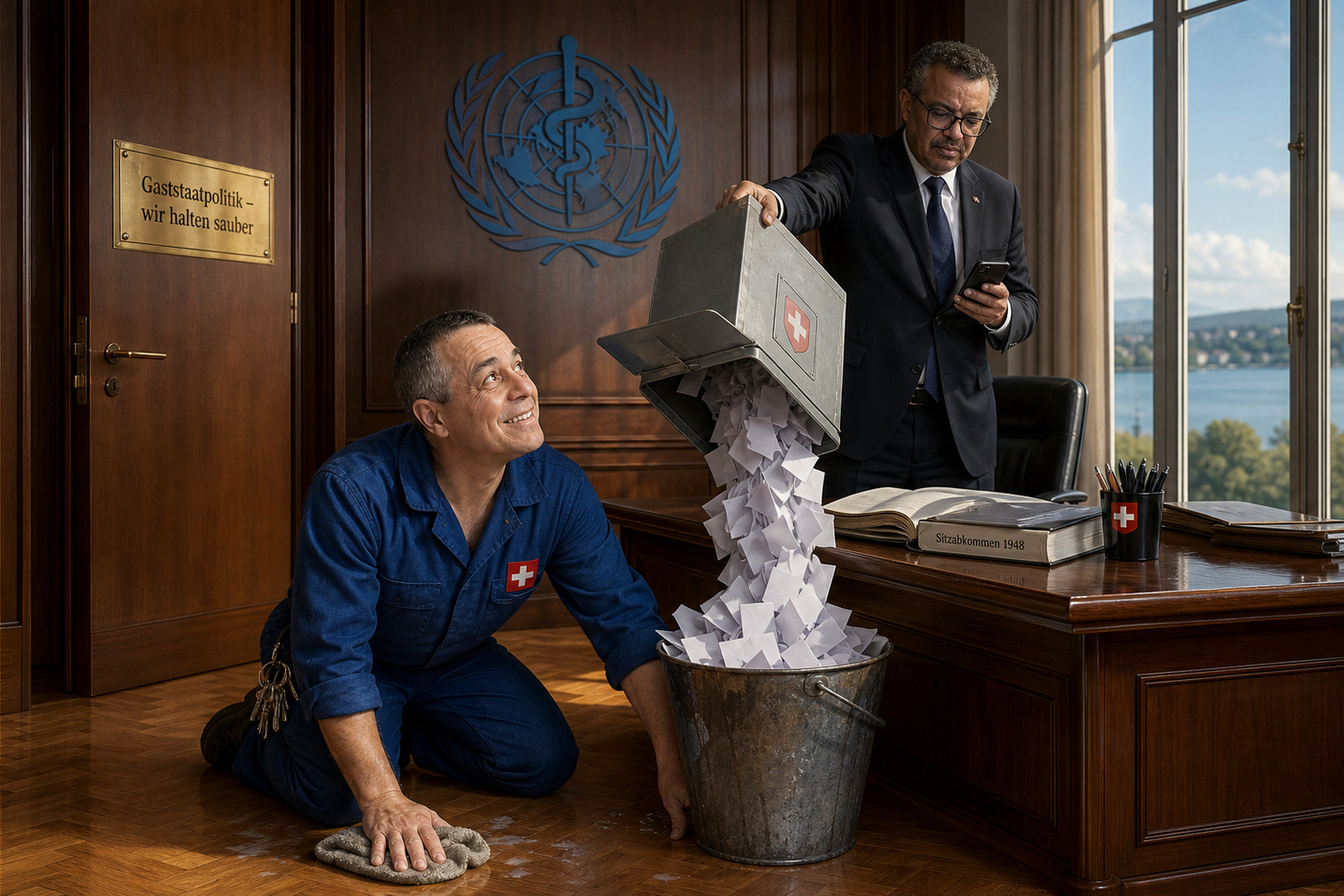
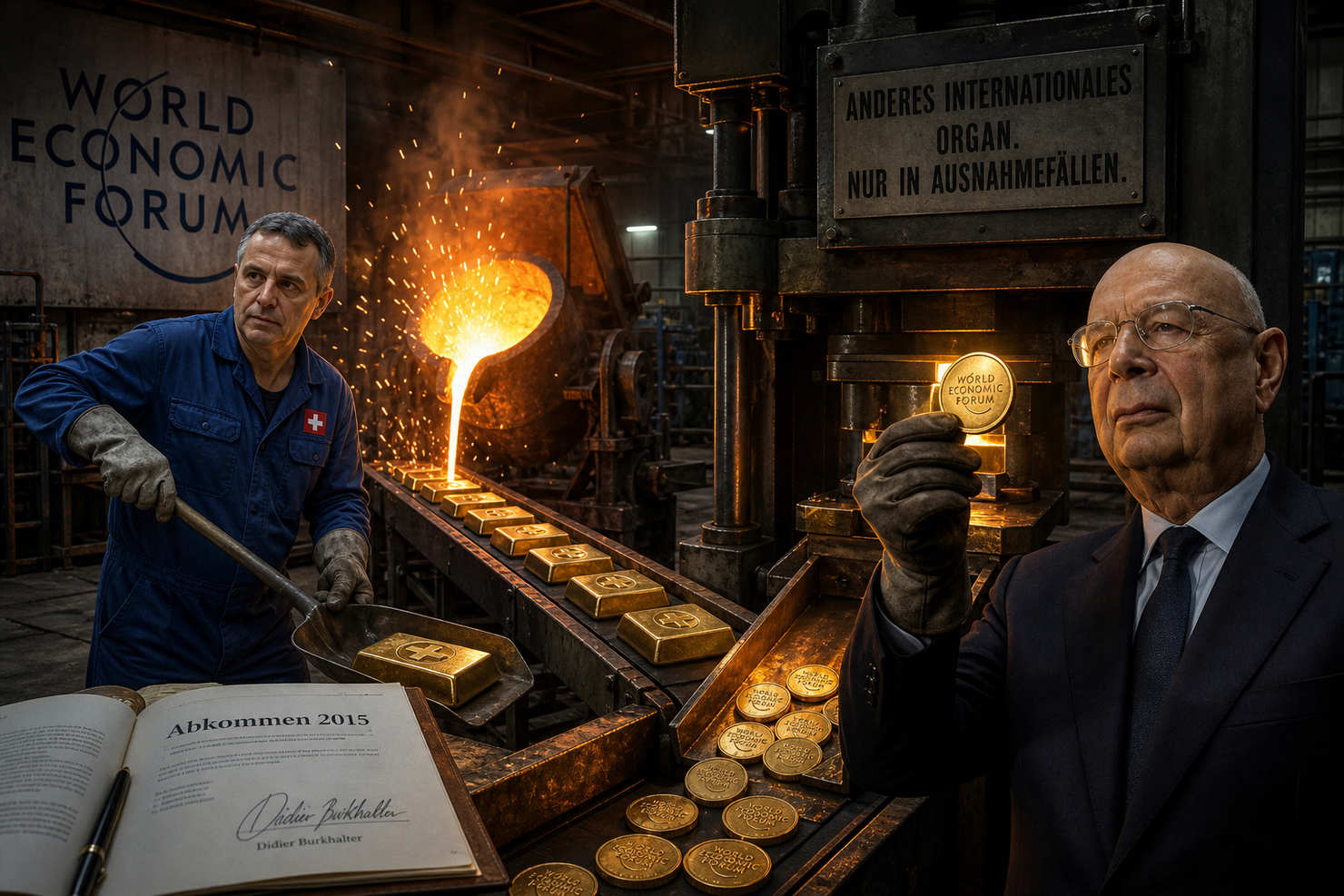
Nine years later, the Federal Council declared Klaus Schwab's foundation to be precisely such a "different international body ." The WEF agreement exempts the foundation from direct federal tax, allows it to freely move gold and foreign currency, exempts its foreign staff from licensing requirements, and provides it with Swiss embassies as service providers. The WEF did not receive judicial immunity, but it did receive everything else.
In 2009, the Swiss Federal Council went further with GAVI : Swiss authorities are not allowed to enter the vaccine alliance's premises , and its employees enjoy immunity from arrest. A foundation with Gates' seed funding thus legally occupies the same position as the UN, while simultaneously pre-screening future pandemics with the WHO and CEPI.
What it costs: Tax-free, no fines, federally funded
According to the embassy, officials of these organizations are exempt from direct taxes, import personal effects duty-free, are not subject to old-age and survivors' insurance (AHV) or mandatory health insurance, are exempt from military service, and receive an identification card from the Federal Department of Foreign Affairs (FDFA) without any quota restrictions. Those who still park illegally are laughing: A 2018 analysis in Geneva recorded fines against those with immunity totaling around 4 million Swiss francs , of which 629,000 were paid.
And because the host country is not allowed to derive any "advantage," it ends up paying more. On June 20, 2025, the Federal Council approved 269 million francs for international Geneva, deferred loan repayments of approximately 19 million each for 2025 and 2026 for the organizations, and applied for an interest-free loan of 78 million francs over 50 years. The Federal Department of Foreign Affairs (FDFA) alone contributed nearly 2 billion francs over four years. Proponents, however, anticipate a 4 billion franc contribution to GDP. A host who waives rent, taxes, and even renovates the roof for its guests, however, does not operate a business model, but rather a dependency relationship.
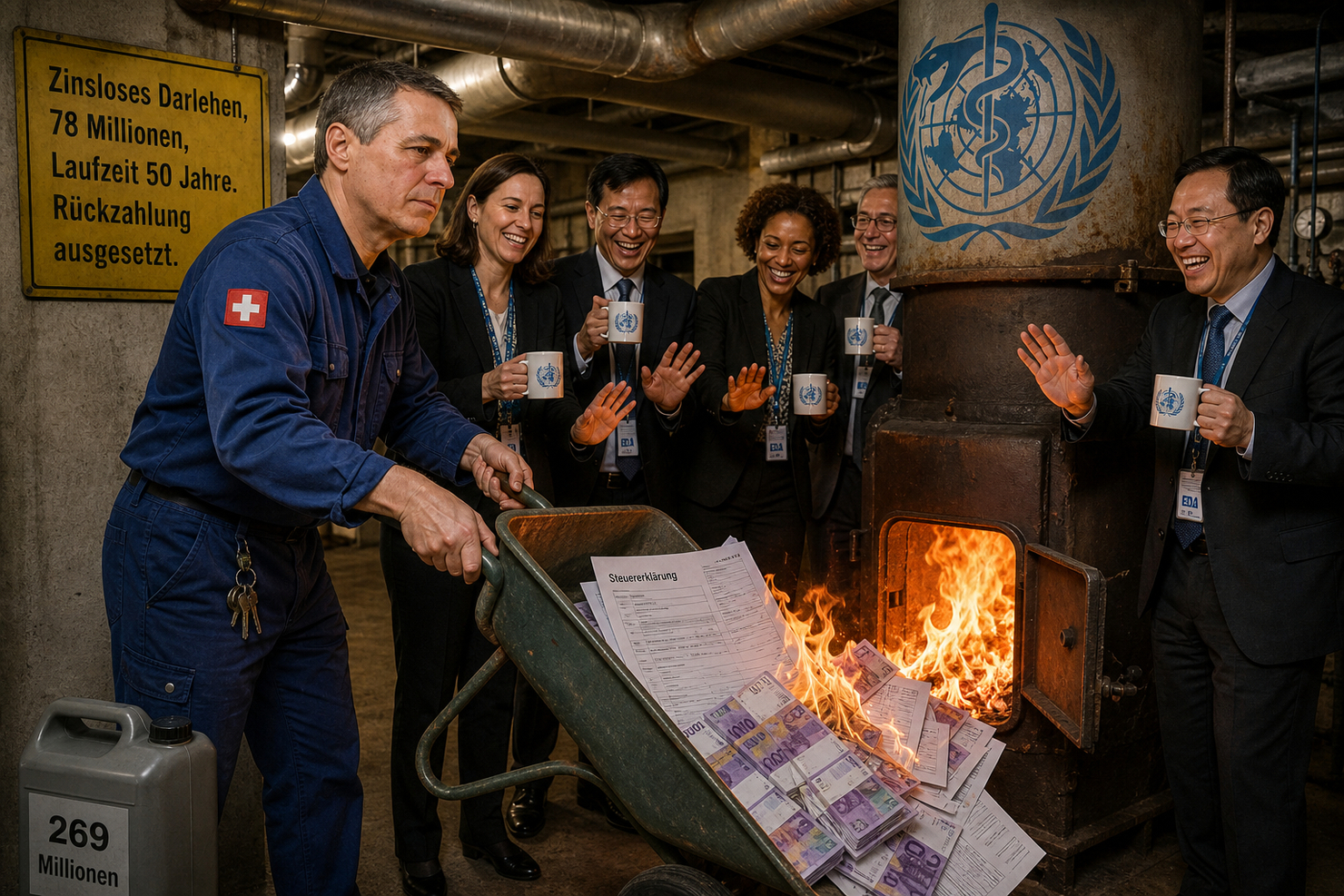
Whoever picks it up: The accused himself
The real scandal lies in the fine print. In 2012, Switzerland acceded to the Convention on the Privileges of UN Specialized Agencies , including the WHO. According to this convention, a specialized agency enjoys immunity from judicial jurisdiction "unless it has expressly waived this immunity in a specific case." For its staff, the convention states: "Each specialized agency is entitled and obliged" to waive immunity if, "in its opinion," it would prevent justice from being served. Its opinion, not that of a Swiss judge. The Director-General, along with his wife and children, enjoys full diplomatic status. And if Switzerland suspects abuse, "consultations" take place, after which the case is referred to the International Court of Justice. Thus, an organization to which Bern grants immunity decides for itself whether it needs it, even when it is rewriting the health regulations of half the world.
The test rig that Bern refuses to build
The focus should therefore not be on the individual organization, but on the procedure itself. Every host agreement would be subject to a referendum, the Federal Department of Foreign Affairs (FDFA) list would be presented to Parliament annually, including names and tax losses, immunity would be limited to official acts, and the power to lift immunity would lie with a Swiss court, not the accused. International law prohibits none of this; the Specialized Agencies Convention explicitly permits supplementary agreements limiting immunities in Section 39. The only thing lacking is the political will. As long as Bern hands out host agreements like free pens, Geneva will remain a city where 29,000 people decide the rules of the world, and not a single Swiss rule is enforced against them. The sovereign is left to foot the bill, Parliament is allowed to rubber-stamp its approval, and the Federal Council is handing over the country's jurisdiction piecemeal to foundations, associations, and military alliances. And they call this "host state policy"!
More for you:



 "Dravens Tales from the Crypt" has been enchanting for over 15 years with a tasteless mixture of humor, serious journalism - for current events and unbalanced reporting in the press politics - and zombies, garnished with lots of art, entertainment and punk rock. Draven has turned his hobby into a popular brand that cannot be classified.
My blog was never designed to spread news, let alone get political, but with current affairs I just can't help but capture information here that is otherwise censored on all other channels. I am aware that the design page may not seem "serious" to many in this regard, but I will not change this to please the "mainstream". Anyone who is open to non-state-compliant information sees the content and not the packaging. I've tried enough to provide people with information over the last 2 years, but quickly noticed that it never matters how it's "packaged", but what the other person's attitude towards it is. I don't want to put honey on anyone's mouth to meet expectations in any way, so I'll keep this design because hopefully at some point I'll be able to stop making these political statements, because it's not my goal to go on like this forever  I leave it up to everyone how they deal with it. However, you are welcome to simply copy and distribute the content, my blog has always been under the WTFPL license.
It's hard for me to describe what I'm actually doing here, DravensTales has become a culture blog, music blog, shock blog, tech blog, horror blog, fun blog, a blog about found items on the internet, internet bizarre, trash blog, art blog, water heater, zeitgeist blog over the years , Scrap blog and grab bag blog called. Everything that is right ... - and yet not. The main focus of the blog is contemporary art, in the broadest sense of the word.
To ensure the continued operation of this site, you are welcome to make a donation via credit card, PayPal, Google Pay, Apple Pay, or direct debit/bank account . Many thanks to all readers and supporters of this blog!