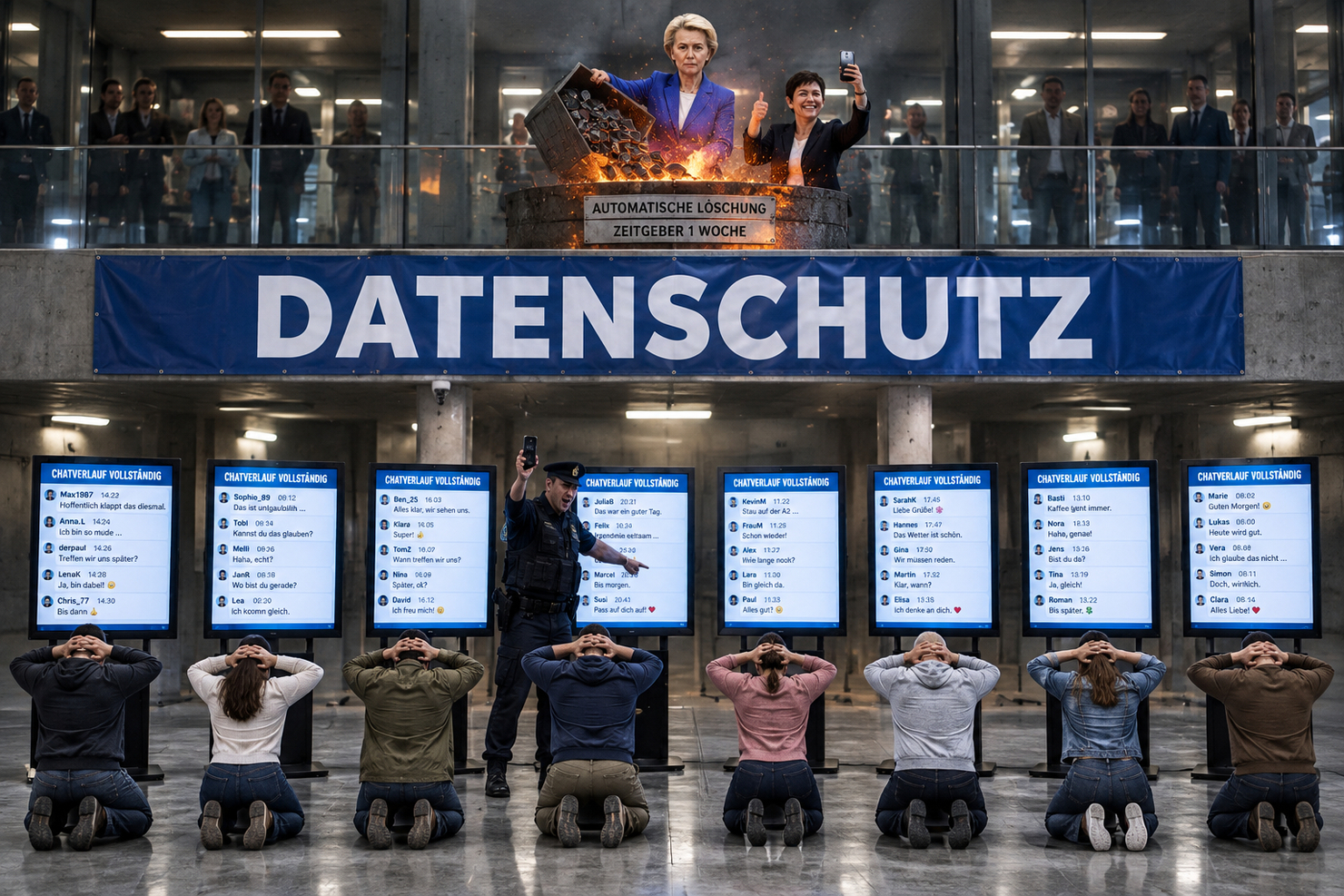
Brussels wants to know what you're texting your sister and makes its own president's messages disappear after a week. In September 2026, the EU Commission informed the Ombudsman in writing that it would not be stopping the automatic deletion of Ursula von der Leyen's text messages. The reason given: cybersecurity. Before that, it was storage space on the phone. Those who have nothing to hide have nothing to fear – apparently, this saying only applies downstairs.
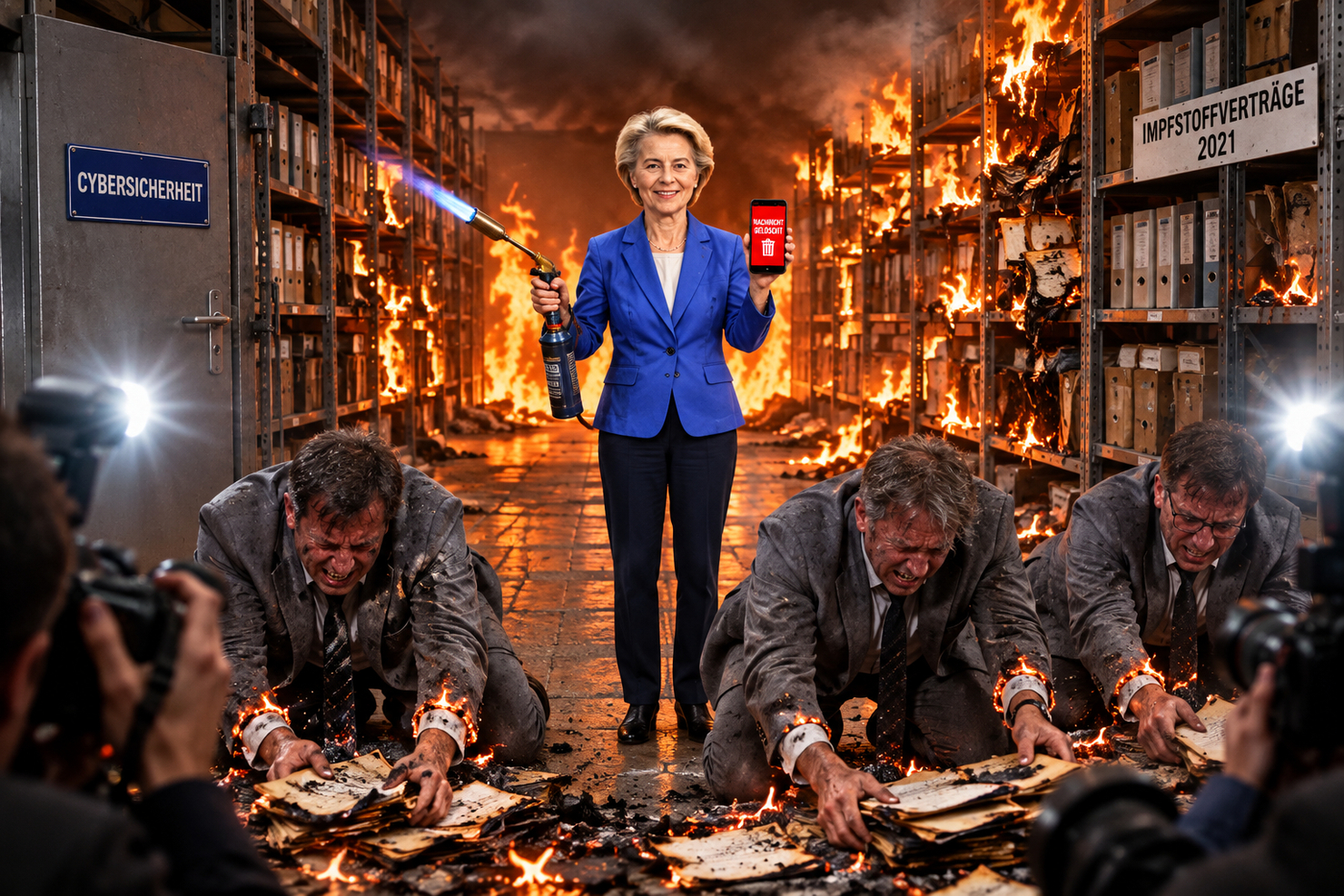
What disappears in this process is not the private life of a politician. It is the communication history of the office that decides on sums of money in the hundreds of billions. Three crises, three flows of money, one delete button.
One week, then the memory is gone.
On June 3, 2026, Ombudsman Teresa Anjinho identified a deficiency in case 2482/2025/NH and recommended that all text and instant messages between heads of state and government and members of the Commission be retained for an appropriate period. The trigger was a signal message from Emmanuel Macron regarding the Mercosur agreement of January 2024. The President's Cabinet left the request for access unprocessed for fifteen months, and the Ombudsman could not rule out the possibility that the message was deleted only after the request had already been received.
The most interesting part isn't in the reprimand, but in their own manual. Since March 3, 2022, the EU security agency CERT-EU has explicitly recommended in its Signals Guidelines that disappearing messages be activated with a reasonable timer; the suggestion is one week. Making messages disappear is therefore a matter of house rules, not an oversight – and can be deactivated again in thirty seconds, also by house rules. They don't want to.
That this justification doesn't hold water was dismantled in a single sentence by Helsinki legal scholar Päivi Leino-Sandberg in the same report: No one demands that official messages be permanently stored on the phone that travels around Europe in the president's handbag. They can be deleted there and securely archived elsewhere. That would be precisely the solution, providing both security and traceability – its only drawback being that something would then remain.
The matter has already been decided legally. On May 14, 2025 , the Court of Justice of the European Union ruled in case T-36/23 that the Commission's information regarding the Pfizer messages was based on mere hypotheses. So, while those at the top are covering their own tracks, the same apparatus continues its tireless work on the indiscriminate scrutiny of private chats , and Switzerland, with its revision of the Swiss Federal Act on the Surveillance of Postal and Telecommunications Traffic (VÜPF) , is already practicing its general suspicion.
The help that stays at home
On December 20, 2023, then-US Secretary of State Antony Blinken stated that ninety percent of security aid to Ukraine was being spent domestically, benefiting American companies and the defense industry. This wasn't a leak; it was a year-end report presented live on camera. The Washington-based CSIS institute calculated that ninety percent of military aid, and roughly sixty percent of all aid overall, was spent domestically.
Europe has adopted the principle and enshrined it in law. On May 27, 2025, the Council approved the €150 billion SAFE loan instrument, the first pillar of a package intended to mobilize over €800 billion. The condition: components from outside the EU, the EEA, and Ukraine may not account for more than 35 percent of the manufacturing costs. In other words, at least two-thirds of every loan is guaranteed to go to European companies. A stimulus program in disguise.
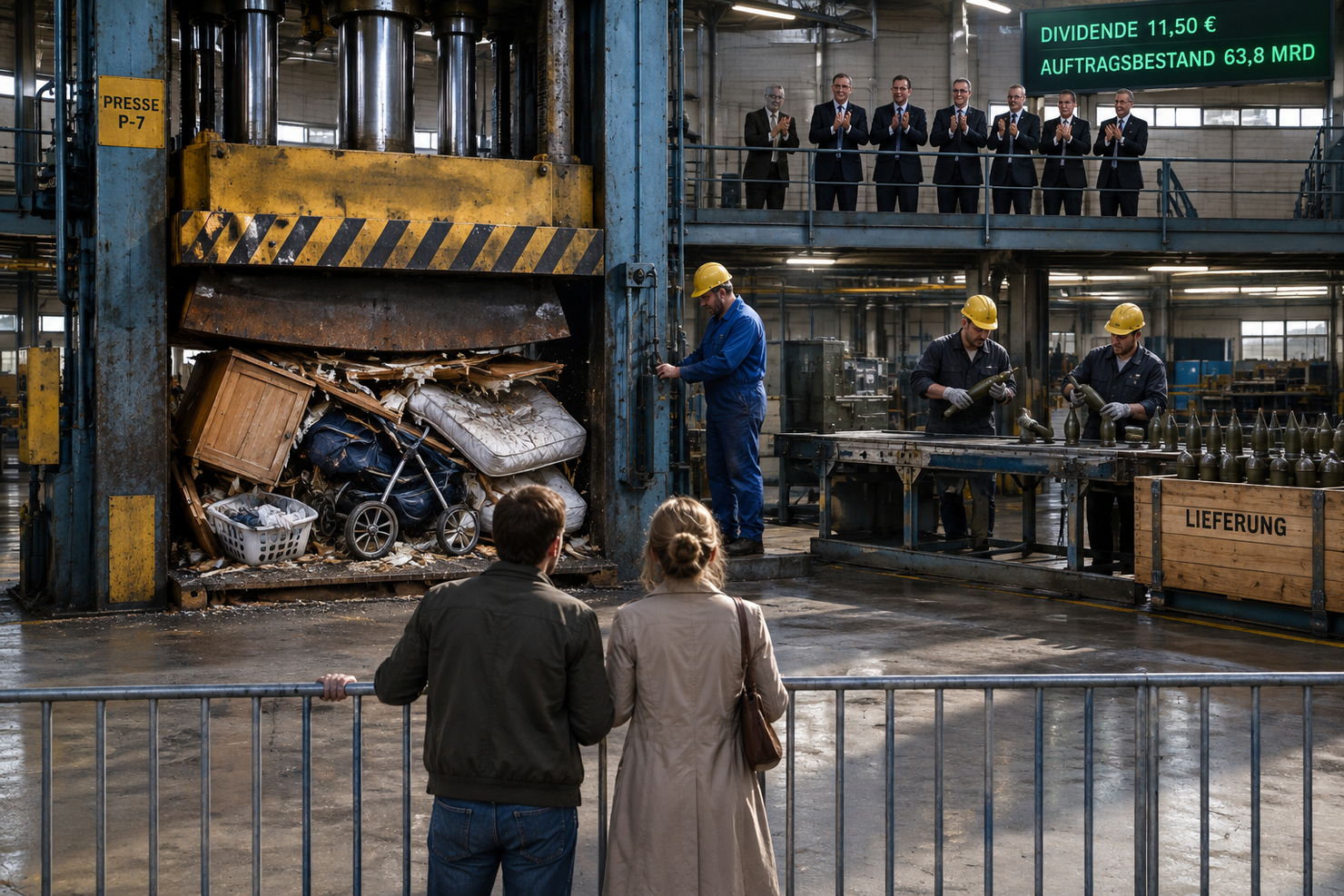
The details are in the annual report. On March 11, 2026, Rheinmetall reported sales of €9,9 billion for 2025, an operating profit of €1,841 billion with an 18,5 percent margin, an order backlog of €63,8 billion, and a dividend of €11,50 instead of €8,10 the previous year. The same report states that Ukraine is its most important customer for weapons and ammunition. For this corporation, war is not a risk, but its business model. For the current year, the company is forecasting sales growth of 40 to 45 percent, to €14,0 to €14,5 billion, and the operating margin for weapons and ammunition was recently at 29 percent. These are not figures achieved by a boutique firm; these are figures achieved by a continent that budgets for its own threat level. The fact that on the other end of the line sits a state whose procurement system is considered a corruption cartel , and to which Switzerland nevertheless throws half a billion euros , doesn't bother the dividend in the slightest.
The contract that no one was allowed to see
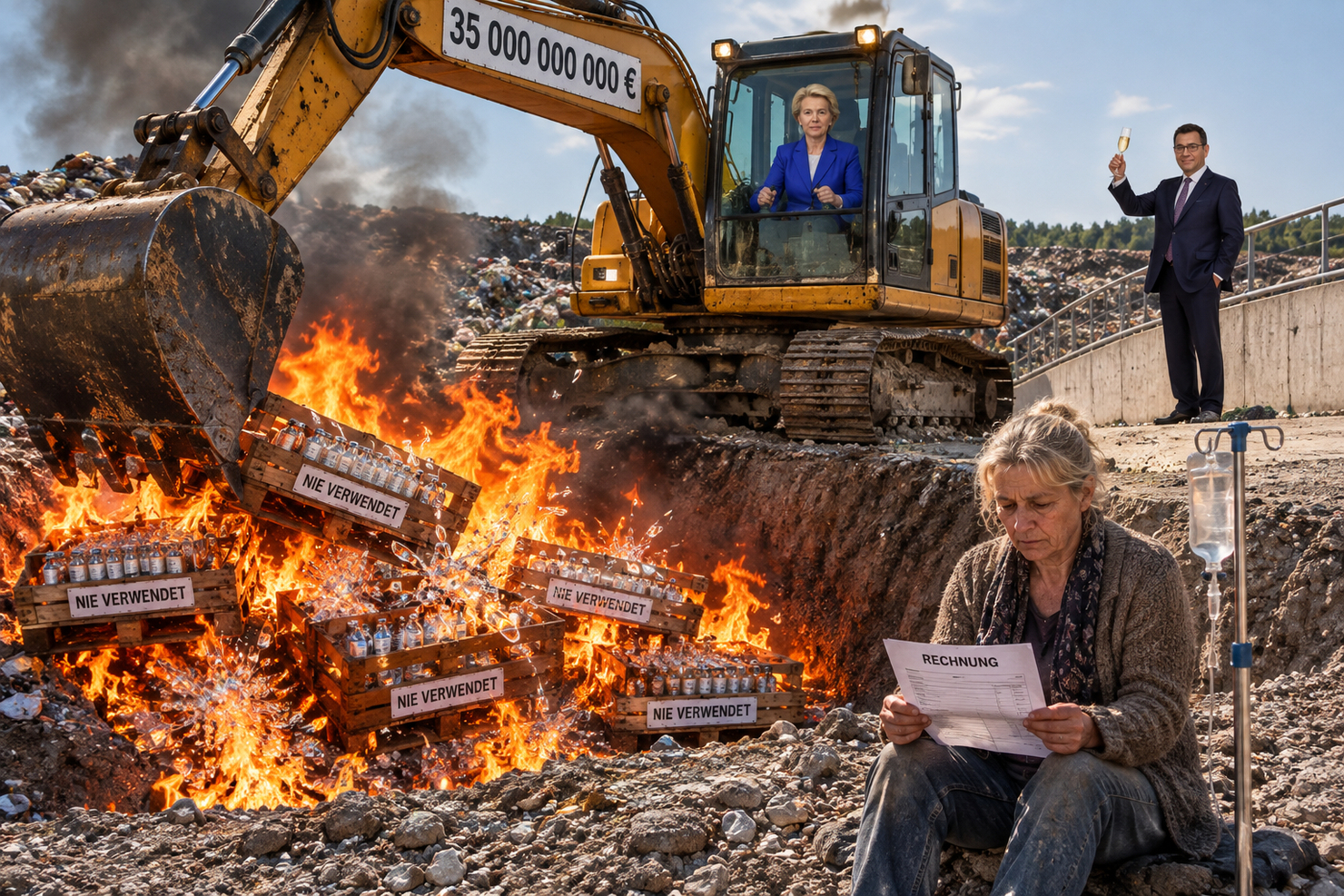
The European Court of Auditors examined vaccine procurement and stated in Special Report 19/2022 : By the end of 2021, the Commission had signed contracts for up to 4,6 billion doses worth around €71 billion for a continent with over 450 million inhabitants. The largest single contract covered 1,8 billion doses and over €35 billion . Many of these were never used.
In this very contract, the Commission President conducted the preliminary negotiations alone. The joint negotiating team was excluded for the only time, contrary to the Commission's decision. When the auditors wanted to know which experts were consulted, when discussions took place, and what was agreed upon, they simply noted that nothing had been done. An audit office denied access to information ceases to be an oversight body and becomes merely decorative. The same report states that over €2,55 billion from the EU budget flowed to manufacturers as advance payments even before each approval, and the weighted average price was around €15 per dose. The contracts were, incidentally, quite enforceable: In June 2021, a Brussels court ruled that AstraZeneca had deliberately breached the contract. So, where the political will existed, it suddenly became possible. What the Commission has failed to do to this day is also documented: It has neither evaluated its own procurement process nor compared it with that of other member states, despite the Council's explicit request to do so. No lessons learned, no key performance indicators, no comparison. For a case involving 71 billion euros, this is no longer negligence, but a matter of principle.
The same report contains the line that no one is advertising: Member States have assumed part of the financial risk that manufacturers would otherwise bear – including compensation for those affected and the corporations' legal fees. The taxpayer paid for the product, the liability, and the entire debate about its effectiveness . And the criminal complaint? Dismissed as inadmissible by the Belgian judiciary in January 2025 because the plaintiff could not prove personal harm, a decision upheld by the Court of Cassation in October 2025. The case wasn't examined on the merits, but rather on the ticket to the proceedings.
The market, which would not exist without the law
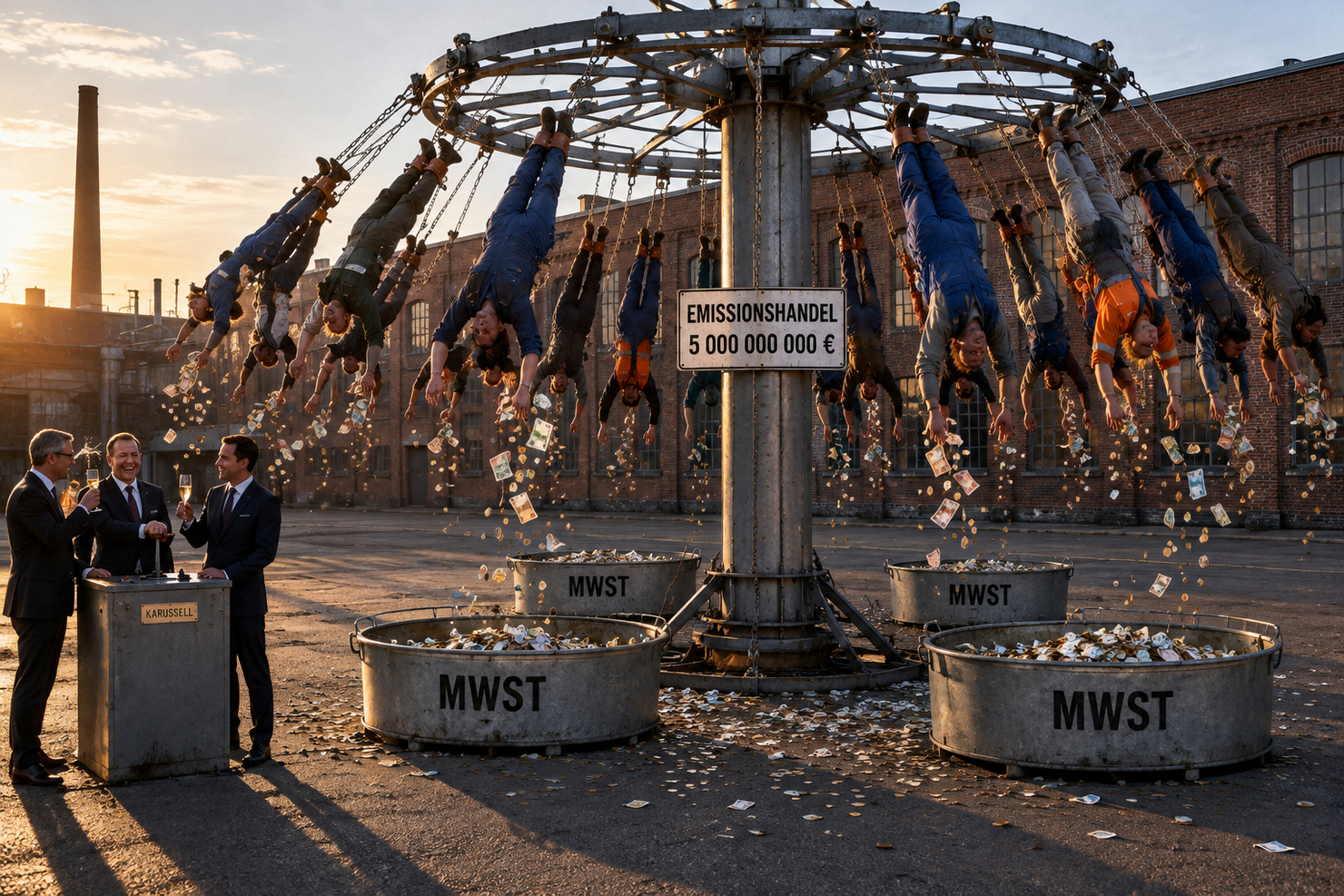
In the case of climate change, the flow of money is even more elegant because it doesn't appear as a subsidy at all. According to the Commission, the auctioning of pollution allowances has generated over €258 billion since 2013 , with more than €43 billion expected in 2025 alone. It's a market that wouldn't exist without legislation, but one in which everyone who trades, stores, or advises on these allowances profits.
Europol has documented what happens when you make air tradable : around five billion euros in damage to national treasury revenues due to VAT carousel fraud involving CO2 certificates, with up to ninety percent of the total market volume in some countries being fraudulent. Ninety percent. This isn't collateral damage; it's a design flaw with guaranteed seats. And because irony is the official language in Brussels: of the 2024 revenue, 3,2 billion euros were returned as state aid to energy-intensive industries so they could absorb their own CO2 surcharge. The tax is collected and then refunded to the polluter—with an administration in between.
And who writes the rules for sustainable finance? The Commission awarded the contract for the study on integrating ESG goals into banking law to BlackRock. In case 853/2020/KR , the Ombudsman noted that the world's largest asset manager has a vested financial interest in precisely this sector and that the conspicuously favorable offer could be interpreted as a strategy to gain insight into and influence over regulation. Her conclusion, however, was lenient: no wrongdoing, because the procurement rules don't even cover such matters. The acquittal, therefore, is that there is no rule that could have been violated. Anyone wanting to see how precisely Brussels distributes billions can find the same pattern in the 8,6 billion for communication and in the largest redistribution project from the bottom to the top.
From this point on, calculations are made, not proofs are provided.
Everything mentioned so far is documented in court rulings, audit reports, and financial statements. The following paragraph is not. From this point on, information is combined, and this is explicitly marked as a conclusion, not as proof.
Three times the same sequence of events: A state of emergency is declared, the urgency allows for procedures without public tender, the responsible body is bypassed or informed after the fact, the sums involved are in the hundreds, traceability is poor – and, of all things, the communication of the person who made the decision no longer exists. Once is coincidence. Three times it's method. Anyone who chooses the same construction method for three major building sites has a blueprint, not a random number generator. There's no proof of an account, no suitcase, no number, and anyone who claims otherwise hasn't read the Court of Cassation. But there's also no harmless explanation for why a woman, with a clear conscience, would defend a thirty-second deletion period against the accountability of an entire continent – twice, with two different justifications. Anyone who scrutinizes citizens to the point of mandatory identification while remaining in the dark themselves has reversed the burden of proof. Not legally. But logically.
The delete key as an oath of office
Transparency isn't a principle in this Union, it's a menu setting, and it's set to "off." The Ombudsman's reprimand has no teeth, the Court of Auditors receives no response, the court gets hypotheses, and citizens get a scanner in their messaging apps. It's no coincidence that the only organization allowed to move billions without a public tender is also the only one whose messages self-destruct. They call this cybersecurity—and it protects exactly one single person!
| findings | Number / Date | Status | Source |
|---|---|---|---|
| Commission rejects storage | Letter dated September 18, 2026 | occupied | Follow the Money |
| Issue regarding deleted Macron message | June 3, 2026, 15-month lay-up period | occupied | Ombudsman 2482/2025/NH |
| Automatic deletion is described in its own guide. | March 3, 2022, Timer 1 week | occupied | CERT-EU 22-002 |
| SMS refusal declared invalid | 14.05.2025, T-36/23 | occupied | General Court, EUR-Lex |
| Military aid remains in the donor country. | 90%, 20.12.2023 | occupied | flash / CSIS |
| SAFE loans with a European quota | 150 billion, max. 35% non-EU | occupied | Council of the EU |
| Defense profits and order backlog | $63,8 billion backlog, dividend $11,50 | occupied | Rheinmetall |
| Vaccine contracts and refusal to provide information | 71 billion, 4,6 billion doses | occupied | Court of Auditors 19/2022 |
| Criminal charges against von der Leyen | Inadmissible 01/2025, confirmed 10/2025 | rejected | taz |
| Revenues from pollution permits | 258 billion since 2013 | occupied | EU Commission |
| CO2 carousel fraud | 5 billion in damage, up to 90% market volume | occupied | Europol |
| BlackRock is involved in writing banking regulations. | 23.11.2020 | reprimanded, no grievance | Ombudsman 853/2020/KR |
More for you:




 "Dravens Tales from the Crypt" has been enchanting for over 15 years with a tasteless mixture of humor, serious journalism - for current events and unbalanced reporting in the press politics - and zombies, garnished with lots of art, entertainment and punk rock. Draven has turned his hobby into a popular brand that cannot be classified.
My blog was never designed to spread news, let alone get political, but with current affairs I just can't help but capture information here that is otherwise censored on all other channels. I am aware that the design page may not seem "serious" to many in this regard, but I will not change this to please the "mainstream". Anyone who is open to non-state-compliant information sees the content and not the packaging. I've tried enough to provide people with information over the last 2 years, but quickly noticed that it never matters how it's "packaged", but what the other person's attitude towards it is. I don't want to put honey on anyone's mouth to meet expectations in any way, so I'll keep this design because hopefully at some point I'll be able to stop making these political statements, because it's not my goal to go on like this forever  I leave it up to everyone how they deal with it. However, you are welcome to simply copy and distribute the content, my blog has always been under the WTFPL license.
It's hard for me to describe what I'm actually doing here, DravensTales has become a culture blog, music blog, shock blog, tech blog, horror blog, fun blog, a blog about found items on the internet, internet bizarre, trash blog, art blog, water heater, zeitgeist blog over the years , Scrap blog and grab bag blog called. Everything that is right ... - and yet not. The main focus of the blog is contemporary art, in the broadest sense of the word.
To ensure the continued operation of this site, you are welcome to make a donation via credit card, PayPal, Google Pay, Apple Pay, or direct debit/bank account . Many thanks to all readers and supporters of this blog!