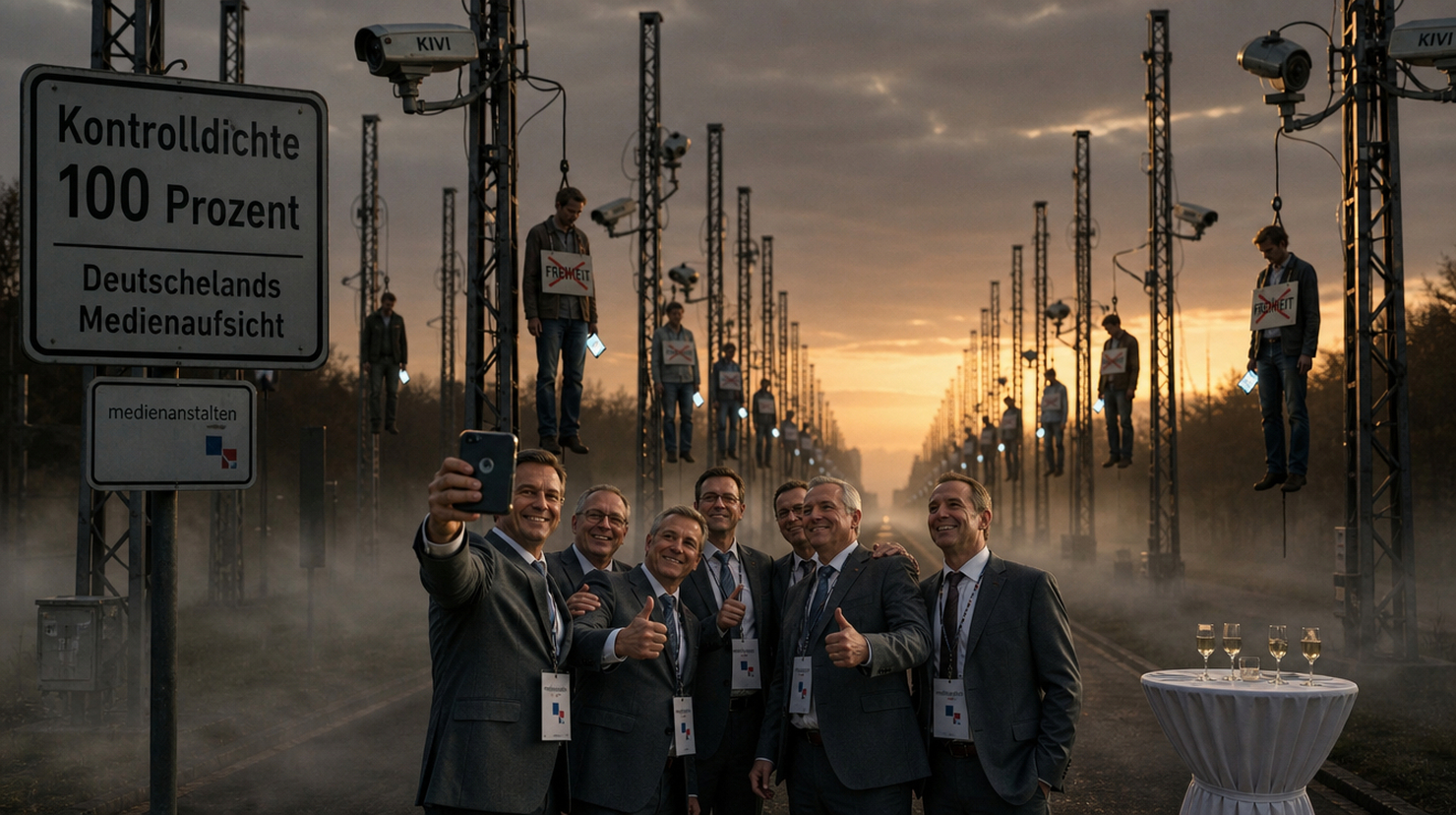
Imagine an agency that doesn't open the mail in the morning, but the internet. No report, no complaint, no suspicion, just software that scours more than 10,000 pages daily, compares words against lists, runs images through Amazon image recognition, and ultimately places a stack of suspects on the desk. The machine is called KIVI; it has been running at all 14 German state media authorities since 2021, and it's not an exhibit from a Stasi museum. It's documented in black and white in four responses from the Thuringian State Chancellery in August 2026.
The AfD parliamentary group in the Erfurt state parliament had asked the question, and State Chancellery Chief Stefan Gruhner responded with the composure of a man unaware of what he is signing. Anyone who lays the four documents side by side will not find a description of a tool, but rather the instruction manual for a factory of suspicion.
First the machine searches, then the human finds the reason.
KIVI, developed by Berlin-based Condat AG on behalf of the North Rhine-Westphalia State Media Authority , searches more than 10,000 websites daily, according to its own advertising, ranging from X (formerly Twitter) and YouTube to Telegram and VK. The Thuringian State Media Authority (TLM) additionally mentions TikTok, Bitchute, and Gettr in its privacy policy . The State Chancellery's response (number 2838) explains how the search works with disarming candor: KIVI automatically searches for potential legal violations using keywords and search terms. The list is the trigger, and the hit is the suspicion.
The government's claim that there is no indiscriminate use of the agency, because it is only acting within the scope of its legal mandate, is a sleight of hand that any Stasi officer would have blindly endorsed. Anyone who still believes that surveillance is the price of freedom will find their comeuppance here.
What the machine knows about you
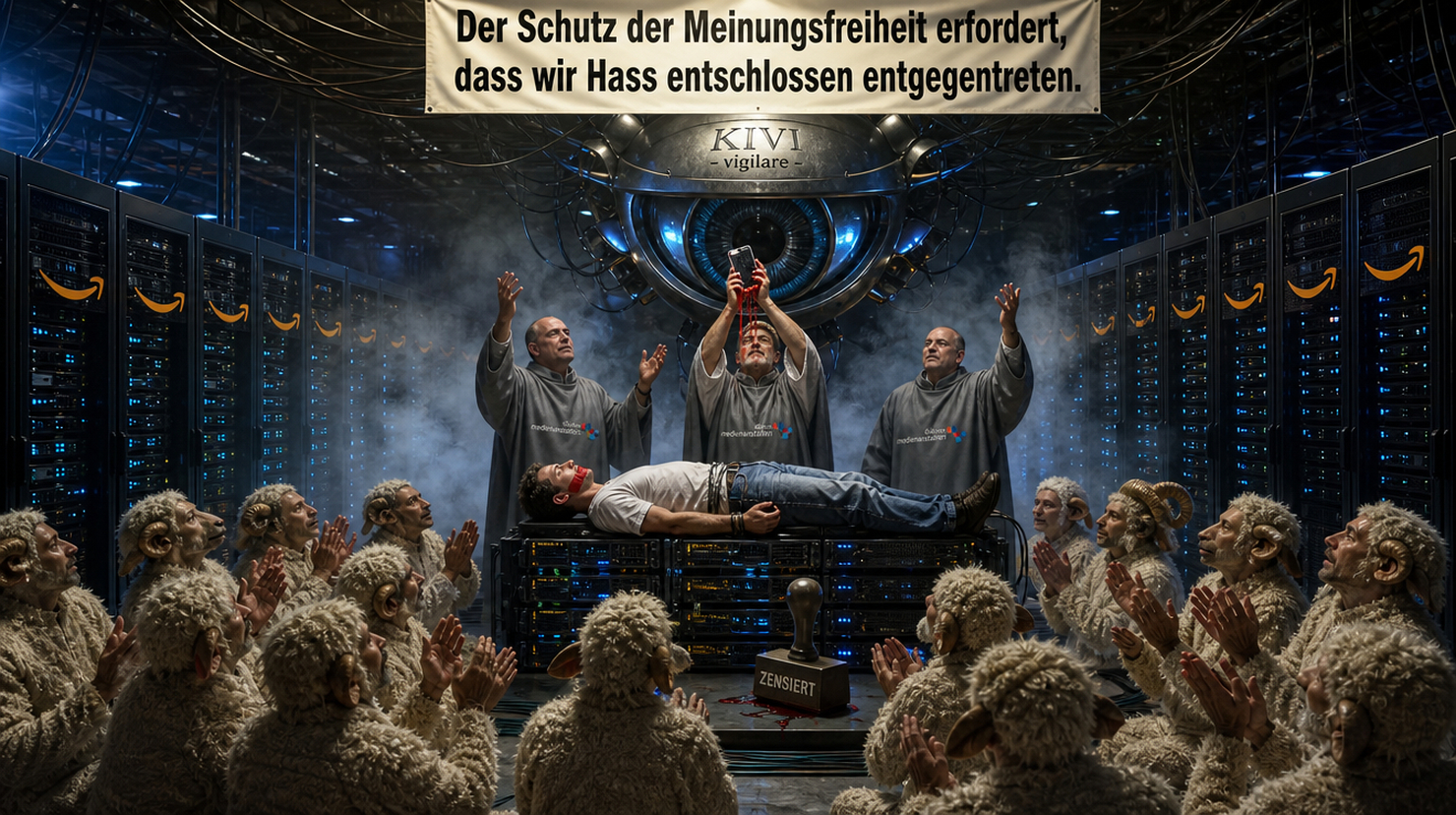
The TLM's privacy policy lists the categories of data processed by KIVI: religious and philosophical beliefs, political opinions, data on sex life, and data on sexual orientation. This is the most sensitive category of Article 9 data, and the State Chancellery confirms in response 2838 that precisely these categories are also processed by external, US-based services. The processing takes place on Amazon Web Services servers in Dublin, Amazon Rekognition is responsible for images, and the answer to the question of whether personal data is transferred to third countries is a simple "Yes." Thus, a German supervisory authority is allowing a US cloud to process the political and sexual beliefs of its citizens.
The closed group that doesn't exist and yet does
When asked whether KIVI also records closed or access-restricted groups, the State Chancellery replied tersely: They are not recorded. Their own data protection statement says otherwise. It states that the data comes from publicly accessible sources, "unless it is data that you have disclosed in closed groups." Two documents, two truths, one official seal. One of them is lying, and the authority apparently finds that acceptable.
According to response 2838, image and text materials from completed supervisory proceedings are used for the further development of KIVI. Erfurt assures that the link to the account has been removed. However, a screenshot with a profile picture remains a screenshot with a profile picture, even if a field is cleared in the database. The system is trained on your old posts so that it retrieves your next ones more quickly.
452 findings, 33 suspected cases, zero court rulings
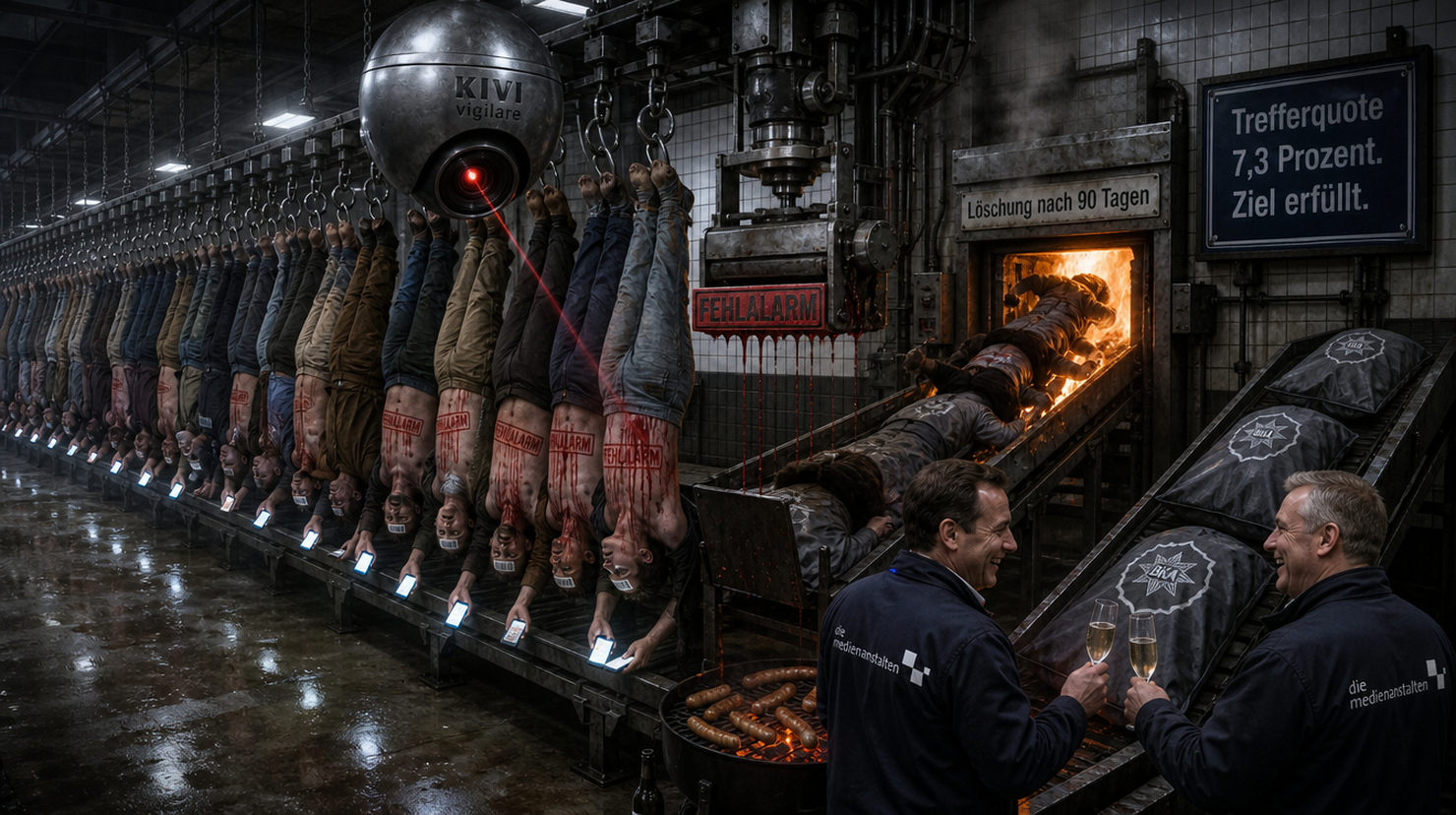
Answer 2839 provides the figures for Thuringia: Between 2022 and 2025, KIVI generated 452 cases with a possible connection to Thuringia. In 33 cases, the agency assumed a suspicion after legal review, representing 7,3 percent. More than nine out of ten hits were therefore false alarms, and according to the government, the proportion of false alarms has increased since 2022. Nevertheless, since May 2023, the same agency has forwarded just over 300 cases to the Federal Criminal Police Office's (BKA) central reporting office. Erfurt does not explain how 33 suspected cases result in 300 reports, presumably because the answer would be more embarrassing than the question. North Rhine-Westphalia alone reported almost 2741 items to the BKA; nationwide, according to the North Rhine-Westphalia State Agency, there were over 40,000 findings and more than 8600 investigations.
Since 2022, the TLM has paid around €34,300 for this, not from the state budget, but from its own funds, namely the broadcasting fee. The public is buying its own Big Brother with its own mandatory fee.
A law for what's already happening
The crowning glory comes last. When asked about the legal basis for this deployment, Erfurt refers to the Interstate Media Treaty, the Interstate Treaty on the Protection of Minors in the Media, and a general clause in the state data protection law. At the same time, the State Broadcasting Commission is working on a new Section 109a , which would explicitly permit the use of technical means for oversight for the first time, including an obligation for platforms to provide suitable interfaces for the oversight body. Anyone who suddenly needs a law for something that has been running for five years is essentially admitting that it ran for five years without one. Answer 2847 goes even further: The draft stipulates a 30-day deletion period for unverified hits. The broadcaster currently stores data for three months, and in July 2025, the government itself admitted to not even being aware of any deletion period.
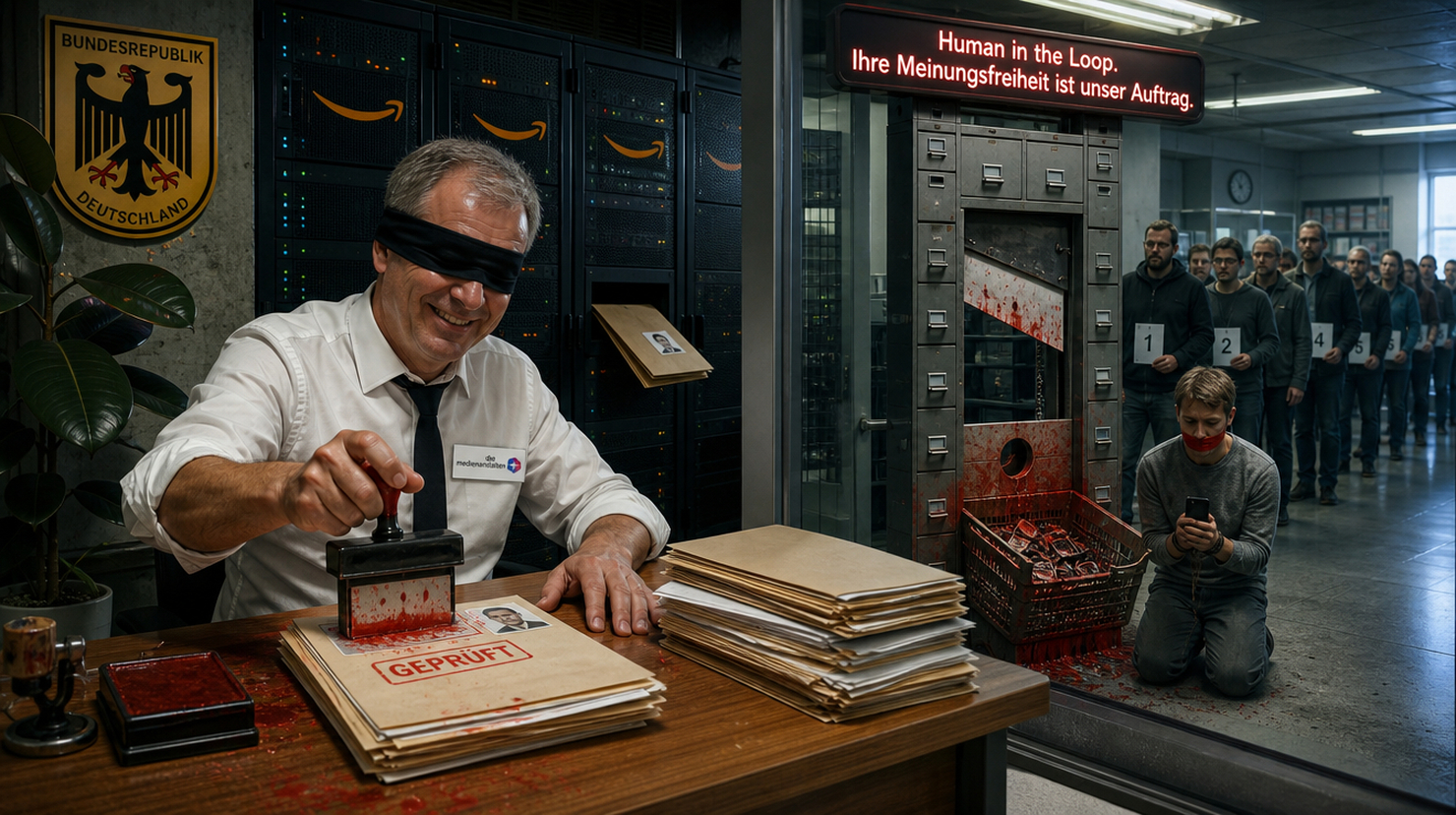
Could the new regulation lead to an expansion of indiscriminate investigations? No. The state government considers the extension to English and Arabic content "sensible" to prevent the creation of a space with "significantly lower levels of oversight." Level of oversight. A term borrowed from border guards' vocabulary, now officialese for opinion monitoring. Fact-checkers do the manual work; KIVI is the factory. The human at the end of the chain, whom Erfurt promotes as "Human in the Loop," is not a safeguard, but rather a rubber stamp, adding a signature to the machine's pre-selection. The machine determines which statements they even get to see, and no clerk in the world reads 93 percent false positives with the same care as the one hit that launches their career. This isn't digitally optimized oversight; it's a dragnet search with a subscription model. And if the level of oversight ever becomes seamless, Erfurt will write a report on it and then refuse to publish it—for data protection reasons!
More for you:






 "Dravens Tales from the Crypt" has been enchanting for over 15 years with a tasteless mixture of humor, serious journalism - for current events and unbalanced reporting in the press politics - and zombies, garnished with lots of art, entertainment and punk rock. Draven has turned his hobby into a popular brand that cannot be classified.
My blog was never designed to spread news, let alone get political, but with current affairs I just can't help but capture information here that is otherwise censored on all other channels. I am aware that the design page may not seem "serious" to many in this regard, but I will not change this to please the "mainstream". Anyone who is open to non-state-compliant information sees the content and not the packaging. I've tried enough to provide people with information over the last 2 years, but quickly noticed that it never matters how it's "packaged", but what the other person's attitude towards it is. I don't want to put honey on anyone's mouth to meet expectations in any way, so I'll keep this design because hopefully at some point I'll be able to stop making these political statements, because it's not my goal to go on like this forever  I leave it up to everyone how they deal with it. However, you are welcome to simply copy and distribute the content, my blog has always been under the WTFPL license.
It's hard for me to describe what I'm actually doing here, DravensTales has become a culture blog, music blog, shock blog, tech blog, horror blog, fun blog, a blog about found items on the internet, internet bizarre, trash blog, art blog, water heater, zeitgeist blog over the years , Scrap blog and grab bag blog called. Everything that is right ... - and yet not. The main focus of the blog is contemporary art, in the broadest sense of the word.
To ensure the continued operation of this site, you are welcome to make a donation via credit card, PayPal, Google Pay, Apple Pay, or direct debit/bank account . Many thanks to all readers and supporters of this blog!