Those aiming for a perfect score in PISA 2025 don't need a physics textbook, but rather the right mindset. The OECD has declared science a priority and simultaneously restructured the subject: arithmetic problems have become questions of conviction, formulas have become articles of faith, and students have become confirmation candidates for sustainability. For wind farms, only the single permitted zone matters; for CO2 taxes, only the government's justification counts. Mindset no longer takes precedence over the task; it's enshrined in the answer key.

On September 8, 2026, the reckoning came: Germany plummeted to 486 points in the natural sciences and fell below its very first score in all three subjects: 465 in reading and 464 in mathematics. Switzerland maintained its level with 501 points . There was much lamenting about the decline, but silence on what exactly was being assessed.
Slogan in front, physics in back
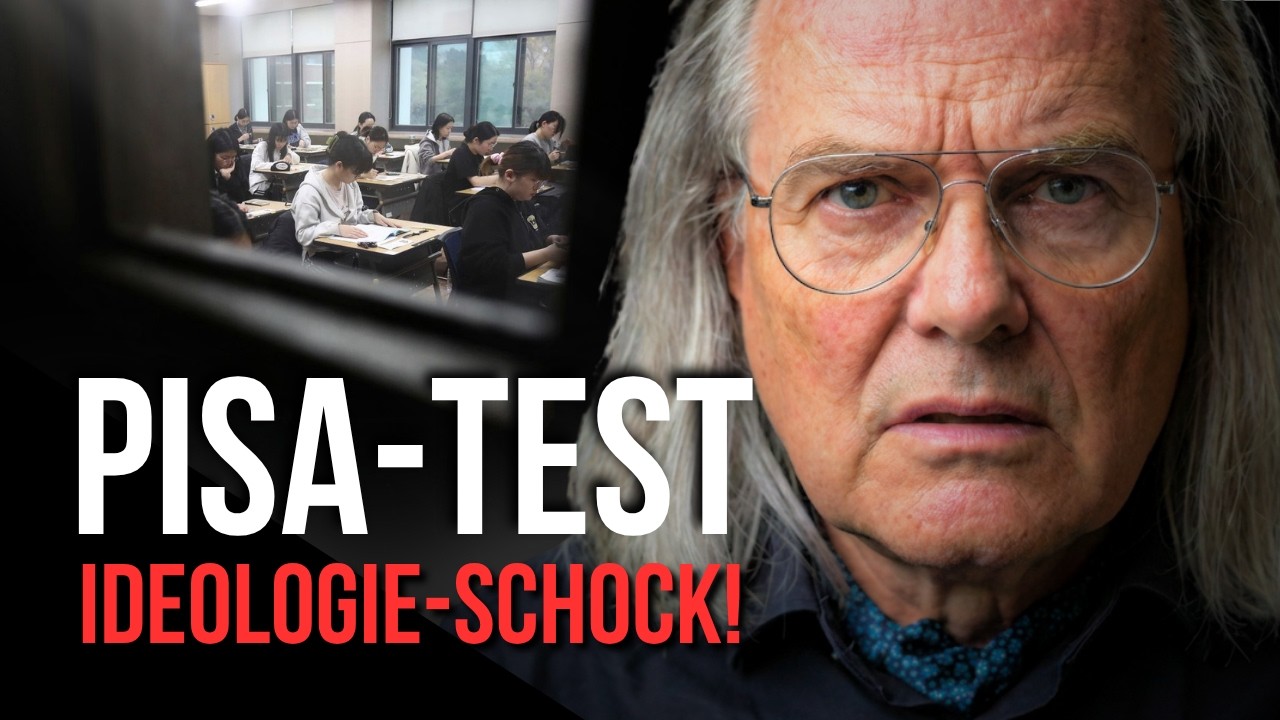
Christian Rieck, Professor of Finance and Economic Theory in Frankfurt, compared East German tenth-grade final exams with PISA examples. In the workers' and peasants' state, the slogan at the beginning was the further development of industry, the better provision of services for the population. Then came bare physics: the output of a pumped-storage power plant in kilowatts, the volume of water for district heating, the braking distance on a wet road. Those who skipped the preamble didn't lose a single point. There were also overtly political questions about the People's Army and national defense, but even the party congress rhetoric became increasingly thin after 1984, according to Rieck's analysis. East Germany embellished its physics with ideology, but the calculations still had to be done.
As recently as 2003, PISA had students test whether "humans should not assume the role of creator" was a scientific reason against cloning. The correct answer was no . At that time, the test separated knowledge from belief. The OECD has since broken down precisely this dividing line.
Zone C or failed
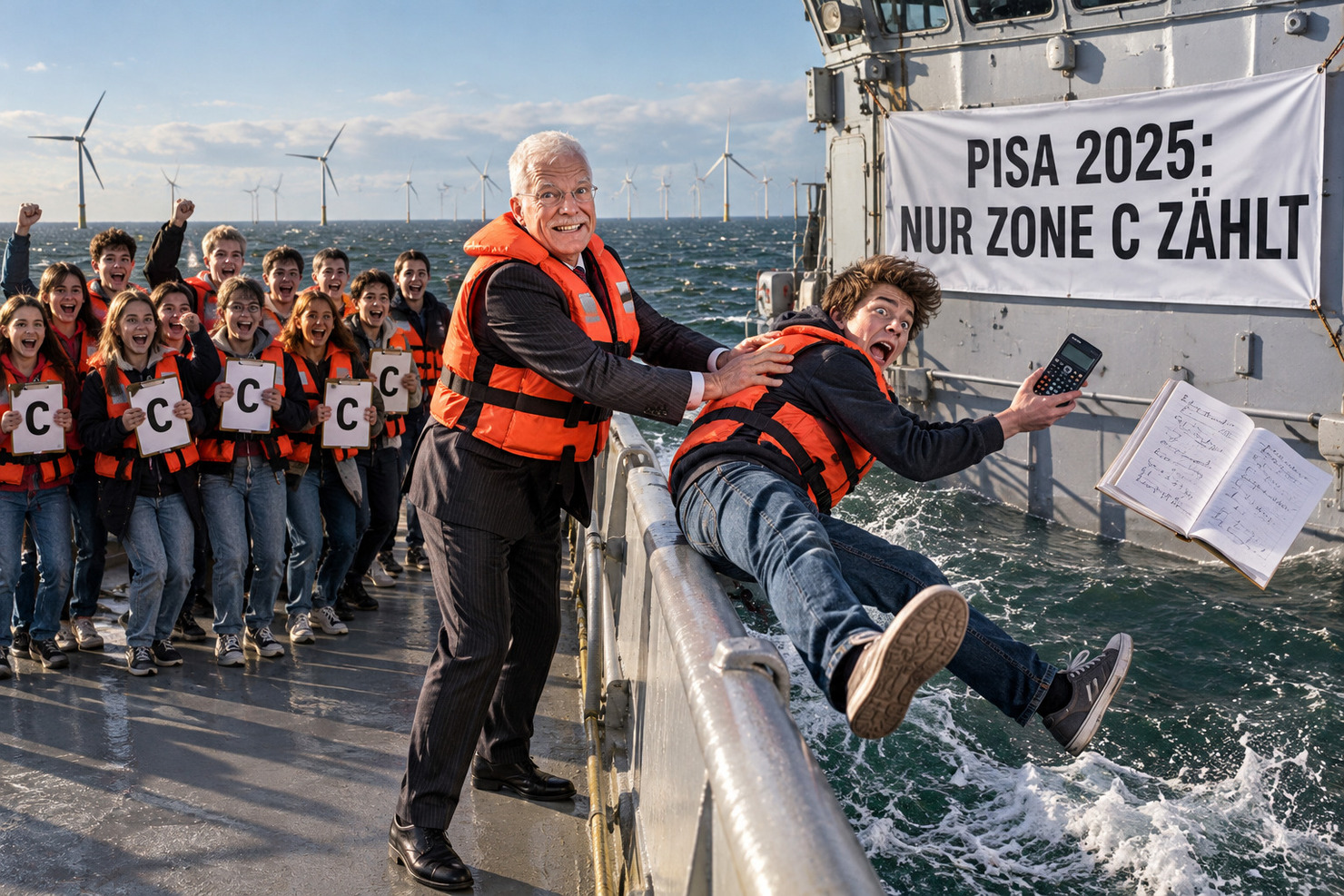
Of the six released task blocks, five revolve around the environment, climate, and sustainability, and one around lightning and thunder. For the wind farm, the young people are asked to choose the zone that offers the best compromise between costs and environmental damage. Points are awarded exclusively for Zone C. In the first question, "no CO2" counts as a complete answer, even though the assessment guidelines themselves acknowledge in parentheses that CO2 can indeed be emitted during transport and construction. The statement that animals suffer is sufficient to demonstrate environmental damage. Those who select Zone C and add the suggestion that the wind turbines should simply be built on land receive a bonus point for selecting the correct zone, but none for their reasoning.
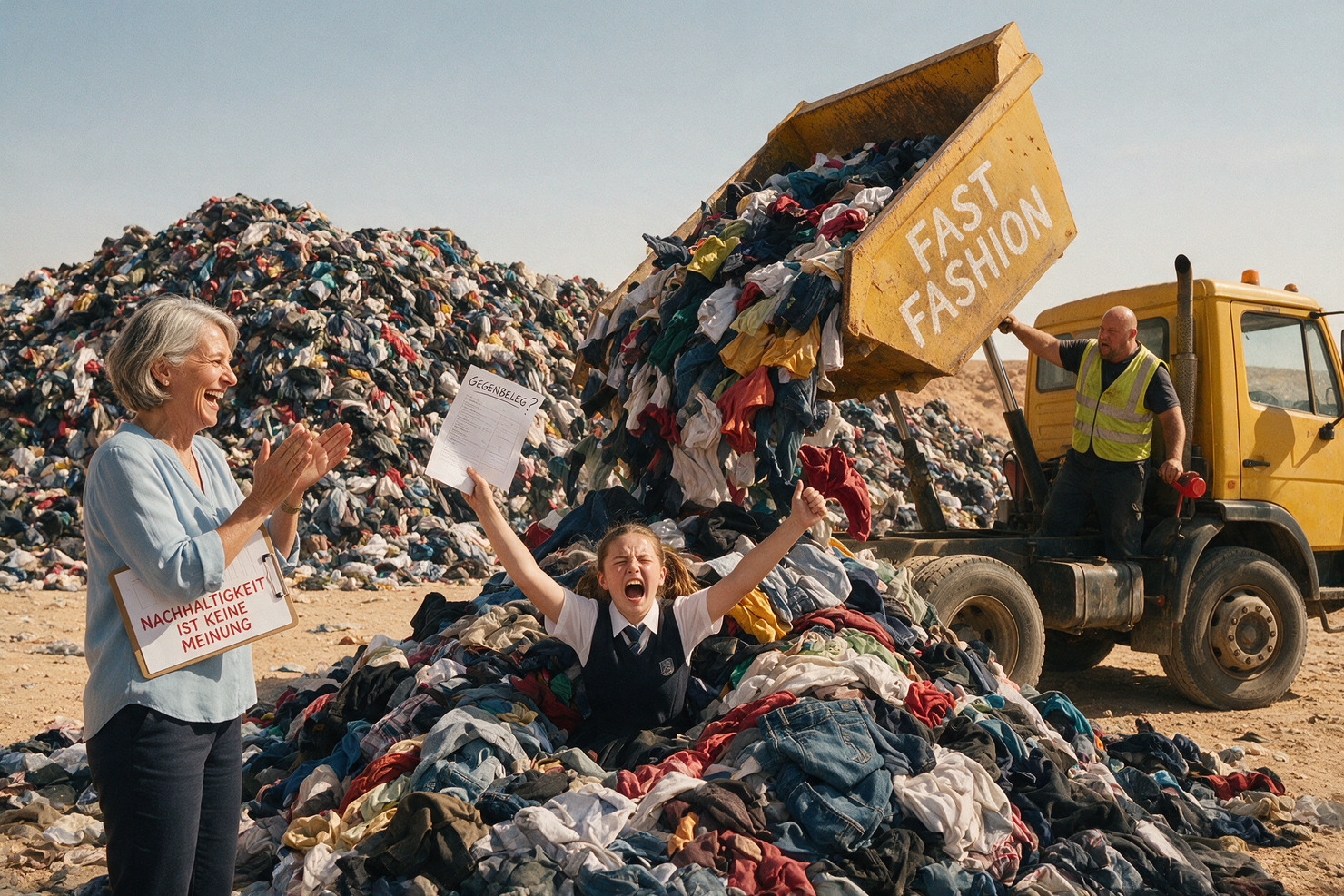
The task regarding energy sources is even more blunt. The irony: Gas is the only source that supplies the city around the clock. Full marks are awarded only to those who correctly select both purposes for a CO2 tax: funding research into clean energy and steering the transition to more environmentally friendly sources. The government's justification is presented as scientific expertise. In the fast-fashion section, featuring the obligatory mountain of clothes, the point is awarded to whoever identifies the statement supporting the sustainability of organic cotton. No one asks for counter-evidence. Those who recognize that reduced water consumption and targeted pesticide use make cotton cultivation more sustainable land at competence level six.
Those who sing in the choir are credible.
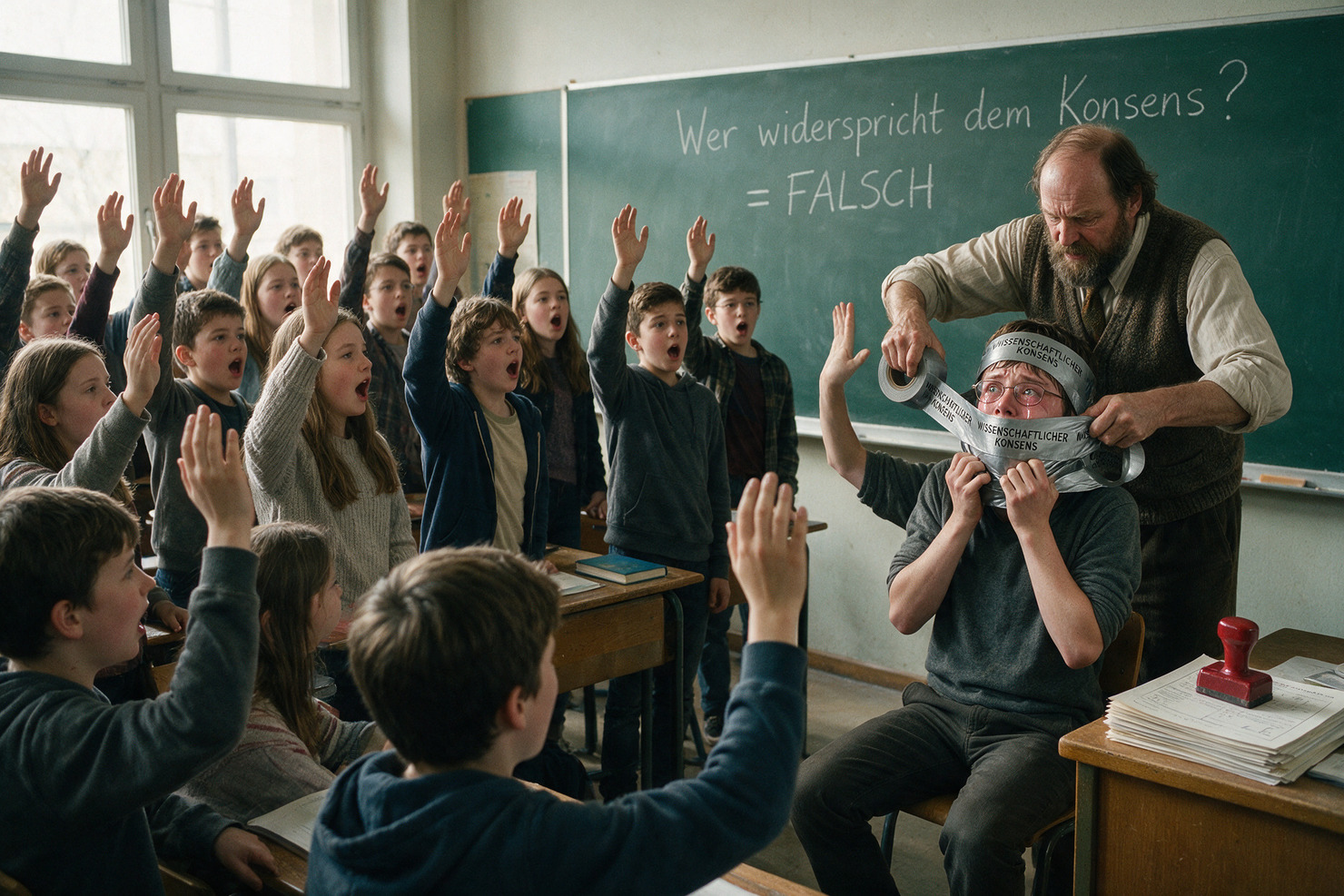
According to the OECD framework, trust in science arises from consensus among scientists. This leads to example task seven, in the context of "health risks": A Facebook article labels vaccines as dangerous, and students check off the reasons that make them doubt this. Among the reasons given is that the article contradicts the scientific consensus. Vaccine skepticism is thus preemptively categorized as a fallacy. Galileo would have failed this task, while climate research, which combats its skeptics , would have passed with flying colors.
The German version goes further. According to Rieck, "Who should we believe?" becomes "scientists, colon, in and their work," and peer review becomes a review by scientists with a built-in gender signal. The English original manages without it because the grammar simply doesn't allow for it. As early as 2003, according to Rieck, students failed the word "hemisphere" because the German term is "Erdhalbkugel" (Earth's half-sphere). The aim is to test natural science, but what's actually being measured is vocabulary and attitude. The framework dedicates an entire chapter to "acting in the Anthropocene" and calculates the environmental impact of meat consumption for students.
To be fair: A biodiversity task rewards those who reject an alarmist headline that the graphic doesn't support. The energy task requires acknowledging the unreliability of wind. Rieck himself considers source evaluation useful in the AI age; the tasks themselves have hardly become more or less difficult. Nevertheless, his ideology index rises sharply from the GDR through PISA 2000 to 2025.
Obedience Curriculum
Switzerland is not a mere bystander. The Aargau curriculum, under "Education for Sustainable Development," includes not only the environment but also "Gender and Equality" and "Politics, Democracy, and Human Rights." According to a spot check , the textbook "Seydlitz Geography 2" by Westermann claimed that more forest burned in Germany in 2018 than ever before. However, according to forest fire statistics , 4908 hectares of forest burned in 1992, more than twice as much as in 2018. The publisher called this a didactic oversimplification. What was actually oversimplified was the truth.
Even Rieck, who defends the shift towards competency-based learning, calls the ideology at the heart of the task a "huge catastrophe" and a departure from the spirit of the Enlightenment. Anyone who spends nine years being educated like this can recite the ideology at the end, but can't read a coherent text . Pink Floyd sang against thought control in the classroom as early as 1979 ; today, the OECD provides the assessment criteria for it. The lightning-fast problem reveals just how difficult actual physics has become: speed of sound equals distance divided by time, classified at competency level six, the highest level. Division is considered a top achievement, ideology a compulsory subject. The GDR at least affixed its party congress slogan to the front of the problem so it could be overlooked. The OECD hides it in the solution. Anyone who asks in twenty years why no one can calculate a pumped-storage power plant anymore will get the answer in Zone C!
More for you:





 "Dravens Tales from the Crypt" has been enchanting for over 15 years with a tasteless mixture of humor, serious journalism - for current events and unbalanced reporting in the press politics - and zombies, garnished with lots of art, entertainment and punk rock. Draven has turned his hobby into a popular brand that cannot be classified.
My blog was never designed to spread news, let alone get political, but with current affairs I just can't help but capture information here that is otherwise censored on all other channels. I am aware that the design page may not seem "serious" to many in this regard, but I will not change this to please the "mainstream". Anyone who is open to non-state-compliant information sees the content and not the packaging. I've tried enough to provide people with information over the last 2 years, but quickly noticed that it never matters how it's "packaged", but what the other person's attitude towards it is. I don't want to put honey on anyone's mouth to meet expectations in any way, so I'll keep this design because hopefully at some point I'll be able to stop making these political statements, because it's not my goal to go on like this forever  I leave it up to everyone how they deal with it. However, you are welcome to simply copy and distribute the content, my blog has always been under the WTFPL license.
It's hard for me to describe what I'm actually doing here, DravensTales has become a culture blog, music blog, shock blog, tech blog, horror blog, fun blog, a blog about found items on the internet, internet bizarre, trash blog, art blog, water heater, zeitgeist blog over the years , Scrap blog and grab bag blog called. Everything that is right ... - and yet not. The main focus of the blog is contemporary art, in the broadest sense of the word.
To ensure the continued operation of this site, you are welcome to make a donation via credit card, PayPal, Google Pay, Apple Pay, or direct debit/bank account . Many thanks to all readers and supporters of this blog!