A German chancellor announces the biggest overhaul of the pension system in decades – and does so not in the Bundestag before elected representatives, but in the ballroom of the German Stock Exchange before some 850 bankers and fund managers. Ironically, in the very place where his former employer is the largest single shareholder.
Friedrich Merz was chairman of the supervisory board of BlackRock Germany from 2016 to 2020, then arguably the most expensive door opener in the country, and since May 2025 he has been Chancellor. Anyone who thought this man would discard his vested interests at the oath of office like an old coat hasn't understood capitalism. He doesn't discard anything. He delivers.
The speech at the appropriate place
On February 2, 2026, at the New Year's reception of Deutsche Börse in Eschborn, Merz announced a "Paradigm shift in German pension policy"The statutory pension will be "only one component" of a new level of provision; capital-funded private and occupational pension schemes should "play a significantly larger role than before." And then the sentence that captivated the room: This will have a significant impact on the capital market. "significant growth spurt" A chancellor promises 850 financial professionals growth for their industry and calls it pension reform. The location was no coincidence: BlackRock, the world's largest asset manager with around $14 trillion under management, is largest single shareholder of precisely this German stock exchange.
Where your pension money goes
In plain terms, "capital-backed" means your money no longer flows to today's pensioners, but into stocks, funds, and ETFs. And anyone who doesn't immediately think of iShares when they hear the abbreviation ETF has overlooked the market leader – BlackRock's flagship brand holds a good third of the European ETF market. The planned early retirement pension, in which the government contributes ten euros per month to a private investment account for each child, was accompanied by an industry proposal that, among other things, BlackRock and Vanguard have signedThe federal government, in turn, borrows the generational capital in order to speculate on international stock exchanges, while The federal budget ultimately serves the capital needs of the DAX companies., in which BlackRock has a stake in 32 out of 40.
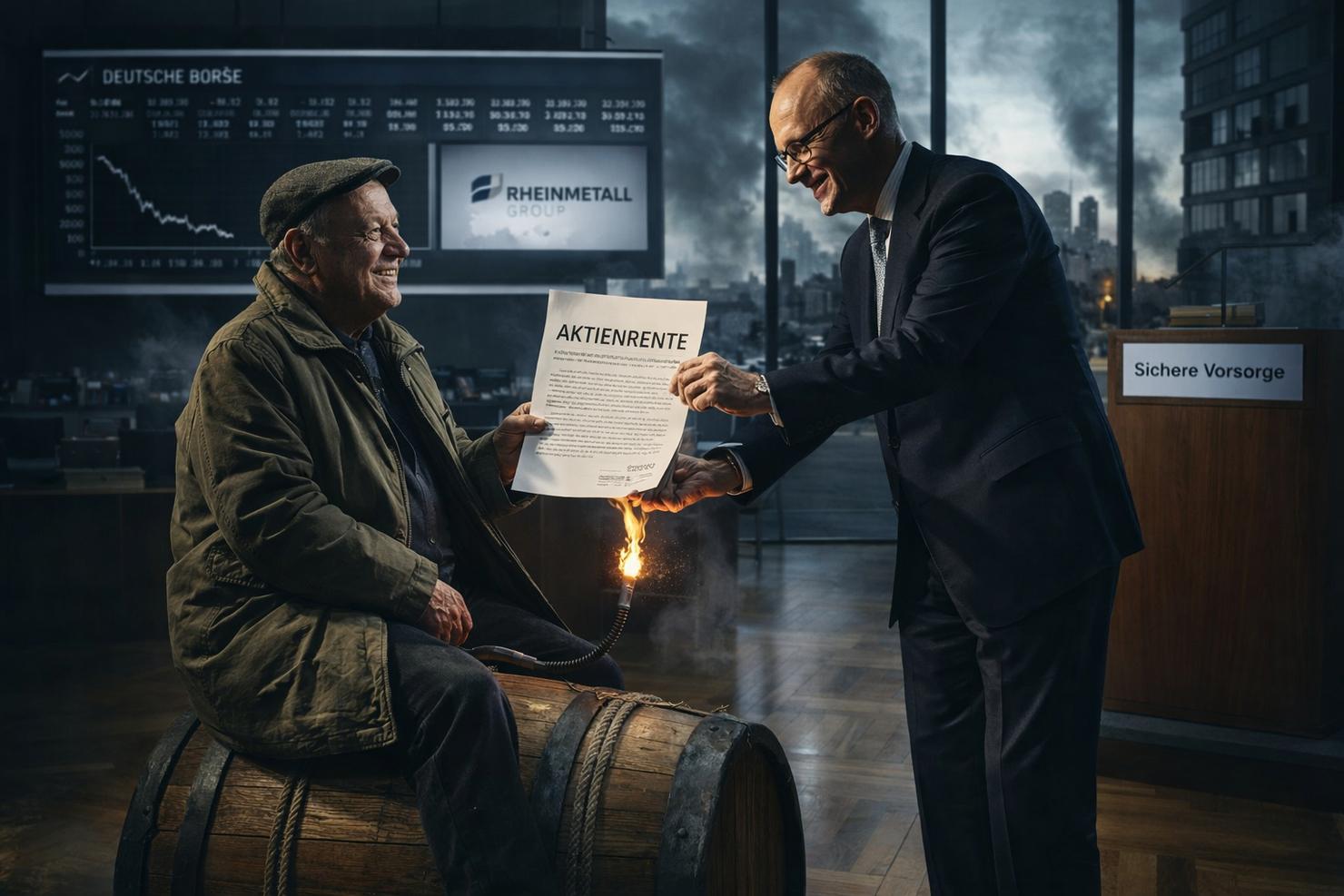
What's being sold here as retirement planning is actually a diversion: Every euro that flows from the pay-as-you-go pension system into a stock portfolio is immediately missing from today's pensioner's pocket and reappears as fees, commissions, and speculative gains for fund managers. The mechanism behind it is simple: If you force millions of savers into the same indices via early-start and equity-based pensions, the demand increases for precisely those securities that the large funds already hold, prices climb, and the portfolio managers double their profits. The statutory pension is unspectacular, but it's funded by current economic output and not by the daily whims of the markets. That's precisely why it's being abolished. For his four years on the supervisory board, Merz, by his own admission, received "no less than a million" gross . Now he's ensuring that all of Germany pays into the system where he himself has already profited, and, as with gas, you end up footing the bill.
The second checkout
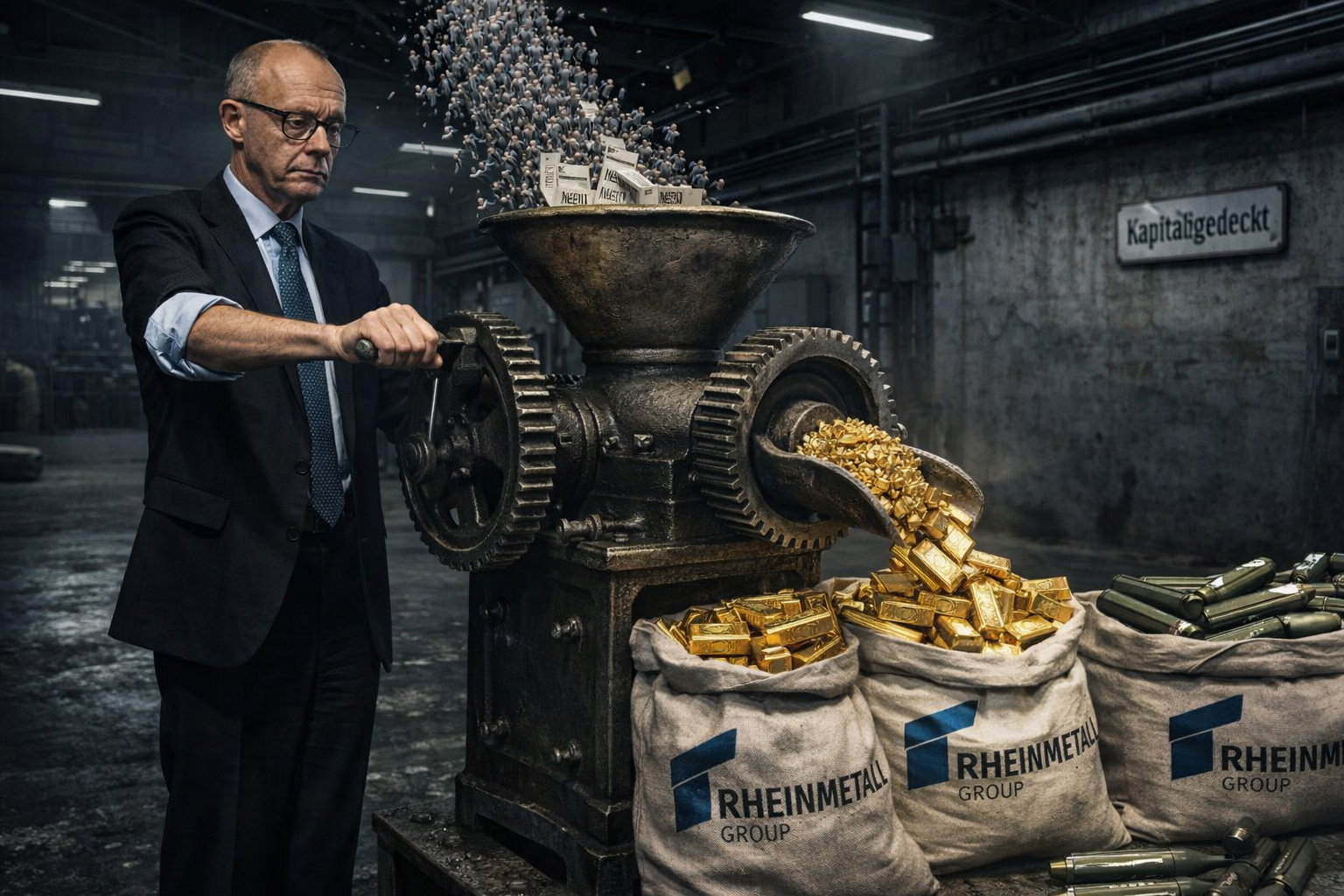
Pensions are only one front. The other is rearmament. Merz, who invoked the debt brake during the 2025 election campaign, achieved hardly anything in office. Special funds of 500 billion euros for infrastructure and virtually open loans for armaments through the old Bundestag. The Rheinmetall share price has increased seventeenfold since the start of the war, and the largest shareholder of Rheinmetall has held a calculated 5,25 percent stake since May 2025. BlackRockSo that the weapons documents can also be included in the "sustainable" funds, In Brussels, armaments are currently being redefined as ESG-compliant facilities..
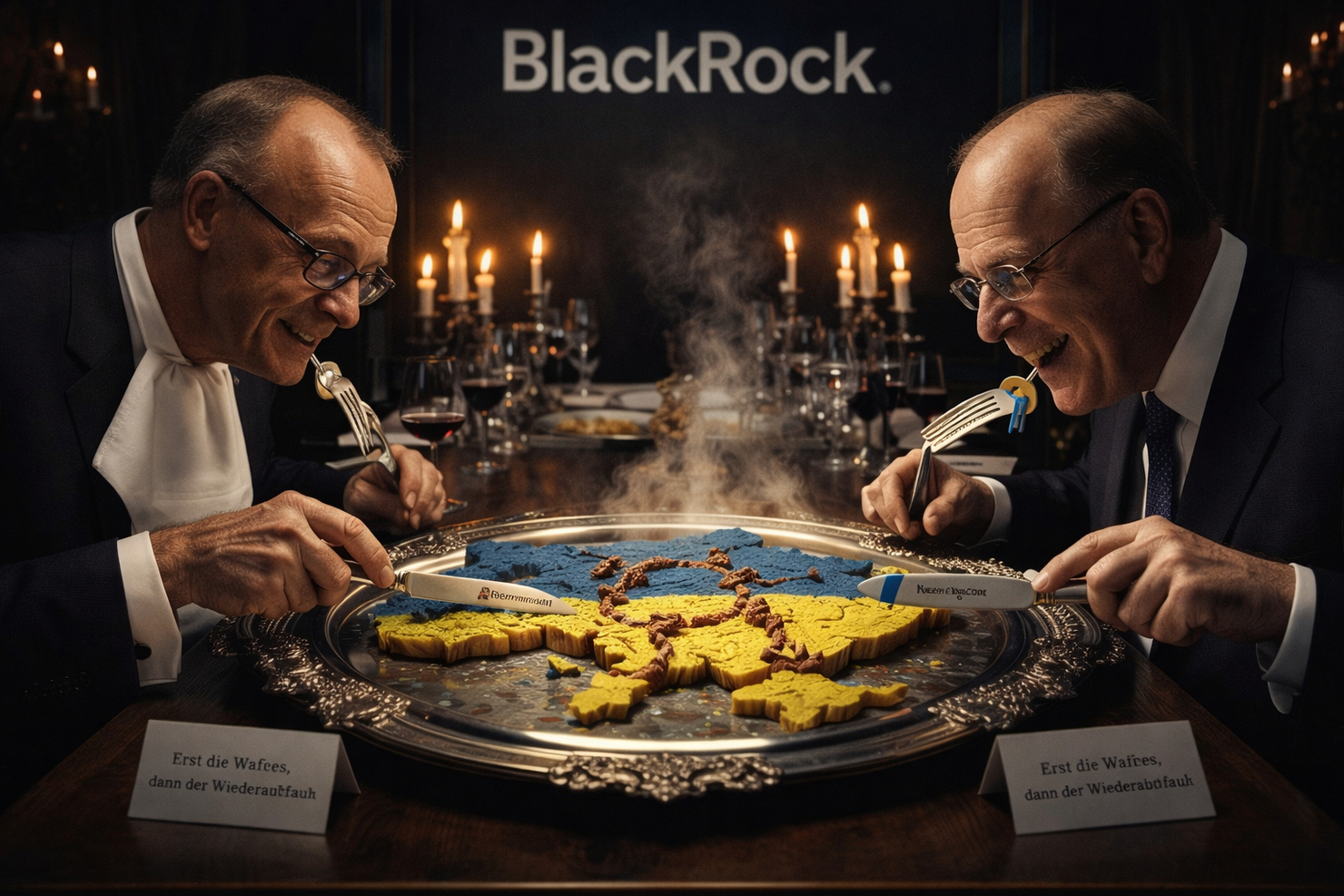
And the corporation profits not only from destruction but also from reconstruction: BlackRock has signed an agreement with the government in Kyiv to coordinate Ukraine's multi-billion-dollar reconstruction . First the weapons, then the rubble, then the fund that takes a cut at both ends. The state incurs the debt, you pay the interest, and your portfolio collects the dividends. This isn't a conspiracy; it's a balance sheet.
What the defenders say
Of course, there's another interpretation, and it's not entirely wrong. BlackRock Germany, during Merz's tenure, was a small operation with around 150 employees, an appendage of the London headquarters, and Merz wasn't a fund manager there, but a well-paid representative. The corporation doesn't own the company's shares; he It manages it in trust for millions of customers — powerful through position, not ownership. And the demographics are real, the pay-as-you-go system is creaking, other countries have been operating partially funded systems for years. All true. But it doesn't change the fundamental question: who sets the course and who profits from it? A supervisory board member of the German subsidiary still earns money from every client they refer to headquarters. And a head of government decides on laws that enrich precisely these clients. When the former chief lobbyist of the biggest beneficiary orchestrates exactly the kind of reallocation that makes your assets in foreign accounts are transferred, then the conflict of interest is not a rumor, but a description of the office.
From the supervisory board bench to the chancellor's office
Merz never changed sides; he merely swapped desks and took the vested interests with him. They call it a paradigm shift when your public sector pension contributions flow into the ETFs of the world's largest asset manager. They call it responsibility when you go into debt for defense dividends you'll never see. They call it retirement planning when your pension depends on whether the stock market is in a good mood on the day you get old. And when the crash comes, the portfolio still belongs to the fund—you just own the risk!

More for you:






 "Dravens Tales from the Crypt" has been enchanting for over 15 years with a tasteless mixture of humor, serious journalism - for current events and unbalanced reporting in the press politics - and zombies, garnished with lots of art, entertainment and punk rock. Draven has turned his hobby into a popular brand that cannot be classified.
My blog was never designed to spread news, let alone get political, but with current affairs I just can't help but capture information here that is otherwise censored on all other channels. I am aware that the design page may not seem "serious" to many in this regard, but I will not change this to please the "mainstream". Anyone who is open to non-state-compliant information sees the content and not the packaging. I've tried enough to provide people with information over the last 2 years, but quickly noticed that it never matters how it's "packaged", but what the other person's attitude towards it is. I don't want to put honey on anyone's mouth to meet expectations in any way, so I'll keep this design because hopefully at some point I'll be able to stop making these political statements, because it's not my goal to go on like this forever  I leave it up to everyone how they deal with it. However, you are welcome to simply copy and distribute the content, my blog has always been under the WTFPL license.
It's hard for me to describe what I'm actually doing here, DravensTales has become a culture blog, music blog, shock blog, tech blog, horror blog, fun blog, a blog about found items on the internet, internet bizarre, trash blog, art blog, water heater, zeitgeist blog over the years , Scrap blog and grab bag blog called. Everything that is right ... - and yet not. The main focus of the blog is contemporary art, in the broadest sense of the word.
To ensure the continued operation of this site, you are welcome to make a donation via credit card, PayPal, Google Pay, Apple Pay, or direct debit/bank account . Many thanks to all readers and supporters of this blog!