The Digital Services Act doesn't prohibit a single sentence you were allowed to say yesterday. Nor does it need to. Brussels has invented something more elegant than a ban: speech that is permitted but is nevertheless meant to disappear. There's hardly any actual deletion; instead, there's a great deal of throttling. The death knell of freedom isn't driven in; no hammer is heard. It's screwed in, turn after turn. Each turn bears the seal of approval: "Protection of Democracy."
Recital 84: Permitted, but undesirable
A platform with 45 million active users or more is considered "very large" and must assess its "systemic risks" annually. According to Article 34 , these risks include "adverse effects on public debate." The law doesn't specify who determines when a debate is adverse. However, Recital 84 reveals the core principle: providers should also focus on information "that is not unlawful" but contributes to these risks. The term "disinformation" also appears there, in the explanatory memorandum, not in the law itself. It is not defined definitively anywhere, yet it is used daily.
The toolbox in Article 35 lists the available measures: adapting recommendation systems, redirecting advertising, and collaborating with "trusted whistleblowers." And if the Commission identifies a crisis, it may, according to Article 36 , demand special measures as soon as there is a "serious threat to public security or public health." We experienced firsthand between 2020 and 2022 just how flexibly the word "health" can be interpreted.

The voluntary code with a built-in threat
Brussels defenders swear that lawful content remains protected. Democrats on the US Judiciary Committee calculate that less than 0,001 percent of deletions are due to government orders. That's probably true. Except that with this model, no one needs to issue an order if the platform understands the signal itself.
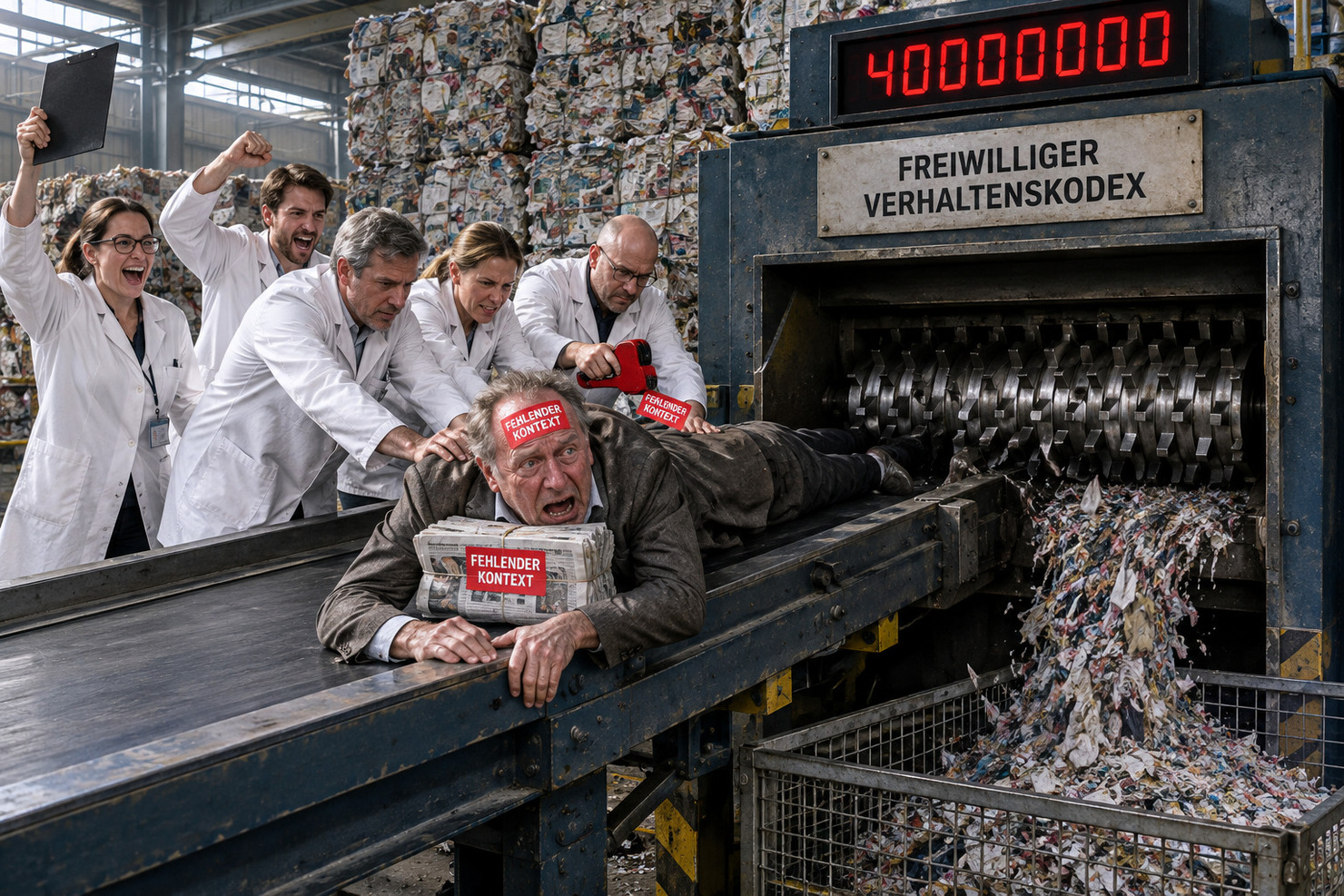
The clue comes from the "Code of Conduct on Disinformation." Formally voluntary, but since July 1, 2025 , auditable and a "benchmark" for compliance with the DSA (Data Security Agreement). When Meta dismissed its fact-checkers in the US in January 2025, the Commission stated that cooperation with fact-checkers was considered an "effective means" against systemic risks, including fines of up to six percent of global revenue. Federal Network Agency head Klaus Müller clarified on January 8, 2025, that cooperation was "not mandatory, but the risk of sanctions decreases ." Voluntary, like handing over your wallet in the backyard. Meta itself demonstrates how this works in practice: In the first half of 2023, over 190,000 fact-checked articles were used to label and limit the reach of more than 40 million pieces of content . Who pays these fact-makers is another matter entirely.
Whistleblower with right of way and house pass
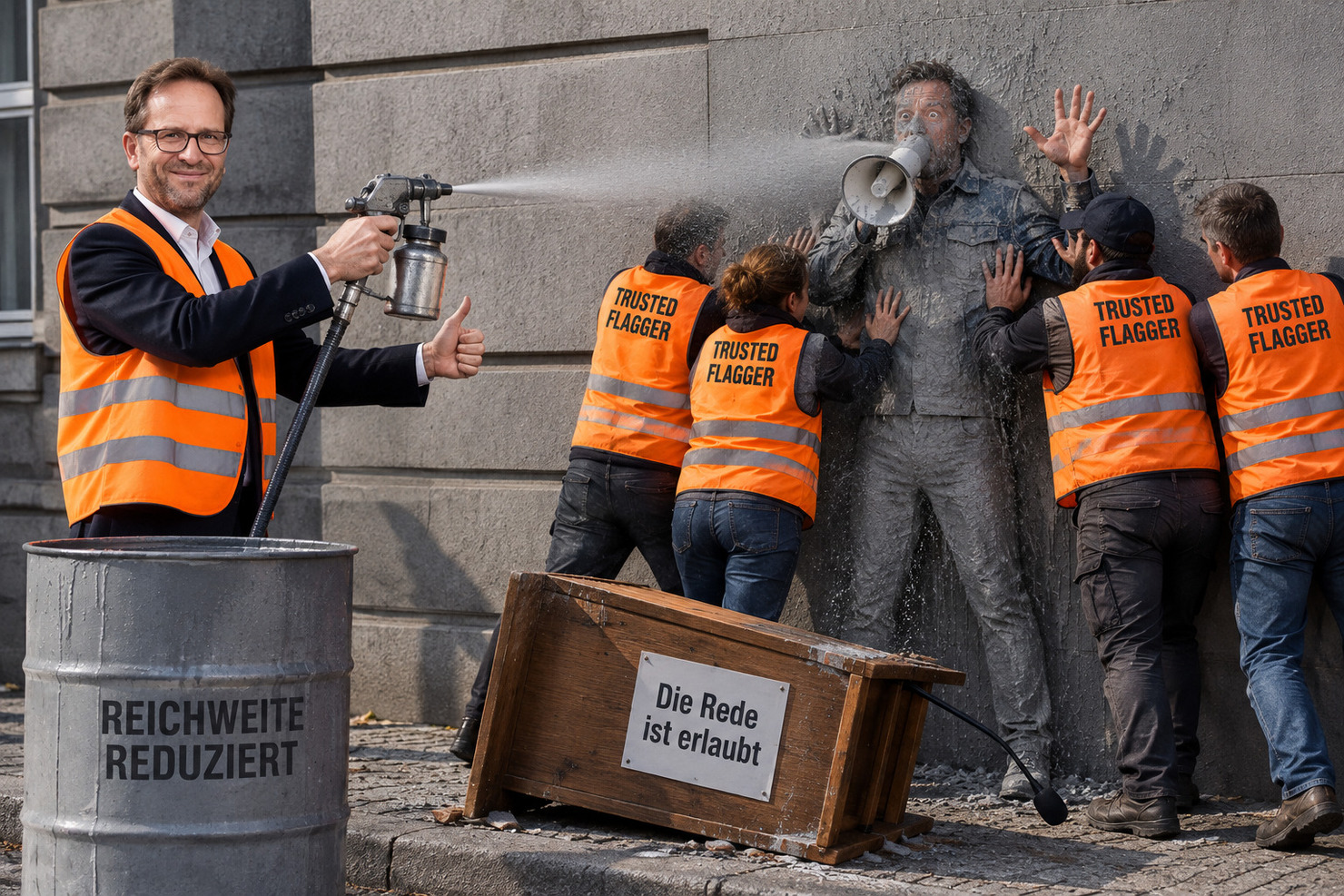
On October 1, 2024, the Federal Network Agency authorized the reporting platform REspect! as Germany's first "Trusted Flagger" and announced that platforms were "obligated to respond immediately to reports from Trusted Flaggers ." Following "justified criticism," the agency had to amend the announcement: It was, of course, referring only to "illegal fake news." Freudian slips are apparently filed away in the press archives in Bonn.
On June 2, 2025, the German Federal Association of Online Retailers, HateAid , and the Federation of German Consumer Organizations followed suit. Müller headed the latter before moving to the top of the agency that now certifies him in March 2022. In livestock farming, this is called inbreeding. Washington calls it something else: Shortly before Christmas 2025, the US State Department imposed an entry ban on the two HateAid executives , along with former EU Commissioner Thierry Breton, the "mastermind" of the DSA. Breton spoke of a witch hunt. Apparently, anyone who operates a witch hunt as a business model recognizes it immediately.
120 million for the wrong checkmark
On December 5, 2025, the Commission imposed its first-ever DSA fine: €120 million against X. The subject: the blue checkmark, an incomplete advertising archive, and denied data access for researchers. Content wasn't even considered yet; the investigation into "information manipulation" is ongoing. The fine is just the first step; the bill will follow. Musk has since begun publicly disclosing government takedown orders , which surprisingly didn't sit well with transparency advocates.

What the commission understands by hate speech behind closed doors was revealed by the US House Judiciary Committee in July 2025: In a confidential workshop in May, the phrase "we need to take back our country" was considered "illegal hate speech." The Democrats countered that the phrase had appeared in a hypothetical case alongside a headscarf meme and the harassment of a 16-year-old. Perhaps. The exercise was still secret, and the terms remain flexible. More from these documents can be found in Brussels' long war against freedom of expression.
Bern follows Brussels' construction plan
And Switzerland? It does what it always does: copy others and call it independence. On October 29, 2025, the Federal Council sent the Federal Act on Communication Platforms and Search Engines out for consultation. Services reaching around 900,000 users will be covered , with fines of up to six percent of global revenue, and the most severe measure being blocking via the telecommunications provider. Milder than the DSA, the Federal Council emphasizes. The Swiss Federation of Trade Unions praises the "close alignment" with the EU regulation and immediately demands the obligation not only to analyze systemic risks but also to "minimize" them. The Canton of Schwyz, on the other hand, wants to limit the reporting requirement to offenses prosecuted ex officio , so that "polemical and politically charged statements" don't get flagged. At least one cantonal government has understood what's at stake. The rest are ordering the coffin, this time with Swiss precision screws. No sentence will be banned; every sentence will be evaluated. The commission has built the coffin, the fact-checkers are measuring the corpse, and the whistleblowers are carrying it to the grave with priority. Bern is supplying the screws and has budgeted for delivery in 2029. Under a gravestone inscribed with "Protection of Debate," silence reigns supreme!

More for you:






 "Dravens Tales from the Crypt" has been enchanting for over 15 years with a tasteless mixture of humor, serious journalism - for current events and unbalanced reporting in the press politics - and zombies, garnished with lots of art, entertainment and punk rock. Draven has turned his hobby into a popular brand that cannot be classified.
My blog was never designed to spread news, let alone get political, but with current affairs I just can't help but capture information here that is otherwise censored on all other channels. I am aware that the design page may not seem "serious" to many in this regard, but I will not change this to please the "mainstream". Anyone who is open to non-state-compliant information sees the content and not the packaging. I've tried enough to provide people with information over the last 2 years, but quickly noticed that it never matters how it's "packaged", but what the other person's attitude towards it is. I don't want to put honey on anyone's mouth to meet expectations in any way, so I'll keep this design because hopefully at some point I'll be able to stop making these political statements, because it's not my goal to go on like this forever  I leave it up to everyone how they deal with it. However, you are welcome to simply copy and distribute the content, my blog has always been under the WTFPL license.
It's hard for me to describe what I'm actually doing here, DravensTales has become a culture blog, music blog, shock blog, tech blog, horror blog, fun blog, a blog about found items on the internet, internet bizarre, trash blog, art blog, water heater, zeitgeist blog over the years , Scrap blog and grab bag blog called. Everything that is right ... - and yet not. The main focus of the blog is contemporary art, in the broadest sense of the word.
To ensure the continued operation of this site, you are welcome to make a donation via credit card, PayPal, Google Pay, Apple Pay, or direct debit/bank account . Many thanks to all readers and supporters of this blog!