Twenty-six years of the Renewable Energy Sources Act, well over 400 billion euros in subsidies paid out of your pocket, and the result reads like a damage report: the highest household electricity prices in the EU, a country that imports more electricity than it exports for the third year in a row, a Federal Court of Auditors that officially labels the energy transition "off track," and an Economics Minister who proudly announces in July 2026 that, "for the first time since the introduction of subsidies," they are now considering where new installations for the electricity grid actually make sense. For the first time. After a quarter of a century. And while Berlin is still trying to cover up the mess, Bern has copied the blueprint with 68,7 percent approval and ordered up the same winter that has already arrived in Germany. The energy transition isn't a construction site that will be finished. It's a design flaw with a ministry at its helm, and the crack doesn't run through the execution, but through the foundation.
The balance sheet after half a trillion
You know the sales figure from every news broadcast: 55,1 percent of gross electricity consumption in 2025 came from renewables. What the news omits is revealed on the next page by the same agency: electricity accounts for only about a quarter of Germany's final energy consumption. According to the Working Group on Energy Balances, wind and solar power covered around eight percent of primary energy consumption in 2025, while petroleum alone accounted for 36 percent. Eight percent after 26 years—that's not a turning point, that's a stalemate. And it was handsomely paid for: around 261 billion euros in feed-in tariffs flowed to the operators by 2018, with the federal budget alone contributing 18,5 billion euros in 2024 and 16,5 billion in 2025. We've already dissected where this half a trillion euros really went . The benefit for the consumer: 38,35 cents per kilowatt-hour in the first half of 2025, the highest in the EU, 34 percent above the average. The benefit for industry: Energy-intensive production shrank by a further 2,3 percent in 2025, and the manufacturing sector by 1,5 percent. This is called transformation. The workforce calls it layoffs.
Physics cannot be subsidized.
The fundamental problem is so simple that a child could understand it, yet a government ministry could overlook it for 26 years: wind and sun deliver power when they want to, not when you cook. According to the Working Group on Energy Balances, all large storage facilities connected to the German grid have a usable capacity of 143,6 gigawatt-hours. Germany consumes around 60 gigawatt-hours per hour. The entire storage infrastructure can therefore power the country for a good two hours; after that, it's candlelight. The Federal Network Agency documented what this looks like in a real-world scenario on January 20, 2025: 70,6 gigawatt-hours of consumption in the hour from 17 to 18 p.m., of which wind and solar supplied 4,6, and the market price skyrocketed to €583,40 per megawatt-hour. In the same year, there were 573 hours with negative prices, a record, because nobody wants the solar power at midday that everyone desperately needs in the evening. A system that simultaneously produces too much and too little is considered defective in engineering terms, but in Berlin, it's called progress. And because spring 2025 was windy, coal-fired power plants increased their output by 10,9 percent. The climate transition, driven by imported coal from Australia and Colombia. Wind turbines never come alone ; they always bring a coal-fired power plant along as their bodyguard.
The internet pays what ideology orders.
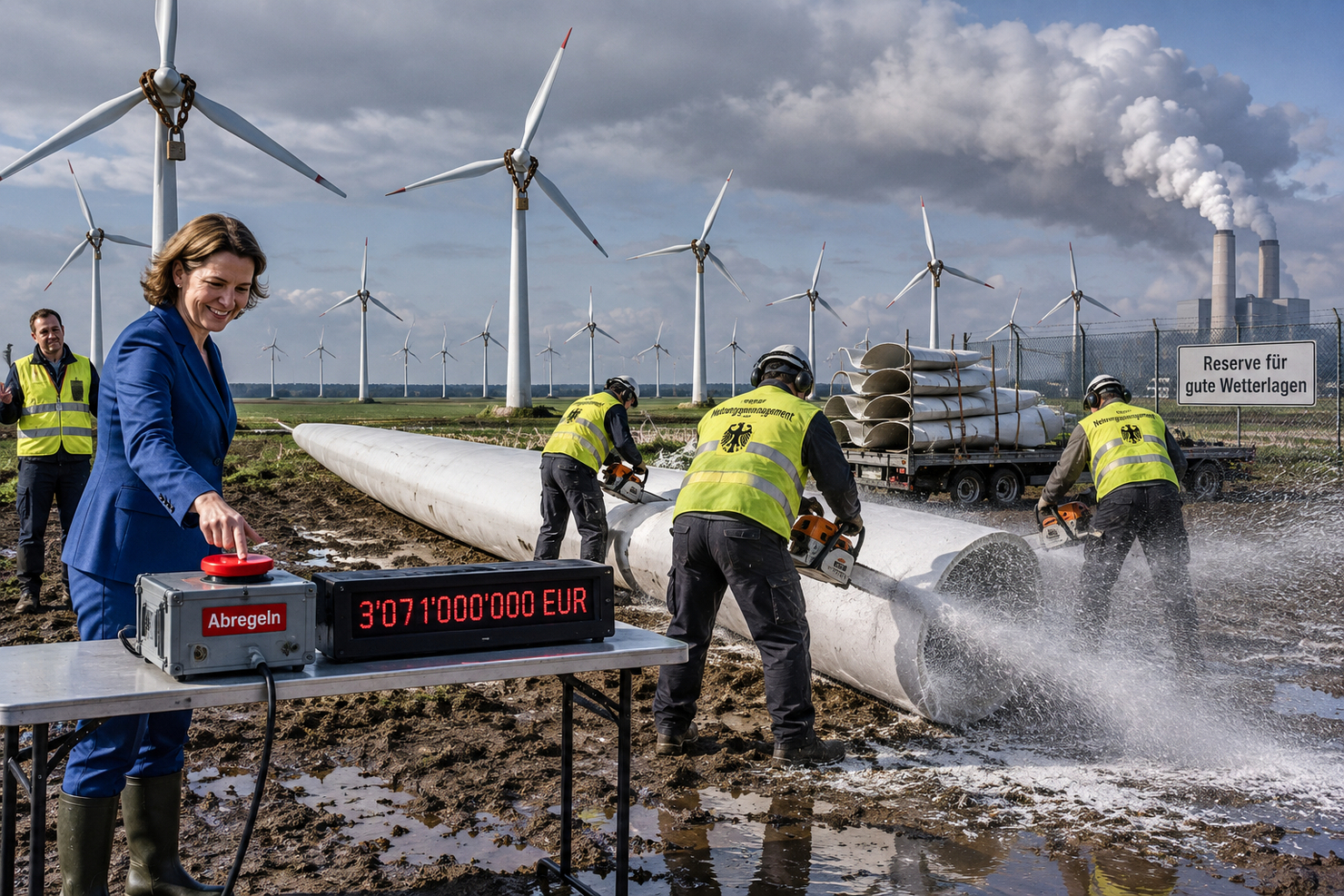
Because electricity is generated where no one needs it, grid congestion management alone will cost around €3,07 billion in 2025, according to the Federal Network Agency. Curtailment of solar power plants increased by 94 percent within a single year. And now for the irony that no cabaret artist could deliver better: The transmission system operators are forecasting congestion costs of €4,6 to €4,9 billion per year for 2027 to 2031. Despite grid expansion, due to the addition of new capacity. The more plants, the more expensive it is to waste electricity. On July 29, 2026, the cabinet approved the grid package and a new Renewable Energy Sources Act (EEG), and the minister announced in a press release that renewables now had to "assume more responsibility, systemically and financially." In other words: The children are grown, maintenance payments are cut, but the chaos in the children's room remains. The fact that the plants are merely decorative without substations was something the local residents had known long before the ministry.
Hydrogen as a mirage, nuclear power as a corpse in the basement
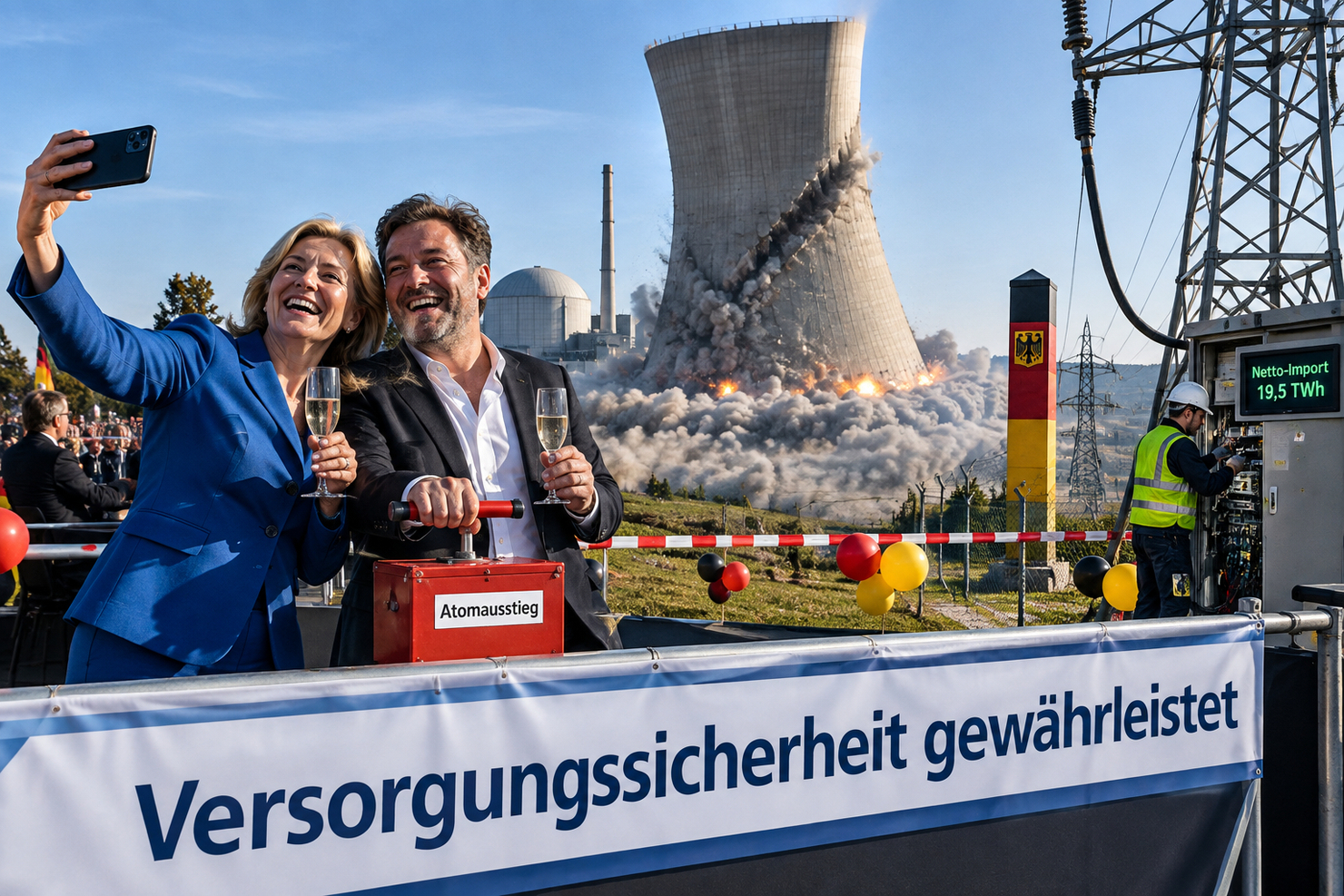
The natural gas that Germany burned in 2025 corresponds to approximately 779 terawatt-hours, according to the Working Group on Energy Balances. This is to be replaced eventually by green hydrogen. According to the German Institute for Economic Research (DIW) , the country's current hydrogen demand is around 46 terawatt-hours, almost entirely produced from natural gas, and the installed electrolysis capacity is around 170 megawatts. The target for 2030 is ten gigawatts. This isn't a gap; it's an abyss with a press spokesperson. Meanwhile, on April 15, 2023, the last three nuclear power plants were shut down, with the official promise that the supply would remain "guaranteed." Since then, it has been guaranteed by the power plants of neighboring countries, because in 2025 Germany imported a net 19,5 terawatt-hours, for the third year in a row, after the country hadn't been a net importer since 2002. So, CO2-free power plants were shut down and decommissioned in order to buy the missing electricity from across the border. Those who can no longer manage the network alone are not pioneers, but rather freeloaders.
Bern is copying the design flaw: Switzerland is headed for the same winter
Anyone who thinks this is a German problem should look at their own electricity meter. On June 9, 2024, the Swiss electorate approved the electricity law with 68,7 percent of the vote , thus belatedly importing the Berlin model: 35 terawatt-hours from solar, wind, and biomass by 2035, starting from just under seven terawatt-hours in 2023—a fivefold increase in eleven years, decided upon by a country that has always been dependent on its neighbors in winter. Just how dependent was calculated by the Swiss Federal Electricity Commission (ElCom) in May 2026: Last winter, Switzerland imported a net 6,8 terawatt-hours, around one-fifth of its winter consumption, because the Gösgen power plant was out of service and hydropower was weak, supplied primarily by French nuclear power plants.
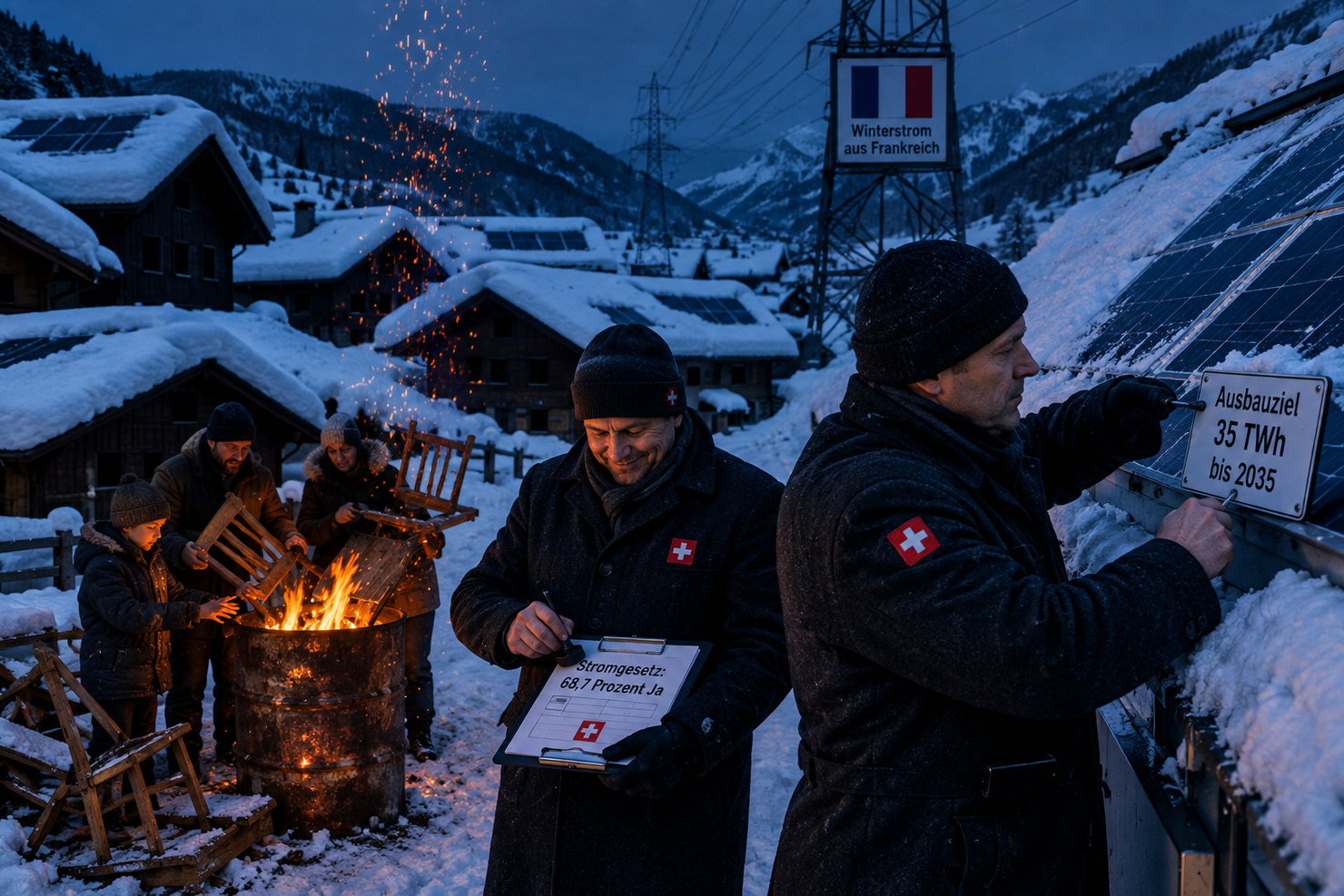
And in 2017, the same electorate, with 58,2 percent of the vote , banned the construction of precisely those power plants that are now being ordered across the border for the winter. Nine years later, Bern reverses course: On June 19, 2026, Parliament lifted the ban on new construction, officially citing the need for "backup" in case renewables "cannot be expanded to the desired extent." So, a law was passed, and in the same breath, insurance was taken out against its failure. The reversal of the phase-out is expected to go to a public vote on February 28, 2027 ; the referendum has been launched.
Meanwhile, payments are made in the same way as in Germany, only in centimes. According to ElCom, the typical household will pay 27,7 centimes per kilowatt-hour in 2026, and this is expected to decrease to 26,5 centimes in 2027 , still well above the pre-2022 level. The grid tariff includes a separate item for "electricity reserve" of 0,41 centimes, which covers the rental of gas turbines that stand ready for periods of low wind and solar power generation – a term no one in Bern seems to want to use. It's a miniature version of Berlin's dual system: solar panels for the summer, when Germany's surplus electricity is essentially giving it away, and in winter, French nuclear power plus reserve power plants for the weeks when the panels are covered in snow. Anyone in Switzerland who thinks the bill will stay north of the Rhine has already paid it through their gas pump and health insurance premiums.
Finding: Foundation instead of facade
The Federal Court of Auditors already dictated the essential points in March 2024: The energy transition is off track, the government's supply assumptions are unrealistic, and the early warning system has been rendered ineffective. Anyone who builds an energy system on sources that deliver 6.5 percent of the energy at 5 p.m. in January has to keep the entire old power plant fleet running as a reserve, double the grid capacity for the peak demand of the new generation, and give away the surplus to neighboring countries at negative prices, only to buy back their electricity at high prices during periods of low demand. Two systems, one meter, your bank account. This is precisely why the so-called energy transition is doomed to failure, not because too little has been built, but because the system is based on a desire for energy, not on actual load curves.
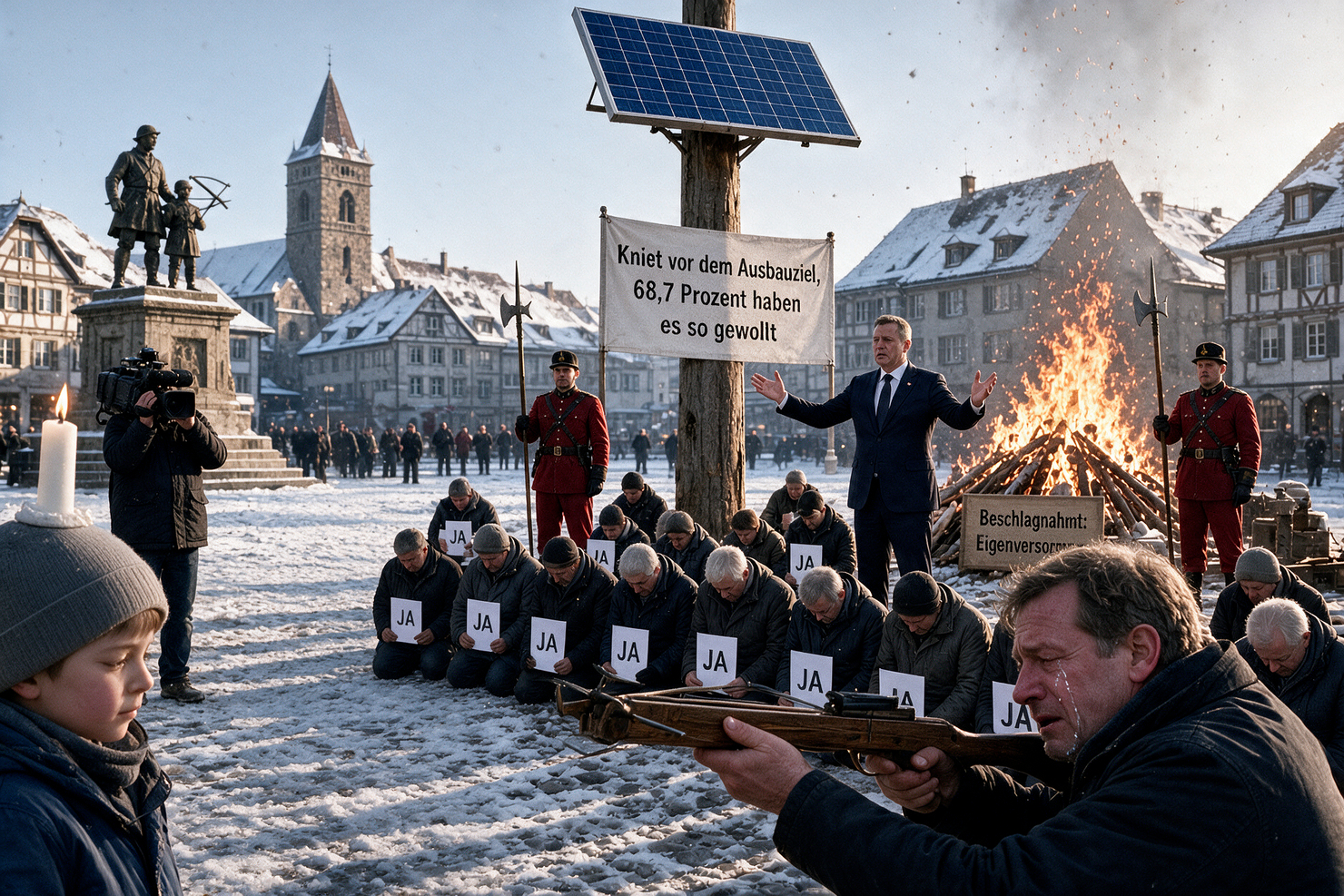
A quarter of a century, half a trillion, and in the end, the minister stands before the press and discovers the power grid. The wind turbines keep turning, the coal keeps burning, the bill keeps growing, only the number of believers is dwindling. The blackout doesn't even have to happen; deindustrialization is already here – and Switzerland stands by, ballot in hand, buying winter electricity from reactors it itself banned, calling it security of supply. Germany has shut down its own energy system – and calls it a "paradigm shift"!
More for you:



 "Dravens Tales from the Crypt" has been enchanting for over 15 years with a tasteless mixture of humor, serious journalism - for current events and unbalanced reporting in the press politics - and zombies, garnished with lots of art, entertainment and punk rock. Draven has turned his hobby into a popular brand that cannot be classified.
My blog was never designed to spread news, let alone get political, but with current affairs I just can't help but capture information here that is otherwise censored on all other channels. I am aware that the design page may not seem "serious" to many in this regard, but I will not change this to please the "mainstream". Anyone who is open to non-state-compliant information sees the content and not the packaging. I've tried enough to provide people with information over the last 2 years, but quickly noticed that it never matters how it's "packaged", but what the other person's attitude towards it is. I don't want to put honey on anyone's mouth to meet expectations in any way, so I'll keep this design because hopefully at some point I'll be able to stop making these political statements, because it's not my goal to go on like this forever  I leave it up to everyone how they deal with it. However, you are welcome to simply copy and distribute the content, my blog has always been under the WTFPL license.
It's hard for me to describe what I'm actually doing here, DravensTales has become a culture blog, music blog, shock blog, tech blog, horror blog, fun blog, a blog about found items on the internet, internet bizarre, trash blog, art blog, water heater, zeitgeist blog over the years , Scrap blog and grab bag blog called. Everything that is right ... - and yet not. The main focus of the blog is contemporary art, in the broadest sense of the word.
To ensure the continued operation of this site, you are welcome to make a donation via credit card, PayPal, Google Pay, Apple Pay, or direct debit/bank account . Many thanks to all readers and supporters of this blog!