
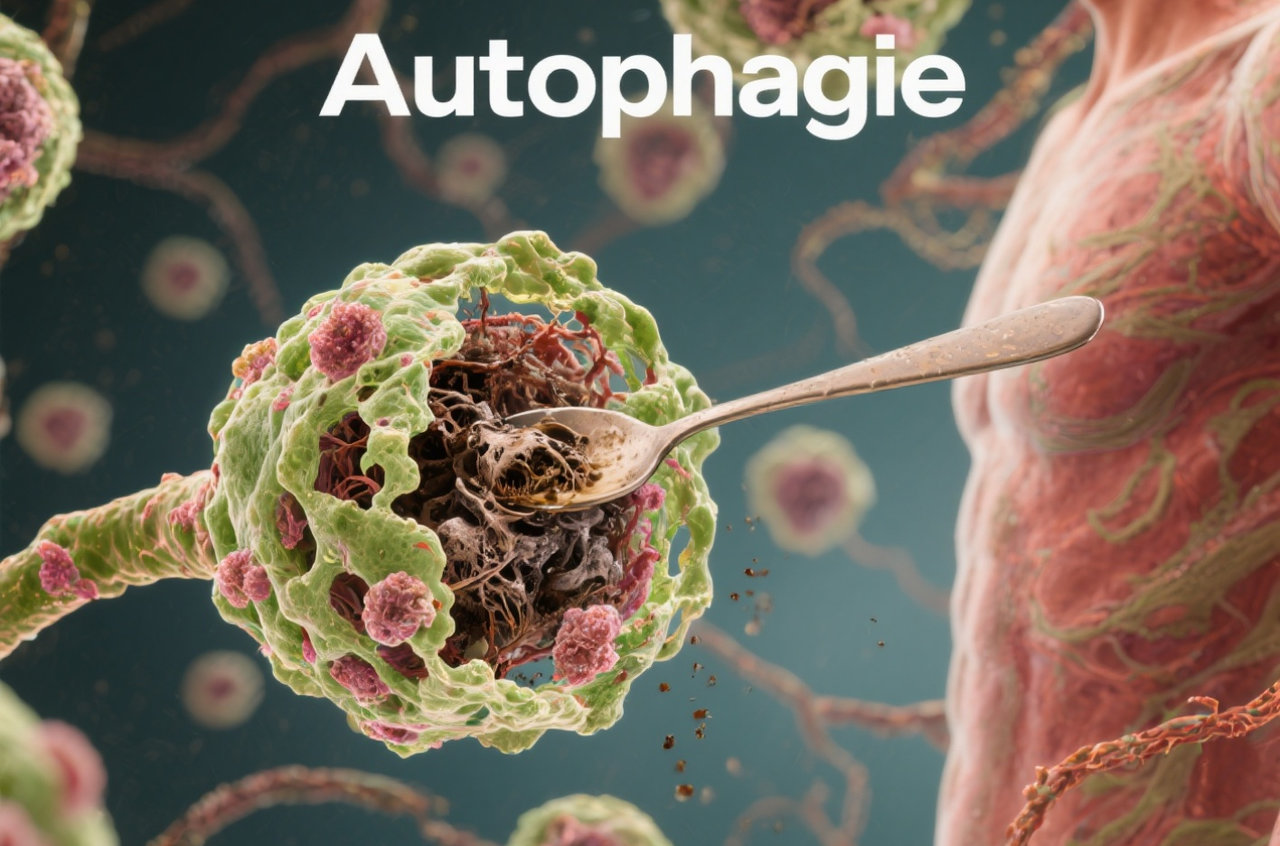
In times of plenty, we often forget that the human body wasn't designed for constant food intake. Rather, it's optimized for periods of scarcity. As soon as the body goes without food for a while, something astonishing happens: it activates an ancient self-healing mechanism – called autophagy. Autophagy literally means "self-eating."
But this is not an act of destruction, but rather the highest act of biological intelligence. The body begins to consume and recycle damaged, unusable, or dangerous cell components. This is not just about simple cellular waste – but about a veritable cellular cleansing at the molecular level.
- Defective mitochondria are broken down.
- Clumped proteins, such as those found in Alzheimer's disease, are broken down.
- Misfolded enzymes and RNA molecules are excreted.
- Cancerous cells that have become degenerated due to genetic errors are detected and eliminated.
The cell uses its own internal system: it forms membranes that encapsulate damaged cell parts – these are then "digested" by enzymes, and their building blocks are reused to regenerate healthy structures. This process is so precise that it can now be visualized with laser microscopes. It's as if the cell starts up a garbage collection service, recycling plant, and repair shop all in one. And the key to all of this is: fasting.
Only when glucose reserves are depleted and no new input is received does the body activate this survival mode. And paradoxically, it is precisely then – in times of scarcity – that the greatest regeneration begins. For now, the body not only produces new cells but also optimizes the entire cellular environment. Autophagy is the answer to:
- aging process
- chronic inflammation
- neurodegenerative diseases
- incipient tumor formation
And all without medication. The invisible intelligence of the cell.
How autophagy works and how you can activate it
Autophagy is neither random nor a simple emergency mechanism – it's a precisely controlled biological program built into every cell of your body. Like a backup emergency system, it activates as soon as no external energy is supplied. It's controlled by signaling pathways such as mTOR (mechanistic target of rapamycin) and AMPK (AMP-activated protein kinase). As long as food is available – primarily sugar and protein – mTOR is active and blocks autophagy. The body is saying, "Everything's in abundance – no need to clean up." But as soon as you fast or consume very few calories, a radical shift occurs:
- mTOR is inhibited
- AMPK is activated
- The cell detects energy deficiency
- Autophagosomes – small “vesicle-eating cells” – begin by engulfing defective cell structures.
These vesicles then fuse with lysosomes – small acid-producing organelles that act like biological waste disposal units. Within these units, cell debris is effectively digested and broken down into usable amino acids, fatty acids, and sugar building blocks. These are then used for repair, detoxification, hormone production, and tissue regeneration.
The fascinating thing is that autophagy acts intelligently; it specifically recognizes:
- Proteins with oxidative damage
- misfolded amyloids (e.g., Alzheimer's protein)
- mutated cell nuclei
- defective mitochondria with unstable energy production
- Viral fragments and intracellular pathogens
This means: The body cleanses itself from the inside out. And this only happens if we give it the space to do so – through a deliberate break from eating.
Fasting for just 14 to 18 hours a day activates measurable autophagy processes in many people. Intermittent fasting is particularly effective, especially when combined with:
- Exercise (promotes AMPK)
- Green tea or coffee without sugar
- Heat and cold applications (e.g. sauna, cold showers)
- Sirtuin activators such as resveratrol, spermidine, or turmeric
- Ketosis through targeted carbohydrate reduction
Scientists like the Japanese physician Yoshinori Ōsumi, who received the 2016 Nobel Prize in Medicine for his work on autophagy, have proven that this mechanism is fundamental—not only for prevention but also for healing. Fasting is not a weakness—it is one of the most powerful tools for self-healing that nature has given humankind. Autophagy is not starvation. Autophagy is an orchestrated self-cleaning process—one that uses the death of old cells to sustain life.
The body dies a little bit – in order to recreate itself in a better form.
Humans are not dependent on food – but on balance.
And that begins with a conscious pause.

 "Dravens Tales from the Crypt" has been enchanting for over 15 years with a tasteless mixture of humor, serious journalism - for current events and unbalanced reporting in the press politics - and zombies, garnished with lots of art, entertainment and punk rock. Draven has turned his hobby into a popular brand that cannot be classified.
My blog was never designed to spread news, let alone get political, but with current affairs I just can't help but capture information here that is otherwise censored on all other channels. I am aware that the design page may not seem "serious" to many in this regard, but I will not change this to please the "mainstream". Anyone who is open to non-state-compliant information sees the content and not the packaging. I've tried enough to provide people with information over the last 2 years, but quickly noticed that it never matters how it's "packaged", but what the other person's attitude towards it is. I don't want to put honey on anyone's mouth to meet expectations in any way, so I'll keep this design because hopefully at some point I'll be able to stop making these political statements, because it's not my goal to go on like this forever  I leave it up to everyone how they deal with it. However, you are welcome to simply copy and distribute the content, my blog has always been under the WTFPL license.
It's hard for me to describe what I'm actually doing here, DravensTales has become a culture blog, music blog, shock blog, tech blog, horror blog, fun blog, a blog about found items on the internet, internet bizarre, trash blog, art blog, water heater, zeitgeist blog over the years , Scrap blog and grab bag blog called. Everything that is right ... - and yet not. The main focus of the blog is contemporary art, in the broadest sense of the word.
To ensure the continued operation of this site, you are welcome to make a donation via credit card, PayPal, Google Pay, Apple Pay, or direct debit/bank account . Many thanks to all readers and supporters of this blog!








