
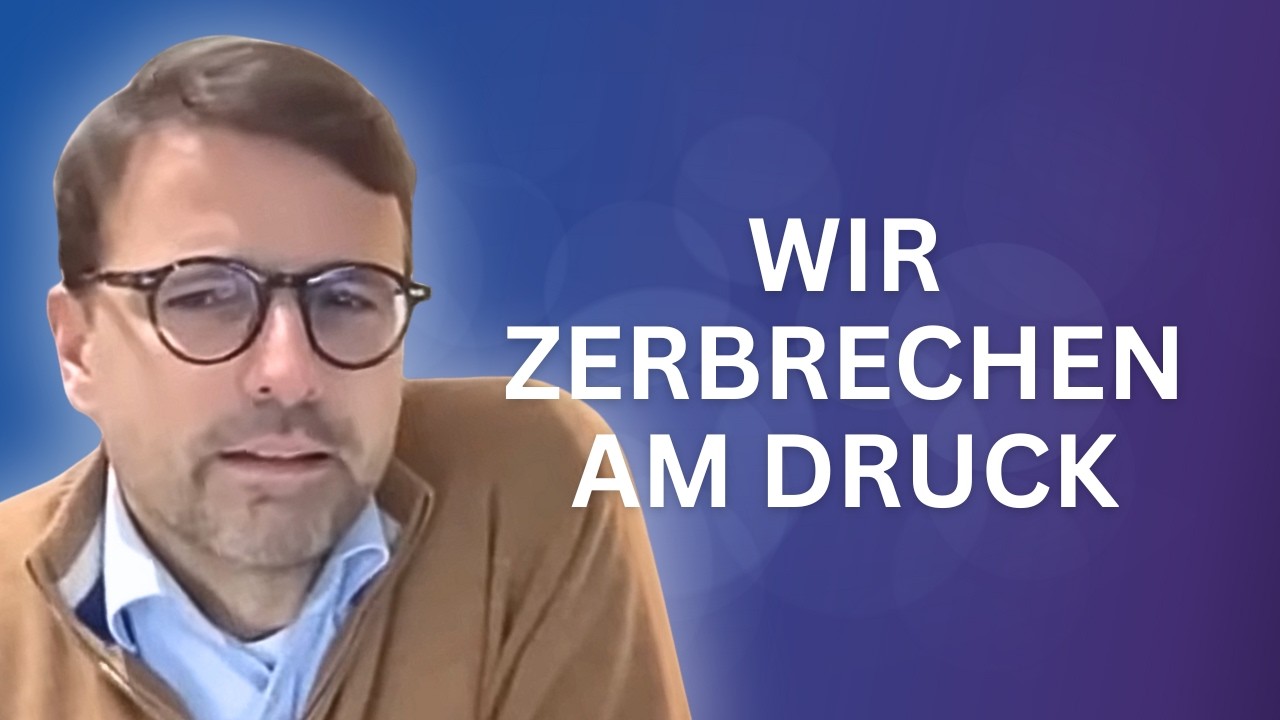
Burnout, says psychiatrist Bonelli, isn't caused by too much work, but by the wrong motivation. That sounds like the kind of sentence you'd embroider on a pillow and then sell as therapy. But unfortunately, it contains a rather unpleasant kernel of truth: it's not the hours that kill you. It's the invisible program in your head that turns every hour into a loyalty test.
Bonelli tells the story of a bishop who observed priests suffering from burnout and discovered that it's not necessarily those who work the hardest who are affected. Rather, it's those who feel the need to prove themselves. And there we are, right in the middle of a modern national pastime: performance as identity. "I perform, therefore I am." If I don't deliver, I'm not just tired. I am nothing. And those who think like this don't work. They pray for recognition.
To explain this, Bonelli invokes a distinction from the history of psychology: intrinsic vs. extrinsic. Intrinsic means: I do something for its own sake. Extrinsic means: I do it so that I am seen. Applause. Status. Appreciation. The difference is brutally simple: The intrinsic attitude serves the purpose. The extrinsic attitude uses the purpose to enhance oneself. It's like "I love you" vs. "I need you so I don't feel empty." Sounds similar, but it's a completely different animal.
Then Freudenberger comes along with his famous burnout phases, and Phase 1 is a direct hit: the urge to prove something to others. Not health. Not meaning. Not balance. But: "Look, I can do this." Phase 2: Extreme striving for achievement. Phase 3: Overwork plus neglect of needs and social contacts. And just like that: Life becomes a single-lane highway to exhaustion, with no exit.
What's particularly interesting is how Bonelli delves into the problem of perfectionism: perfectionists aren't "ambitious," they're anxious. Afraid of mistakes, afraid of criticism, afraid that a typo in an email will devalue their very existence. He tells of people who wake up in the middle of the night to check for typos lying around like dead beetles. That's not work ethic. That's panic in business attire.
And now for the really painful part: This mindset isn't private; it's contagious. Bonelli essentially calls it a societal virus. The comparisons begin, the hamster wheel spins faster, and suddenly it seems normal to wear yourself out for recognition. Working for money is almost more honest. Working for appreciation is the elegant form of dependency. Then you jump over ever higher hurdles until your legs give way. And when you fall, the system says, "Too bad. Next."
In the second part of his presentation, Bonelli addresses something rarely considered together, yet constantly intertwined: crises. They tear us from the familiar and hurl us to places we never intended to go. Between collapse and new beginnings, a hope emerges, one not based on motivational slogans, but on clarity. Those who don't shy away from despair recognize what truly motivates them. And can then act anew.
That's the bitter irony: burnout is often not a punishment for overworking. It's the consequence of turning oneself into a commodity. And nobody stays healthy for long when they have to sell themselves like a product every day.
More for you:






 "Dravens Tales from the Crypt" has been enchanting for over 15 years with a tasteless mixture of humor, serious journalism - for current events and unbalanced reporting in the press politics - and zombies, garnished with lots of art, entertainment and punk rock. Draven has turned his hobby into a popular brand that cannot be classified.
My blog was never designed to spread news, let alone get political, but with current affairs I just can't help but capture information here that is otherwise censored on all other channels. I am aware that the design page may not seem "serious" to many in this regard, but I will not change this to please the "mainstream". Anyone who is open to non-state-compliant information sees the content and not the packaging. I've tried enough to provide people with information over the last 2 years, but quickly noticed that it never matters how it's "packaged", but what the other person's attitude towards it is. I don't want to put honey on anyone's mouth to meet expectations in any way, so I'll keep this design because hopefully at some point I'll be able to stop making these political statements, because it's not my goal to go on like this forever  I leave it up to everyone how they deal with it. However, you are welcome to simply copy and distribute the content, my blog has always been under the WTFPL license.
It's hard for me to describe what I'm actually doing here, DravensTales has become a culture blog, music blog, shock blog, tech blog, horror blog, fun blog, a blog about found items on the internet, internet bizarre, trash blog, art blog, water heater, zeitgeist blog over the years , Scrap blog and grab bag blog called. Everything that is right ... - and yet not. The main focus of the blog is contemporary art, in the broadest sense of the word.
To ensure the continued operation of this site, you are welcome to make a donation via credit card, PayPal, Google Pay, Apple Pay, or direct debit/bank account . Many thanks to all readers and supporters of this blog!








