
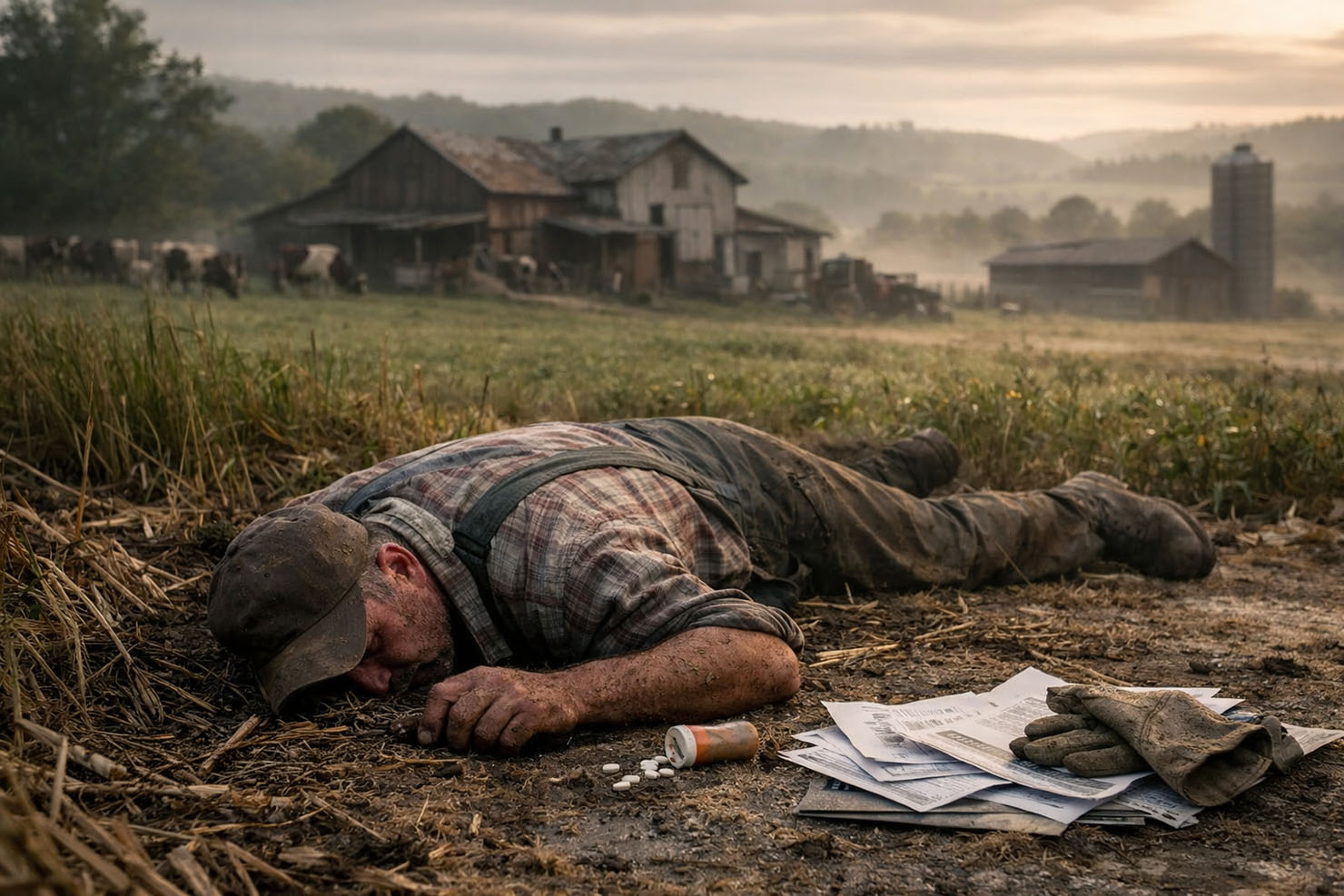
Idyllic, isn't it? Lush green meadows, fresh country air, the simple life on the farm. The farmer gets up early, does his work, goes to bed tired in the evening – and everything is fine. That's the image that commercials for butter and milk have been selling us for decades. The reality is quite different, and it's so uncomfortable that even the media prefer to ignore it. Farmers commit suicide significantly more often than the rest of the population.
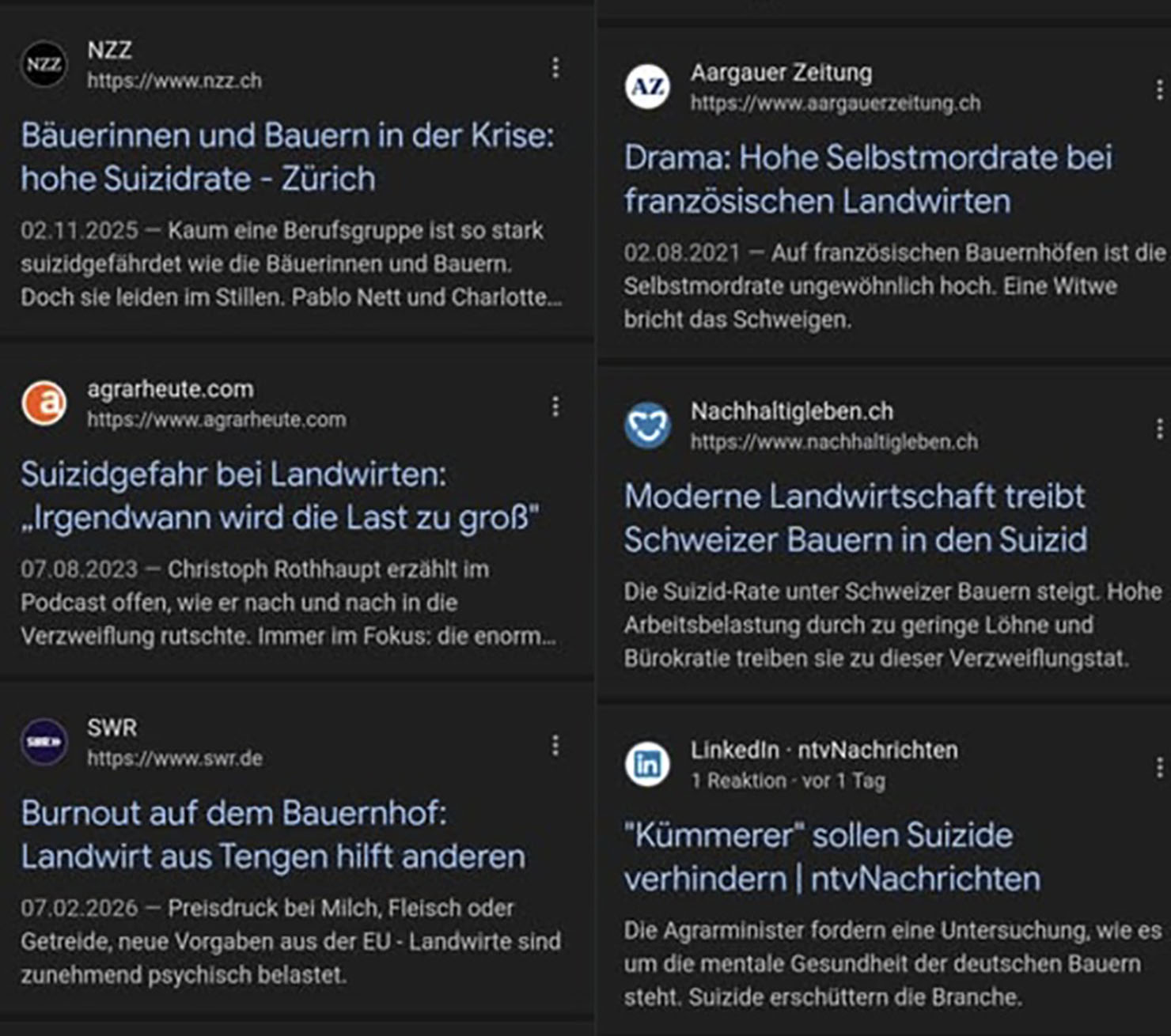
According to experts, this applies to virtually all Western industrialized nations. In Switzerland, the suicide risk among farmers is 37 percent higher than among other men from rural communities. In some EU member states, the suicide rate in agriculture is 20 percent above the national average. France, England, Austria, Switzerland – everywhere the same trend, everywhere the same collective indifference. And Germany? In Germany, there is no data on suicide rates in agriculture, even though it has long been known that psychological stress is increasing. No figures are collected. No figures are wanted. Because figures create responsibility, and responsibility, as is well known, is the least popular of all political concepts in this country.
The situation is clear enough. A typical farmer's workday begins at 5 a.m. and ends at 21 p.m., with a six- to seven-day workweek, and vacations are often out of the question. Persistently low prices, rising costs, and heavy debt burdens are pushing farms into financial difficulties. Furthermore, bureaucratic and societal demands continue to increase. The risk of burnout is said to be up to 4,5 times higher than in other professions. And one in five farmers leaves the workforce due to serious mental health issues. This isn't an isolated case. This is an epidemic. A silent, invisible, and completely socially accepted epidemic.
The culture in agriculture often emphasizes values like stoicism, strength, and traditional notions of masculinity. This can lead farmers to neglect their own needs. Working in remote areas and the constant pressure to be available can lead to loneliness and social isolation. The farmer remains silent. He has learned to be silent. He has learned that complaining is weakness, that seeking help means failure, that you solve problems yourself—just as his parents and grandparents did. And so he dies quietly, without the news reporting it, without a government minister holding a press conference, without anyone taking to the streets.
He feeds us. Literally. Germany's food self-sufficiency rate is 86 percent. Without farmers, there would be no bread, no vegetables, no meat, no milk. And what do farmers get in return? Rock-bottom prices from discount supermarkets, EU bureaucracy, contempt from parts of society – and the comforting feeling of being systemically important. That has to be enough. Politicians have reacted, of course. Ten agricultural organizations have established a working group on suicide prevention in the agricultural sector, which includes the Federal Ministry of Agriculture, the German Farmers' Association, and the social insurance institution for agriculture, forestry, and horticulture. One working group. With ten organizations. They meet, they discuss, they develop strategies. Perhaps one day there will be a policy paper. Then maybe a campaign. Then maybe an app. While outside, farms continue to die, and their owners with them.
So what can you do? Not the working group. Not the ministry. You, personally, today?
Buy local. Directly from the farmer, at the farmers' market, in the farm shop. Not because it's a feel-good experience, but because every euro that goes directly to the producer is a euro that doesn't disappear into the discount supermarket, which drives farmers into a corner with dumping prices. This isn't a romantic gesture – it's structural support. Concrete, measurable, effective. Listen. If you know a farmer, ask him how he's really doing. Not how the harvest was. How he is. Benno Winkler from the Swiss network Hofkonflikt advises: Address the issue, get help quickly, don't make it taboo, and don't think you're the only one. It costs nothing but time and attention – two resources that are supposedly scarce in this society, even though we spend hours staring at screens.
Talk about it. In your community, on social media, wherever you have a voice. The suicide rate among farmers isn't a taboo subject that needs protecting—it's a scandal that needs to be called out. Loudly, uncomfortablely, as often as necessary, until someone with real decision-making power takes notice. And if you're a farmer yourself, or know someone in crisis: The farmers' helpline in Germany can be reached at 0800-1110111, in Austria at 0810-67 68 10, and in Switzerland at 041 820 02 15. Free of charge. Anonymous. From people who understand what's at stake. Fields aren't cultivated by working groups. And farmers aren't saved by bureaucrats and press releases.
(via Martin)
More for you:




 "Dravens Tales from the Crypt" has been enchanting for over 15 years with a tasteless mixture of humor, serious journalism - for current events and unbalanced reporting in the press politics - and zombies, garnished with lots of art, entertainment and punk rock. Draven has turned his hobby into a popular brand that cannot be classified.
My blog was never designed to spread news, let alone get political, but with current affairs I just can't help but capture information here that is otherwise censored on all other channels. I am aware that the design page may not seem "serious" to many in this regard, but I will not change this to please the "mainstream". Anyone who is open to non-state-compliant information sees the content and not the packaging. I've tried enough to provide people with information over the last 2 years, but quickly noticed that it never matters how it's "packaged", but what the other person's attitude towards it is. I don't want to put honey on anyone's mouth to meet expectations in any way, so I'll keep this design because hopefully at some point I'll be able to stop making these political statements, because it's not my goal to go on like this forever  I leave it up to everyone how they deal with it. However, you are welcome to simply copy and distribute the content, my blog has always been under the WTFPL license.
It's hard for me to describe what I'm actually doing here, DravensTales has become a culture blog, music blog, shock blog, tech blog, horror blog, fun blog, a blog about found items on the internet, internet bizarre, trash blog, art blog, water heater, zeitgeist blog over the years , Scrap blog and grab bag blog called. Everything that is right ... - and yet not. The main focus of the blog is contemporary art, in the broadest sense of the word.
To ensure the continued operation of this site, you are welcome to make a donation via credit card, PayPal, Google Pay, Apple Pay, or direct debit/bank account . Many thanks to all readers and supporters of this blog!








