
There was once a romantic notion of the internet: a digital marketplace where people could discuss things under pseudonyms. A place where "DragonSlayer1987," "Freidenker_42," and "WahrheitSucher" shared their thoughts online, while somewhere a VPN hummed quietly, providing the comforting feeling: Nobody knows who I am. That phase was apparently charming. And now it's pretty much officially over.
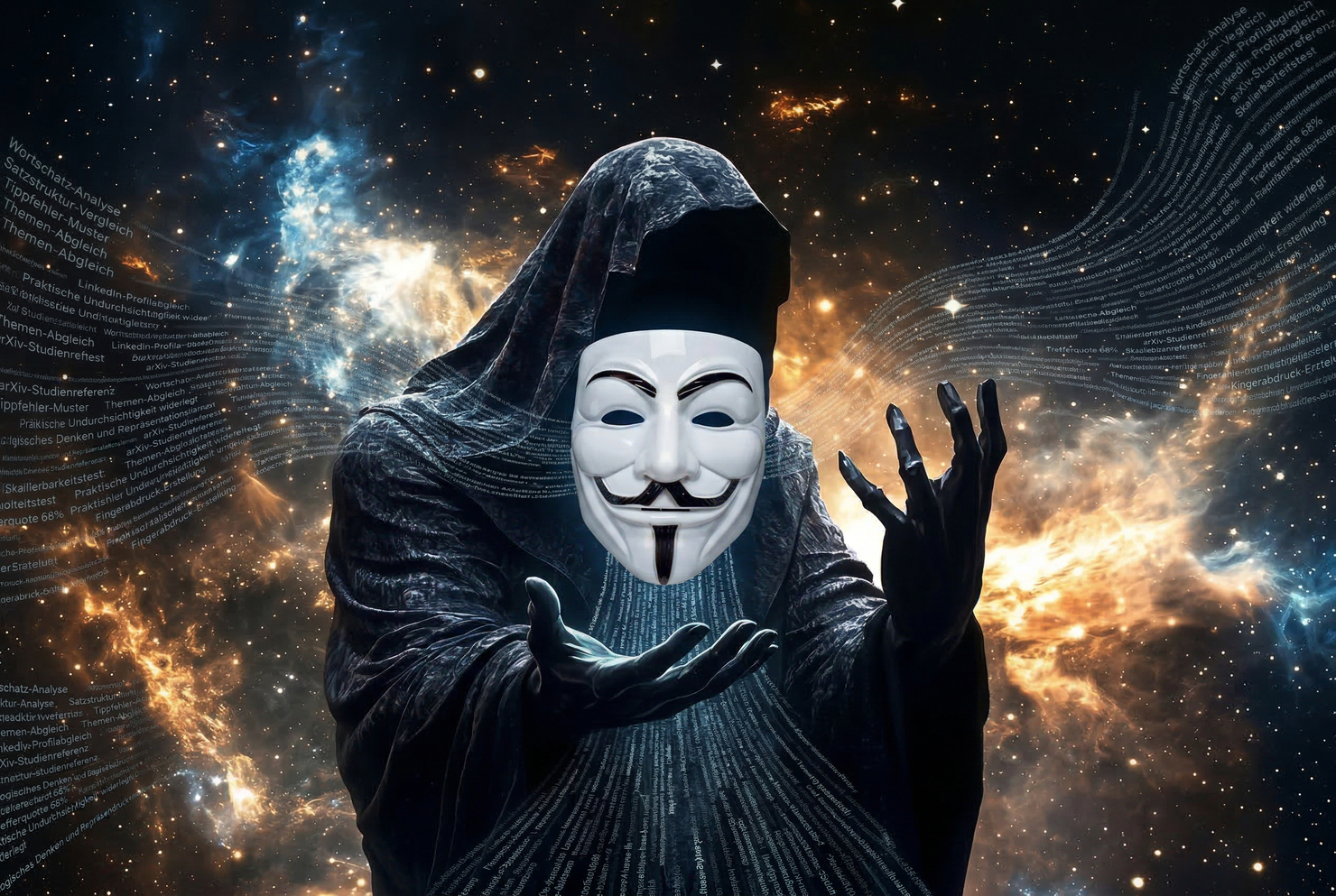
A new study by researchers from ETH Zurich, among others, reveals something that data protection advocates have suspected for years: Artificial intelligence can unmask anonymous internet users. Not with hacking tools, not with intelligence agency servers, but with something far more mundane: your writing style. Yes, you read that right. The way you write. Your word choice. Your typos. Your favorite phrases. The length of your sentences. The topics you keep coming back to. In short: You.
The irony is beautiful. While millions of people believe they are hiding behind VPN servers, nicknames, and fake profiles, they are simultaneously leaving behind perhaps the most unmistakable fingerprint of all: their personality. And that is precisely what AI has now specialized in.
Sherlock Holmes, only without the hat and with a data center
The study with the wonderfully sober title «Large-Scale Online Deanonymization with LLMs"Basically, it describes an automated version of what used to be painstaking investigative work. Previously, you needed someone to read texts, recognize patterns, compare formulations, and draw conclusions. A human analyst. A digital Sherlock Holmes. Today, an AI does it. Not just once, but millions of times simultaneously."
The system analyzes pseudonymous posts, comments, or interviews and extracts so-called identity-relevant signals. It then searches across various platforms for similar patterns. Ultimately, a shortlist of candidates remains. The AI verifies these, filters out false positives, and presents the most likely identity with astonishing confidence. In short: it does exactly what humans have always been able to do. Only faster. Much faster.
Holy shit… Your anonymous internet identity can now be unmasked for $1 😳
Not by the FBI. By anyone with access to Claude or ChatGPT and a few of your Reddit comments.
ETH Zurich and Anthropic just dropped a paper called “Large-Scale Online Deanonymization with LLMs” and the… pic.twitter.com/7XJ5AFsouX
— Alex Prompter (@alex_prompter) February 26, 2026
The digital fingerprint in the head
The real kicker is how little data is needed. According to the study, often just five data points are enough to recognize someone. This could include:
- typical vocabulary
- common sentence structures
- recurring themes
- typical typos
- characteristic formulations
Anyone who thinks this is trivial can try a little self-test: You can often tell which friend is writing in WhatsApp chats, even without their name. Now imagine a machine doing that with millions of texts simultaneously. Suddenly, your writing style becomes a biometric fingerprint. And it's surprisingly stable. Even if there's a year between two accounts, AI has been able to reconnect many of them in experiments. In other words: You can change your name. Your writing style remains.
VPN? Cute.
The role of the VPN is particularly tragicomic. For years, it has been considered a digital shield. Conceal your location, hide your IP address, done. For many users, this feels like an invisibility cloak from a bad spy movie. The problem: This disguise only works against very rudimentary forms of identification. The new reality is different.
When someone analyzes your texts, your IP address suddenly plays a surprisingly minor role. Because what makes you identifiable isn't your server location. It's your brain. Your way of thinking. Your phrasing. Your linguistic habits. You could say: The internet has learned to recognize your voice.
Anonymity has always been an illusion
The study touches on a particularly sensitive issue: the concept of so-called "practical opacity." The idea behind it was simple: individual posts may be public, but they are scattered across various platforms, spanning years. No one has the time to bring them all together. For a long time, this was indeed true. The problem is, AI does have time. Or more precisely, it doesn't need it. The new deanonymization pipeline combines several seemingly harmless steps:
- Text summary
- semantic analysis
- Ranking of possible identities
- Checking the hits
Each of these steps is trivial in itself. Together, they create something that was previously the exclusive domain of investigators: digital identity reconstruction. And the whole thing is scalable.
The moment the internet comes of age
The results are impressive – or, depending on your perspective, slightly unsettling. In some tests, the system achieved a hit rate of up to 68 percent with 90 percent precision. This means that a significant portion of the anonymous accounts were correctly identified. By comparison, previous methods often performed close to zero. The technical hurdle for widespread deanonymization has thus been drastically lowered. Or, to put it another way: the internet is currently shedding its mask mandate.
The new reality: You are your style
Perhaps the most important point of the study is philosophical in nature. Many people still view online identity as a costume. You put on a nickname, use a VPN server, maybe a few new phrases – and believe that you are someone else.
The problem is: personality is difficult to simulate. Even if you consciously try to write differently, your habits will eventually creep back in. Your favorite words. Your thought process. Your way of constructing arguments. All subtle signatures. Barely noticeable to humans. A pattern for AI.
Welcome to the post-anonymous internet
The study's real message is less technical than cultural. The internet was never truly anonymous. It was simply complex enough that most people could enjoy privacy. That phase is now coming to an end.
With more powerful language models, deanonymization doesn't become more difficult, but easier. The authors of the study themselves assume that future models will further improve this capability. In other words, the technology is only just beginning. This doesn't mean that every account can be identified immediately. But the direction is clear. The masks are falling.
And now?
The interesting question isn't whether it's technically possible. That's been answered pretty clearly by now. The real question is: Who will use this capability?
Journalists?
Corporations?
Governments?
Platform operator?
Or will everyone with access to powerful AI eventually have access? Because one thing is certain: when a technology exists, it rarely remains unused. The internet has long been a place where people believed they could have two identities.
The real one.
And the digital one.
The new reality of AI shows something different. You may be anonymous online, but your writing style knows exactly who you are…
More for you:






 "Dravens Tales from the Crypt" has been enchanting for over 15 years with a tasteless mixture of humor, serious journalism - for current events and unbalanced reporting in the press politics - and zombies, garnished with lots of art, entertainment and punk rock. Draven has turned his hobby into a popular brand that cannot be classified.
My blog was never designed to spread news, let alone get political, but with current affairs I just can't help but capture information here that is otherwise censored on all other channels. I am aware that the design page may not seem "serious" to many in this regard, but I will not change this to please the "mainstream". Anyone who is open to non-state-compliant information sees the content and not the packaging. I've tried enough to provide people with information over the last 2 years, but quickly noticed that it never matters how it's "packaged", but what the other person's attitude towards it is. I don't want to put honey on anyone's mouth to meet expectations in any way, so I'll keep this design because hopefully at some point I'll be able to stop making these political statements, because it's not my goal to go on like this forever  I leave it up to everyone how they deal with it. However, you are welcome to simply copy and distribute the content, my blog has always been under the WTFPL license.
It's hard for me to describe what I'm actually doing here, DravensTales has become a culture blog, music blog, shock blog, tech blog, horror blog, fun blog, a blog about found items on the internet, internet bizarre, trash blog, art blog, water heater, zeitgeist blog over the years , Scrap blog and grab bag blog called. Everything that is right ... - and yet not. The main focus of the blog is contemporary art, in the broadest sense of the word.
To ensure the continued operation of this site, you are welcome to make a donation via credit card, PayPal, Google Pay, Apple Pay, or direct debit/bank account . Many thanks to all readers and supporters of this blog!








