
They truly deserve respect. It's no easy task to simultaneously preach democracy and dismantle it, to promise and obstruct accountability, to demand transparency and lock away data – all while maintaining such an utterly unwavering self-image as an upright representative of the people. This achievement deserves recognition. Not applause, but recognition nonetheless.
Professor Dr. Stefan Homburg sits on the Enquete Commission of the German Bundestag. This commission was presented to the public with a solemn air as a place for coming to terms with the past, for healing wounds, for social reconciliation after the pandemic. The official narrative was that the aim was to understand what had happened. Transparency. Accountability. Learning lessons. What Homburg is experiencing there is a masterclass in institutional self-immunization.
First: graphics. In a commission tasked with evaluating data, graphics are not allowed to be shown. Majority decision. Initial justification: copyright. The Robert Koch Institute (RKI), Germany's federal institute for public health, could sue the German Bundestag for copyright infringement. When this legal nonsense failed to convince even the most sympathetic observers, the vote was held – and the CDU/CSU, SPD, Greens, and Left Party voted together: no graphics. In a country where one in eight school classes has a projector, the parliamentary majority decides that no graphics may be shown in the German Bundestag. This is the biggest public health policy event of the post-war era.
Then: data. The Paul Ehrlich Institute had introduced an app at the time – the SafeVac app – with which 700,000 people documented their vaccination status and side effects. A comprehensive survey, the kind researchers usually only dream of. Homburg requests access to this data from the commission. The Bundestag, the highest constitutional body in the republic, is thus asking its own federal agencies to release data that was specifically collected for research purposes. The majority of the commission decides: They do not want to see this data.
Not: We can't get them. Not: The data protection situation is complicated. They don't want to see them. That's a subtle but crucial distinction. It's the difference between a commission that wants to uncover the truth and a commission that's supposed to uncover the truth without actually finding anything out. Eighty percent of the commission members, says Homburg, made their own name for themselves with mandatory vaccinations and lockdowns. They now sit on a body that could theoretically prove they were wrong back then. It's not surprising that they lack interest in the truth. It's astonishing that anyone seriously believed it could be any different.
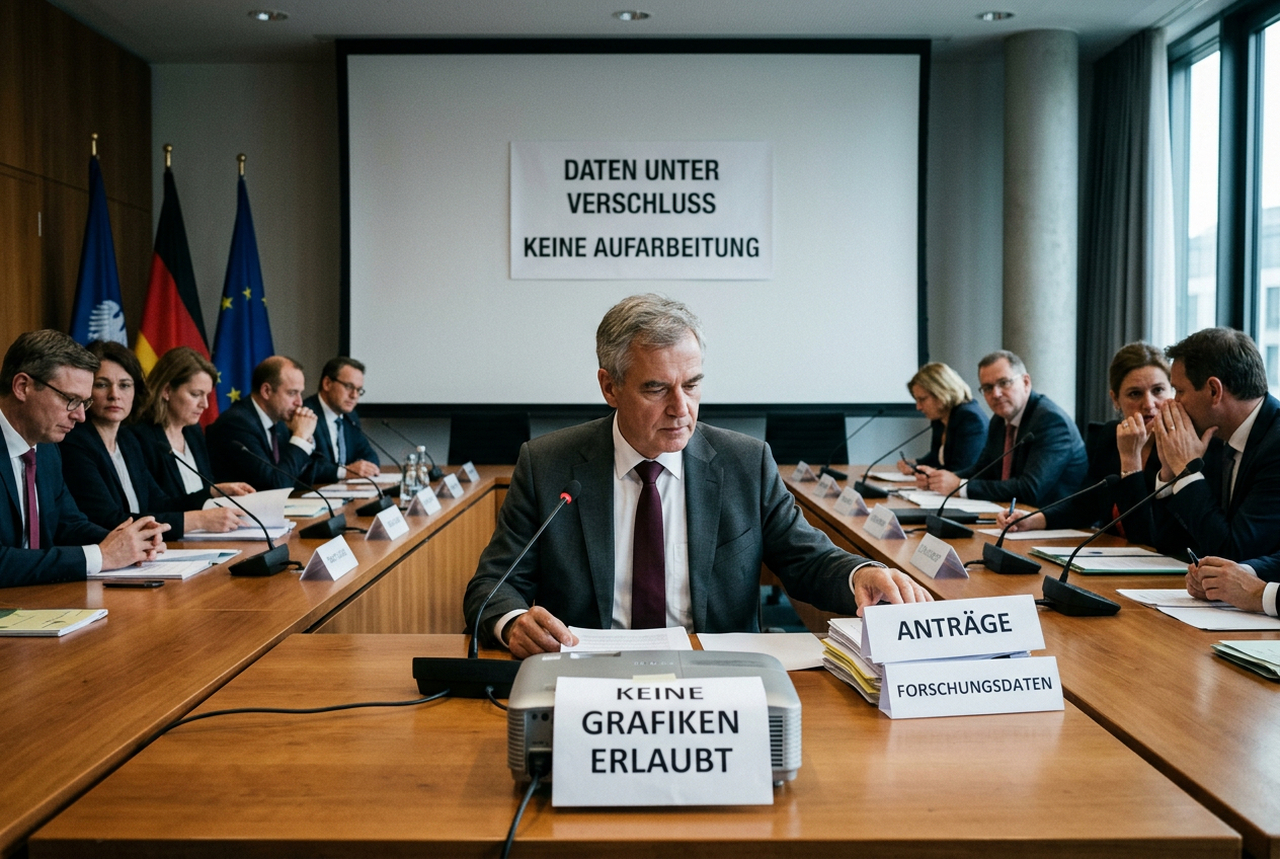
It gets even better. Motions are no longer explained orally. There is no debate. The motion appears, the four established parties vote against it, and that's it. The form of democracy is preserved. Its substance lies somewhere on the floor, caught in the middle.
4000 pages of RKI (Robert Koch Institute) protocols, released by a whistleblower in 2024, paint a picture that casts this parliamentary refusal to cooperate in an even more remarkable light. On March 24, 2020—one day after the start of the first lockdown in the history of the Federal Republic—the RKI noted internally, in essence: The flu season is over anyway. Hospitals reported empty wards, while the Tagesschau (Germany's main evening news program) conjured up triage scenarios daily. The Robert Koch protocols show that internally they knew what they denied externally. And the then Federal Minister of Health spoke publicly of the "pandemic of the unvaccinated"—a phrase that, as the RKI noted internally, was simply inaccurate. But they didn't dare tell him so. He used it in every speech.
Democracy, Homburg explained, and he knows what he's talking about – he advised three federal governments, sat on constitutional commissions, rode in politicians' limousines – so that wasn't democracy. It was the opposite. Totalitarian systems, he says, are characterized by the state's massive intervention in the life of every individual. Eventually, everyone becomes interested in politics – not because they want to, but because they have to.
That's exactly what happened. And the people who caused this are now sitting on a commission investigating the matter, obstructing the investigation. By majority vote. Democratically legitimized. Completely convinced they are the good guys. This pattern isn't new. It's the timeless logic of those who consider their own exercise of power to be for the common good and any question about it an attack. Back then, anyone who showed a graph that questioned the lockdown was branded an enemy of the state. Today, anyone who wants to show graphs in a commission will be outvoted. The method changes. The goal remains the same: no inconvenient data, no inconvenient questions, no accountability.
Before the 2021 federal election, 100 percent of all top politicians said they were against mandatory vaccination. Afterwards, almost all of them were in favor. Scholz declared in the Bundestag that he had been in favor "as always." Cold-blooded. Without a trace of shame. With the calm self-assurance of someone who knows that no one will hold him accountable—least of all an inquiry commission that isn't allowed to show any charts.
This is the real result of this commission. Not a report. Not a single finding. But how does a democracy present itself when those who are supposed to protect it tremble before it? Anyone who claims to be a champion of democracy but hides data like a squirrel hides nuts in autumn probably has a preference for secrecy rather than democratic principles. Anyone who promises to investigate the past but forbids graphic representation doesn't want to investigate. And anyone who still sees themselves as a guardian of the truth either has an extraordinary talent for self-deception—or simply hopes that people will forget.
Experience has shown that they are right about that…
More for you:




 "Dravens Tales from the Crypt" has been enchanting for over 15 years with a tasteless mixture of humor, serious journalism - for current events and unbalanced reporting in the press politics - and zombies, garnished with lots of art, entertainment and punk rock. Draven has turned his hobby into a popular brand that cannot be classified.
My blog was never designed to spread news, let alone get political, but with current affairs I just can't help but capture information here that is otherwise censored on all other channels. I am aware that the design page may not seem "serious" to many in this regard, but I will not change this to please the "mainstream". Anyone who is open to non-state-compliant information sees the content and not the packaging. I've tried enough to provide people with information over the last 2 years, but quickly noticed that it never matters how it's "packaged", but what the other person's attitude towards it is. I don't want to put honey on anyone's mouth to meet expectations in any way, so I'll keep this design because hopefully at some point I'll be able to stop making these political statements, because it's not my goal to go on like this forever  I leave it up to everyone how they deal with it. However, you are welcome to simply copy and distribute the content, my blog has always been under the WTFPL license.
It's hard for me to describe what I'm actually doing here, DravensTales has become a culture blog, music blog, shock blog, tech blog, horror blog, fun blog, a blog about found items on the internet, internet bizarre, trash blog, art blog, water heater, zeitgeist blog over the years , Scrap blog and grab bag blog called. Everything that is right ... - and yet not. The main focus of the blog is contemporary art, in the broadest sense of the word.
To ensure the continued operation of this site, you are welcome to make a donation via credit card, PayPal, Google Pay, Apple Pay, or direct debit/bank account . Many thanks to all readers and supporters of this blog!








