
The supermarket has long been a place of comforting illusions. Bright lighting, friendly packaging, happy cows on boxes, crisp tomatoes on glossy labels. Everything looks natural. Fresh. Healthy. And then a little app comes along, symbolically lifts the pretty packaging – and suddenly there's the ingredient list, more reminiscent of a chemistry lab than a food product. The app is called Yuka. And it has a remarkable ability: it shatters illusions.
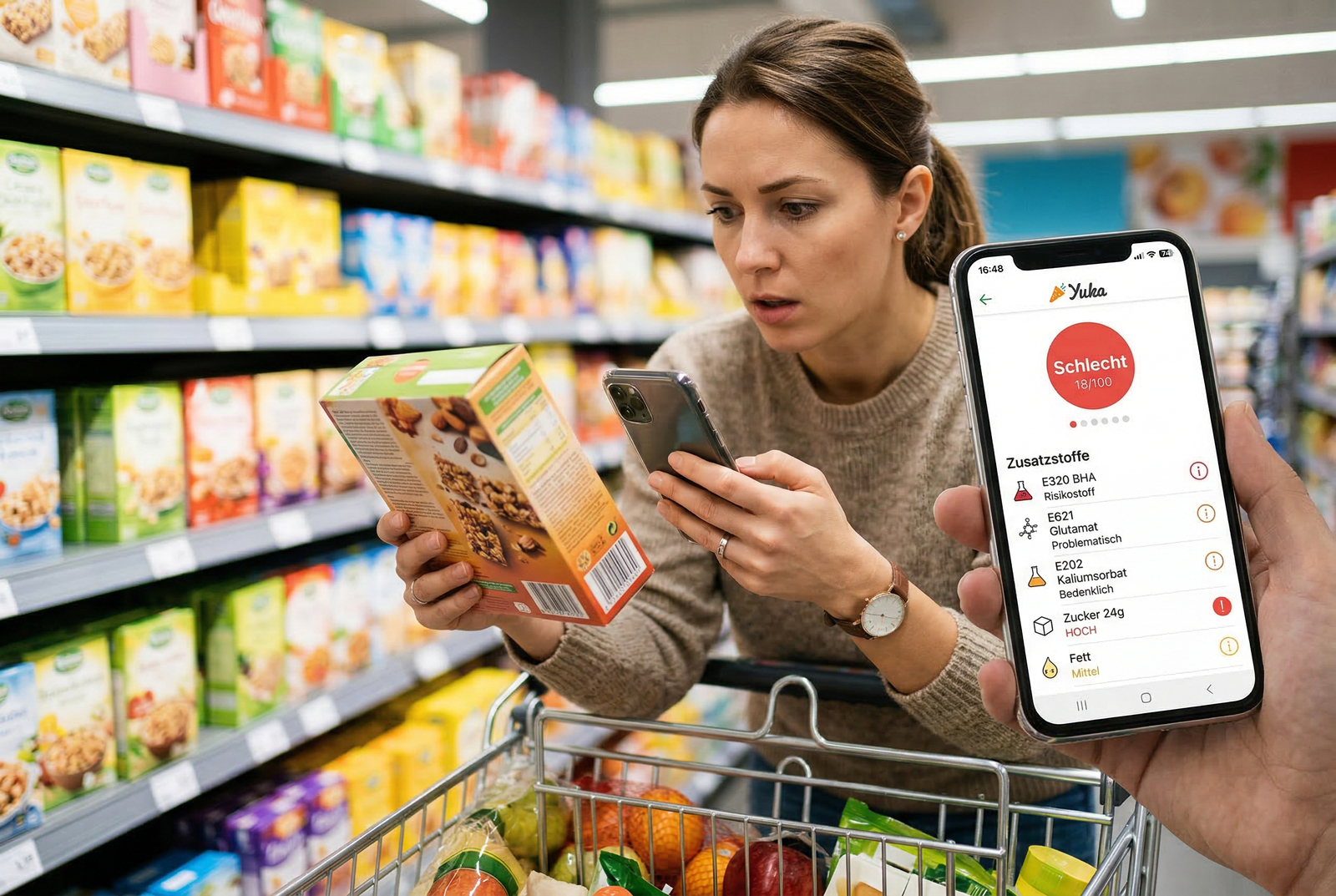
The principle is simple. Scan the barcode, wait two seconds – and your smartphone tells you exactly what you've put in your shopping cart. Not the marketing. Not the advertising message. But the objective analysis of the ingredients. And that's where the fun begins.


The moment when your favorite snack becomes a lab product
So you're standing in the supermarket, scanning a product you've been buying for years out of sheer curiosity – perhaps expecting a solid "okay". Instead, a result somewhere between "bad" and "catastrophic" appears on the screen. Suddenly, terms like these start popping up:
- additives
- emulsifiers
- Color stabilizers
- flavor enhancer
- preservatives
And somewhere in the margin, there's the friendly remark that some of these substances are controversial. "Controversial," by the way, is a wonderful word. In practice, it often means: "Some scientists find it problematic, others say the data is unclear – and the food industry says: It's all completely harmless." The consumer then gets to decide whom to believe.
Welcome to the age of highly processed food
The real problem only becomes apparent after the tenth scan. Because at some point, you realize something unpleasant: a significant portion of what we've been eating for decades is no longer food in the traditional sense. It's highly processed industrial products. Products whose ingredient lists are longer than many a short story. Sometimes a single product consists of:
- Sugar
- modified starch extract
- flavors
- emulsifiers
- thickeners
- dyes
and a minimal amount of the ingredient pictured on the packaging. The strawberry on the packaging is therefore more of an aesthetic suggestion than an actual indication of the ingredients.
The small nutrition compass in the supermarket
And this is precisely where Yuka becomes interesting. Because the app doesn't just say, "This is problematic." It also says, "Here's a better alternative." It almost works like a navigation system for shopping.
Scan → Evaluation → Alternative.
Suddenly you realize that there are often products that:
- significantly better ingredients
- have fewer additives
- or are simply closer to real food.
Sometimes just moving to the next shelf is enough. Sometimes you only need to switch brands. And sometimes you realize that for years you've been buying products that were more like food simulations.
Surprise: Even cosmetics are a chemical adventure.
The second exciting part begins in the bathroom. Because Yuka doesn't just work on food, but also on cosmetics. Creams. Shampoos. Deodorants. Products we smear on our skin every day are suddenly analyzed just like a granola bar. And once again, terms like these appear:
- hormonally active substances
- potential allergens
- problematic preservatives
- Environmentally critical ingredients
It quickly becomes apparent that the cosmetics industry has also developed an impressive array of chemical innovations. Not all of it is dangerous. But much of it is… let's say diplomatically… debatable.
The market of conscious consumers
An interesting side effect of these apps is a quiet shift in power. Previously, this information resided almost exclusively with the manufacturers. The average consumer only saw:
- Packing
- Advertising
- Ingredients list in font size 6
Today, a simple scan with a smartphone is all it takes – and suddenly you have an analysis in seconds. That changes things. Because markets react to demand. When enough people start scanning, comparing, and switching, pressure is put on manufacturers. Not through regulation, but through conscious purchasing decisions.
Other projects are following suit.
Yuka is not alone, by the way. There are now several initiatives pursuing the exact same goal: transparency. For example:
- CodeCheck – also a scanning app for food and cosmetics.
- Or Open Food Facts – a huge open database maintained by a worldwide community.



Millions of products are documented there. Not by corporations, but by users. It's essentially crowdsourcing for the truth about what's in your shopping cart.
The uncomfortable realization
After a few days using such apps, one realization sticks: the modern food world is astonishingly far removed from what our grandparents would have considered food. Many products are technically brilliant. Durable. Stable. Perfectly designed for transport and storage. But sometimes they are also extremely processed. And that's precisely what a simple barcode scan mercilessly reveals.
The good news
The good news is: you don't have to become a nutrition guru to benefit. Often, small changes are enough. A different product. A different brand. A few less additives. Nobody will shop perfectly. But conscious shopping is easier than ever these days.
The irony of modern nutrition
The greatest irony is that we now need technology to find out what's actually in our food. In the past, you recognized food by its appearance. Today, you recognize it by an app saying, "This is still somewhat real food." Progress certainly has many faces. Sometimes, it even looks like a barcode scanner.
More for you:




 "Dravens Tales from the Crypt" has been enchanting for over 15 years with a tasteless mixture of humor, serious journalism - for current events and unbalanced reporting in the press politics - and zombies, garnished with lots of art, entertainment and punk rock. Draven has turned his hobby into a popular brand that cannot be classified.
My blog was never designed to spread news, let alone get political, but with current affairs I just can't help but capture information here that is otherwise censored on all other channels. I am aware that the design page may not seem "serious" to many in this regard, but I will not change this to please the "mainstream". Anyone who is open to non-state-compliant information sees the content and not the packaging. I've tried enough to provide people with information over the last 2 years, but quickly noticed that it never matters how it's "packaged", but what the other person's attitude towards it is. I don't want to put honey on anyone's mouth to meet expectations in any way, so I'll keep this design because hopefully at some point I'll be able to stop making these political statements, because it's not my goal to go on like this forever  I leave it up to everyone how they deal with it. However, you are welcome to simply copy and distribute the content, my blog has always been under the WTFPL license.
It's hard for me to describe what I'm actually doing here, DravensTales has become a culture blog, music blog, shock blog, tech blog, horror blog, fun blog, a blog about found items on the internet, internet bizarre, trash blog, art blog, water heater, zeitgeist blog over the years , Scrap blog and grab bag blog called. Everything that is right ... - and yet not. The main focus of the blog is contemporary art, in the broadest sense of the word.
To ensure the continued operation of this site, you are welcome to make a donation via credit card, PayPal, Google Pay, Apple Pay, or direct debit/bank account . Many thanks to all readers and supporters of this blog!








