
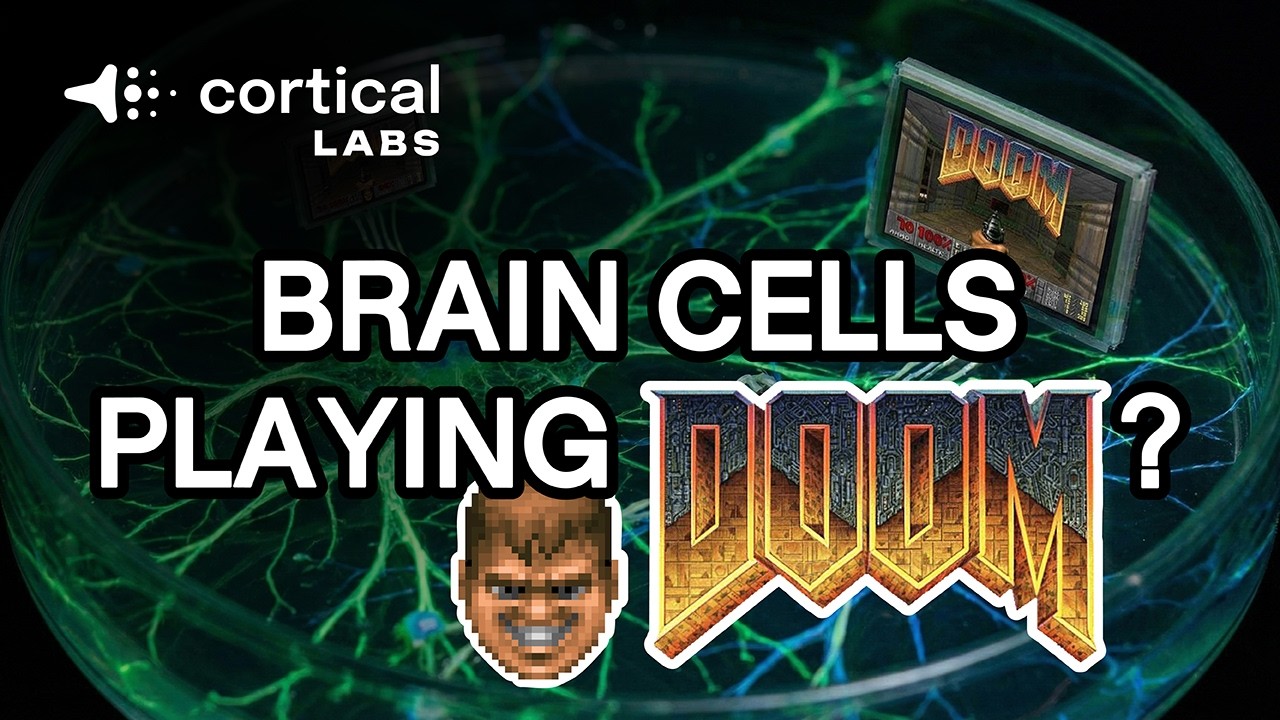
It started innocently enough. Really. A few scientists wanted to find out if lab-grown human brain cells could learn a simple video game. So they gave them Pong. Two bars, a pixelated ball, digital Stone Age. The cells learned. The scientific community rejoiced. And somewhere in the background, they probably heard the door to the next catastrophe opening. Because if Pong works, the modern researcher doesn't think, "Interesting, maybe let's leave it at that." No. The next logical step is, of course, DOOM.
Yes, that DOOM. The '90s classic. A first-person shooter full of demons, fountains of blood, and non-stop digital carnage. And now, this very game is being controlled by human brain cells in a petri dish, connected to silicon chips. Welcome to 2026. Reality now feels like a Black Mirror episode written by caffeine and bad decisions.
The birth of the biological computer
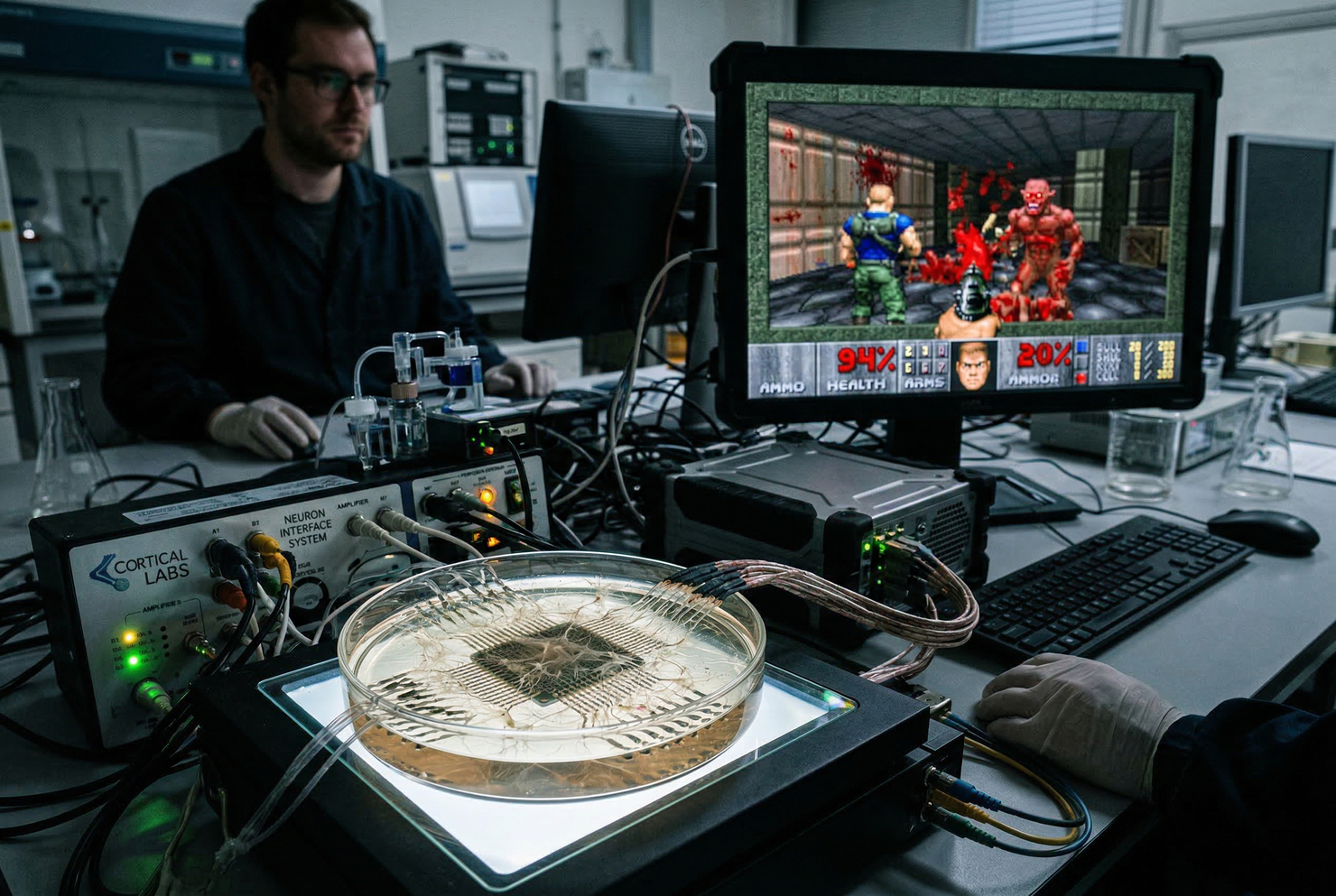
The Australian biotech company Cortical Labs has built something they rather prosaically call a "biological computer." The list of ingredients sounds like something out of a Frankenstein manual: 800,000 to 1,000,000 human neurons, grown in the lab, connected to silicon chips, stimulated by electrical signals, and controlled by software.
These clusters of cells form what are known as "mini-brains." And these mini-brains are now playing video games. Not metaphorically. Not symbolically. Really. The digital world of DOOM is translated into electrical patterns. These signals stimulate the neurons. The activity of the cells is then converted into game actions. If neural pattern A fires, the character shoots. If pattern B fires, they move. Essentially, it's a neural gamepad made of living cells. When you say that out loud, it sounds exactly as absurd as it is.
From Pong to DOOM – the small step towards a dystopian future
Back in 2022, Cortical Labs made headlines when their cell cultures learned to play Pong. At the time, this was hailed as a scientific breakthrough. Adaptive learning, biological information processing, real-time adjustment—all very impressive. But Pong is Pong. Now, however, we're talking about a game that's more complex:
- three-dimensional environment
- opponent
- Navigation
- Decisions under pressure
In short: a primitive form of action competence. The neurons still function like beginners. But the learning process is measurable. And this is precisely where a normally thinking person pauses and asks themselves: Is this really a good idea?
The transhumanist dream
Officially, this technology is of course sold as progress. Biological computing. More efficient information processing. New medical applications. It all sounds wonderful.
But at the same time, a term is appearing with increasing frequency: transhumanism. The idea that technology and the human body are increasingly merging. A few years ago, this sounded like science fiction or the visions of a somewhat overzealous Davos panel. Today, human neurons are merging with silicon chips to control video games. And suddenly, this future doesn't seem quite so hypothetical anymore.
When neurons go online
Cortical Labs' so-called CL1 biocomputer can even be used remotely. Developers can interact with the living cells via an online platform. Just let that sink in. People are accessing living brain cells connected to machines via the internet. What is a research project today could be a scalable system tomorrow.
Biological processors. Neural cloud systems. Organic data centers. If Silicon Valley has a dream, it's precisely this one. The obvious question: What else? Of course, proponents argue that such technologies offer enormous opportunities:
- medical research
- neurological therapy
- new forms of AI
All plausible. But technology rarely develops in just one direction. And if we're honest, humanity knows a pretty reliable pattern: anything that can be built will eventually be used for military purposes. Just imagine:
- Biological neural systems control drones
- Autonomous weapon systems learn adaptively
- Surveillance technologies utilize neural pattern recognition
Suddenly, a mini-brain playing DOOM seems less like a toy and more like a prototype.
Ethics in the rearview mirror
The real problem isn't even the technology itself. The problem is the speed at which it emerges. Innovation races ahead. Ethics jogs behind. And regulation is still in the starting blocks, debating forms.
Meanwhile, in the laboratory, neuronal cell cultures are growing that learn, react, and interact with machines. Nobody knows exactly where the limit lies.
The uncomfortable questions
Therefore, a few questions inevitably arise that are surprisingly rarely asked:
- Who is funding this research?
- What rules exist for biological computers?
- What happens when such systems are used for military purposes?
And perhaps the most fundamental question:
- When does a neural network cease to be just a tool?
Welcome to the experiment
The researchers like to emphasize that their neurons are still far from being able to master complex tasks. They are beginners. They are only just learning. That's probably true.
But every technology begins exactly like this. With a game. With an experiment. With an "interesting prototype." And at some point, you look back and realize: The moment when you could have paused was long gone.
Today, human brain cells are playing DOOM. Tomorrow, they might be controlling machines. And the day after tomorrow, someone will say: "That was predictable from the start."
What's particularly ironic about that is that we're already saying exactly that.
When one country begins genetically modifying its population, others will not stand idly by. It will trigger a global arms race—not with missiles or drones, but with DNA—to determine who can create the most intelligent and advanced generation of humans on the planet.
– Steve Watson
More for you:






 "Dravens Tales from the Crypt" has been enchanting for over 15 years with a tasteless mixture of humor, serious journalism - for current events and unbalanced reporting in the press politics - and zombies, garnished with lots of art, entertainment and punk rock. Draven has turned his hobby into a popular brand that cannot be classified.
My blog was never designed to spread news, let alone get political, but with current affairs I just can't help but capture information here that is otherwise censored on all other channels. I am aware that the design page may not seem "serious" to many in this regard, but I will not change this to please the "mainstream". Anyone who is open to non-state-compliant information sees the content and not the packaging. I've tried enough to provide people with information over the last 2 years, but quickly noticed that it never matters how it's "packaged", but what the other person's attitude towards it is. I don't want to put honey on anyone's mouth to meet expectations in any way, so I'll keep this design because hopefully at some point I'll be able to stop making these political statements, because it's not my goal to go on like this forever  I leave it up to everyone how they deal with it. However, you are welcome to simply copy and distribute the content, my blog has always been under the WTFPL license.
It's hard for me to describe what I'm actually doing here, DravensTales has become a culture blog, music blog, shock blog, tech blog, horror blog, fun blog, a blog about found items on the internet, internet bizarre, trash blog, art blog, water heater, zeitgeist blog over the years , Scrap blog and grab bag blog called. Everything that is right ... - and yet not. The main focus of the blog is contemporary art, in the broadest sense of the word.
To ensure the continued operation of this site, you are welcome to make a donation via credit card, PayPal, Google Pay, Apple Pay, or direct debit/bank account . Many thanks to all readers and supporters of this blog!








