
There's a lie that's committed millions of times every day without anyone being prosecuted, without authorities intervening, without the evening news even reporting on it. It takes place in the brightly lit produce section of every supermarket, among gleaming apples, flawless tomatoes, and avocados that look so perfect they could have been designed by a professional. That lie is called freshness. And it has a chemical name: 1-methylcyclopropene.
Apples, pears, tomatoes—many of the vegetables you buy in the supermarket have these astonishing qualities: they are almost identical in weight and size, radiate freshness, with glossy apples, perfectly ripe bananas, and tomatoes that show absolutely no damage on their skin, unlike those you grow yourself. A land of plenty, one might say. Or, to put it more precisely: industrial deception with official approval.
1-Methylcyclopropene is a hydrocarbon derived from petroleum, through a process that also produces chloro-2-methylpropene, heptans, and methylcyclohexanes—the latter being known carcinogens. Read that again slowly. The process that produces the fume sprayed on your apple generates carcinogenic substances as byproducts. That's the starting point. The rest doesn't get any better.
1-Methylcyclopropene is fumigated onto the fruit after harvesting, ensuring that the fruit, which looks as fresh as if it had just been picked from the tree, has waited up to twelve months, sometimes even longer, before its appearance in the supermarket – often treated as a speculative commodity, sold from storage when prices rise. Twelve months. A year. The apple in your hand could be older than the federal government that approved it, and it looks as if it were freshly picked.
1-Methylcyclopropene essentially stops ethylene production for months, thus halting the ripening process. This results in treated fruits or vegetables remaining firm, preventing them from shriveling and drying out. The conversion of starch to sugar and the breakdown of acidity are delayed. The aging process is biologically frozen. The fruit exists in a state of enforced youth, a chemical Dorian Gray – flawless on the outside, but inside long since what it would be if nature were allowed to take its course.
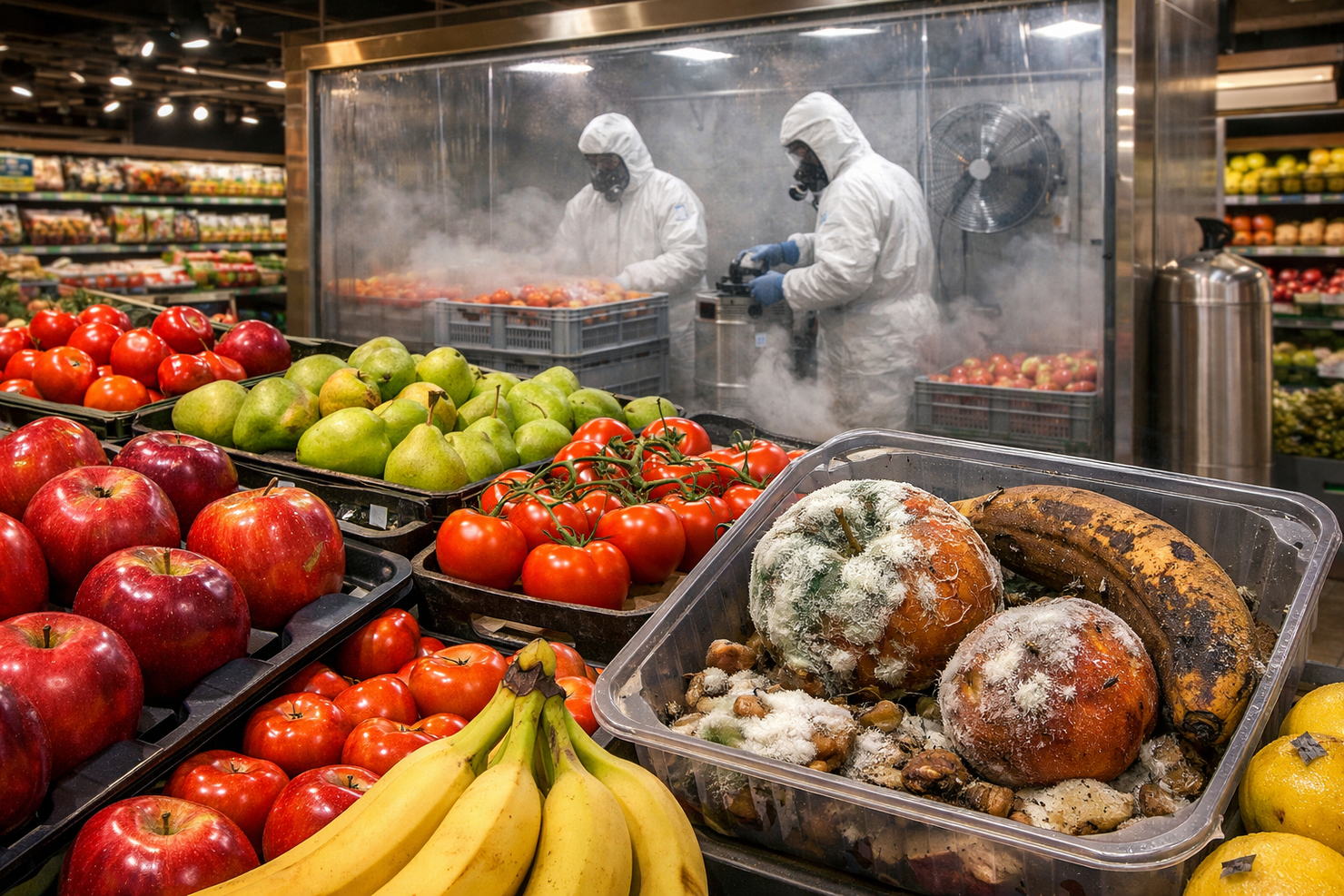
And then it arrives home. And then what everyone knows and no one could explain happens: The apple, which in the store seemed to be bursting with life, begins to mold within hours. The banana, perfectly yellow just moments ago, is brown the next day. No sooner is the banana home than it succumbs to the ravages of time with astonishing speed, while the apples often show no signs of natural aging even after weeks, only to develop a form of rot or mold within hours that leaves even specialized fruit flies baffled. This isn't nature. This is the breakdown of chemical suppression, which loses its effectiveness as soon as the fruit is removed from the controlled storage environment.
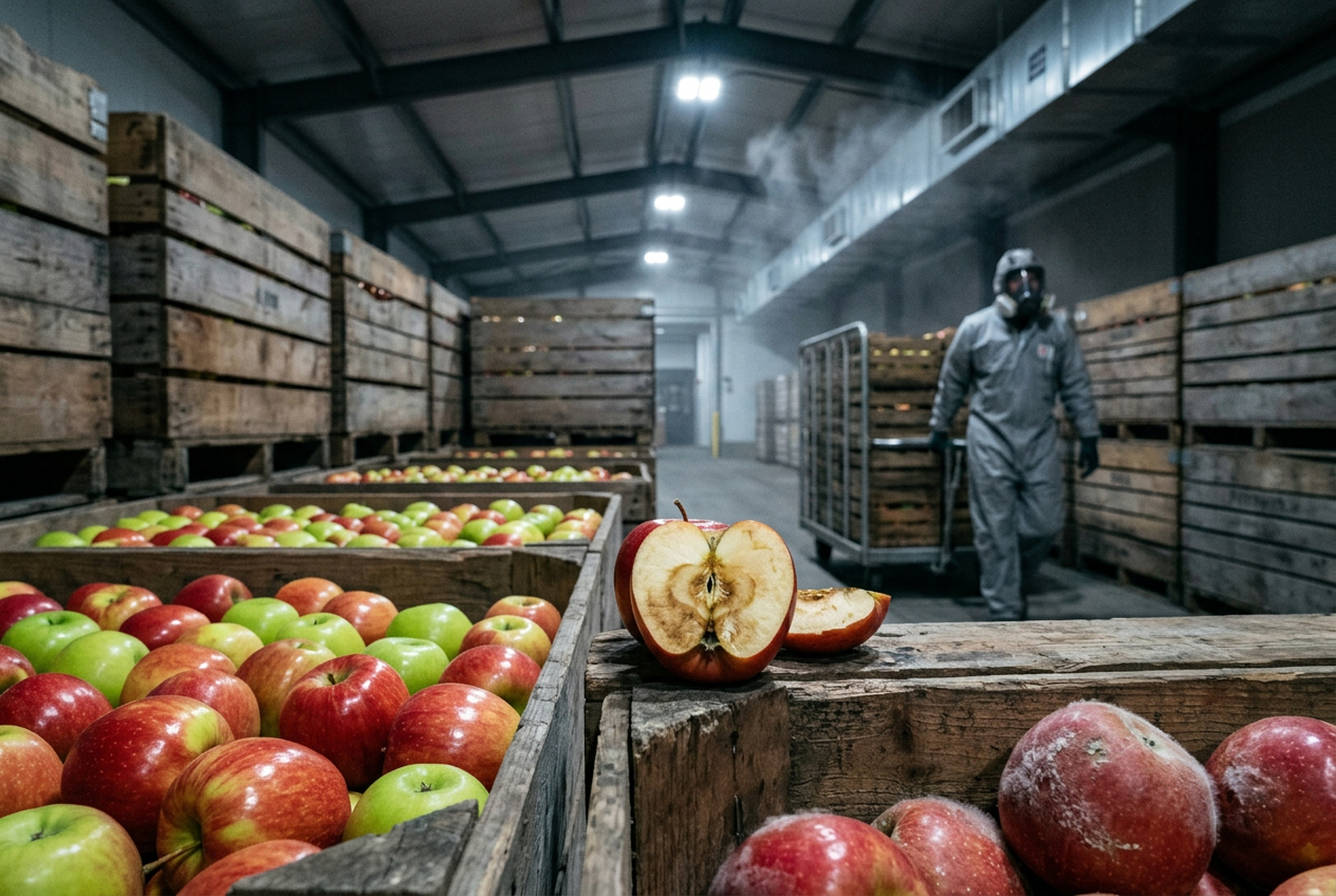
The characteristic smell and taste of apples, pears, apricots, peaches, tomatoes, and avocados are removed from our sense of taste and smell. If you've ever wondered why apples, regardless of variety, have the same, more or less bland, barely apple-like taste and none of them smell – here's the explanation: 1-methylcyclopropene. The collective taste memory of a generation has been altered. Anyone under forty who grew up in the city may never have eaten a truly ripe apple in their life. They don't know what one smells like. They consider the supermarket product the norm – because it's the only norm they know.
And what about the authorities? In the EU, 1-methylcyclopropene has been approved since the mid-2000s – with the gaps in safety testing that we've come to expect. As far as toxicology is concerned, not much has been analyzed. 1-methylcyclopropene is considered safe. So why test it? Why test it? A question that authorities are clearly asking themselves seriously and answering with "why, exactly?"
As recently as 2018, some thirteen years after its approval, a status report by the European Food Safety Authority stated: "The metabolism of 1-methylcyclopropene in plants was not investigated." Thirteen years after its approval. The metabolism of the substance in the treated plants—that is, what happens to the chemical inside the apple, what intermediate products are formed, and what effect these have on the person who eats it—was not investigated. Not because there were no questions. But because radioactive traces found in a single experiment were so small that the search for metabolites was discontinued.
One experiment. One. And then: No data equals no danger. That's not science. That's the institutionalized absence of curiosity, when curiosity would be bad for business.
No concerns were raised about the effects of 1-methylcyclopropene on the environment, the food chain, the soil, surface waters, and the drinking water into which it is released—concerns that would have been significant enough to deny its approval. No data, no danger. This principle is applied so reliably in the pharmaceutical, food, and chemical industries that it could now be considered the official regulatory model.
The result is a supermarket system where freshness is a marketing category, not a biological condition. Where an apple can be a year old and look as if it were freshly picked. Where the consumer pays for an experience that doesn't exist—for flavor that has been removed, for ripeness that has been locked in, for freshness that is simulated. And where, thirteen years after its approval, the authority that was supposed to be monitoring this still doesn't know what the substance inside the treated fruit is actually doing.
Brand names like SmartFresh, AgroFresh, Harvista, Ripe Lock, Ethylbloc, or Fysium sound like innovation, progress, a solution to a problem. The problem they solve is the market's impatience with biology. The apple in the supermarket is beautiful. It's flawless. It smells of nothing. It tastes of nothing. And it's highly likely to be a year old. Enjoy…
More for you:






 "Dravens Tales from the Crypt" has been enchanting for over 15 years with a tasteless mixture of humor, serious journalism - for current events and unbalanced reporting in the press politics - and zombies, garnished with lots of art, entertainment and punk rock. Draven has turned his hobby into a popular brand that cannot be classified.
My blog was never designed to spread news, let alone get political, but with current affairs I just can't help but capture information here that is otherwise censored on all other channels. I am aware that the design page may not seem "serious" to many in this regard, but I will not change this to please the "mainstream". Anyone who is open to non-state-compliant information sees the content and not the packaging. I've tried enough to provide people with information over the last 2 years, but quickly noticed that it never matters how it's "packaged", but what the other person's attitude towards it is. I don't want to put honey on anyone's mouth to meet expectations in any way, so I'll keep this design because hopefully at some point I'll be able to stop making these political statements, because it's not my goal to go on like this forever  I leave it up to everyone how they deal with it. However, you are welcome to simply copy and distribute the content, my blog has always been under the WTFPL license.
It's hard for me to describe what I'm actually doing here, DravensTales has become a culture blog, music blog, shock blog, tech blog, horror blog, fun blog, a blog about found items on the internet, internet bizarre, trash blog, art blog, water heater, zeitgeist blog over the years , Scrap blog and grab bag blog called. Everything that is right ... - and yet not. The main focus of the blog is contemporary art, in the broadest sense of the word.
To ensure the continued operation of this site, you are welcome to make a donation via credit card, PayPal, Google Pay, Apple Pay, or direct debit/bank account . Many thanks to all readers and supporters of this blog!








