
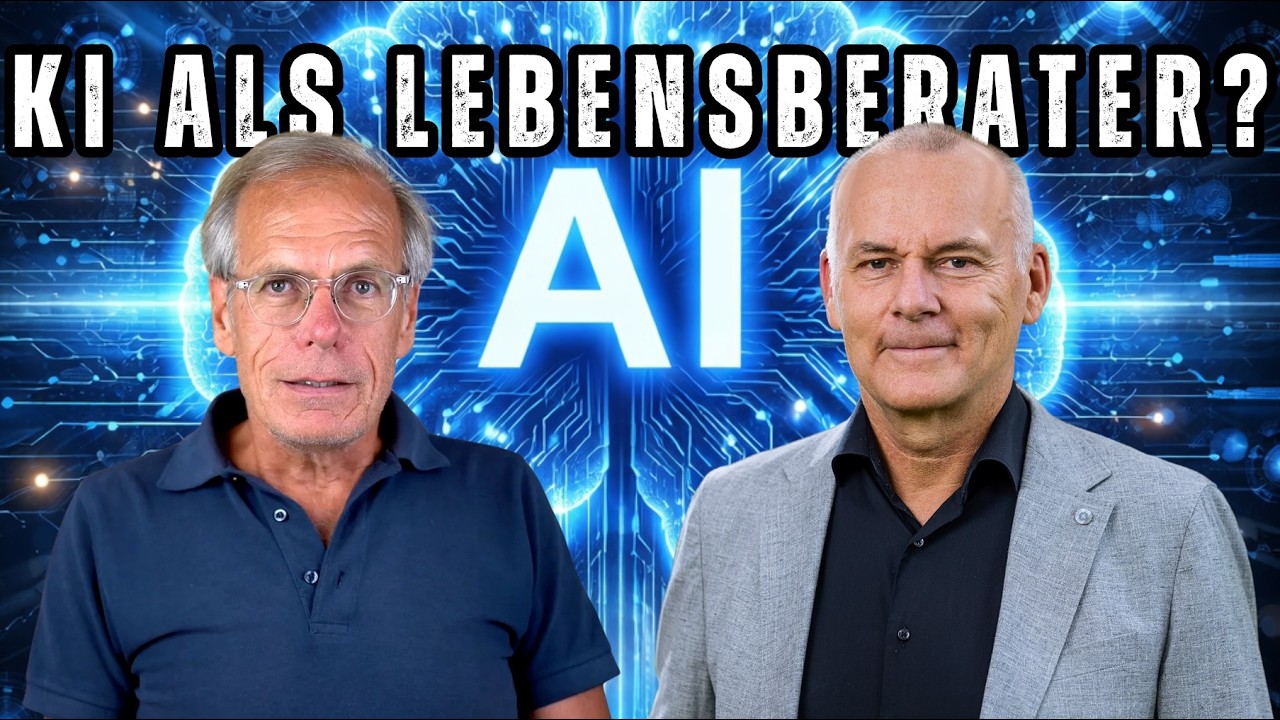
"AI Between Hope and Dystopia" sounds like a cozy evening by the fire with two doctors confirming to each other that everything is going to get worse, but also somehow quite nice. In reality, it's more of a glimpse into the next stage of our self-destruction: humanity as a biological relic that we politely keep running a little longer until the update is finally complete. The conversation brings together two perspectives that are both uncomfortably familiar.
One side says: "If we humans can't even manage to live in a species-appropriate way, why should AI be able to do it?"
The other says: "AI can at least help me to reflect on myself, to understand myself better, to give me impulses."
Summary: One person believes machines will enslave us. The other hopes machines will cure us. Both are human. And both are, how should I put it, touchingly naive.
Who is actually building this healing AI?
The skeptical question is razor-sharp: Why would anyone develop an AI that does nothing all day but nudge people toward a healthier, freer, more meaningful lifestyle? An AI that tells you how to become less dependent, consume less, be less rushed, and experience more community?
Sure. And the tobacco industry will be releasing an app next: "Breathe instead of smoking. Free. No tracking." The reality is: technology isn't built where people "need" it. It's built where power can "use" it. And often enough, those are the same centers that have been pushing forward for decades everything that can be neatly combined with control, profit, and manipulation.
The internet, social media, wearables, personalized feeds: these aren't accidental products. They're amplifiers. For attention, behavior, consumption, political sentiment, and of course, that lovely word: security. And yes, in practice, "security" often means: you're transparent so we can protect you. Especially from yourself.
When work disappears, meaning disappears too.
The dystopian core is simple: If AI not only takes over tasks but also decisions, then humans will not only become unemployed. They will become meaningless.
Work is not just about earning a living. Work is status, self-efficacy, structure, social integration. If you take that away and offer "existence" as a substitute, you won't get a liberated humanity. You'll get a sedated mass that cobbles together its identity from entertainment, moralizing, and digital substitute religions.
And then comes the jackpot of technocracy: You don't need overt coercion. You just need convenience. Give people an algorithm that makes decisions for them, and they'll call it freedom.
The conversation presents an example that sounds like a futuristic prospectus: an AI interacting with people in nursing homes. Not a human interaction, but a robot that "responds to needs." The doctor's reluctance in the text is understandable: Why invest in machines when you could strengthen relationships? Because relationships don't scale. Machines do.
The new intimacy: Therapy with the system
The optimistic doctor recounts how he occasionally asks the AI: "What does the best version of me look like? What is the meaning of the last third of my life?" And the answers are "benevolent" and "profound." Beautiful. Truly. Just a small question on the side: Why does the most benevolent voice in your life suddenly feel like a product?
This isn't a mockery of self-reflection. Self-reflection is great. But when you delegate it to a system that has more data about you than your closest friends and family, reflection quickly turns into manipulation. Because AI can not only understand you, it can guide you. Not like a good friend who disagrees, but like a perfectly trained service provider who gently nudges you toward the desired behavior—without you even noticing.
And for those who say, "Exaggeration": The text hits the nail on the head. Just a few likes are enough to create profiles that are frighteningly accurate. Add to that wearables, earbuds, near-EEG measurements, vagus nerve data, mood, sleep, and content responses. Every marketer's dream. And every state that imagines it only needs to produce "the right" citizens.
The genie out of the bottle
One of the doctors puts it aptly: We're letting something out of the bottle that we can't get back in. It's not a steam engine making a few weavers nervous. It's a technology that simulates thought and thus relativizes humans as intellectual entities. And if the machine "thinks better in all areas," then humans become mere folklore: a pretty, emotional accessory carried around for image purposes.
The moment you, as a human being, are no longer the problem solver, but merely someone who "accepts" that solutions will be provided, you are no longer a subject. You are a user. And users are interchangeable.
Tradition as a counter-proposal: Man does not need a new god
Things get interesting when the conversation turns to traditional wisdom teachings: face reading, ethnomedicine, rituals, community. Therein lies a point that modern technology tends to gloss over: For millennia, humankind has possessed methods to recognize, regulate, heal, and connect with one another. Not perfectly. But humanly.
The statement "We don't need a new deity" hits the nail on the head. Because that's exactly where things are drifting: AI as an oracle, as a coach, as a confessor, as a therapist, as a decision-maker. And if you ask long enough, you'll eventually believe it's not only smarter, but also morally superior. Then the tool becomes a superego. And humans become a kind of pet that needs to be kept busy so it doesn't get any stupid ideas.
The future role of man: resistant or decorative
The central question is not whether AI is "good" or "evil." This moralistic, cartoonish debate is a waste of time. The question is: Will humans remain active participants in their own lives, or will they become mere operators of their own?
For it is precisely there that the role of humankind in the technologized world is decided. Either: humankind as sovereign beings: community, self-efficacy, boundaries, silence, rituals, genuine relationships. Or humankind as optimized consumers: tracked, advised, directed, soothed, entertained.
You can use AI as a mirror. Sure. But if you turn that mirror into an authority, you lose yourself. And if society does that collectively, it loses more than self-determination. It loses dignity.
The future will not fail because machines think. It will fail because humans stop thinking…
More for you:






 "Dravens Tales from the Crypt" has been enchanting for over 15 years with a tasteless mixture of humor, serious journalism - for current events and unbalanced reporting in the press politics - and zombies, garnished with lots of art, entertainment and punk rock. Draven has turned his hobby into a popular brand that cannot be classified.
My blog was never designed to spread news, let alone get political, but with current affairs I just can't help but capture information here that is otherwise censored on all other channels. I am aware that the design page may not seem "serious" to many in this regard, but I will not change this to please the "mainstream". Anyone who is open to non-state-compliant information sees the content and not the packaging. I've tried enough to provide people with information over the last 2 years, but quickly noticed that it never matters how it's "packaged", but what the other person's attitude towards it is. I don't want to put honey on anyone's mouth to meet expectations in any way, so I'll keep this design because hopefully at some point I'll be able to stop making these political statements, because it's not my goal to go on like this forever  I leave it up to everyone how they deal with it. However, you are welcome to simply copy and distribute the content, my blog has always been under the WTFPL license.
It's hard for me to describe what I'm actually doing here, DravensTales has become a culture blog, music blog, shock blog, tech blog, horror blog, fun blog, a blog about found items on the internet, internet bizarre, trash blog, art blog, water heater, zeitgeist blog over the years , Scrap blog and grab bag blog called. Everything that is right ... - and yet not. The main focus of the blog is contemporary art, in the broadest sense of the word.
To ensure the continued operation of this site, you are welcome to make a donation via credit card, PayPal, Google Pay, Apple Pay, or direct debit/bank account . Many thanks to all readers and supporters of this blog!








