
There's a type of official who reads the Basic Law roughly the way a burglar reads the floor plan of your apartment: not as a boundary, but as a set of instructions. Fundamental and human rights were invented so that citizens could keep the state at bay—today, the state shoves them in the citizen's face when it rings their doorbell, confiscates their tablet, and tries to scan their chats. The protective shield has become an official ID. And the best part? You're even supposed to thank them.
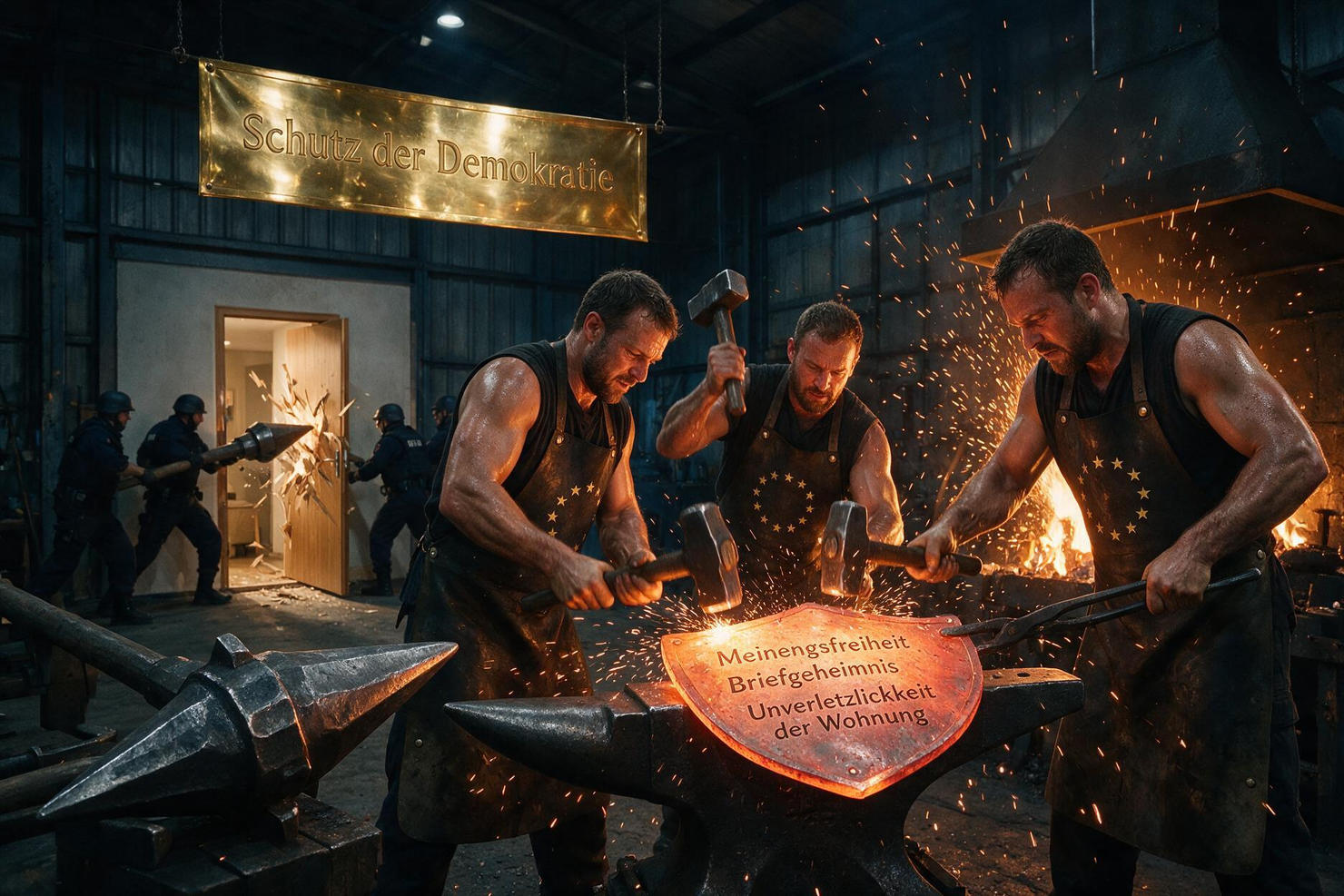
Legal doctrine is refreshingly unambiguous on this point. Since Georg Jellinek's doctrine of status, the following has been established: Freedoms are status negativus – defensive rights of the individual against state intervention. The state must respect a sphere of freedom, period. It is not the citizen who must justify why they are allowed to speak, think, or encrypt – the state must justify why it wants to intervene. Freedom of expression, the right to one's home, the confidentiality of correspondence, privacy: all fences meant to keep the Leviathan out. Fundamental and human rights are defensive rights, not rights of dominance – no office, no minister, and no commission derives from them a license to invade other people's living rooms, mailboxes, or minds.
How to turn a shield into a battering ram
This very reinterpretation has been in full swing for years. The trick is legally elegant: one takes the so-called duty to protect – the undeniably honorable idea that the state should also protect its citizens from attacks by third parties – and blows it up into a "Fundamental right to security" The Bundestag's Research Services dryly noted the objections: such a construct would de-individualize fundamental rights and turn civil liberties into their opposite – security is not a fundamental right, but a state responsibility. In other words: anyone who transforms a citizen's right to protection into a power of intervention for the state has not developed the constitution further, but hijacked it. The right to protection says "this far and no further." The right to dominance says "in the name of your security, everything belongs to me." The difference between the rule of law and a guardianship institution lies between these two.
The practice: Ringing the doorbell at six o'clock in the morning
Europe demonstrates this in practice every day. In Bavaria, the criminal police visited a pensioner and confiscated his tablet because he had called a minister a "moron" in a cartoon – the Bamberg Public Prosecutor's Office The court-ordered search of the apartment for insulting a "public figure" was confirmed in writing. The investigation into the satirical image later... temporarily suspended The fact that this happened doesn't make things better, but worse: the search was the punishment. Yes, insults are a crime and always have been – but a special paragraph that protects politicians better than you and opens your front door for a single bad word is no longer justice, it's lèse-majesté with a case number.
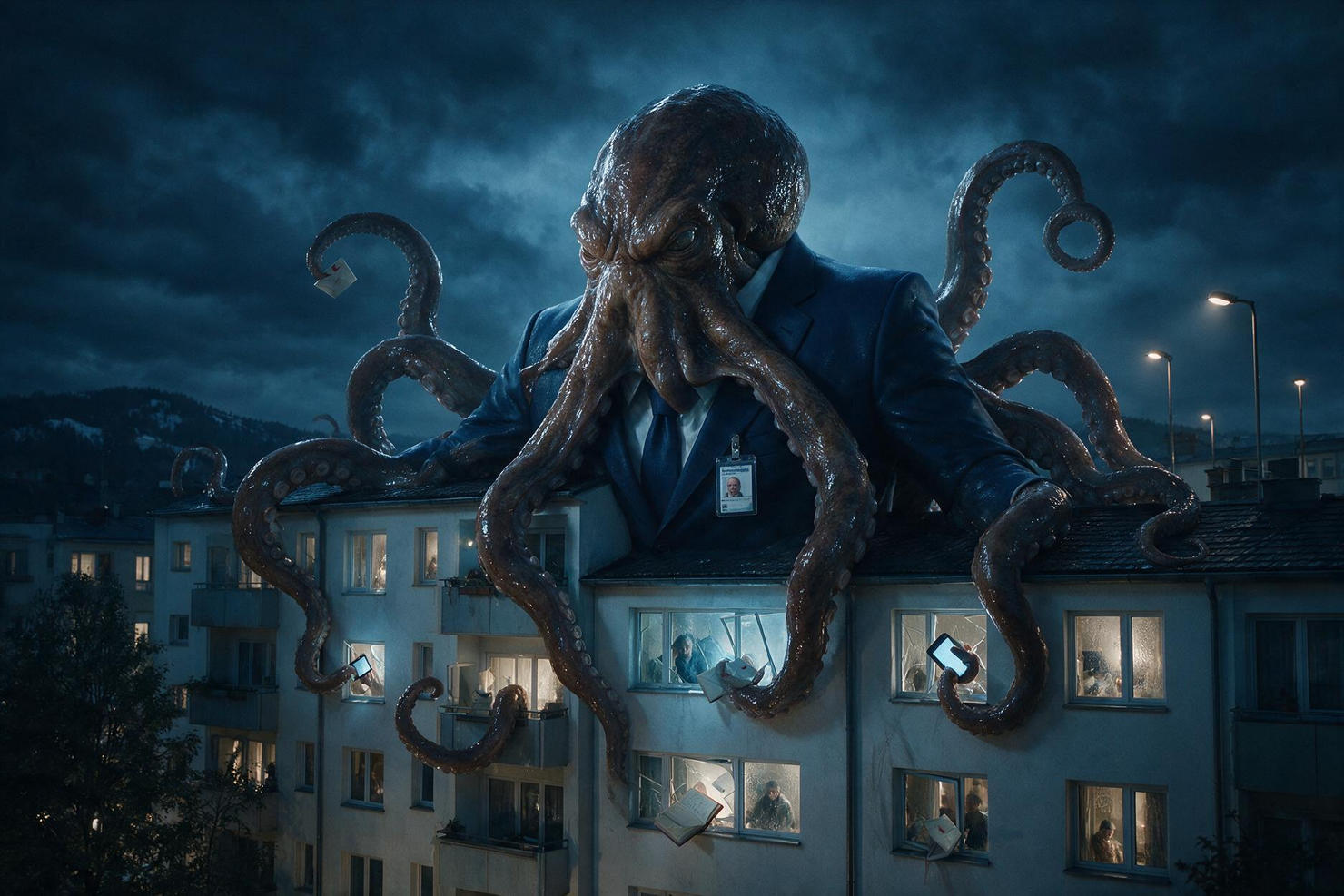
Britain is pursuing the same logic on an industrial scale: Over 12,000 arrests in a single year for "grossly offensive" online messages, roughly 33 per day, almost 60 percent more than before the pandemic – as can be read in the House of Lords' library , which also notes that convictions plummeted by almost half during the same period. So, they're arresting masses of people they can't even convict afterward. The process itself is the message: Keep your mouth shut, or we'll come for you.
And Brussels? The EU extended voluntary chat monitoring in July via an expedited procedure , after Parliament had previously rejected it – they keep voting until they get the desired result. Meanwhile, the trilogue negotiations continue to tinker with the permanent regulation, and internal Council documents, according to netzpolitik.org , show that several member states are determined to reinstate the indiscriminate scanning of all messages. Indiscriminate means: you are a suspect simply because you exist. This is the purest form of the right to dominate – the surveillance apparatus declares your privacy a security vulnerability and itself the patch.
The Big Bang Myth
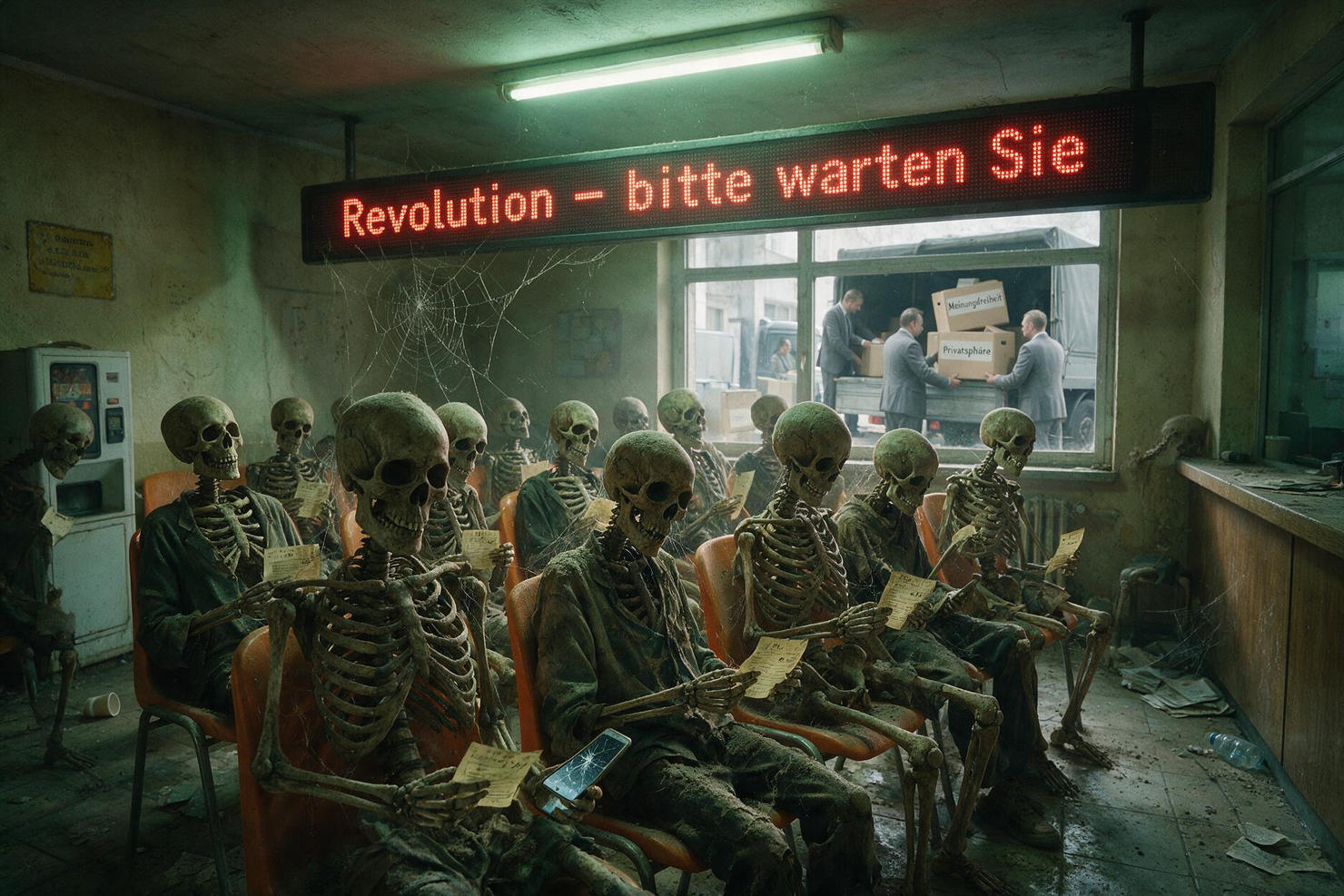
And what do the outraged do? They wait. For the historic upheaval, for the mass movement, for the day when "the people rise up." This is the most convenient form of capitulation ever invented: one delegates one's own backbone to an imaginary crowd that never arrives, and still feels rebellious. Rule of the few It thrives precisely on the fact that the many wait for one another. Obedience is not a force of nature; it is demonstrated daily, individually – by everyone who remains silent even though they could object, who censors themselves before anyone demands it, who prefers the unencrypted convenience of the surveillance-proof alternative.
Resistance today doesn't mean barricading, but rather perseverance on a small scale: Naming and demanding the right to protection at every opportunity. Suing where legal action is possible. Encrypting what can be encrypted. Speaking out about what is legal, even when it's inconvenient – especially then. Not submitting a request where none is necessary. Those who only whisper about their rights have already surrendered them.
No one can eat the foundation with impunity.
A right you don't exercise is a museum piece; a right you only exercise with permission is an act of grace—and a state that treats your freedoms as mere commodities is no longer a state governed by the rule of law, but an occupier in letterhead. These defensive rights were written precisely against the kind of authority they now administer. They search homes for puns, arrest citizens by the dozen for online posts, want to scrutinize every private message—and call this "protecting democracy"! Don't wait for salvation from the masses; it won't come! Stand up for yourself, every day, with every infringement—because a defensive right that no one defends is nothing more than decoration on the coffin of freedom!
More for you:






 "Dravens Tales from the Crypt" has been enchanting for over 15 years with a tasteless mixture of humor, serious journalism - for current events and unbalanced reporting in the press politics - and zombies, garnished with lots of art, entertainment and punk rock. Draven has turned his hobby into a popular brand that cannot be classified.
My blog was never designed to spread news, let alone get political, but with current affairs I just can't help but capture information here that is otherwise censored on all other channels. I am aware that the design page may not seem "serious" to many in this regard, but I will not change this to please the "mainstream". Anyone who is open to non-state-compliant information sees the content and not the packaging. I've tried enough to provide people with information over the last 2 years, but quickly noticed that it never matters how it's "packaged", but what the other person's attitude towards it is. I don't want to put honey on anyone's mouth to meet expectations in any way, so I'll keep this design because hopefully at some point I'll be able to stop making these political statements, because it's not my goal to go on like this forever  I leave it up to everyone how they deal with it. However, you are welcome to simply copy and distribute the content, my blog has always been under the WTFPL license.
It's hard for me to describe what I'm actually doing here, DravensTales has become a culture blog, music blog, shock blog, tech blog, horror blog, fun blog, a blog about found items on the internet, internet bizarre, trash blog, art blog, water heater, zeitgeist blog over the years , Scrap blog and grab bag blog called. Everything that is right ... - and yet not. The main focus of the blog is contemporary art, in the broadest sense of the word.
To ensure the continued operation of this site, you are welcome to make a donation via credit card, PayPal, Google Pay, Apple Pay, or direct debit/bank account . Many thanks to all readers and supporters of this blog!








