
There are people who know war. Not from television, not from the news, not from the speeches of politicians who have never held a weapon and never will. But from their own lives. From their own childhood. From the moment a mother wraps her child in a blanket to smuggle it through a roadside checkpoint, and soldiers with machine guns bang on the window and declare that they will shoot her if she so much as reaches behind her.
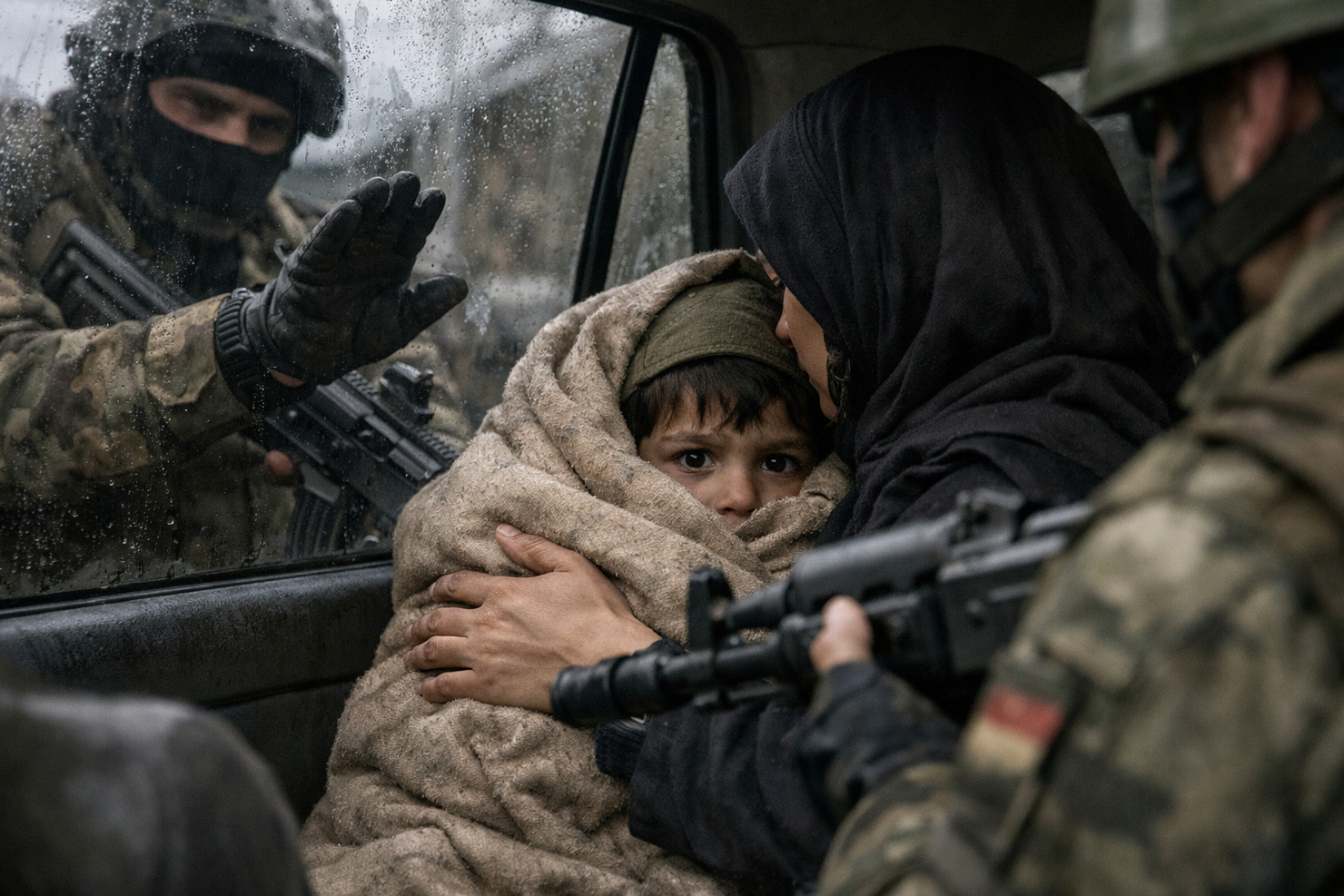
B-Lash, born in Iran in 1982 and now living in Germany, is one such person. His first escape attempt failed in Ankara—mother and child were betrayed and forced to return to Iran. The second attempt succeeded: at the age of five, he was smuggled onto a plane, declared a relative of a flight attendant who risked his life in the process. The attendant wore an army uniform with a German flag on it. The child didn't know what was going on, except that he was supposed to be quiet and not speak to the stranger.
This is not a thriller. This is a life story. And this life story doesn't end in bitterness, resignation, or hatred—but with a man who today works in politics, makes music, practices journalism, writes a book, and speaks with a clarity about the mechanisms of the world that has been acquired through decades of difficult experience and no other method. Meanwhile, Germany is preparing its children for war.
Warfare readiness is the new buzzword of the season. Arms spending at levels that collective memory has already forgotten were once unthinkable. A debate about conscription, no longer treated as a fringe issue, but as responsible realism. And a media landscape that accompanies all of this with that calm, matter-of-fact tone it considers objective, which is in reality a complete absence of historical awareness.
B-Lash has a simple suggestion: Go to the Ukrainian border. Gather up the remaining people. Put them in buckets. Show them what the game is. And then ask them if they still want to play.
This is not a rhetorical device. This is a serious recommendation. Anyone who discusses war as an abstract geopolitical necessity without ever having seen the concrete reality of what war does to people—to children, to mothers, to families—is discussing something they don't understand. And they are making decisions about it as if they did.
That is the real scandal: not that people have to experience war. That is as old as humanity itself. The scandal is that people who have never experienced war speak with complete nonchalance about the necessity of sending others into it. That the separation from the concrete to the abstract has been so complete that the order to shoot and the death of the shooter and the shot at have become two separate realities that no longer have anything to do with each other.
B-Lash doesn't understand this distance. He can't understand it. Because for him, the image of his mother having to raise her hands while the machine gun is pointed at her isn't abstract. It's a concrete memory. And because he has this memory, he also has something that most war debaters lack: an awareness of what's at stake when one speaks carelessly.
What distinguishes him – and this is perhaps the most remarkable thing – is not cynicism or resignation. Rather, it's an optimism that cannot be derived from the situation he describes. He has recorded sixteen albums and never earned a penny from them. He has spoken out about things for which he was vilified, threatened, and attacked, back when there was no financial return. He has sat for years in a room where he was the only one asking the questions he asked, and he has persevered.
This isn't a hero. This is someone who can't do otherwise. And that's the difference between him and those who are now jumping on the bandwagon because it's gained momentum. They, too, can do otherwise. They're just not doing it right now because it's not worth it. B-Lash couldn't do otherwise when it wasn't worth it. This isn't about moral superiority—it's a biographical fact.
The path to a better future, which the interview circles without fully grasping, has less to do with programs and books than with a single shift: Those who have experienced war talk about war differently. Those who have experienced displacement talk about displacement differently. Those who have seen a mother raise her hands while a machine gun is pointed at her understand what a state is doing when it declares this necessary.
Germany has just collectively decided not to understand this. It has chosen to mistake armament for responsibility and military preparedness for maturity. It has decided that learning from history means repeating the same mistakes with better PR.
And elsewhere sits a man who, at the age of five, was forced into an army uniform to flee a country that was terrorizing its population in the name of revolution, and who nevertheless—or perhaps precisely because of this—looks optimistically to the future. Sometimes the person with the clearest vision has the least reason to be optimistic…
More for you:






 "Dravens Tales from the Crypt" has been enchanting for over 15 years with a tasteless mixture of humor, serious journalism - for current events and unbalanced reporting in the press politics - and zombies, garnished with lots of art, entertainment and punk rock. Draven has turned his hobby into a popular brand that cannot be classified.
My blog was never designed to spread news, let alone get political, but with current affairs I just can't help but capture information here that is otherwise censored on all other channels. I am aware that the design page may not seem "serious" to many in this regard, but I will not change this to please the "mainstream". Anyone who is open to non-state-compliant information sees the content and not the packaging. I've tried enough to provide people with information over the last 2 years, but quickly noticed that it never matters how it's "packaged", but what the other person's attitude towards it is. I don't want to put honey on anyone's mouth to meet expectations in any way, so I'll keep this design because hopefully at some point I'll be able to stop making these political statements, because it's not my goal to go on like this forever  I leave it up to everyone how they deal with it. However, you are welcome to simply copy and distribute the content, my blog has always been under the WTFPL license.
It's hard for me to describe what I'm actually doing here, DravensTales has become a culture blog, music blog, shock blog, tech blog, horror blog, fun blog, a blog about found items on the internet, internet bizarre, trash blog, art blog, water heater, zeitgeist blog over the years , Scrap blog and grab bag blog called. Everything that is right ... - and yet not. The main focus of the blog is contemporary art, in the broadest sense of the word.
To ensure the continued operation of this site, you are welcome to make a donation via credit card, PayPal, Google Pay, Apple Pay, or direct debit/bank account . Many thanks to all readers and supporters of this blog!








