
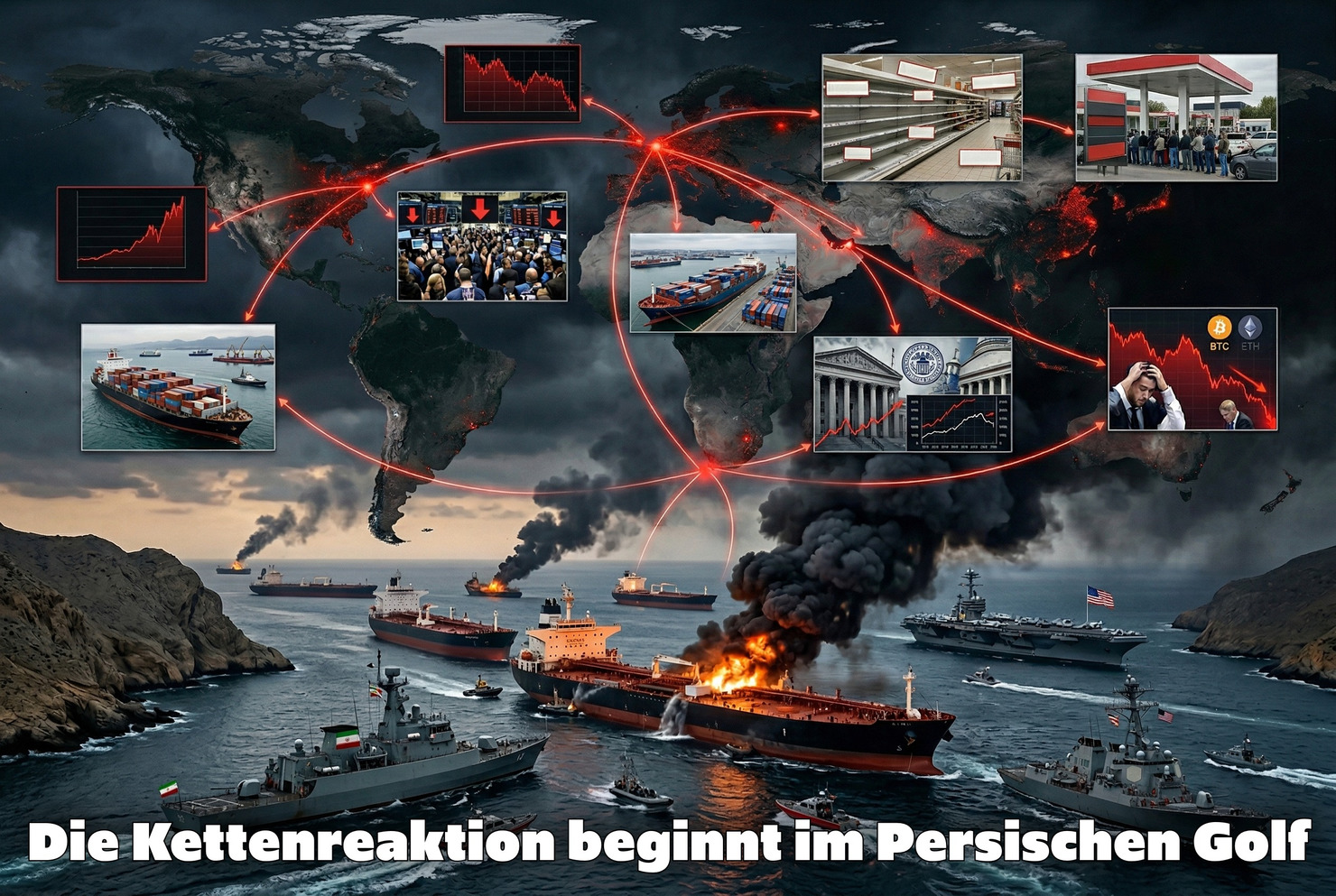
The next 24 hours could be the ugliest of 2026. Not because of a hashtag. Not because of another talk show meltdown. But because a strait that many wouldn't even be able to find on a map is suddenly becoming the global epicenter. The Strait of Hormuz.
A narrow strip of water between Oman and Iran. Geographically unremarkable. But in reality, it's the planet's bottleneck. Almost a fifth of global oil consumption flows through this maritime hinge every day. If it closes, it's not a symbolic act. It's a systemic disruption of the world economy's lifeblood.
Over 20 percent of the global oil supply is at stake. And while headlines talk of missiles, retaliation, and alliances, many overlook the crucial point:
It's not just about oil. It's about the network that's connected to it.
JP Morgan called a complete closure of the Strait of Hormuz the worst-case scenario in an Israel-Iran conflict. Not for dramatic effect, but for mathematical reasons. If the price of oil doesn't rise moderately, but instead shoots up to $120 or $130 per barrel, then we're not talking about a price spike. We're talking about a chain reaction.
Oil is not an isolated commodity. It is a price anchor.
When oil prices rise, inflation returns. Not as a theory, but as a reality. Every $10 movement per barrel acts like a lever on the consumer price index. Transportation, production, energy – everything is affected. And while central banks are currently struggling to put the genie of inflation back in the bottle, such a shock would unleash it with full force.
A return to inflation means: goodbye to interest rate cuts.
No interest rate cuts mean: yields rise.
Rising yields mean: liquidity becomes scarcer.
And when liquidity becomes scarcer, it becomes clear what markets really are – not places for ideals, but machines for risk management.
Then investors don't sell what they dislike. They sell what they can turn into cash. Highly valued tech stocks. Small caps. Speculative growth. Anything liquid and volatile. And yes – crypto too.
Bitcoin isn't falling because the blockchain is failing. It's falling because it's being traded like a high-beta risk asset. When leveraged positions are unwound and overcrowded trades implode, volatility accelerates. This isn't ideology. This is market mechanics.
Many underestimate the structural dimension of this situation. Saudi Arabia alone accounts for around 38 percent of crude oil deliveries through the Hormuz corridor, approximately 5,5 million barrels per day. Added to this are Kuwait, Qatar, Bahrain, and a large portion of Saudi production.
Alternative routes? Hardly any. Pipelines can be diverted – but not to an extent that would compensate for a complete production outage. There is no easy alternative route on this highway.
Transportation costs are already rising. Tankers are being rerouted. Insurance premiums are skyrocketing. Ships are keeping their distance from military zones. This isn't panic. This is an active reassessment of risk. And this is precisely where the difference between a short-term shock and a structural event begins.
A structural supply shock doesn't disappear with a press conference. It takes root. Markets no longer begin to price fear—they begin to price duration. And duration is toxic. Because as soon as market participants assume that the oil price isn't just high in the short term, but will remain elevated for an extended period, the macroeconomic regime changes. Investment decisions are postponed. Borrowing costs rise. Companies cut back. Consumers hold back.
Liquidity is becoming scarcer – not only on traders' screens, but in the real economy.
What many don't want to see: We live in a system accustomed to a constant supply of energy. Cheap oil was the invisible subsidy mechanism of globalization. Supply chains, just-in-time production, cheap transport – everything is based on the assumption that energy flows.
If this bottleneck is seriously blocked, it is not an isolated geopolitical incident. It is an intervention in the fundamental architecture of the system.
There are three scenarios:
First: The rhetoric calms down. Oil prices drop. Markets breathe a sigh of relief. The system continues to function as usual.
Secondly: Persistent tensions. Not a complete standstill, but constant uncertainty. Oil prices remain high. Inflation remains stubborn. Hopes for low interest rates are fading.
Third: Complete collapse of traffic due to Hormuz. Oil prices skyrocket. The macroeconomic environment collapses.
Scenario three is the moment when not only prices rise, but assumptions break down. The assumption of stable energy flows. The assumption of controllable inflation. The assumption that central banks can always rescue the country with interest rate cuts.
The next 24 hours are crucial not because they might be spectacular. They are crucial because markets are beginning to reassess probabilities. And probabilities are the foundation of every portfolio. Those who focus solely on headlines right now are overlooking the real risk.
This is not about a regional conflict. It's about a systemic lever.
Oil. Inflation. Interest rates. Liquidity.
Four terms. One chain.
If it collapses, more than just the oil price will collapse…
More for you:




 "Dravens Tales from the Crypt" has been enchanting for over 15 years with a tasteless mixture of humor, serious journalism - for current events and unbalanced reporting in the press politics - and zombies, garnished with lots of art, entertainment and punk rock. Draven has turned his hobby into a popular brand that cannot be classified.
My blog was never designed to spread news, let alone get political, but with current affairs I just can't help but capture information here that is otherwise censored on all other channels. I am aware that the design page may not seem "serious" to many in this regard, but I will not change this to please the "mainstream". Anyone who is open to non-state-compliant information sees the content and not the packaging. I've tried enough to provide people with information over the last 2 years, but quickly noticed that it never matters how it's "packaged", but what the other person's attitude towards it is. I don't want to put honey on anyone's mouth to meet expectations in any way, so I'll keep this design because hopefully at some point I'll be able to stop making these political statements, because it's not my goal to go on like this forever  I leave it up to everyone how they deal with it. However, you are welcome to simply copy and distribute the content, my blog has always been under the WTFPL license.
It's hard for me to describe what I'm actually doing here, DravensTales has become a culture blog, music blog, shock blog, tech blog, horror blog, fun blog, a blog about found items on the internet, internet bizarre, trash blog, art blog, water heater, zeitgeist blog over the years , Scrap blog and grab bag blog called. Everything that is right ... - and yet not. The main focus of the blog is contemporary art, in the broadest sense of the word.
To ensure the continued operation of this site, you are welcome to make a donation via credit card, PayPal, Google Pay, Apple Pay, or direct debit/bank account . Many thanks to all readers and supporters of this blog!








