
World War III is knocking politely at the door once again. Not loudly. Not dramatically. More like a grumpy neighbor who's been threatening for years to "really come over someday." And this time, the situation is supposedly particularly serious.
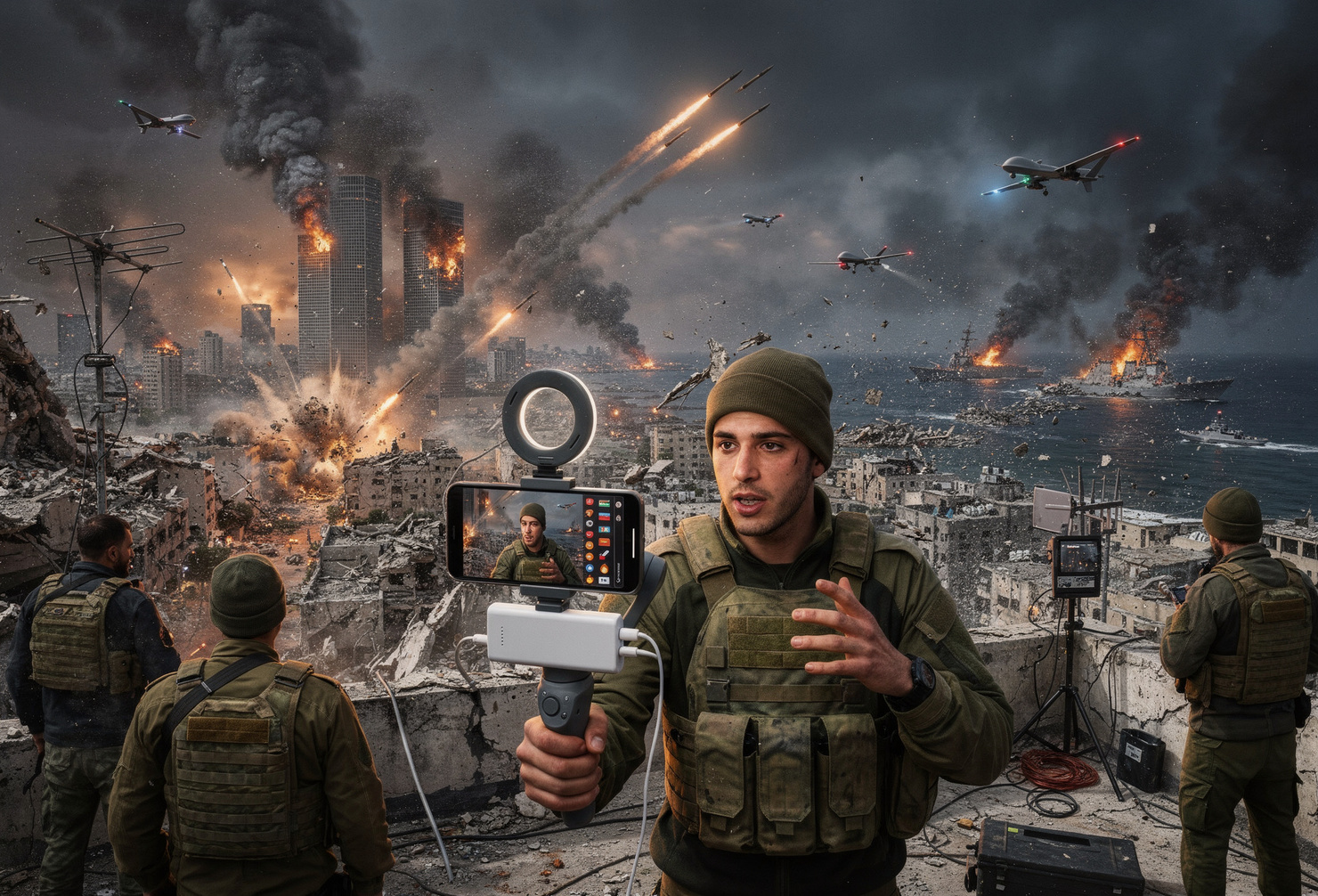
Tel Aviv now looks like Gaza in places, it is said. Rockets with multiple warheads are striking, entire streets disappearing in dust. Iran is now allegedly using cluster munitions, those neat little gifts of modern warfare designed to turn as many people as possible into very small problems at once. And the best part: this is supposedly not even the full arsenal. In other words: this was just the overture.
Meanwhile, the Houthis from Yemen are attacking US warships, allegedly with Iranian and Chinese anti-ship missiles. Two American ships are reportedly already out of action—perhaps sunk, perhaps damaged, or perhaps simply part of the usual fog of information, which in wartime is about as reliable as a weather forecast on a volcano. At the same time, Shiite militias in Iraq are shelling US bases in Syria. North Korea is reportedly offering Iran a nuclear bomb—a diplomatic gift, so to speak. One has to give Kim Jong-un credit: when he offers something, he goes all out.
Meanwhile, the British are reinforcing their military bases in Cyprus. Turkey, for its part, is bringing weapons and soldiers to the Turkish-controlled part of the island. Because nothing promotes stability quite like two NATO states militarily sizing each other up. The airport in Doha is badly damaged. So are US bases in Kuwait. China is sending military warnings to the US and Israel. Oil and gas prices are rising faster than the pulse of European economic ministers. In short: The ingredients for a global conflagration now read like the menu of a geopolitical nightmare.
And somewhere in news studios around the world, analysts sit and explain with solemn faces that "the situation is complex." Complex is a charming euphemism for: no one really has control over this dynamic anymore. Of course, the big term is immediately trotted out again: World War III. The problem is that this term is now used almost as frequently as "historic times" or "unprecedented crisis." For decades, we've been told about World War III. Sometimes in Ukraine. Sometimes in Taiwan. Sometimes in the Middle East. Sometimes everywhere at once.
And yet, something interesting is happening: The world is sliding ever closer to a global confrontation, without anyone officially wanting to admit that this is precisely what is happening. Instead, politicians talk about "regional conflicts." Military leaders speak of "strategic tensions." The media of "escalation risks." This all sounds considerably more reassuring than what is actually going on: A growing number of states are currently testing how far they can go before someone finally loses their nerve.
The whole thing is reminiscent of a group of drunks experimenting with fireworks at a gas station, reassuring each other that everything is "under control." Of course, the information industry plays a role in this. Every new explosion, every missile, every military movement is immediately blown out of proportion and becomes a headline. After all, disasters sell better than stability. And while the world oscillates between panic and apathy, something far more dangerous is happening: the idea of a major war is slowly becoming normalized.
People are getting used to the idea. Another attack here. Another threat there. Another military warning from Beijing. Another NATO deployment. Another missile launch. The line between crisis and normalcy is beginning to blur. Perhaps that's the real horror of modern wars: they don't begin with a bang. They begin with an endless series of escalations, each one a little worse than the last. Until eventually, no one can say exactly when a conflict turned into a world war.
But don't worry.
The experts continue to assure us that everything is under control – incidentally, they said the same thing in 1913…
More for you:



 "Dravens Tales from the Crypt" has been enchanting for over 15 years with a tasteless mixture of humor, serious journalism - for current events and unbalanced reporting in the press politics - and zombies, garnished with lots of art, entertainment and punk rock. Draven has turned his hobby into a popular brand that cannot be classified.
My blog was never designed to spread news, let alone get political, but with current affairs I just can't help but capture information here that is otherwise censored on all other channels. I am aware that the design page may not seem "serious" to many in this regard, but I will not change this to please the "mainstream". Anyone who is open to non-state-compliant information sees the content and not the packaging. I've tried enough to provide people with information over the last 2 years, but quickly noticed that it never matters how it's "packaged", but what the other person's attitude towards it is. I don't want to put honey on anyone's mouth to meet expectations in any way, so I'll keep this design because hopefully at some point I'll be able to stop making these political statements, because it's not my goal to go on like this forever  I leave it up to everyone how they deal with it. However, you are welcome to simply copy and distribute the content, my blog has always been under the WTFPL license.
It's hard for me to describe what I'm actually doing here, DravensTales has become a culture blog, music blog, shock blog, tech blog, horror blog, fun blog, a blog about found items on the internet, internet bizarre, trash blog, art blog, water heater, zeitgeist blog over the years , Scrap blog and grab bag blog called. Everything that is right ... - and yet not. The main focus of the blog is contemporary art, in the broadest sense of the word.
To ensure the continued operation of this site, you are welcome to make a donation via credit card, PayPal, Google Pay, Apple Pay, or direct debit/bank account . Many thanks to all readers and supporters of this blog!








