
Spotify has found the solution: the green checkmark. The music industry's digital organic label, awarded to all those artists who can prove they actually exist—measured by concert appearances, merchandise sales, and social media activity. Soon, labels like "drug-addicted musician," "species-appropriate band management," and "composed without sheet music" will probably be added. Mozart wouldn't get one today. Too little content. Poor reel rate. Zero hoodies.
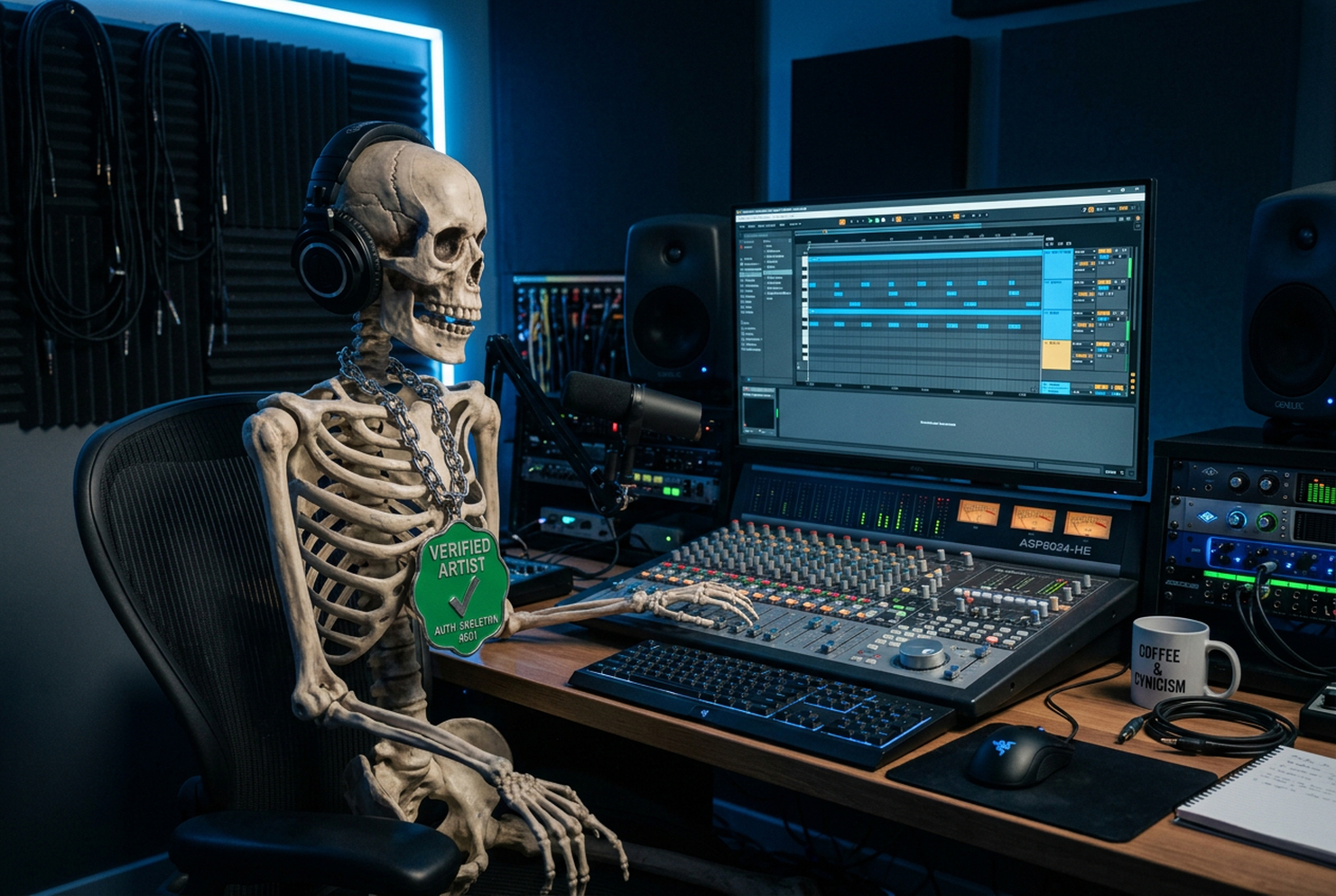
The criteria for this certificate of authenticity are so clear they take your breath away – but not with admiration. Because what Spotify defines as "authentic" has absolutely nothing to do with music. It's not the quality of a composition that's being evaluated. Not whether a song truly resonates with someone. Not whether someone has practiced, felt, and struggled for years. No. What matters is whether you act up enough on TikTok and whether your merch store is doing well. This is the new definition of art: the marketability of an artist's profile, packaged in a green icon.
The factory is complaining about the conveyor belt
Just let that sink in. For decades, the music industry industrially cobbled together what it then called "music." Five songwriters for a pop hit. Auto-tune until the voice sounds like a calibrated synthesizer. Ghost producers in the background, building the actual track, while the face on the cover is busy with interviews and photo shoots. Production teams quantizing every note, mastering every bar, and digitally smoothing out every mistake. That was the standard for decades—and nobody at Spotify batted an eye.
Now AI arrives. It produces the same plastic. Only faster. Without studio costs. Without negotiations with the ghost producer. And suddenly the industry discovers authenticity. The factory is complaining about the conveyor belt. This is no longer satire—this is humanity in its purest form. The AI music, of course, remains online. It isn't removed. It's flagged. The label now reads: "Contains traces of the future." Those who can't eliminate a threat label it with a warning and call it innovation.
12 million artists, 1 cent per month
Spotify is home to around 12 million artists. The vast majority earn less in a year than a typical Bern resident spends on a coffee trip. Only about one in 200 manages to earn over $10,000 annually – the rest struggle for fractions of a cent per stream. Anyone who laughs at this is heartless. Anyone surprised by it hasn't been paying attention in recent years.
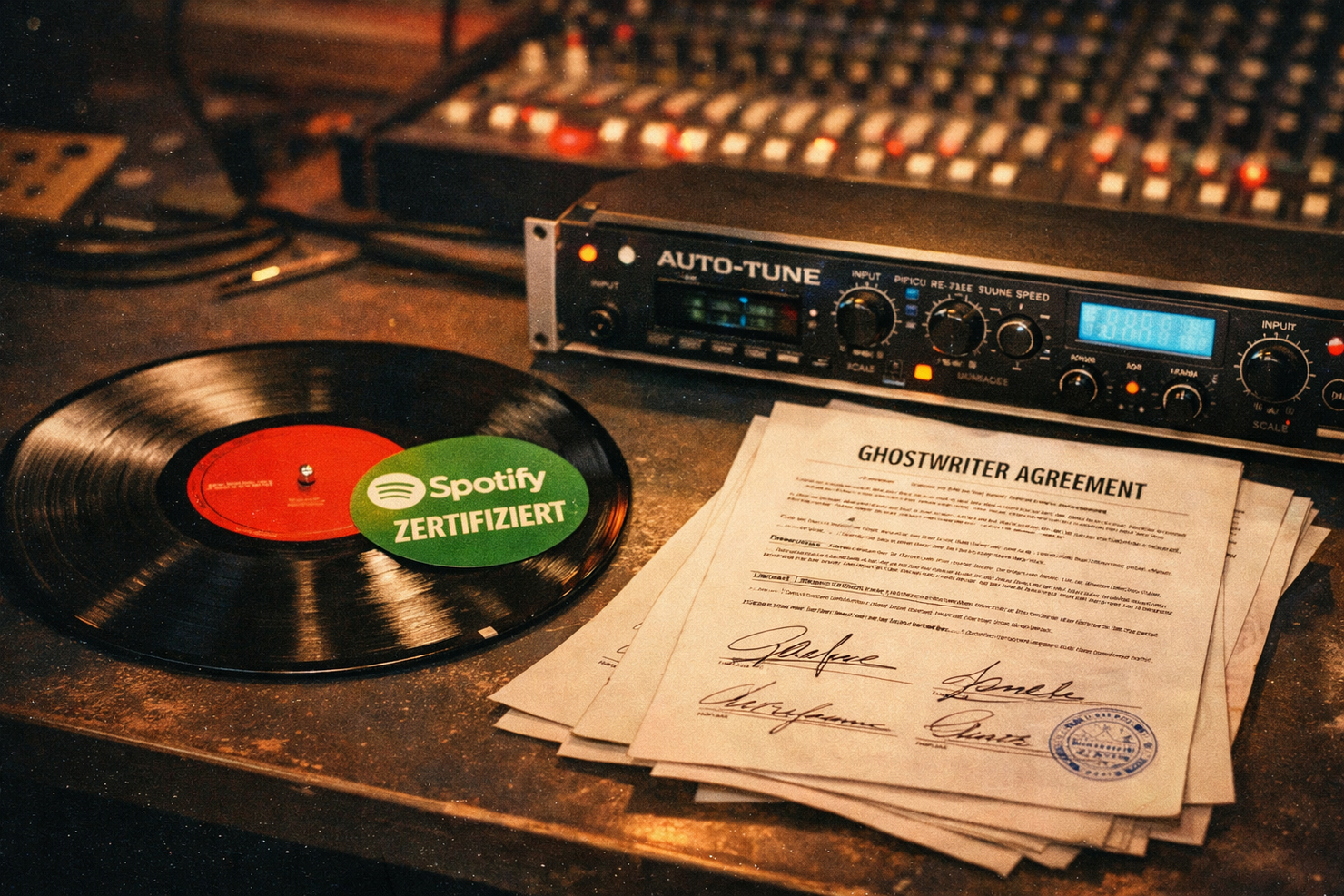
Into this already toxic situation, AI floods in around 70,000 new tracks every day. Generic background music without soul, without story, without a single moment of human vulnerability – produced in seconds, uploaded in minutes, and algorithmically placed identically to every other track. The consequence is mathematical, not moral: those who don't want to drown in this sea need visibility. And Spotify will henceforth grant visibility to those who can tick the right box. This isn't a judgment of quality. This is identity marketing – and the difference is significant.
The fluid boundary
This is where the discussion becomes philosophically uncomfortable – and precisely where it becomes interesting. Because what exactly is "handmade" in a production that runs on digital audio workstations, pulls samples from libraries, and uses compressors and EQ settings that no human ear can precisely control in real time? What is "human" about a track that consists of 80 percent plug-ins and whose final touch was a mastering algorithm?
AI analyzes within seconds which compressors were used, which EQ settings were applied, how the panning is positioned – and recognizes just as quickly whether a production is AI-generated or not. The machine's ear is already sharper than the human ear. Anyone who thinks a green checkmark creates a clear dividing line understands neither the technology nor the history of pop production.
Humanity has always integrated technology into creation. The electric guitar didn't devalue rock music. Auto-Tune has—depending on your perspective—created some of the most irritating and some of the most interesting textures in modern pop production. The boundary between "real" and "artificial" has never been technical. It has always been a question of the economic interests of those who happened to be in charge of defining the criteria.
And that's precisely the point Spotify so elegantly avoids with this checkmark: It's not about art. It's not about quality. It's about the fact that a platform with 12 million artists and a constantly growing flood of AI needs a selection mechanism – and this mechanism should look as little like curation as possible and as much like fairness as possible. The green checkmark is a disguise of a market necessity as an ethical statement. The industry, which has misused authenticity as a marketing buzzword for decades, is now discovering it as a bulwark.
Anyone who has sold plastic as art for decades shouldn't be surprised when machines deliver the same thing faster and cheaper – and anyone who now reaches for the checkmark only proves that the industry never saw the artist as a human being, but as a product with a face!
More for you:





 "Dravens Tales from the Crypt" has been enchanting for over 15 years with a tasteless mixture of humor, serious journalism - for current events and unbalanced reporting in the press politics - and zombies, garnished with lots of art, entertainment and punk rock. Draven has turned his hobby into a popular brand that cannot be classified.
My blog was never designed to spread news, let alone get political, but with current affairs I just can't help but capture information here that is otherwise censored on all other channels. I am aware that the design page may not seem "serious" to many in this regard, but I will not change this to please the "mainstream". Anyone who is open to non-state-compliant information sees the content and not the packaging. I've tried enough to provide people with information over the last 2 years, but quickly noticed that it never matters how it's "packaged", but what the other person's attitude towards it is. I don't want to put honey on anyone's mouth to meet expectations in any way, so I'll keep this design because hopefully at some point I'll be able to stop making these political statements, because it's not my goal to go on like this forever  I leave it up to everyone how they deal with it. However, you are welcome to simply copy and distribute the content, my blog has always been under the WTFPL license.
It's hard for me to describe what I'm actually doing here, DravensTales has become a culture blog, music blog, shock blog, tech blog, horror blog, fun blog, a blog about found items on the internet, internet bizarre, trash blog, art blog, water heater, zeitgeist blog over the years , Scrap blog and grab bag blog called. Everything that is right ... - and yet not. The main focus of the blog is contemporary art, in the broadest sense of the word.
To ensure the continued operation of this site, you are welcome to make a donation via credit card, PayPal, Google Pay, Apple Pay, or direct debit/bank account . Many thanks to all readers and supporters of this blog!








