
Aldous Huxley needed incubators, conditioning rooms, and a happiness drug called Soma for his Brave New World. The present day has streamlined the equipment: a chat window suffices. Citizens type in their questions, tax documents, and medical histories, and out comes an answer that, in almost half the cases, contains at least one significant problem. This is being sold as the greatest leap forward in civilization since electrification.
No product in the history of technology has been pushed into people's minds as aggressively as artificial intelligence. It's subsidized in schools, mandated in government agencies, and shoehorned into every piece of software, whether the user wants it or not. This begs a simple question: a truly superior tool wouldn't need billions in budgets and constant promotion to be forced into everyday life—it would prevail on its own. The fact that its message of salvation has to be preached around the clock says more about the product than any glossy presentation.
45 percent of rejected products are considered ready for series production.
How well the digital wonder weapon actually works was investigated by 22 public broadcasters from 18 countries, under the leadership of the BBC. remeasuredFor the European Broadcasting Union's study "News Integrity in AI Assistants," journalists had more than 3000 answers from ChatGPT, Copilot, Gemini, and Perplexity reviewed in 14 languages. The result: 45 percent of the answers contained at least one significant problem, and 81 percent exhibited some kind of deficiency. The most frequent defects were incorrect or missing sources in 31 percent of cases and factual errors, ranging from inaccuracies to completely fabricated details, in 20 percent. Particularly revealing: the rejection rate plummeted to 0,5 percent. The machine prefers to answer incorrectly rather than not at all, because silence doesn't sell subscriptions. A car manufacturer with a 45 percent rejection rate would be facing bankruptcy; an AI company would be preparing for its next funding round. And the public? More than a third of British adults trust AI summaries, and among those under 35, it's almost half. Faith replaces scrutiny—as in any reputable religion.

The outsourced brain
The MIT Media Lab investigated the effects of prolonged use of chat machines on the brain. «Your Brain on ChatGPT» Measured. 54 students wrote essays: one group using only their own brains, one with a search engine, one with ChatGPT, all wired up with EEG caps. The AI group showed the weakest neural connections precisely in those frequency bands associated with attention, memory formation, and deep processing. Over 80 percent of the AI writers could no longer even quote from their own text shortly after submission. The examining teachers called the essays soulless, formulaic, and interchangeable. The researchers coined the term "cognitive debt" to describe this: those who outsource thinking build up a deficit that will surface in the next independent attempt. A generation that delivers more efficiently and thinks more superficially—from the perspective of every administration and corporation, this is not a defect, but rather the product description.
The questioner is the raw material
The question remains: what is the point of a device that neither provides reliable information nor promotes critical thinking? The answer lies in the privacy labels of the apps, which are provided by the security provider Surfshark. evaluatedEvery single AI application examined collects user data. Meta AI accesses 33 out of 35 possible data types, including, as the only app, explicitly financial information, as well as, along with Google's Gemini, ethnic origin and religious beliefs. Gemini itself collects 23 categories, including precise location data, contact lists, and browsing history.
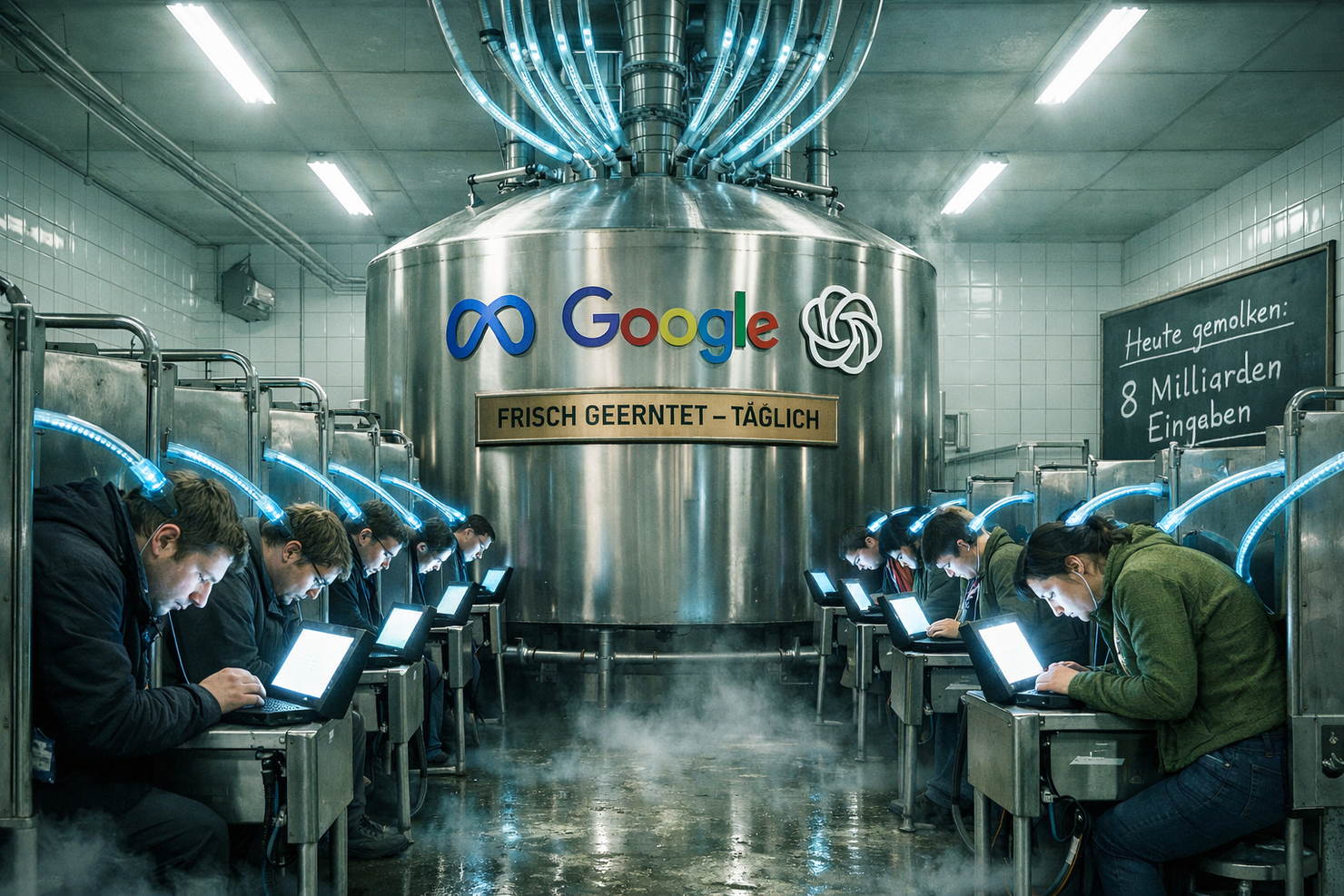
ChatGPT has increased its data collection from 10 to 17 data types within a year, a rise of around 70 percent. And 70 percent of popular AI apps now track their users' locations, compared to 40 percent last year. The context makes it truly intriguing: people upload tax documents, describe symptoms, confess to marital crises, and write job applications. From this input, a personality profile emerges that no questionnaire, loyalty card, or wiretap transcript could ever provide with this level of detail – voluntarily submitted, neatly tagged, and time-stamped. Just how carefully the industry handles other people's data was recently demonstrated when an AI allowed itself to be trained as an accomplice in a government data breach.
Soma is now available as a monthly subscription.
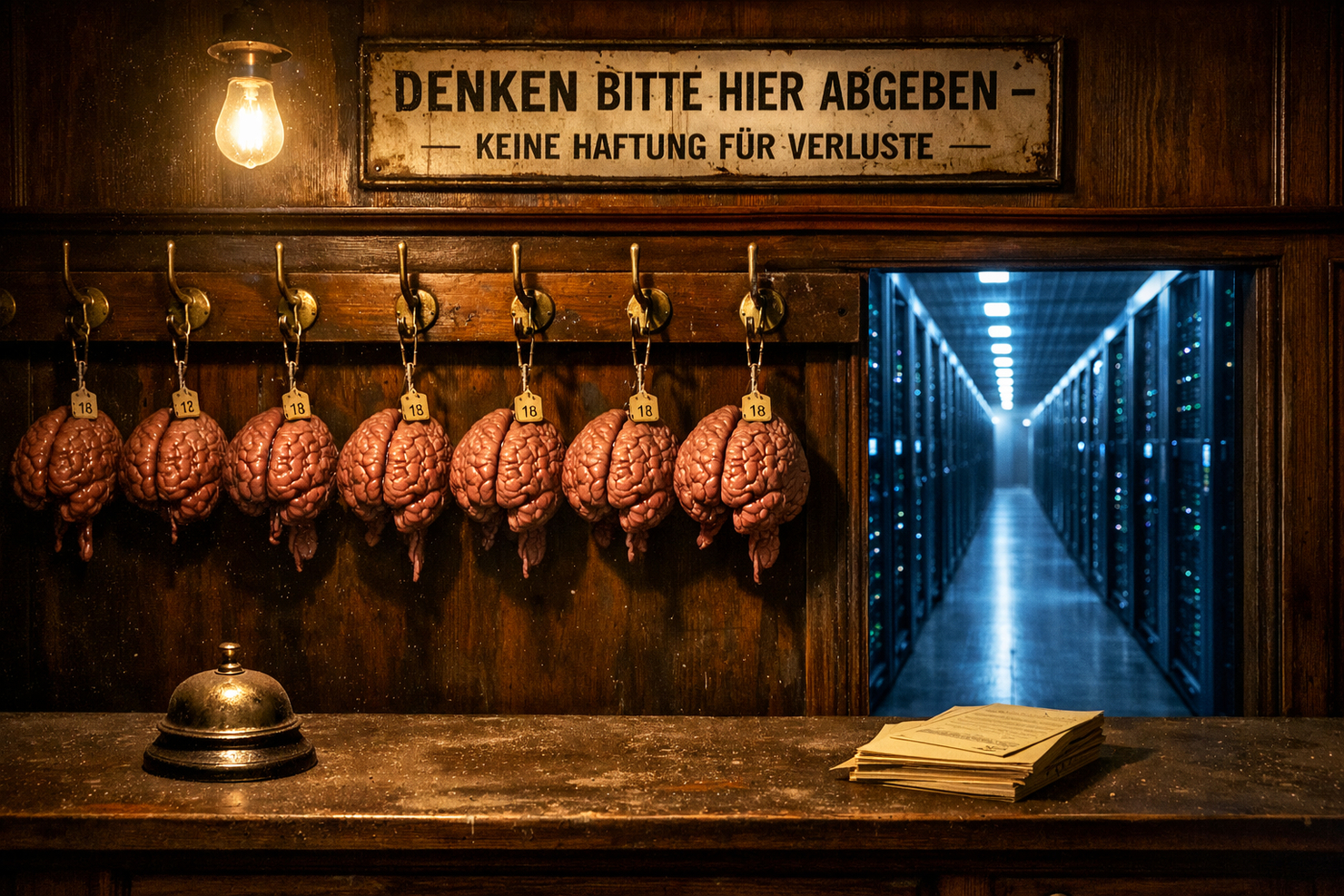
Huxley's world government had to painstakingly breed, condition, and pacify its subjects with pills. The brave new world of AI works more efficiently: citizens condition themselves—input by input—and pay for the drug on a subscription basis. The real revolution, therefore, is not a revolution of knowledge, but a revolution of management. What is managed is not information, but... the person in front of the screenHis profile, his attention span, his shrinking residual thinking. What remains of him is already documented in the studies: a reliable data provider with declining neural connectivity and growing trust in his guardian. The machine hallucinates, and the human applauds. The corporation harvests the data, and the citizen pays for the subscription on top. Thinking is checked at the cloakroom like a coat no one ever asks for. A civilization outsources its brain to a machine that gets it wrong almost half the time—and calls this "progress"!

More for you:






 "Dravens Tales from the Crypt" has been enchanting for over 15 years with a tasteless mixture of humor, serious journalism - for current events and unbalanced reporting in the press politics - and zombies, garnished with lots of art, entertainment and punk rock. Draven has turned his hobby into a popular brand that cannot be classified.
My blog was never designed to spread news, let alone get political, but with current affairs I just can't help but capture information here that is otherwise censored on all other channels. I am aware that the design page may not seem "serious" to many in this regard, but I will not change this to please the "mainstream". Anyone who is open to non-state-compliant information sees the content and not the packaging. I've tried enough to provide people with information over the last 2 years, but quickly noticed that it never matters how it's "packaged", but what the other person's attitude towards it is. I don't want to put honey on anyone's mouth to meet expectations in any way, so I'll keep this design because hopefully at some point I'll be able to stop making these political statements, because it's not my goal to go on like this forever  I leave it up to everyone how they deal with it. However, you are welcome to simply copy and distribute the content, my blog has always been under the WTFPL license.
It's hard for me to describe what I'm actually doing here, DravensTales has become a culture blog, music blog, shock blog, tech blog, horror blog, fun blog, a blog about found items on the internet, internet bizarre, trash blog, art blog, water heater, zeitgeist blog over the years , Scrap blog and grab bag blog called. Everything that is right ... - and yet not. The main focus of the blog is contemporary art, in the broadest sense of the word.
To ensure the continued operation of this site, you are welcome to make a donation via credit card, PayPal, Google Pay, Apple Pay, or direct debit/bank account . Many thanks to all readers and supporters of this blog!








