An ETH professor calculates that climate change will cost the global economy five percent by the end of the century – every year, more than a single COVID-19 pandemic . Twenty lines later, Watson asks whether it wouldn't be smarter to emit the CO2 here and buy certificates abroad. Her answer: "Yes." The apocalypse costs a pandemic annually, and the solution is a receipt from Bangkok. Anyone who talks like this isn't selling climate protection, they're selling trade.
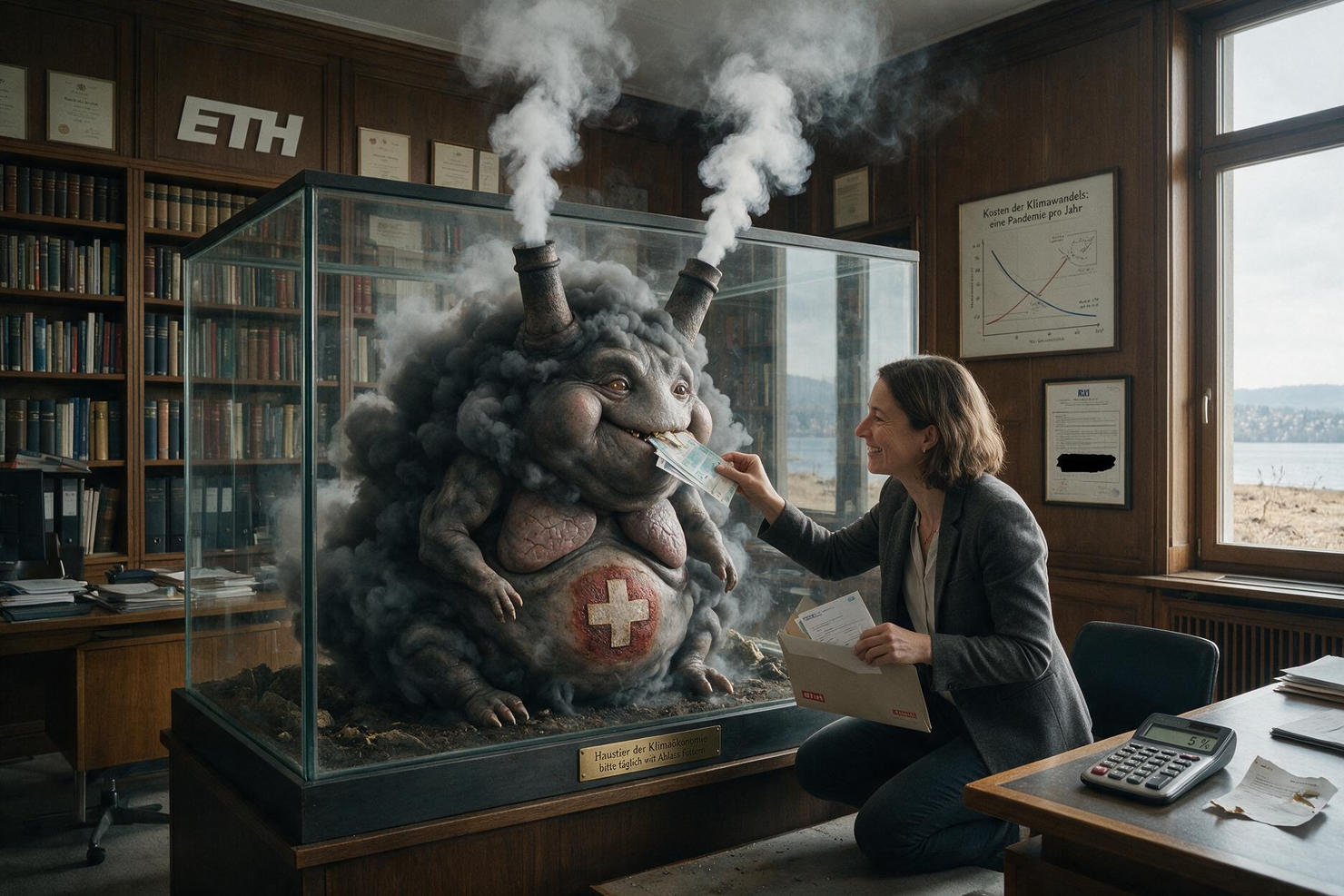
Lint Barrage models the costs of climate change at ETH Zurich. Her tool is the DICE model, which she relaunched in 2024 together with Nobel laureate William Nordhaus . It is precisely this background that makes the interview so instructive, because just a few years ago the same model was predicting the opposite.
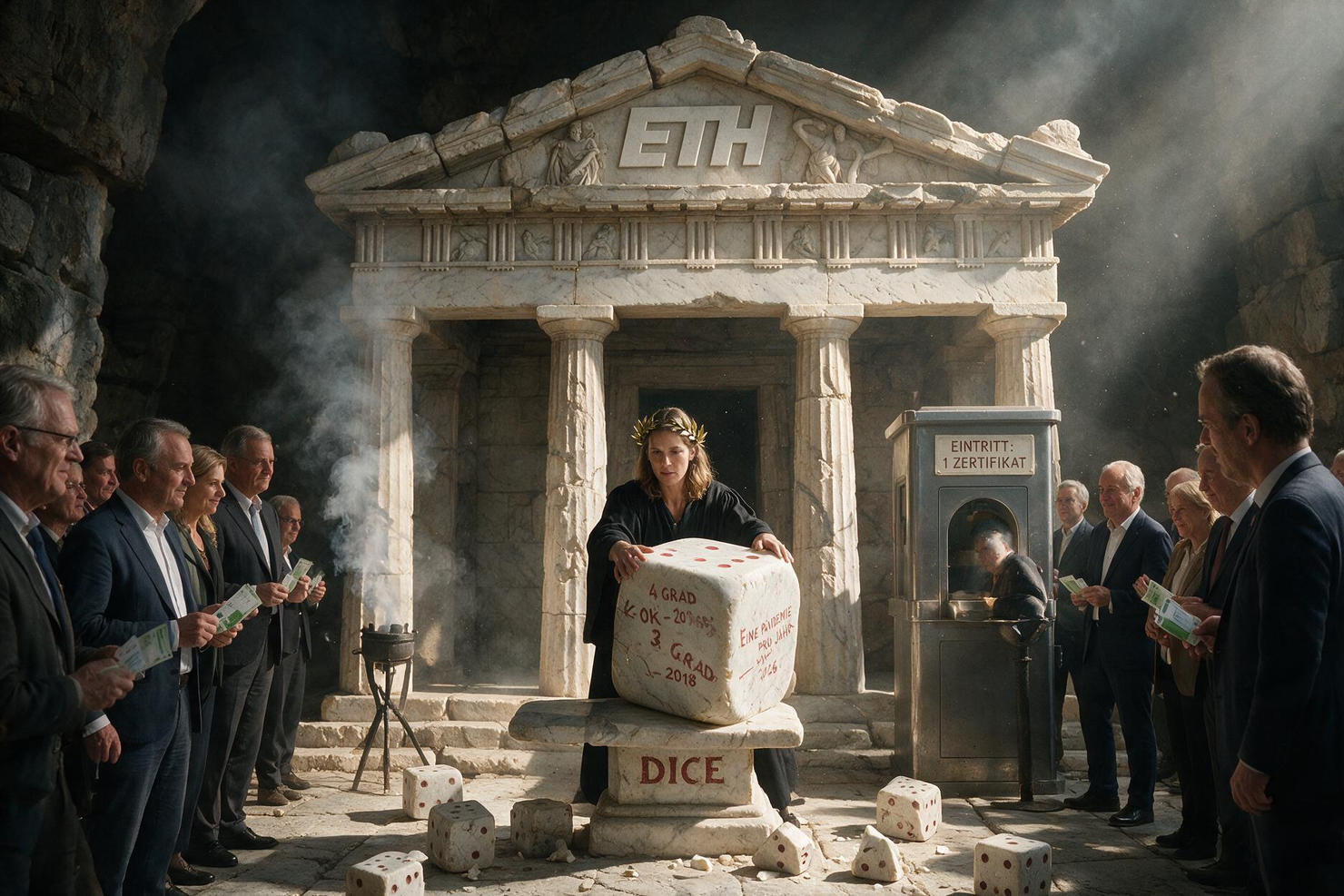
The oracle, which adjusts its numbers annually.
Nordhaus explained in his Nobel Lecture 2018 A warming of around three degrees by 2100 and four degrees by 2150 is considered the economic optimum, with damages amounting to just over two percent of global production at three degrees. The revised version with a barrier significantly lowers the optimum, but remains far above any Paris Agreement target. And now, in this heatwave summer, it's already announcing the next "update": the costs are likely to be even higher. A model whose results shift from "four degrees are okay" to "one pandemic per year" in six years doesn't measure the climate. It measures political expediency. The world has already seen how this kind of calculation ends up in a real-world scenario, when... Model prophets predicted the world would go to ruin.
The pandemic as a unit of measurement – of all things!
The three percent of global economy that uses cash reserves as a benchmark wasn't eaten up by the virus. The International Monetary Fund simply titled its report at the time. "The Great Lockdown" and stated in October 2020 that The lockdowns were a major factor in the collapse.Sweden, which did not impose a lockdown, came according to a peer-reviewed comparative study with low excess mortality and comparatively low economic costs.
And the leaked minutes of the RKI crisis team show that the upgrade of the risk assessment from "moderate" to "high" in March 2020, the basis for all fundamental rights infringements, was waiting for a "signal" rather than for concrete data. As became clear after the redactions, the signal came from the RKI's own vice president – which doesn't make things any better. A state of emergency hinged on a name, not on evidence. Barrage thus uses politically generated damage as a unit of measurement for modeled damage and calls this a comparison. One could also call it a confession.
The receipt from Bangkok
Now for the real kicker. The same woman who predicts an annual pandemic says "yes" to further pollution abroad in exchange for payment. Switzerland wants to achieve this by 2030. halve their emissions compared to 1990 and offset some of this through climate protection projects abroad, via international treaties under Article 6 of the Paris Agreement. The first tranche ever transferred was approximately 2000 tons from electric buses in Bangkok, developed by the Zurich-based certificate trader South Pole for a Thai corporation, which is a quarter owned by UBS SingaporeThe aid organizations' analysis concludes that the buses would have come even without Swiss money. This is the market that Barrage considers efficient: We pay for something that would happen anyway and book it as a rescue.
The research on this topic comes from none other than their own university. A meta-study with ETH Zurich participation, published in Nature Communications, examined almost a billion tons of traded carbon credits and found that less than 16 percent represent actual emission reductions, a quarter for forest protection, and statistically zero for wind power. A study in Science demonstrated that most rainforest projects barely reduced deforestation and yet issued millions of certificates.
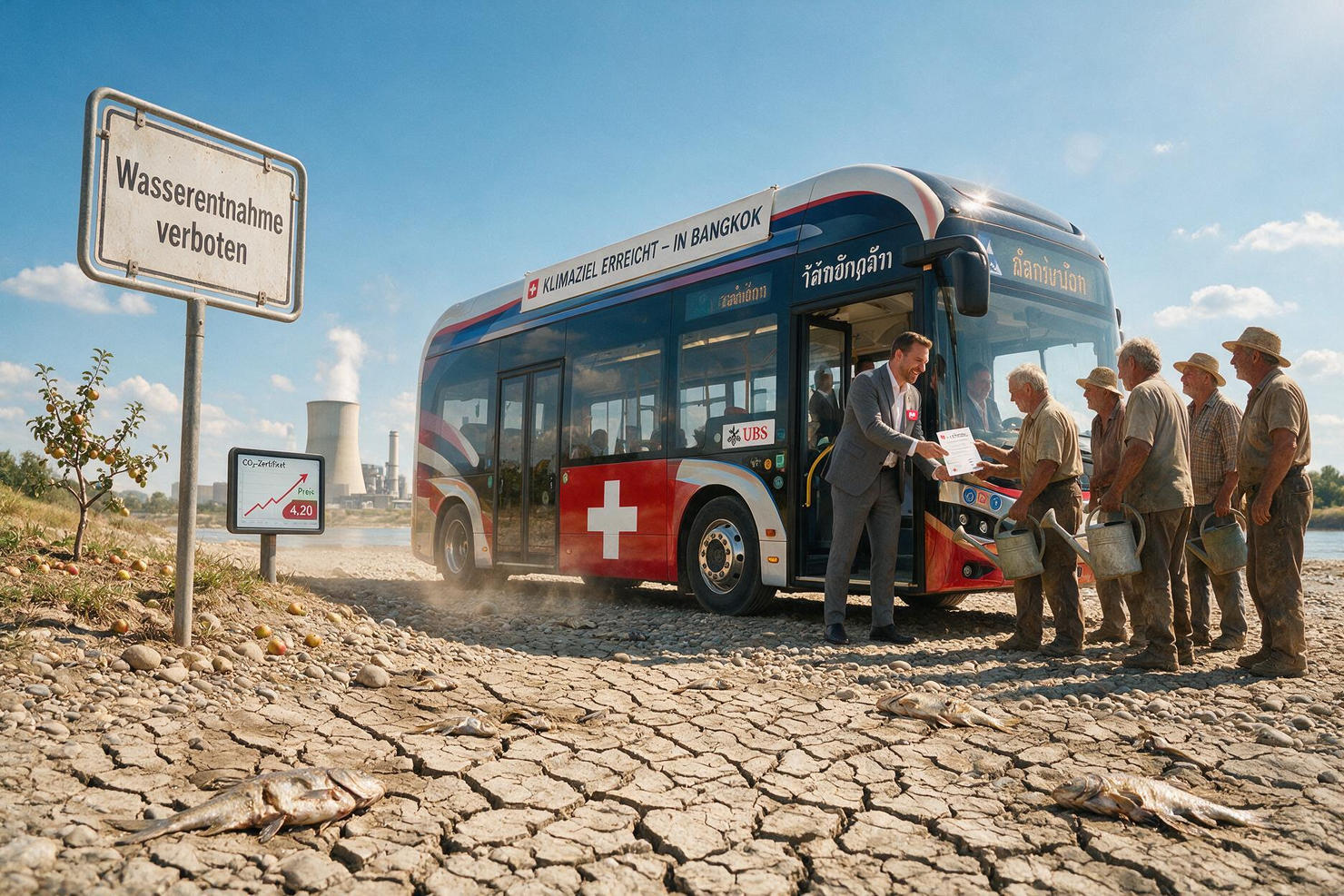
Anyone who says "yes" to buying certificates despite these findings doesn't consider reduction efficient, but rather the trading of indulgences. The fact that this business model functions identically domestically is demonstrated by the fictitious climate projects you paid for at the gas pump and the mechanism used to sell certificates and water cents based on heat panic.
What's real about summer – and what's being sold
Balance requires taking the opposing view seriously, so we do. Summer 2026 is real. MeteoSwiss is measuring From April to June, only 56 percent of the usual rainfall occurred., on par with 1976, the lowest value since 1901 and compares it to a three-degree worldBarrage is right that heat kills people, reduces harvests, and lowers productivity – no one disputed that in 2003. However, the same MeteoSwiss blog also contains a sentence that no interview quotes: Warming primarily intensified drought through evaporation; the rainfall deficit itself was not significantly increased by climate change. 1947, 1976, 2003, 2018, 2026 – drought is an old visitor, evaporation is the new phenomenon. This is a finding, not an excuse.
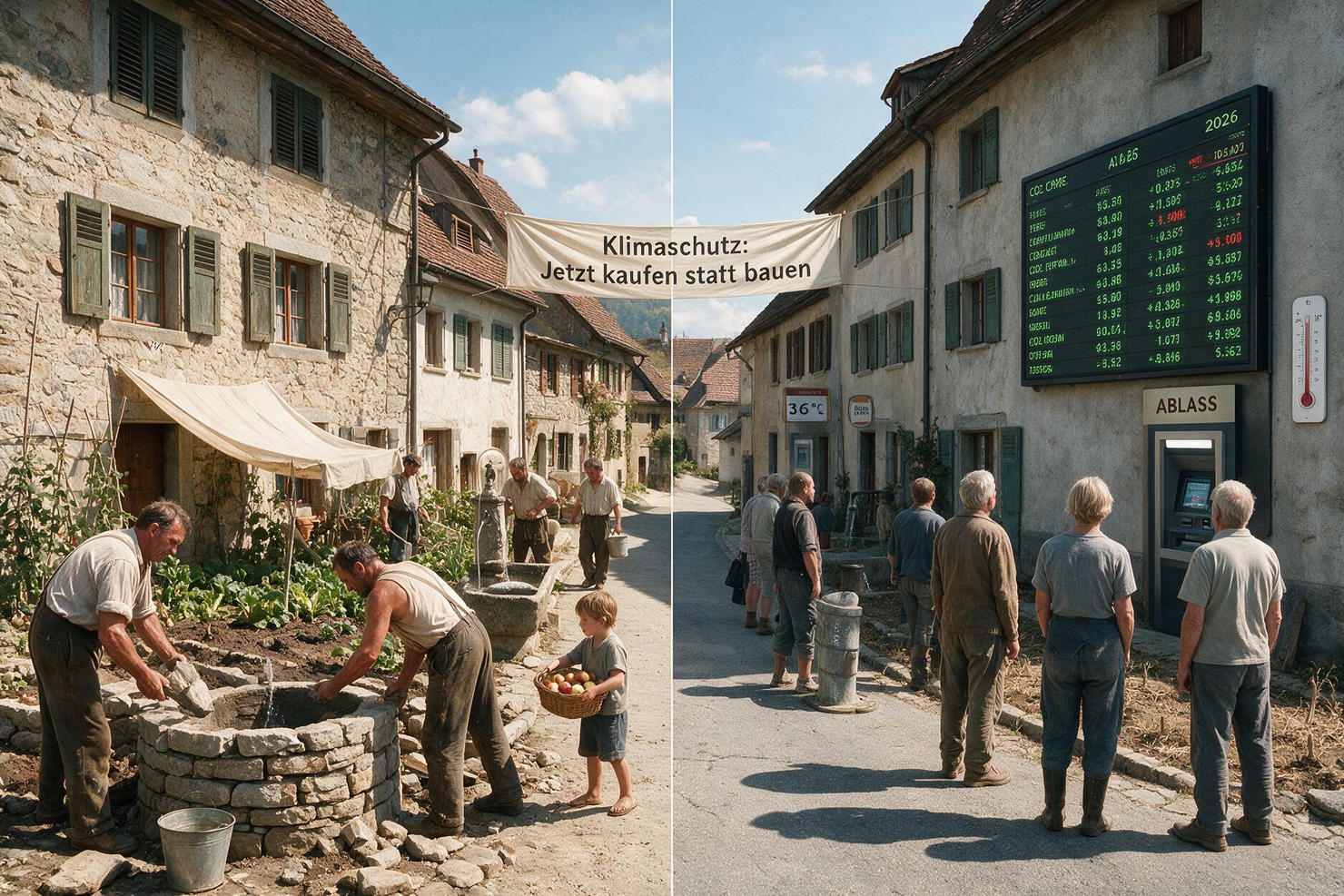
And that's precisely where physics diverges from politics. Those who want to curb evaporation build storage, shade, and manage water resources. Those who proclaim an "annual pandemic" and in the next breath recommend carbon credits from Bangkok don't want to prevent heat, but rather impose a price. The pandemic has shown how a model becomes law and a signal becomes a state of emergency, and climate trading follows the same choreography with better weather. The thermometer provides the images, the model provides the percentages, and the stock market delivers the bill. A professor calculates the catastrophe down to the decimal point and sells the solution to the highest bidder. A federal government buys its emissions reductions in Thailand and taxes summers at home. A science that rewrites its own oracle every six years and calls it insight—and everyone calls this "climate protection"!
More for you:



 "Dravens Tales from the Crypt" has been enchanting for over 15 years with a tasteless mixture of humor, serious journalism - for current events and unbalanced reporting in the press politics - and zombies, garnished with lots of art, entertainment and punk rock. Draven has turned his hobby into a popular brand that cannot be classified.
My blog was never designed to spread news, let alone get political, but with current affairs I just can't help but capture information here that is otherwise censored on all other channels. I am aware that the design page may not seem "serious" to many in this regard, but I will not change this to please the "mainstream". Anyone who is open to non-state-compliant information sees the content and not the packaging. I've tried enough to provide people with information over the last 2 years, but quickly noticed that it never matters how it's "packaged", but what the other person's attitude towards it is. I don't want to put honey on anyone's mouth to meet expectations in any way, so I'll keep this design because hopefully at some point I'll be able to stop making these political statements, because it's not my goal to go on like this forever  I leave it up to everyone how they deal with it. However, you are welcome to simply copy and distribute the content, my blog has always been under the WTFPL license.
It's hard for me to describe what I'm actually doing here, DravensTales has become a culture blog, music blog, shock blog, tech blog, horror blog, fun blog, a blog about found items on the internet, internet bizarre, trash blog, art blog, water heater, zeitgeist blog over the years , Scrap blog and grab bag blog called. Everything that is right ... - and yet not. The main focus of the blog is contemporary art, in the broadest sense of the word.
To ensure the continued operation of this site, you are welcome to make a donation via credit card, PayPal, Google Pay, Apple Pay, or direct debit/bank account . Many thanks to all readers and supporters of this blog!