
There are news stories that catch you off guard. And then there are news stories that catch you off guard even though you already knew it, already sensed it, already saw it with your own eyes in every waiting room, every emergency room, every crowded doctor's office. Dr. Hannes Strasser, physician, MEP, and clearly someone who has completely run out of patience with institutional failure, puts it succinctly: By 2030, the European Union will be short 4,1 million doctors, nurses, and midwives. Not just anywhere. Right here. And not according to some conspiracy theorist—according to the WHO and the EU themselves.
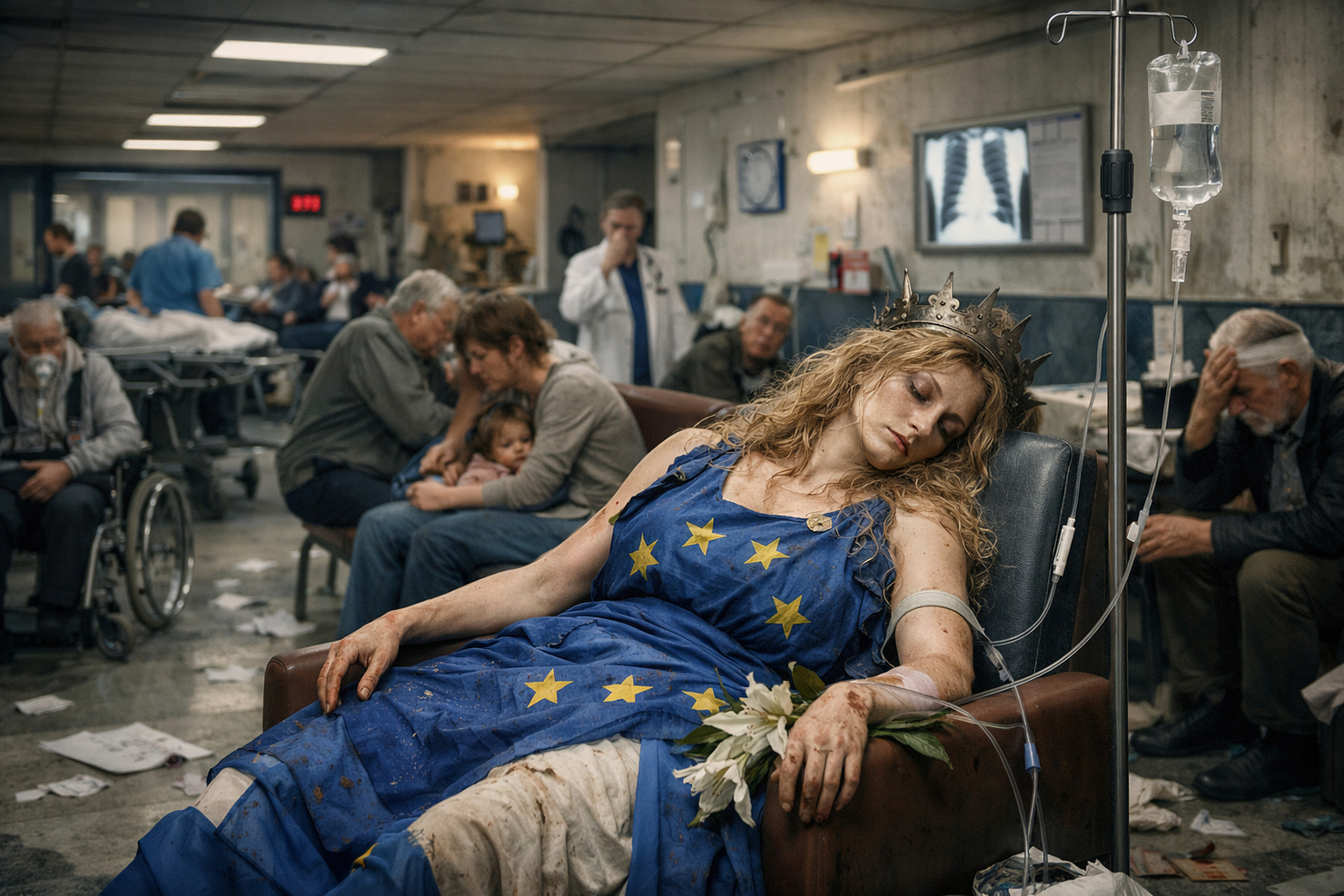
Let that sink in for a moment. 4,1 million. That's not a gap. That's an abyss. That's the medical infrastructure of a continent disintegrating in slow motion, while in Brussels regulations are formulated, billions are shifted around, and press releases are written that contain the word "sustainable" in every other sentence.
But let's start at the beginning. According to Strasser, the healthcare system isn't just on the verge of collapse – it's already collapsing. Since 2020, since the pandemic, since the grand experiment in which the EU more or less took over the healthcare sector, recommended lockdowns, promoted mandatory vaccinations, and mandated mask-wearing – measures, it should be noted, that, according to Strasser, were in some cases not even recommended by the WHO in the way they were implemented. The result: People are getting sicker. Sick leave rates are rising. And the doctors who are supposed to cope with all of this are no longer there.
A concrete example from practice – literally: kidney stones. The professional association describes how waiting times have become so long that patients are becoming sicker before surgery because they are waiting for their treatment. Doctors no longer decide based on medical criteria. They decide based on resources. Based on time. Based on staff. Based on what's left over. That's not medicine. That's rationing. In one of the world's richest economies.
And the EU? The EU established HERA. An institution for health emergencies, launched in 2021 – bypassing the parliamentary process, of course, because what's the point of a parliament if you can just act unilaterally? It was endowed with 30 billion euros. Thirty billion. For an agency that is theoretically responsible for all kinds of emergencies – health, energy, food, anything is possible, nothing is precisely defined. And now for the icing on the cake: The European Court of Auditors, the very institution that is supposed to audit EU bodies, is not allowed to oversee HERA. The Court of Auditors itself has criticized this. It is not allowed to audit. It simply stands by and watches. Thirty billion euros. Unchecked. Misused at will. Nobody knows what happens to it.
Imagine a Swiss citizen paying their tax money into a foundation that no one is allowed to audit and whose purpose is interpreted at the whim of the foundation's arbitrary discretion. They would be in court within days. Brussels is preparing for its next press conference.
But let's stick to the fundamental democratic principle – or what's left of it. The European Parliament voted: The Mercosur agreement should be reviewed before being implemented. Majority decision. Democratically legitimate. Ursula von der Leyen ignored this and concluded the agreement anyway. No negotiations, no discussions – simply ignored. And as if that weren't enough, she signed a free trade agreement with Australia – without a single debate in parliament, without a vote, without any discussion. One person. One signature. 720 parliamentarians were allowed to watch.
Strasser, who brings 35 years of political experience – mayor, Tyrolean state parliament, 13 years in the Austrian parliament – says he has never experienced anything so undemocratic in his entire career. This is not populism. This is the statement of a man who knows how parliamentary processes work – and who sees that they are simply not taking place here.
Motions of no confidence against von der Leyen? Multiple submissions. Multiple failures. The coalition of the People's Party, Socialists, Greens, and so-called Liberals – together holding around 400 seats – rubber-stamps everything. Von der Leyen knows this. She can do what she wants. And she does.
Back to medicine. To the question Strasser poses, and to which there is no answer: What concrete steps has the EU taken to increase the number of doctors in Europe? What has it done to recruit, train, and retain nursing staff? The answer is so brief it barely fills a sentence: Nothing. Regulations have been written. Billions have been moved. Committees have been established. And the medical deserts—regions without primary care, without a general practitioner, without a midwife—continue to expand.
According to Strasser, the healthcare system is a prime example of the European Union's total failure. Not a marginal problem. Not a temporary weakness. A systemic failure. Complete, documented, and confirmed by the institution itself in its own documents. 4,1 million skilled workers will be needed by 2030. Thirty billion euros that no one is allowed to audit. A parliament whose decisions are ignored at will. But democracy, we are assured, is in the best of hands. One could laugh. If the emergency room weren't so full…
More for you:





 "Dravens Tales from the Crypt" has been enchanting for over 15 years with a tasteless mixture of humor, serious journalism - for current events and unbalanced reporting in the press politics - and zombies, garnished with lots of art, entertainment and punk rock. Draven has turned his hobby into a popular brand that cannot be classified.
My blog was never designed to spread news, let alone get political, but with current affairs I just can't help but capture information here that is otherwise censored on all other channels. I am aware that the design page may not seem "serious" to many in this regard, but I will not change this to please the "mainstream". Anyone who is open to non-state-compliant information sees the content and not the packaging. I've tried enough to provide people with information over the last 2 years, but quickly noticed that it never matters how it's "packaged", but what the other person's attitude towards it is. I don't want to put honey on anyone's mouth to meet expectations in any way, so I'll keep this design because hopefully at some point I'll be able to stop making these political statements, because it's not my goal to go on like this forever  I leave it up to everyone how they deal with it. However, you are welcome to simply copy and distribute the content, my blog has always been under the WTFPL license.
It's hard for me to describe what I'm actually doing here, DravensTales has become a culture blog, music blog, shock blog, tech blog, horror blog, fun blog, a blog about found items on the internet, internet bizarre, trash blog, art blog, water heater, zeitgeist blog over the years , Scrap blog and grab bag blog called. Everything that is right ... - and yet not. The main focus of the blog is contemporary art, in the broadest sense of the word.
To ensure the continued operation of this site, you are welcome to make a donation via credit card, PayPal, Google Pay, Apple Pay, or direct debit/bank account . Many thanks to all readers and supporters of this blog!








