
There's a tool that can reshape beliefs without the victim even noticing the intervention—and half the communications industry thrives on it. It's called framing, it works with the connotations of words, and its most persistent enemy isn't the alert citizen or the heroic advocate for enlightenment. Its most persistent enemy is the pedantic nitpicker who insists on definitions and the immigrant who painstakingly deciphers every German sentence by hand.

The brain is idling.
Human working memory is a joke of a storage device. Psychologist George Miller already estimated its capacity in 1956 at seven magical units, plus or minus two More disjointed bits simply won't fit. To prevent the brain from constantly overloading, it groups information into larger units, a process called chunking: 1945 occupies four slots, while 1945, as a historical date, only takes up one. Incidentally, this has nothing to do with the ten bits per second to do what Caltech measured as the speed limit of conscious thought in 2024 – two different findings that are often conflated into a single number in cases of half-knowledge.
When reading, the brain doesn't patiently wait for every word. It anticipates what's coming next, retrieving concepts and sentence patterns in advance, thus saving energy. The infamous Garden Path sentences in English—"The horse raced past the barn fell"—demonstrate just how reliably this autopilot works, as the prediction is so consistently wrong that you have to read the sentence twice. The brain is constantly guessing. And those who are constantly guessing are constantly susceptible to manipulation.
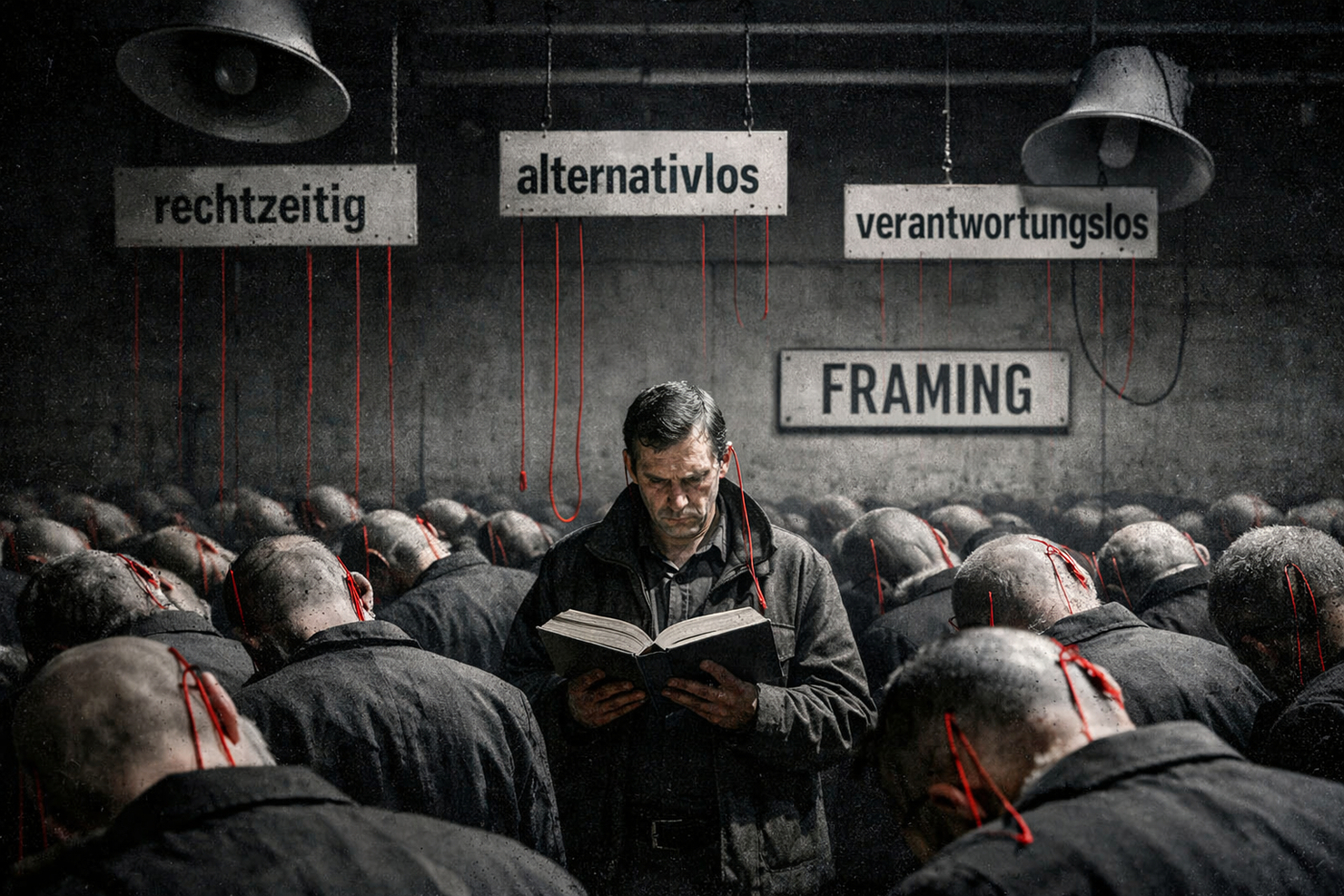
Where the connotation leads the cudgel
This is precisely where framing comes into play. Whether something should be done in good time, early, or promptly conveys the same factual information—but three different levels of emphasis, with "promptly" being the most forceful. A critic examines, a denier lies: same action, completely different connotation. The insidious thing about it is that this connotation is processed without conscious thought. No one consciously decides to consider "conspiracy theorist" a credible description—the judgment is made before reason has even been consulted. Daniel Kahneman called the relevant mode "fast, lazy thinking," which takes every shortcut it can get. The linguist Elisabeth Wehling has... “Political framing” The demonstration showed how professional communicators pave the way with these abbreviations: taxes become a "burden," corporate profits become "high achievers," dissenters become "conspiracy theorists," and war becomes a "special operation." The frame is set before the argument even begins.
The defect in the system
And now for the catch, the flaw in this whole beautiful machine: it only works when idle. Framing is effective exclusively where language is processed automatically – that is, by native speakers. Those who speak German as a foreign language have to consciously decode every unfamiliar construct, and with this conscious decoding, the embedded emotional subtext is already defused. The same applies to the language pedant who stubbornly demands a definition for every term, who distinguishes between "separation of powers" and "segregation of powers," and who refuses to accept the label offered. The English writer George Orwell anticipated this principle: shrinking vocabulary shrinks the space of thought along with it – and that is precisely the point of the exercise. You can't grasp a thought for which there is no word – a new label is therefore never merely a label, but a suggestion of how to feel. The pedant rejects the proposal, the non-native speaker doesn't even hear it. The multi-billion-dollar persuasion machine thus fails precisely because of two of the most inconspicuous figures of all: the know-it-all and the migrant. Those who only skim a headline compress the rest. automatically to "it'll be fine" – those who scrutinize every word won't even get into that mode.
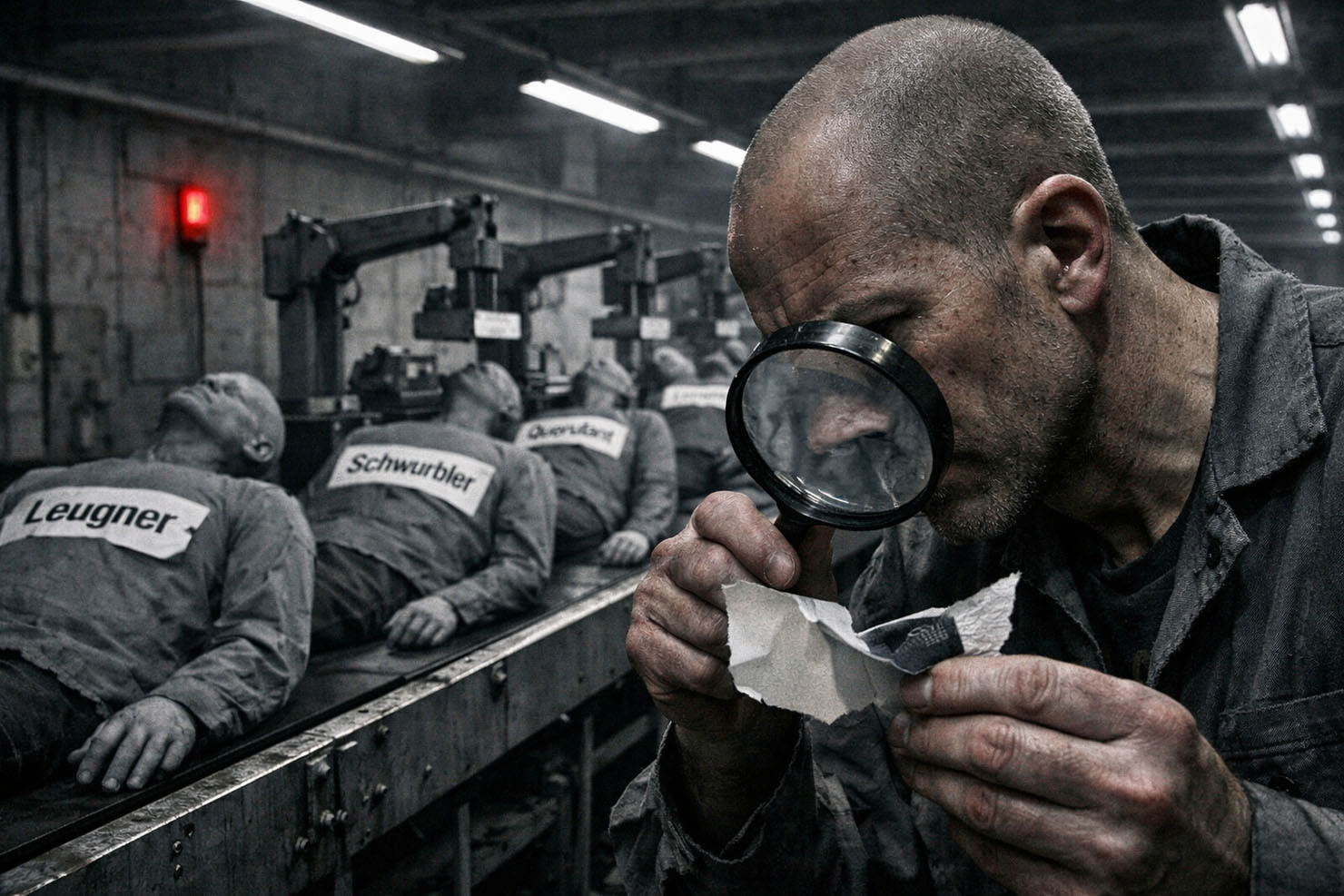
Before the cheers break out
This immunity is not a shield, but a loophole. Firstly, targeted manipulation was never a secret. A research group from Yale published an article in the journal "Vaccine" in 2021. Completely and openly testedThe study investigated which messages most effectively boost vaccination rates and found that appeals to shame and social pressure are the most effective, with the welcome side effect that those treated in this way were subsequently more willing to judge the unvaccinated. No backroom deals, no conspiracy: a peer-reviewed paper, proudly published. Secondly, the analytical defense mechanism has a loophole that everyone can exploit. Poetic and figurative language completely bypasses the analytical language center. It connects directly to emotional memory – The metaphor trumps fact-checking, every time. Even the pedant cries out at the right image. And the foreign language learner, who sees through the subtle frame, stumbles all the more unwittingly into the crude one – into the loud headline, the gesture of authority, the bare number that needs no connotation to have an effect. And thirdly, the most uncomfortable point: Whoever warns you about framing, frames you while warning you withAgenda setting, priming, framing – these tools do not belong to any one side alone.
Keep your words
The unpleasant conclusion remains. Language is not a neutral container for finished thoughts; it actively shapes them. Anyone who adopts the vocabulary of the other side has already accepted their framework before even opening their mouth. The only remotely reliable defense is the most tedious discipline in the world: asking what a word actually means. And refusing to swallow the accompanying label. That pedantry and the effort of foreign languages are the last bulwarks against the opinion industry is the most cynical twist in the whole story. Keep your own words—or someone else will soon be writing the thoughts you think are your own!

More for you:





 "Dravens Tales from the Crypt" has been enchanting for over 15 years with a tasteless mixture of humor, serious journalism - for current events and unbalanced reporting in the press politics - and zombies, garnished with lots of art, entertainment and punk rock. Draven has turned his hobby into a popular brand that cannot be classified.
My blog was never designed to spread news, let alone get political, but with current affairs I just can't help but capture information here that is otherwise censored on all other channels. I am aware that the design page may not seem "serious" to many in this regard, but I will not change this to please the "mainstream". Anyone who is open to non-state-compliant information sees the content and not the packaging. I've tried enough to provide people with information over the last 2 years, but quickly noticed that it never matters how it's "packaged", but what the other person's attitude towards it is. I don't want to put honey on anyone's mouth to meet expectations in any way, so I'll keep this design because hopefully at some point I'll be able to stop making these political statements, because it's not my goal to go on like this forever  I leave it up to everyone how they deal with it. However, you are welcome to simply copy and distribute the content, my blog has always been under the WTFPL license.
It's hard for me to describe what I'm actually doing here, DravensTales has become a culture blog, music blog, shock blog, tech blog, horror blog, fun blog, a blog about found items on the internet, internet bizarre, trash blog, art blog, water heater, zeitgeist blog over the years , Scrap blog and grab bag blog called. Everything that is right ... - and yet not. The main focus of the blog is contemporary art, in the broadest sense of the word.
To ensure the continued operation of this site, you are welcome to make a donation via credit card, PayPal, Google Pay, Apple Pay, or direct debit/bank account . Many thanks to all readers and supporters of this blog!








