
There are stories that are not spoken, but sigh through the very rings of time itself. Stories in which a plant is more than just a raw material. Stories in which something living is suppressed, not because it harms, but because it heals.
The hemp plant belongs to these ancient beings. A green archetype, older than any empire, more humble than any law, and yet more powerful than all the systems that sought to eradicate it.
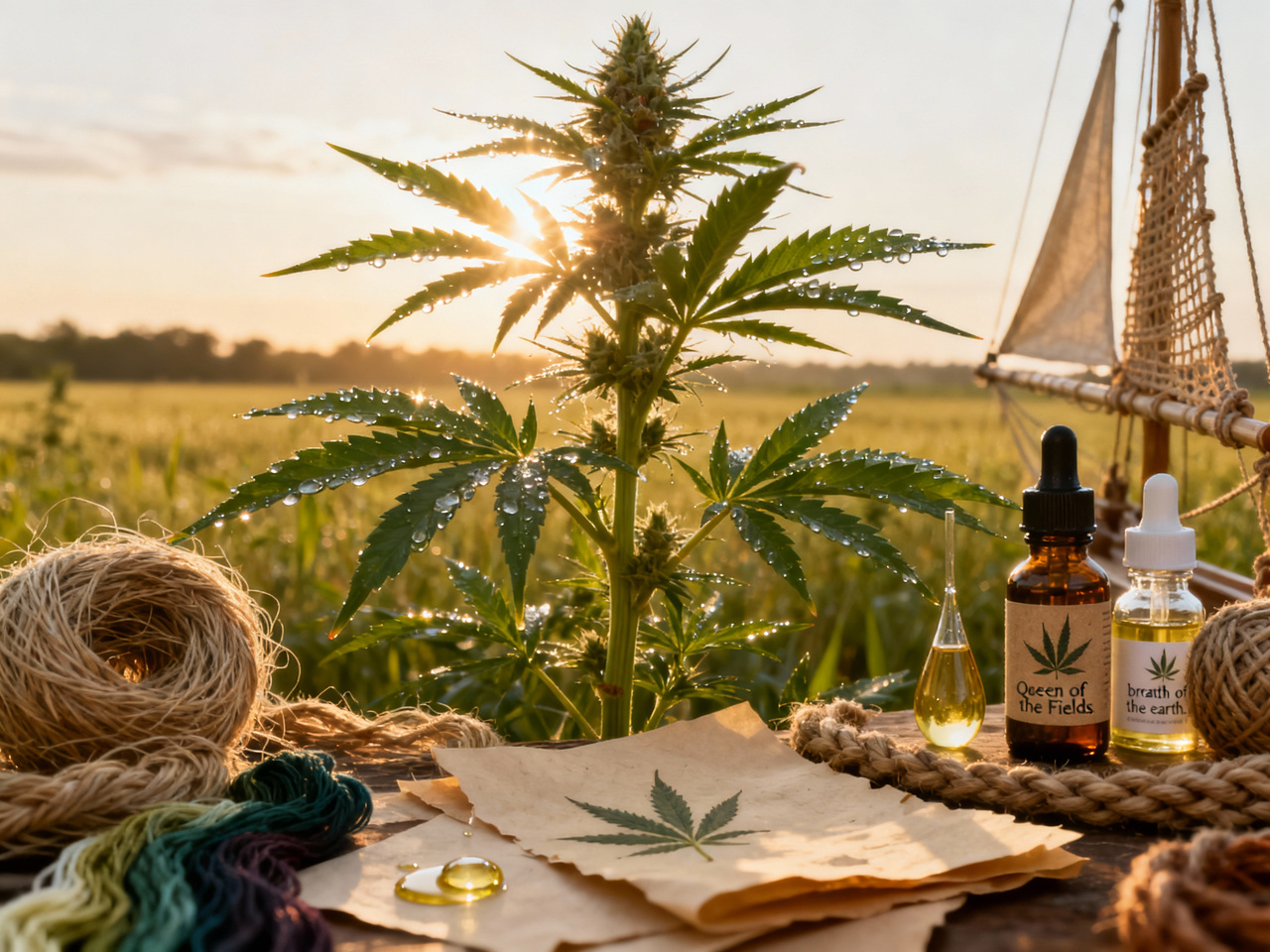
Barely a century ago, it was commonplace: Cannabis sativa, the fiber that held the world together. Until 1833, it reigned supreme in the fields. From it came fabrics, oils, medicinal tinctures, paper, sails, ropes, and paints. It carried the sun's energy into people's bodies, nourishing them, clothing them, and healing them. Hemp fiber was considered unbreakable, as if it carried the very breath of the earth within it.
In the second half of the 19th century, hemp was ubiquitous. Half of all medicines sold at that time were derived from this single plant. Over 25,000 products were made from its cellulose – from cellophane to dynamite. A raw material as flexible as life itself. A raw material that needed no fossil ancestor and didn't deplete the soil.
But then, as always happens when healing is involved, a healed patient becomes a lost customer. And a plant that grants self-sufficiency is an enemy of those who need dependence to rule.
The shadow of the 20th century fell over the fields. Not because the plant was dangerous, but because it was too useful. Too robust. Too independent. Too little reliant on machines, monopolies, and patents. And so it was banished, not through scientific discovery, but through political power. The prohibition was not protection—it was a victory for the rising industries: cotton, paper, oil, pharmaceuticals.
Where natural wealth flows, those who profit from artificial shortages lose out.
Humanity sold its green goddess for more profitable idols.
Since then, we've been talking about sustainability while banning the one raw material that truly deserves the term. We preach environmental protection while ignoring the plant that regenerates the soil, binds CO₂, requires hardly any water, no pesticides, no monoculture, and no factory-bred dependencies.
Hemp is not a plant.
It is a reminder of how free we could be.
And that is precisely the problem.
Because hemp means self-sufficiency.
Autarky means independence.
Independence means that people are less controllable.
Every fiber of hemp is a small act of sovereignty.
Each oil a drop of self-determination.
Every hemp product used is a reminder that we could build systems that work in harmony, rather than in contradiction, with all living things.
Perhaps that is why the plant was not only devalued, but demonized.
Not because it harbors dark forces – but because it brings light.
Because it shows us that another world would be possible. A world in which cycles are self-sustaining, in which nature and culture are not enemies, and in which healing is not a business model but a natural state.
But plants don't sleep.
They are waiting.
Perhaps now is the time for hemp to emerge from the shadows – like an old teacher who has patiently waited for humanity to listen again. Not the people of 1900, working with ropes and sails. But the people of today, who have destroyed enough to be open again to what heals.
The question is not whether hemp should be banned.
The question is how much freedom a society can tolerate when a single plant is enough to remind it that it never had to become dependent.
Perhaps that is the real reason why this ancient green teacher still lives in exile today…
More for you:






 "Dravens Tales from the Crypt" has been enchanting for over 15 years with a tasteless mixture of humor, serious journalism - for current events and unbalanced reporting in the press politics - and zombies, garnished with lots of art, entertainment and punk rock. Draven has turned his hobby into a popular brand that cannot be classified.
My blog was never designed to spread news, let alone get political, but with current affairs I just can't help but capture information here that is otherwise censored on all other channels. I am aware that the design page may not seem "serious" to many in this regard, but I will not change this to please the "mainstream". Anyone who is open to non-state-compliant information sees the content and not the packaging. I've tried enough to provide people with information over the last 2 years, but quickly noticed that it never matters how it's "packaged", but what the other person's attitude towards it is. I don't want to put honey on anyone's mouth to meet expectations in any way, so I'll keep this design because hopefully at some point I'll be able to stop making these political statements, because it's not my goal to go on like this forever  I leave it up to everyone how they deal with it. However, you are welcome to simply copy and distribute the content, my blog has always been under the WTFPL license.
It's hard for me to describe what I'm actually doing here, DravensTales has become a culture blog, music blog, shock blog, tech blog, horror blog, fun blog, a blog about found items on the internet, internet bizarre, trash blog, art blog, water heater, zeitgeist blog over the years , Scrap blog and grab bag blog called. Everything that is right ... - and yet not. The main focus of the blog is contemporary art, in the broadest sense of the word.
To ensure the continued operation of this site, you are welcome to make a donation via credit card, PayPal, Google Pay, Apple Pay, or direct debit/bank account . Many thanks to all readers and supporters of this blog!








