A blood pressure-lowering drug, whose mechanism of action earned it the Nobel Prize in Medicine in 1998, has been available over the counter for decades, yet it is rarely prescribed. The reason is not medical: you can't patent an amino acid. Five years of taking cholesterol-lowering medication as a preventative measure prevents a heart attack in one out of 104 people, saves zero lives, and causes diabetes in one out of fifty.

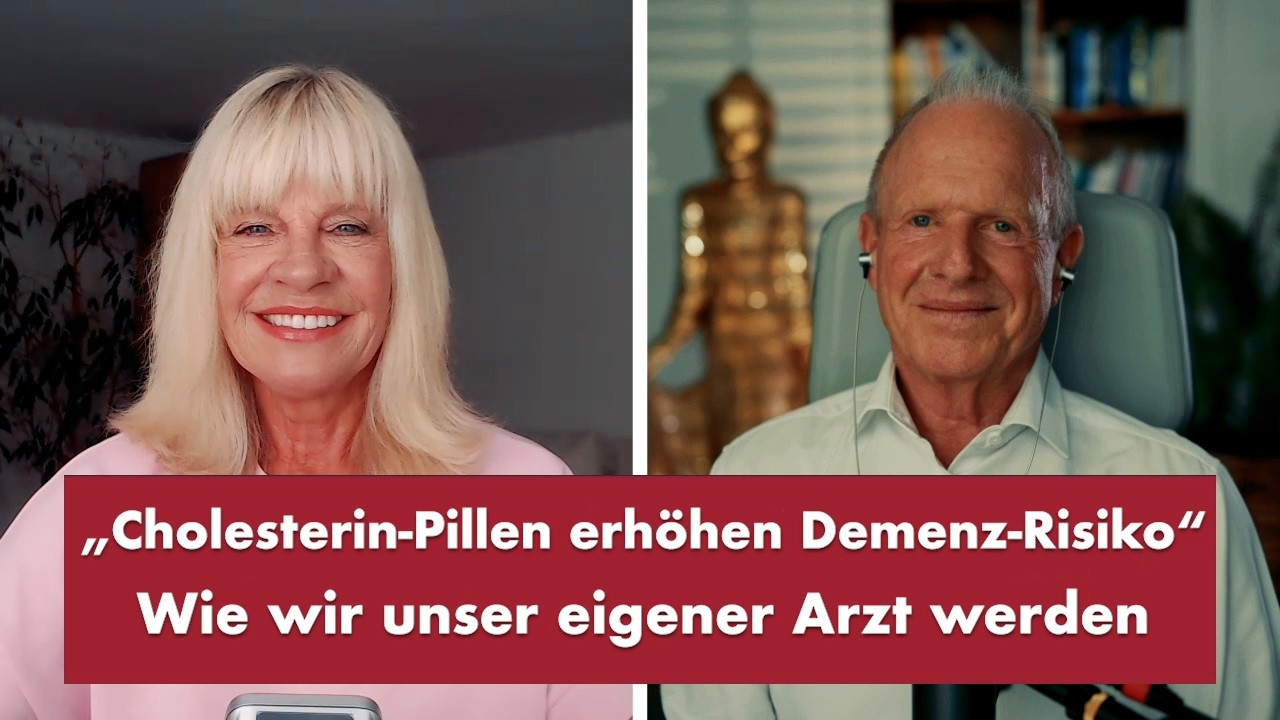
These figures don't come from some conspiracy theory pamphlet, but from TheNNT , a group of doctors who, according to their own statement, accept no outside funding and no advertising. Salzburg-based doctor Michael Spitzbart says the same thing in a more forceful tone in a conversation with Milena Preradovic and recommends throwing the pills away immediately. Some of his figures don't stand up to scrutiny. The astonishing thing is that this makes the situation worse, not better.
The hit rate that nobody talks about
Statins reliably lower cholesterol. According to current data, they do not reduce the risk of death in people without a prior heart attack. Ninety-eight percent of those treated experience no benefit over five years, while one in ten suffers from muscle problems. Furthermore, twelve randomized studies with approximately 1800 participants show that these drugs measurably lower coenzyme Q10 levels – precisely the substance on which the powerhouses of muscle cells depend.
The same group of doctors concludes that the Mediterranean diet is significantly more effective than any statin and is harmless. This is not an unfounded claim: PREDIMED , a Spanish state-funded study with 7447 participants, reduced serious cardiovascular events by thirty percent. Olive oil and nuts.
The dementia accusation, however, doesn't hold water in this harsh form. The largest analysis, comprising 55 studies and over seven million patients, finds a lower risk of dementia with statins, while the randomized long-term trials find nothing at all. Anyone who saves zero lives and leaves one in ten paying the price with muscle damage hardly needs dementia as an accusation anyway.
Four cancers a day and ninety percent fat
Two figures from the conversation need to be dissected because both are incorrect, yet both point to something substantiated.
Firstly, the myth that everyone gets cancer four times a day, which the immune system then eliminates. The number four is just folklore; nobody has ever actually counted four. The underlying mechanism, however, is explained in every textbook – and on Bayer 's oncology website , where it states that cancer cells develop daily and are generally eliminated by the immune system. When a pharmaceutical company itself promotes the premise of immune surveillance, it's difficult to dismiss it as mere esotericism.

Secondly, it is claimed that fructose is converted into energy at a rate of ten percent and into fat at a rate of ninety percent. Isotope tracer studies in humans show something different: around 41 percent is converted into glucose, about a quarter into lactate, and less than one percent directly into blood lipids . The ninety percent figure is orders of magnitude off. The point still stands, however, only better substantiated: when sugar was replaced with starch in 41 overweight children for nine days, with the same calorie intake, liver fat and abdominal fat decreased . Nine days. Without a single medication.
Otto Warburg received the Nobel Prize in 1931 for his discovery that tumor cells ferment sugar instead of metabolizing it. From this, Spitzbart derives an annual four- to six-week ketogenic diet. His evidence, as he himself admits, consists of his patient base – forty years of anecdotal evidence. Research is exactly as advanced as the industry has allowed it to be: In 2018, Lewis Cantley's group showed in Nature that ketosis suppresses insulin feedback and makes a class of cancer drugs effective in mouse models. Administered on its own, the diet was harmful in one of the models. The sobering conclusion is: Without high-quality clinical trials, the effects in humans remain unknown. They don't exist because no one is investing hundreds of millions in proving that a product should be avoided. This is the actual business model , and it works perfectly with sugar, where politicians prefer to tax symptoms and subsidize causes.
Measure instead of swallowing
Spitzbart's approach is unspectacular and therefore unsellable: The body needs forty-seven essential substances, and if one of them is at seventy percent, the whole system is functioning at seventy percent. Measure first, then replenish.
What's astonishing is how well-documented this is once you look at it. Arginine, the amino acid that won the 1998 Nobel Prize: eleven double-blind studies showed a systolic blood pressure reduction of 5,4 millimeters of mercury . Dietary fiber binds bile acids, the body synthesizes new ones from cholesterol, and cholesterol levels decrease. In an analysis of 218 randomized controlled trials, exercise significantly outperformed control conditions in cases of depression .

Things get really strange when it comes to inner dialogue. It's said that only ten percent of people in the Western world engage in positive self-talk. The counter-statistic – that eighty percent of all thoughts are negative – has been circulating in self-help literature for decades, routinely attributed to the National Science Foundation, which has never published such a study. The actual measurements were somewhat more modest: up to seventy percent of spontaneous thoughts are negative, and the number of daily thoughts, according to research by a group at Queen's University, is around 6200, not 60,000. The general idea is correct, but the impact is borrowed.
And then comes the real irony: While tryptophan is recommended to combat nighttime rumination, psychiatry is currently dismantling its own serotonin narrative. Joanna Moncrieff's review article in Molecular Psychiatry finds no reliable evidence that depression is caused by a serotonin deficiency. Nevertheless, over eighty percent of the population considers it proven. Advertising has been more effective than the molecule itself. Incidentally, the recommended serotonin level from a lab test is of no help, because the serum level reveals virtually nothing about the level in the brain – the blood-brain barrier is non-negotiable.
One potentially painful point: exceeding the recommended dosage tenfold with tryptophan isn't a dare, but rather, when taken concurrently with antidepressants, a path to serotonin syndrome. Those who fabricate their own side effects are no wiser than the company that conceals them.
Ninety vaccinations, six children and a light metal
This is where all three sides are inaccurate. The figure of ninety to eighteen vaccinations is incorrect: The American calendar, including annual flu and COVID-19, comes to 72 doses , while in German-speaking countries, thanks to combination vaccines, the number is significantly lower. Furthermore, aluminum hydroxide is not a heavy metal, but a light metal – mercury would have been, but the long-lasting thiomersal was already removed from routine vaccinations in 2001.

The claim that allergies are ten times less common in unvaccinated individuals stems from a survey of 415 homeschooling families, which even cited a factor of thirty for allergic rhinitis and was subsequently retracted twice. Now comes the part that neither side wants to hear. The Robert Koch Institute examined the same question in 17,641 children participating in the KiGGS survey and found no correlation between vaccination status and atopy. Of the children included in the analysis, 0,7 percent were unvaccinated. In the six-to-ten-year-old age group, this finding is based on a mere six unvaccinated children, and in the eleven-to-seventeen-year-old age group, on eight. Six. With this sample size, nothing can be proven, in either direction, and no one has funded a larger study.
Regarding aluminum itself, a Danish registry analysis of 1,2 million children found no association with fifty chronic diseases, but independent researchers are launching a methodological attack on the study . Meanwhile, the most revealing fact is verifiable: the Paul Ehrlich Institute explains, upon request , why aluminum remains in use. A different adjuvant system would require a completely new development with new clinical trials. It's not about safety. It's about approval costs.
When the treatment itself is on the death list
The most compelling claim remains: that medicine itself is the third leading cause of death. This figure originates from Martin Makary and Michael Daniel, who in 2016 averaged four studies from the years 2000 to 2008 in the BMJ and extrapolated to the American hospital admissions of 2013. The result: approximately 251,000 deaths. No new data, no formal synthesis – the editors of BMJ Quality & Safety made this perfectly clear ; later analyses arrive at significantly lower preventable mortality figures. And yet: the fact that the debate centers on the order of magnitude rather than a reliable figure is not due to incompetent researchers. It stems from the fact that no death certificate includes a field for this question.
In the end, we have an industry that has ignored a 1998 Nobel Prize for almost thirty years because the molecule has no owner. It sells pills for five years that prevent one heart attack per 104 patients and calls that prevention. It funds ninety percent of the studies that test its own products and is amazed by the excellent results. And if someone recommends olive oil, walks, and a proper blood test, they'll say there's no evidence for it—which is absolutely true, because nobody ever paid for it!
More for you:






 "Dravens Tales from the Crypt" has been enchanting for over 15 years with a tasteless mixture of humor, serious journalism - for current events and unbalanced reporting in the press politics - and zombies, garnished with lots of art, entertainment and punk rock. Draven has turned his hobby into a popular brand that cannot be classified.
My blog was never designed to spread news, let alone get political, but with current affairs I just can't help but capture information here that is otherwise censored on all other channels. I am aware that the design page may not seem "serious" to many in this regard, but I will not change this to please the "mainstream". Anyone who is open to non-state-compliant information sees the content and not the packaging. I've tried enough to provide people with information over the last 2 years, but quickly noticed that it never matters how it's "packaged", but what the other person's attitude towards it is. I don't want to put honey on anyone's mouth to meet expectations in any way, so I'll keep this design because hopefully at some point I'll be able to stop making these political statements, because it's not my goal to go on like this forever  I leave it up to everyone how they deal with it. However, you are welcome to simply copy and distribute the content, my blog has always been under the WTFPL license.
It's hard for me to describe what I'm actually doing here, DravensTales has become a culture blog, music blog, shock blog, tech blog, horror blog, fun blog, a blog about found items on the internet, internet bizarre, trash blog, art blog, water heater, zeitgeist blog over the years , Scrap blog and grab bag blog called. Everything that is right ... - and yet not. The main focus of the blog is contemporary art, in the broadest sense of the word.
To ensure the continued operation of this site, you are welcome to make a donation via credit card, PayPal, Google Pay, Apple Pay, or direct debit/bank account . Many thanks to all readers and supporters of this blog!