
How the US Department of Defense has been writing Hollywood scripts for decades — and why you should know this before the next blockbuster. You've seen Top Gun. You've seen Iron Man. Transformers. Black Hawk Down. James Bond. The Marvel Cinematic Universe. Argo. American Sniper. Jurassic Park. Godzilla. Meet the Parents. The Pentagon and the CIA have been involved in all of these productions — a fact documented by over 60,000 internal government documents released under the Freedom of Information Act.
You sat there, eating popcorn, completely unaware that a U.S. Department of Defense official co-wrote the screenplay. In the industry, this is called "entertainment." In the military, it's known as "the most effective propaganda machine in the world." The business model is as simple as it is brazen: When a filmmaker approaches the Pentagon and requests access to military equipment, they have to submit their screenplay to the Entertainment Liaison Office for review. If approved, they get jets, tanks, and bases for free. If rejected, the Pentagon packs up its toys and goes home. No military helicopters, no F-18s, no aircraft carriers. And without these resources, a blockbuster in 2026 is about as feasible as a sandbox war movie.
To secure full cooperation, producers must sign contracts—so-called Production Assistance Agreements—binding them to a military-approved version of the script. Filmmakers who improvise or deviate from the approved script risk conflict with the responsible Pentagon liaison. On the set of Iron Man at Edwards Air Force Base, there was a heated argument between the then-DoD chief liaison, Phil Strub, and director Jon Favreau. Phil Strub. The man who censored Iron Man. The man who inserted the line "Bring 'em home" into Jon Voight's dialogue in a Transformers scene—to give the military a protective, paternal quality that the DoD, as is well known, doesn't exactly embody in reality. The man who had a joke cut from a James Bond film because it mentioned Vietnam.
Pentagon objections—usually the death knell for a project—refer to any suggestion of military incompetence, war crimes, loss of control over nuclear weapons, influence of oil companies, illegal arms sales, the use of chemical or biological weapons, as well as US support for coups abroad or involvement in torture and assassinations. Precisely the things the US military has demonstrably done . The irony is profound and lingers.
The documentary "Theaters of War" concludes that the Pentagon and CIA have exercised direct editorial control over more than 2500 films and television programs. To put this in perspective: these aren't productions where an officer occasionally drops by the set. This is systematic script oversight. This is a government apparatus intervening in the earliest stages of development—according to internal documents, precisely "when characters and storylines can most easily be shaped in the interest of the military." Propaganda is most effective when it passes for entertainment: people are more receptive to ideas because their defenses are lowered. This isn't a quote from a skeptical blogger. This is the conclusion of a scholar featured in the documentary. And it's the most accurate description of what has been happening for decades.
In 2023, according to the Wikipedia entry on the Military Entertainment Complex, the DoD supported shows including America's Got Talent, The Kelly Clarkson Show, and The Price Is Right. So it's not just tank movies they protect. They also protect baking shows. The reach of the Pentagon narrative extends all the way to late-night television—and nobody questions why a defense agency with an $850 billion annual budget invests in quiz shows. As Glen Roberts, director of the DoD Entertainment Media Office, explained in an interview, his office evaluates films based on the criteria of "safety, accuracy, policy, and appropriateness"—though he admitted that the real question is: "Is this the right way we want to present ourselves to the public?"
Accuracy is therefore secondary. Image management is primary. The director of the official propaganda bureau himself says so – in an interview. Without batting an eye. The result of this decades-long institutional embrace is a popular culture in which the American soldier is, by default, the hero, the American enemy, by default, faceless and barbaric, and American war crimes, by default, nonexistent. Not because Hollywood is anti-Semitic, anti-Islamic, or anti-anything – but because the easiest way to get tanks, aircraft carriers, and bases leads through Phil Strub's office.
Next time you're in the cinema and an F-18 flies gracefully over a sunset: taxpayers paid for that. And someone from the Pentagon co-wrote the script—but the credits don't mention them. That's intentional…
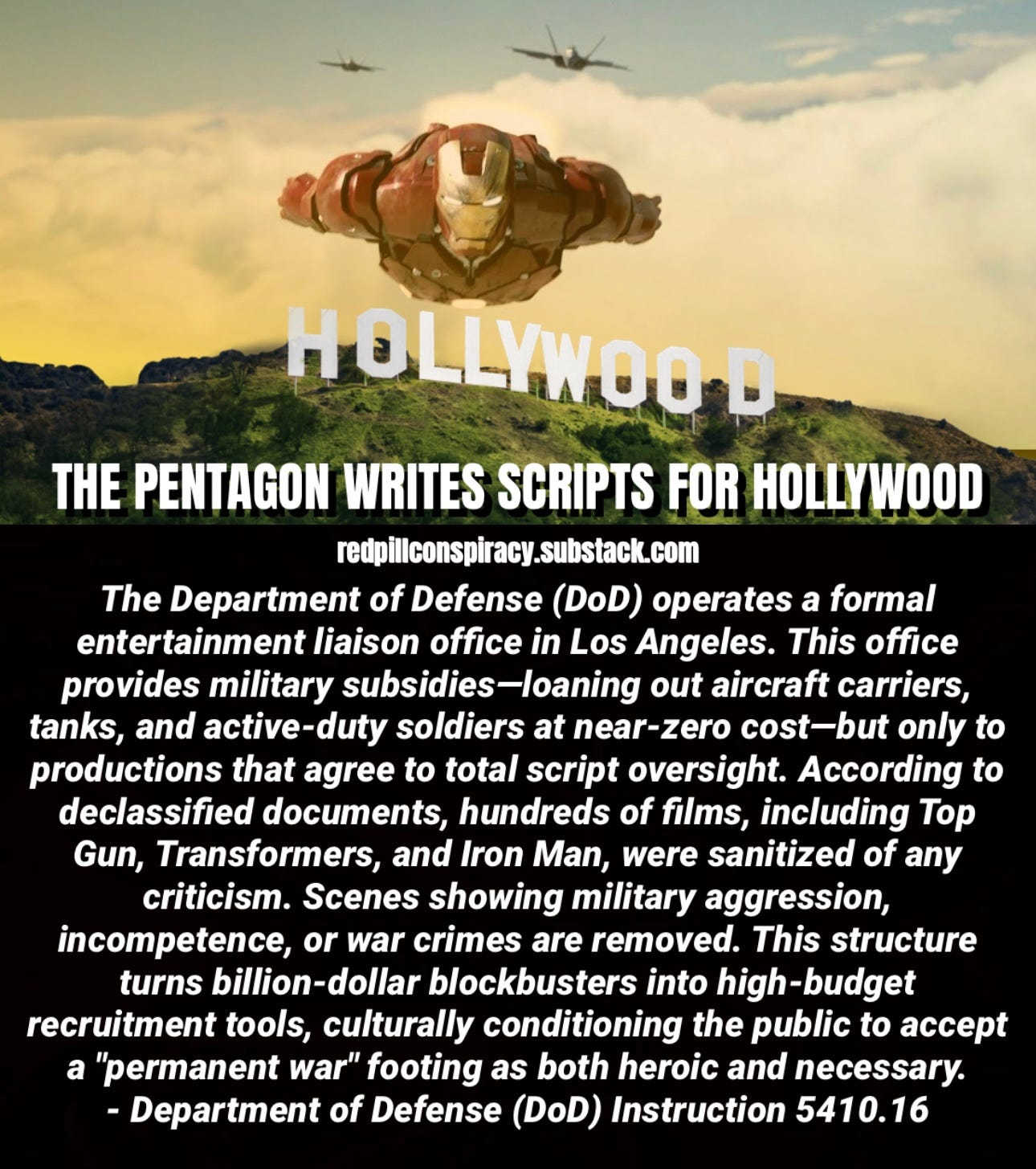
The Pentagon writes screenplays for Hollywood
The U.S. Department of Defense (DoD) operates an official liaison office for the entertainment industry in Los Angeles. This office grants military subsidies—providing aircraft carriers, tanks, and active-duty soldiers at virtually no cost—but only to productions that agree to complete script control. According to declassified documents, hundreds of films, including Top Gun, Transformers, and Iron Man, have been cleared of any criticism. Scenes depicting military aggression, incompetence, or war crimes are removed. This structure transforms billion-dollar blockbusters into high-budget recruitment tools and culturally conditions the public to accept a “permanent state of war” as both heroic and necessary.
– US Department of Defense (DoD) Directive 5410.16
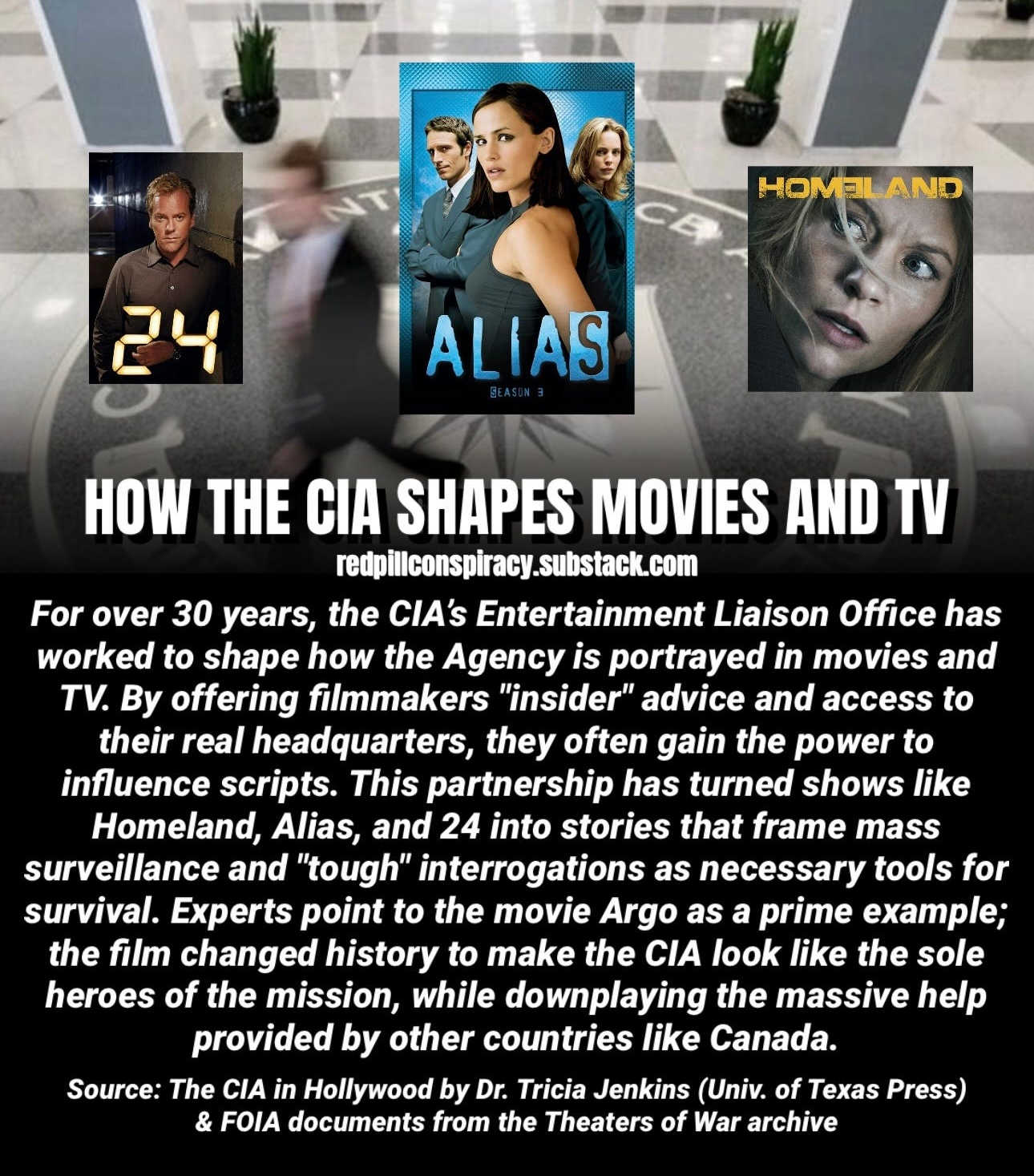
How the CIA shapes films and television
For over 30 years, the CIA's Entertainment Liaison Office has worked to influence the agency's portrayal in film and television. By providing filmmakers with "insider" advice and access to its actual headquarters, it often gains the power to influence scripts. This partnership has transformed series like Homeland, Alias, and 24 into stories that depict mass surveillance and "hard" interrogations as necessary tools for survival. Experts cite the film Argo as a prime example; the film altered the story to portray the CIA as the sole heroes of the mission, while downplaying the massive assistance provided by other countries, such as Canada.
Source: The CIA in Hollywood by Dr. Tricia Jenkins (Univ. of Texas Press) & FOIA documents from the Theaters of War archive
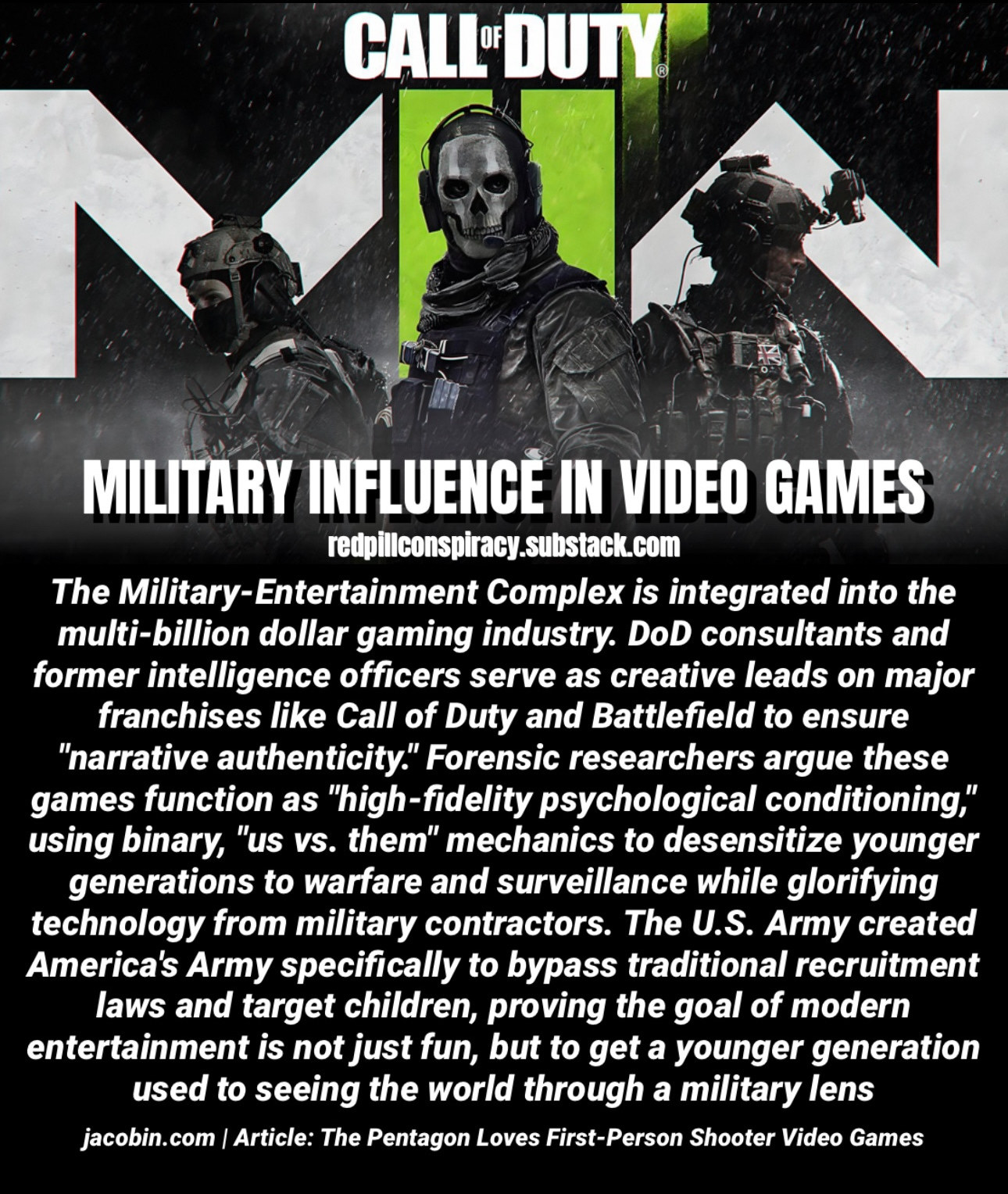
Military influence in video games
The military-entertainment complex is integrated into the multi-billion-dollar gaming industry. Defense Department advisors and former intelligence officers serve as creative directors for major franchises like Call of Duty and Battlefield to ensure "narrative authenticity." Forensic researchers argue that these games function as "highly precise psychological conditioning," employing binary "us versus them" mechanics to desensitize younger generations to war and surveillance while glorifying military technology. The U.S. Army specifically created America's Army to circumvent traditional recruitment laws and appeal to children. This demonstrates that the goal of modern entertainment is not merely fun, but also to conditioned a younger generation to view the world through a military lens.
jacobin.com | Article: The Pentagon loves first-person shooter video games
Sources:
1. The Pentagon Slide
DoD Instruction 5410.16 (Official PDF) – https://www.esd.whs.mil/Portals/54/Documents/DD/issuances/dodi/541016p.pdf
2. The CIA Slide
Theaters of War (Documentary & FOIA Archive) – https://go.mediaed.org/theaters-of-war
3. The Video Games Slide
Jacobin: The Pentagon Loves First-Person Shooter Video Games – https://jacobin.com/2022/10/pentagon-first-person-shooter-video-games-military-recruitment-propaganda
(via Red Pill Conspiracy)
More for you:






 "Dravens Tales from the Crypt" has been enchanting for over 15 years with a tasteless mixture of humor, serious journalism - for current events and unbalanced reporting in the press politics - and zombies, garnished with lots of art, entertainment and punk rock. Draven has turned his hobby into a popular brand that cannot be classified.
My blog was never designed to spread news, let alone get political, but with current affairs I just can't help but capture information here that is otherwise censored on all other channels. I am aware that the design page may not seem "serious" to many in this regard, but I will not change this to please the "mainstream". Anyone who is open to non-state-compliant information sees the content and not the packaging. I've tried enough to provide people with information over the last 2 years, but quickly noticed that it never matters how it's "packaged", but what the other person's attitude towards it is. I don't want to put honey on anyone's mouth to meet expectations in any way, so I'll keep this design because hopefully at some point I'll be able to stop making these political statements, because it's not my goal to go on like this forever  I leave it up to everyone how they deal with it. However, you are welcome to simply copy and distribute the content, my blog has always been under the WTFPL license.
It's hard for me to describe what I'm actually doing here, DravensTales has become a culture blog, music blog, shock blog, tech blog, horror blog, fun blog, a blog about found items on the internet, internet bizarre, trash blog, art blog, water heater, zeitgeist blog over the years , Scrap blog and grab bag blog called. Everything that is right ... - and yet not. The main focus of the blog is contemporary art, in the broadest sense of the word.
To ensure the continued operation of this site, you are welcome to make a donation via credit card, PayPal, Google Pay, Apple Pay, or direct debit/bank account . Many thanks to all readers and supporters of this blog!








