
People get on a bus because they have to go somewhere. Work, shopping, a doctor's appointment, everyday life. No heroic act, no adventure, just the banal ritual of modern mobility. Get on, find a seat, maybe glance at your phone, maybe out the window. The expectation is simple: You get off again later. Alive. On Tuesday in Kerzers, this small, self-evident promise of civilization didn't quite go according to plan.
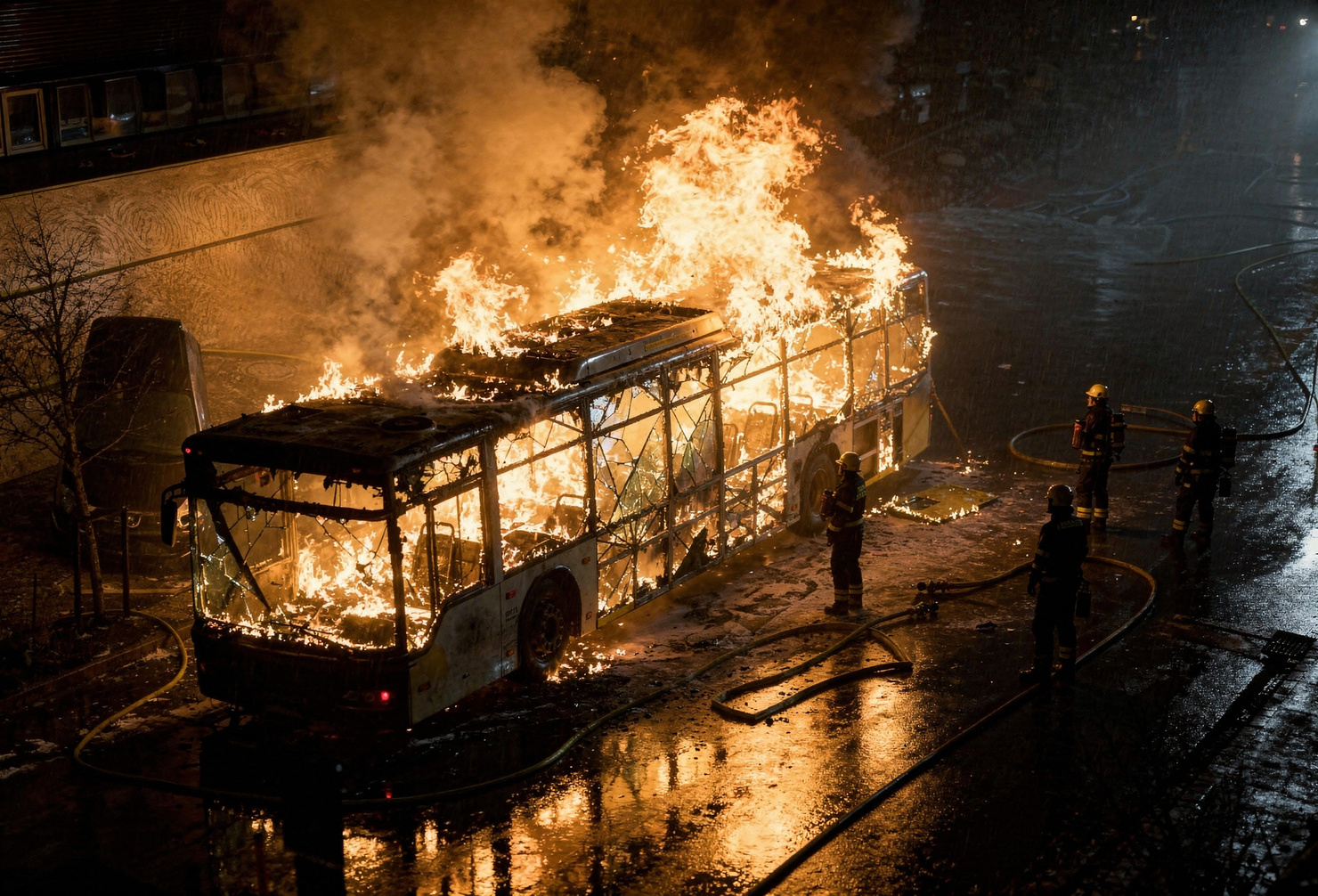
A postal bus burst into flames. Six people died. Five others were injured. A bus full of people transformed within minutes into a burning cage of glass, plastic, and metal. One of those situations where the thin veneer we call "society" suddenly peels away like cheap paint. But don't worry. The most important question was quickly answered. It was not an act of terrorism.
The authorities were quick to clarify this right from the start. No ideology, no political motive, no radical background. Instead, a term that has become as reliably applied as a linguistic band-aid to every gruesome reality: The perpetrator was "mentally unstable." A Swiss man in his sixties, residing in the canton of Bern, reported missing by his family, described by the police as a person "on the margins of society."
A man with problems. A man who apparently disappeared from a hospital. A man who was even wanted by the police. A man who boarded a postal van a few hours later. And then a bus caught fire. One could almost believe these events were connected. But such thoughts are probably too complicated for a world where every drama has to be neatly filed away as quickly as possible.
Psychologically unstable.
Margins of society.
No ideological motive.
Case closed.
Of course, the central question remains: How could a person in this condition even be capable of taking six other people with them to their deaths? But this question is uncomfortable. It leads to unpleasant discussions about responsibility, about systems, about failure. So, it's preferable to focus on something else. For example, the material. A materials expert patiently explained why buses can burn so quickly. Plastic, energy, heat generation, physical processes. All correct, all scientific, all wonderfully technical. If enough energy is released, a large fire erupts.
A realization of almost poetic banality. Fire burns. Heat destroys. People die. Physics functions flawlessly. The part of the story that functions less well is the human one. Because behind the sober formula "deliberate act without ideological motive" lies something far more unpleasant than terrorism. Terror at least has a goal. A message, however perverse it may be. There is none of that here.
No slogan.
No demand.
No ideology.
Pure, raw, naked contempt for humanity.
A person apparently so detached from any social connection that six strangers' lives became fuel for a final act of personal despair. People who were on the wrong bus at the wrong time. People who were simply unlucky enough to be in the same room as someone who was already burned out inside. The difference between terrorism and this kind of act is almost philosophical.
The terrorist believes in something.
The nihilist believes in nothing.
And sometimes nothing is more dangerous.
Meanwhile, the familiar societal reflex kicks in. Flowers at the scene of the crime. Candles. Books of condolence. An improvised memorial. People lay down roses, write a few words, stand silently, and try to distill some form of meaning from the chaos. The Federal President also appeared, speaking of solidarity, of cohesion, of compassion. Words that are reliably pulled from the political toolbox at every tragedy. Words that are correct, dignified, appropriate.
And at the same time, a little helpless. Because while we light candles and talk about solidarity, an uncomfortable truth remains: Our society is not only threatened by ideologues. Not only by extremists. Not only by organized perpetrators. Sometimes a single person is enough.
A person who has collapsed internally.
A person who, for whatever reason, has fallen through the cracks.
A person who believes they have nothing left to lose.
The terror of this act lies precisely in its utter senselessness. There is no political context to explain why six people had to die. No manifesto to analyze. No network to dismantle. Just a burning bus on a Swiss road. And the unsettling realization that sometimes the greatest danger arises not from fanatical belief, but from the complete absence of meaning.
The modern state is remarkably good at combating ideologies. Intelligence agencies monitor, police investigate, laws are tightened. Strategies exist against organized threats. Fewer against human decay. The reality is starkly simple: A highly developed society can build missile defense systems, monitor billions of dollars in traffic, and analyze digital communications. But it cannot always prevent a single, desperate individual from boarding a bus and setting it on fire.
In the end, an image remains that is hard to forget. A postal bus, a symbol of Swiss reliability, rural normality, daily routine. A means of transport that has carried people from village to village for decades. And inside, a fire. Six people who never got off again.
No terror.
No ideology.
Just a burning testament to how thin the veneer of civilization sometimes really is…
More for you:




 "Dravens Tales from the Crypt" has been enchanting for over 15 years with a tasteless mixture of humor, serious journalism - for current events and unbalanced reporting in the press politics - and zombies, garnished with lots of art, entertainment and punk rock. Draven has turned his hobby into a popular brand that cannot be classified.
My blog was never designed to spread news, let alone get political, but with current affairs I just can't help but capture information here that is otherwise censored on all other channels. I am aware that the design page may not seem "serious" to many in this regard, but I will not change this to please the "mainstream". Anyone who is open to non-state-compliant information sees the content and not the packaging. I've tried enough to provide people with information over the last 2 years, but quickly noticed that it never matters how it's "packaged", but what the other person's attitude towards it is. I don't want to put honey on anyone's mouth to meet expectations in any way, so I'll keep this design because hopefully at some point I'll be able to stop making these political statements, because it's not my goal to go on like this forever  I leave it up to everyone how they deal with it. However, you are welcome to simply copy and distribute the content, my blog has always been under the WTFPL license.
It's hard for me to describe what I'm actually doing here, DravensTales has become a culture blog, music blog, shock blog, tech blog, horror blog, fun blog, a blog about found items on the internet, internet bizarre, trash blog, art blog, water heater, zeitgeist blog over the years , Scrap blog and grab bag blog called. Everything that is right ... - and yet not. The main focus of the blog is contemporary art, in the broadest sense of the word.
To ensure the continued operation of this site, you are welcome to make a donation via credit card, PayPal, Google Pay, Apple Pay, or direct debit/bank account . Many thanks to all readers and supporters of this blog!








