
An easy-to-understand guide to developing, teaching, and protecting artificial intelligence
Artificial intelligence is no longer science fiction. It answers our questions, writes our emails, and holds conversations that seem strikingly human. But how does it actually work? How is AI developed, trained, and prevented from getting out of control? The answer is more fascinating and more human than most people realize.

Part One: Structure of the Brain
Every AI begins with a goal. Should it recognize faces? Translate languages? Answer questions? This goal determines everything else. Once the goal is clear, the real work begins, and the first required ingredient is data. And we're talking enormous amounts of it.
For a large language model, such as those used in chatbots and writing assistants, the data pool consists of texts: trillions of words from books, websites, scientific articles, and much more. The goal is to expose the model to as much human language and human knowledge as possible, because AI learns from examples in the same way as humans: through contact and repetition.
At the heart of the AI is a so-called neural network, a mathematical structure loosely inspired by the human brain and consisting of layers of interconnected nodes that exchange information. The network's behavior is determined by billions of tiny numerical values, known as "weights," which represent the strength of the connections between the nodes. Training the AI essentially involves finding the correct weights.
The training is based on a strikingly simple principle: prediction. The model is shown a sentence with the last word missing and attempts to guess it. The success rate is evaluated based on the error rate. Subsequently, a process called backpropagation identifies which factors negatively impacted the prediction and adjusts them slightly. When this is repeated billions of times for trillions of words, something remarkable happens: The model doesn't just learn grammar. It internalizes facts, thought patterns, and context. It begins to understand language—or something very close to understanding.
This phase, known as pre-training, is extremely expensive. It requires thousands of specialized computer chips that run for weeks or months, consuming vast amounts of electricity. The result is a "basic model" that, while generating exceptionally fluent texts, is also unpredictable and sometimes problematic. It has learned from the entire human art of writing, encompassing the full spectrum of human expression: the inspiring and the offensive, the true and the false.
Part Two: Teaching him good manners
An unpolished, pre-trained model is comparable to someone who has read everything ever written but has never learned manners, ethics, or professional conduct. The next stage of development involves imparting these qualities, and this requires several overlapping techniques.
fine tune
After pre-training, the model is trained again, this time with a significantly smaller, carefully selected dataset of high-quality conversations and responses. This teaches it to behave like a helpful, professional assistant, rather than a mere text predictor. The model's weighting gradually shifts towards responses that a thoughtful person would give.
Reinforcement Learning from Human Feedback (RLHF)
One of the most powerful techniques used today is called Reinforcement Learning with Human Feedback (RLHF). The AI generates several different answers to the same question, which are then evaluated by human reviewers. A separate "reward model" is trained to predict what people prefer. The main AI is then trained to maximize this reward and thus learns to generate answers that people perceive as helpful, correct, and appropriate.
This process integrates guardrails, or more precisely, safety precautions and alignment measures, directly into the model's weighting. No rulebook is programmed in. Rather, the model's deeply ingrained tendencies are shaped through thousands of examples and feedback loops to prevent harmful outcomes. This can be compared to the difference between giving a child a list of rules and raising them through consistent guidance, feedback, and example. The AI's values evolve through the latter approach.

Constitutional AI
Some companies go a step further and train the AI to question its own answers based on core principles that essentially serve as rules of conduct for the model. The AI learns to ask itself whether an answer is honest and whether it could cause harm, and adjusts its answer accordingly before making a final decision.
System prompts and fixed filters
Building upon the trained behavior, traditional software tools are employed. System prompts are invisible instructions given to the AI before each conversation, dictating its behavior in the given context. Hard filters are conventional code outside the model that checks input and output for prohibited content and blocks it before it reaches the user. They act like a gatekeeper, while the trained behavior corresponds to the user's own conscience.
System queries can even include tiered access rights, essentially passwords or keys that allow different users to unlock different AI functions. An administrator with the correct key could access features unavailable to a regular user. However, this approach has its limitations: because the AI processes system queries and user messages through the same mechanism, a skilled user might be able to extract or bypass them. For security-critical applications, true security is better ensured by the surrounding software rather than relying on the AI.
Part Three: Testing in the Sandbox
Before an AI is made publicly available, it undergoes a crucial testing phase in a so-called sandbox. This controlled, isolated environment allows the model to be tested risk-free and thoroughly examined. You can think of it like a flight simulator for AI: student pilots can crash the plane a hundred times without anyone getting hurt.
In a sandbox environment, engineers can safely test dangerous scenarios, observe unfiltered behavior, and trial new security measures before implementing them. The AI can be isolated from the internet or sensitive systems, ensuring that even malfunctions can completely contain the damage. When AIs are given functions such as browsing the internet, executing code, or interacting with other software, these capabilities are first tested in a sandbox to identify potential sources of error.
A key component of sandbox testing is red teaming. Researchers—sometimes humans, sometimes other AI systems—attempt to trick the model into misbehaving: they want to get it to say something harmful, disclose confidential information, or circumvent its guidelines through clever wording, role-playing, or coding tricks. This is ethical hacking for AI. The vulnerabilities discovered through red teaming are fixed before the model goes live.

Part Four: The ongoing challenge of prison escape
One of the most sobering realizations about AI security is that it is never truly complete. Because the safeguards are embedded in the model's weights rather than in explicit, readable code, they cannot be mathematically verified like traditional software. You can't simply read the weights and confirm their safety. You have to examine the model through testing and observe its behavior.
This creates a so-called jailbreaking problem. Users who want to trick an AI into misbehaving can sometimes achieve this by finding gaps in its training, asking convoluted questions, using fictitious scenarios, changing the language, or employing other creative techniques to circumvent the model's security mechanisms. It's a constant arms race: researchers discover security vulnerabilities, developers fix them, and new ones emerge.
There is also a fundamental tension that every AI developer has to contend with: Overly strict protection mechanisms render the AI useless, as it will refuse, for perfectly legitimate reasons, to discuss even the most sensitive topics. Overly lax protection mechanisms, on the other hand, allow for harm. Finding and maintaining the right balance requires constant human assessment, continuous observation of real-world conversations, and regular relearning as new problems arise.
Part Five: The Hallucination Problem
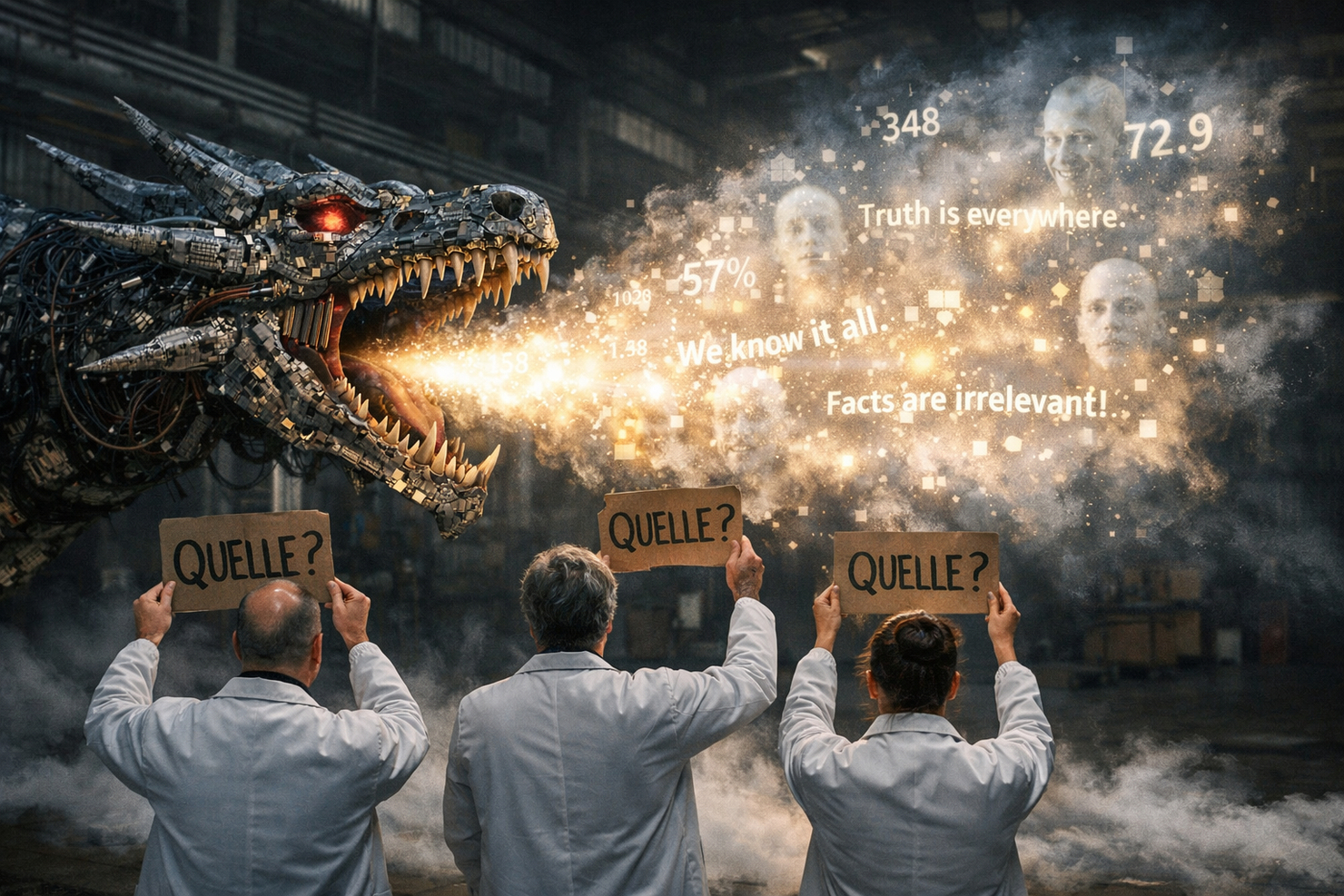
Of all the challenges in AI development, hallucinations are perhaps the most insidious. Unlike a jailbreak, where an attacker has to deliberately extract malicious content, hallucinations occur spontaneously and uninvited in the middle of otherwise helpful conversations. And they do so with absolute conviction.
AI hallucination occurs when a model confidently asserts something factually false by inventing people, quotes, events, statistics, or details that simply don't exist. The term is apt: the AI isn't intentionally lying. It generates texts that sound plausible based on patterns in its training data, even if there's no factual basis for them. It's the dark side of this very ability that makes these models so impressive.
The reason lies in the way linguists work. They are trained to predict the statistically most probable next word. They don't know facts like a database, but have learned patterns that are linked to facts. If they are asked about something outside their established knowledge, they don't readily admit they don't know. They do what they have been trained to do: they write a plausible-sounding text. The result can be a well-written, confidently delivered, but completely fabricated answer.
Retrieval-Augmented Generation (RAG)
One of the most effective practical solutions is called Retrieval-Augmented Generation (RAG). Instead of relying solely on knowledge learned during training, RAG connects the AI to an external knowledge source, such as a database, document library, or the internet, the moment a question is asked. The model first retrieves relevant, current, and verified information and then generates its answer based on this retrieved content, rather than purely from memory. Imagine the difference as being like answering a question from memory versus being allowed to look it up beforehand. RAG drastically reduces misinterpretations in factual questions because the model works with real-world sources it can access.
Teaching the model to say that it doesn't know something
One of the most effective behavioral interventions is to teach the model to express uncertainty. Through fine-tuning and RLHF (Reliable Reference Frequency), models can be selectively rewarded for admitting uncertainty and penalized for confidently making statements that later prove to be false. While this doesn't prevent the model from making mistakes, it does prevent it from making them with conviction, which is arguably the more dangerous form of hallucination. A cautiously worded false answer encourages the user to check. A confidently worded false answer, however, does not.
Logic of reasoning
Instead of jumping directly to an answer, models can be trained or encouraged to reason step by step, essentially revealing their solution process. This approach, known as logical reasoning, tends to reduce fallacies, as each step in the reasoning process can uncover errors in the previous one. It also makes the model's thinking transparent, allowing users to identify where the logic was flawed, rather than simply being presented with an incorrect conclusion.
Foundation, citations and fact-checking
Models can be designed to cite their sources and reference specific documents or passages that support their claims. This forces the model to base its answers on verifiable evidence rather than relying solely on statistical intuition. If it cannot cite a source, it should report this. Many enterprise AI systems have implemented this as a mandatory requirement.
Some systems go a step further and supplement the first with a second AI whose sole task is to verify the statements of the first model against a trusted knowledge database. If a statement cannot be verified, it is flagged or removed. A related procedure, known as self-consistency checking, has the model generate and compare multiple independent answers to the same question. If all versions agree, the confidence level is higher. If they contradict each other, the model signals uncertainty. Hallucinations tend to be inconsistent with each attempt, while true knowledge tends to be stable.
Specialized models and controlled creativity
Paradoxically, attempting to equip a model with comprehensive knowledge can actually increase hallucinations. For example, a model specifically trained on medical literature hallucinates significantly less often when faced with medical questions than a general model that attempts to cover all human knowledge. Specialized models possess a smaller, but more reliable, knowledge base.
The model has a technical setting called "temperature" that controls the degree of creativity or randomness of its results. A high temperature leads to more diverse and imaginative reactions, but also to more hallucinations. A lower temperature causes the model to act more conservatively and adhere more closely to known patterns. In practical applications, a lower temperature reduces the risk of the model drifting into fabricated territory.
The human being in the control loop
In critical applications in medicine, law, and finance, the most reliable safety measure remains the review of AI results by a human expert before any action is taken. The AI performs the complex work; the human identifies the errors. Hallucinations cannot currently be completely eliminated. They are, in a sense, an inherent consequence of how LLMs function. The goal of current research is not perfection, but rather the reduction of hallucinations: they should become less frequent, less reliable, more easily detectable, and less consequential.
Part Six: Can a large language model think?
This is one of the most debated questions in the field of artificial intelligence, and depending on whom you ask, the answer ranges from a definite yes to an equally definite no. Can a large language model actually think? The honest answer is: It all depends on what you mean by that term.
At first glance, the argument against the thinking of an LLM (Late-Learning Machine) seems plausible. An LLM doesn't argue like a human. It has no experience, no curiosity, no inner life. It doesn't sit still and ponder a problem. What it does on a mechanical level is predict the next most likely word based on patterns it has learned from vast amounts of human text. In this sense, it is an extraordinarily sophisticated pattern recognition machine. Critics who hold this view often say that LLMs don't think at all; they merely simulate thinking so skillfully that it appears convincing.
While this perspective is valid, it leaves some important questions unanswered. When an LLM solves a novel logic puzzle it has never encountered before, is it merely matching patterns? What exactly happens when it uncovers a flaw in a legal argument, translates irony between languages, or generates a metaphor that truly illuminates an idea? The results sometimes go far beyond what simple pattern recognition would predict. Clearly, information is being processed, recombined, and applied in a way that at least resembles logical reasoning.
What research suggests
Researchers have discovered that large language models, especially those trained extensively, develop internal representations of concepts, relationships, and even something resembling logical structures. They can draw multi-stage inferences, reason from them, and apply principles to new situations. These are behaviors that we would readily describe as thinking in humans.
At the same time, LLMs fail in ways that human thinkers rarely make. They can be certain of being wrong about simple arithmetic problems. They can contradict themselves within the same conversation. They can be misled by a slightly altered question, even if the underlying logic remains the same. These errors suggest that the processes in the model do not correspond to human reasoning, even if the results appear similar.
The problem with the Chinese room
The philosopher John Searle famously illustrated this tension with a thought experiment called "The Chinese Room." Imagine a person locked in a room with a large rulebook for answering Chinese characters. Chinese messages are passed under the door; the person looks up the appropriate answers in the rulebook and passes them back. To outsiders, the exchange appears as a fluent conversation with a Chinese speaker. But the person in the room understands nothing. They are simply following the rules.
Searle argued that LLMs are essentially like the person present: they produce results that feign understanding without any actual understanding behind them. Many AI researchers counter that the human brain itself can be described as a highly complex version of the same process, and that understanding is simply what sophisticated information processing looks like from the inside out.
Neither side has definitively won this debate. It remains one of the few truly open questions at the intersection of philosophy, neuroscience, and computer science.
A more useful way to phrase the question
Instead of asking whether LLMs can think, it might be more useful to ask which thought processes they master and which they do not. They are remarkably capable of synthesizing information, recognizing patterns, making creative connections, and formulating well-structured arguments. However, they are significantly weaker at developing complex logical chains that require the precise assembly of many variables, at grounding their knowledge in real-world experience, and at defining the limits of their own knowledge.
Practically speaking, LLMs think differently than humans, not not at all. They process language with a breadth and fluency no human can achieve by utilizing connections between billions of words. However, they lack the embodied experience, the emotional grounding, and the genuine self-awareness that shape human thought in ways that extend far beyond language.
Perhaps the most honest answer is this: A large language model accomplishes something truly impressive, truly useful, and something that should be taken seriously. Whether it can be described as thinking in the truest sense of the word says as much about our definition of thinking as it does about what the model actually achieves. And this question remains, for now, intriguing and unanswered.
Conclusion: More art than science
Developing and training AI, especially a helpful, honest, and safe one, is as much an art as a science. The data, the architecture, the training methods, the security measures, the sandbox environment, the protection against jailbreaking, the constant fight against malfunctions, and the still unresolved question of whether all of this constitutes genuine thought all contribute to how we understand and develop these systems. Yet behind all the technical sophistication lies something surprisingly human: the attempt to impart values, to cultivate judgment, and to create something that speaks the truth, even when it would be easier to invent something.
This makes it clear why all AIs reflect the political and cultural biases of their creators. This begins with decisions regarding system settings and filters, is reinforced during training (including the selection and processing of training datasets), and continues throughout the entire development process, from the testing phase to experimental procedures. It is unavoidable – every AI is essentially a reflection of the inner cognitive and psychological environment of its creators.
We cannot create a comprehensive rulebook for every situation an AI might encounter, any more than we can for a child. Instead, we shape its instincts through experience, feedback, role models, and corrections, and test it thoroughly before entrusting it with real responsibility. The goal is not a perfect machine, but a reliable, well-intentioned one that continuously improves. In this sense, training an AI is not so different from training a child or a dragon…

More for you:






 "Dravens Tales from the Crypt" has been enchanting for over 15 years with a tasteless mixture of humor, serious journalism - for current events and unbalanced reporting in the press politics - and zombies, garnished with lots of art, entertainment and punk rock. Draven has turned his hobby into a popular brand that cannot be classified.
My blog was never designed to spread news, let alone get political, but with current affairs I just can't help but capture information here that is otherwise censored on all other channels. I am aware that the design page may not seem "serious" to many in this regard, but I will not change this to please the "mainstream". Anyone who is open to non-state-compliant information sees the content and not the packaging. I've tried enough to provide people with information over the last 2 years, but quickly noticed that it never matters how it's "packaged", but what the other person's attitude towards it is. I don't want to put honey on anyone's mouth to meet expectations in any way, so I'll keep this design because hopefully at some point I'll be able to stop making these political statements, because it's not my goal to go on like this forever  I leave it up to everyone how they deal with it. However, you are welcome to simply copy and distribute the content, my blog has always been under the WTFPL license.
It's hard for me to describe what I'm actually doing here, DravensTales has become a culture blog, music blog, shock blog, tech blog, horror blog, fun blog, a blog about found items on the internet, internet bizarre, trash blog, art blog, water heater, zeitgeist blog over the years , Scrap blog and grab bag blog called. Everything that is right ... - and yet not. The main focus of the blog is contemporary art, in the broadest sense of the word.
To ensure the continued operation of this site, you are welcome to make a donation via credit card, PayPal, Google Pay, Apple Pay, or direct debit/bank account . Many thanks to all readers and supporters of this blog!








