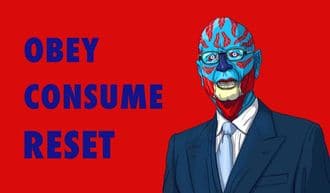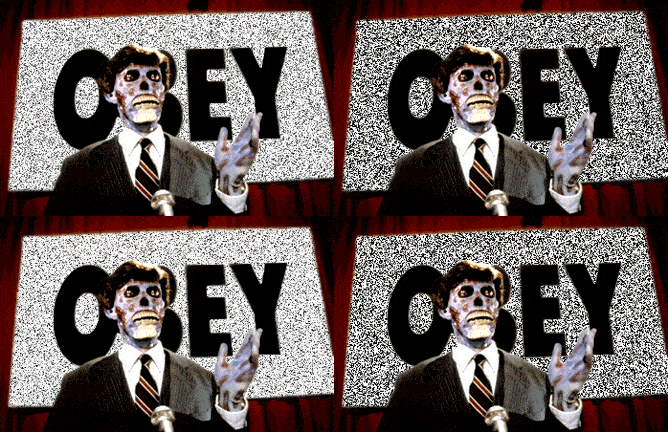
Europe's governments are talking up war against Russia as if their survival depended on it. And it does. Not because Moscow's tanks are already on the Oder River, but because from Berlin to Rome, coffers are empty, factories are half-empty, and voters have deserted them. War is the last economic stimulus program that can still be sold as a civic duty.
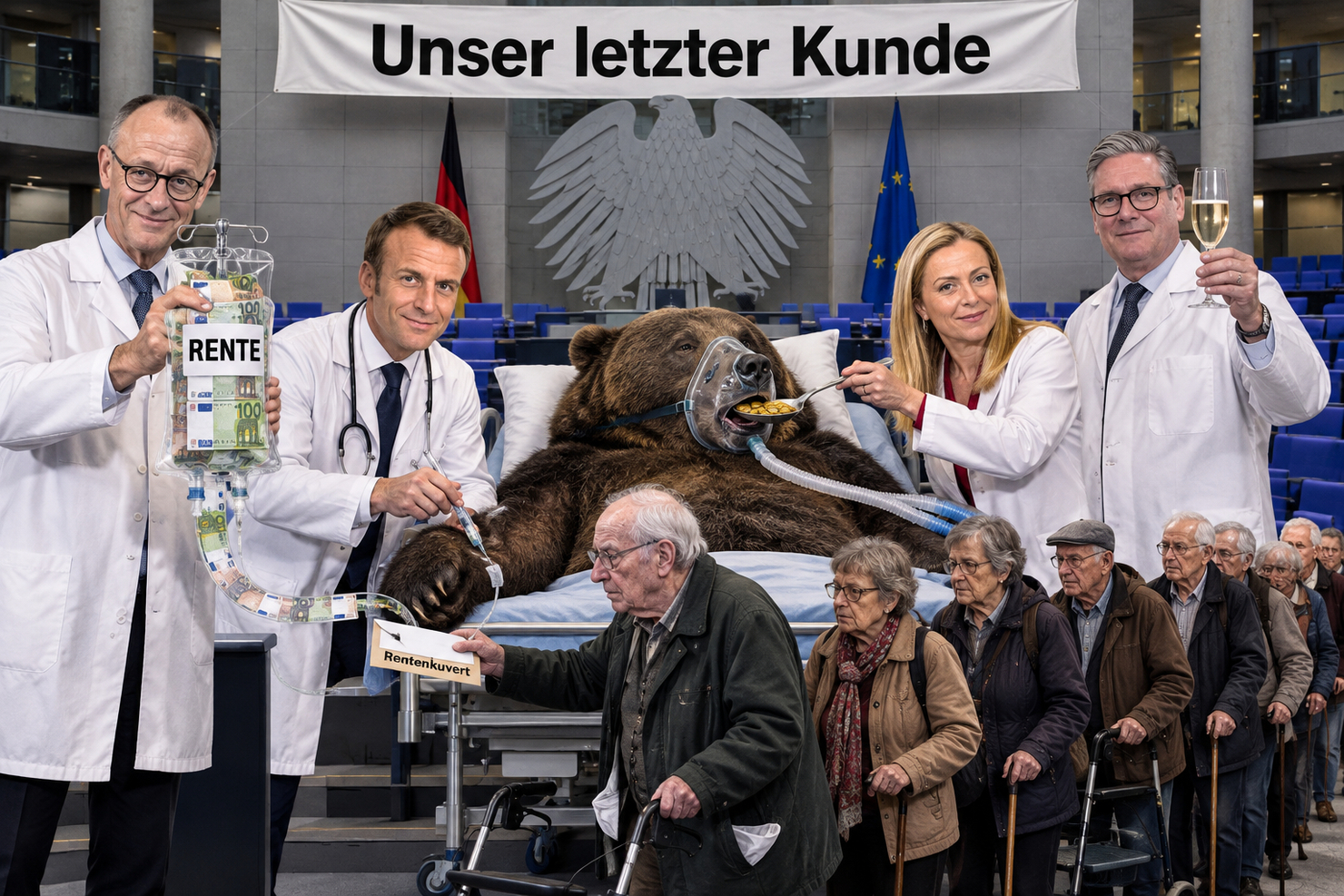
A user on X (formerly Twitter) predicted the failure of three politicians from left to right and compared the German economy to a terminally ill sailor with a wooden leg, unable to find a port thanks to any party platform. Anyone who promises otherwise is either lying or doesn't know any better. Fifteen years of bad decisions, tolerated by the public with the attitude of "hopefully it won't affect me," cannot be undone.
Growth in camouflage pattern
At first glance, the Federal Statistical Office offers a reassuring report. The economy grew by 0,3 percent in the second quarter of 2026, and by 1,0 percent year-on-year . But a closer look reveals who is actually growing. Private consumption sluggish by 0,1 percent, while government spending jumped by 3,0 percent. In the equipment sector, government investment, explicitly including defense, was the primary driver of growth, while automakers suffered revenue losses and the number of employed people was down by a good 210,000 compared to the previous year. The private sector holds its breath, the government buys ammunition, and the Federal Statistical Office labels it "growth dynamics." How this situation arose, without anyone ever taking responsibility, is explained in the article " Germany is dying and nobody was to blame ."
Armor instead of a convertible
Osnabrück shows how the recipe works. Volkswagen has adopted a restructuring plan that will cut up to 50,000 jobs worldwide , half of them in Germany. The company is not guaranteeing the future of four other plants. The Osnabrück plant will be sold to a financial investor and the state of Lower Saxony; in the future, it will produce components for the air defense systems of the Israeli company Rafael.
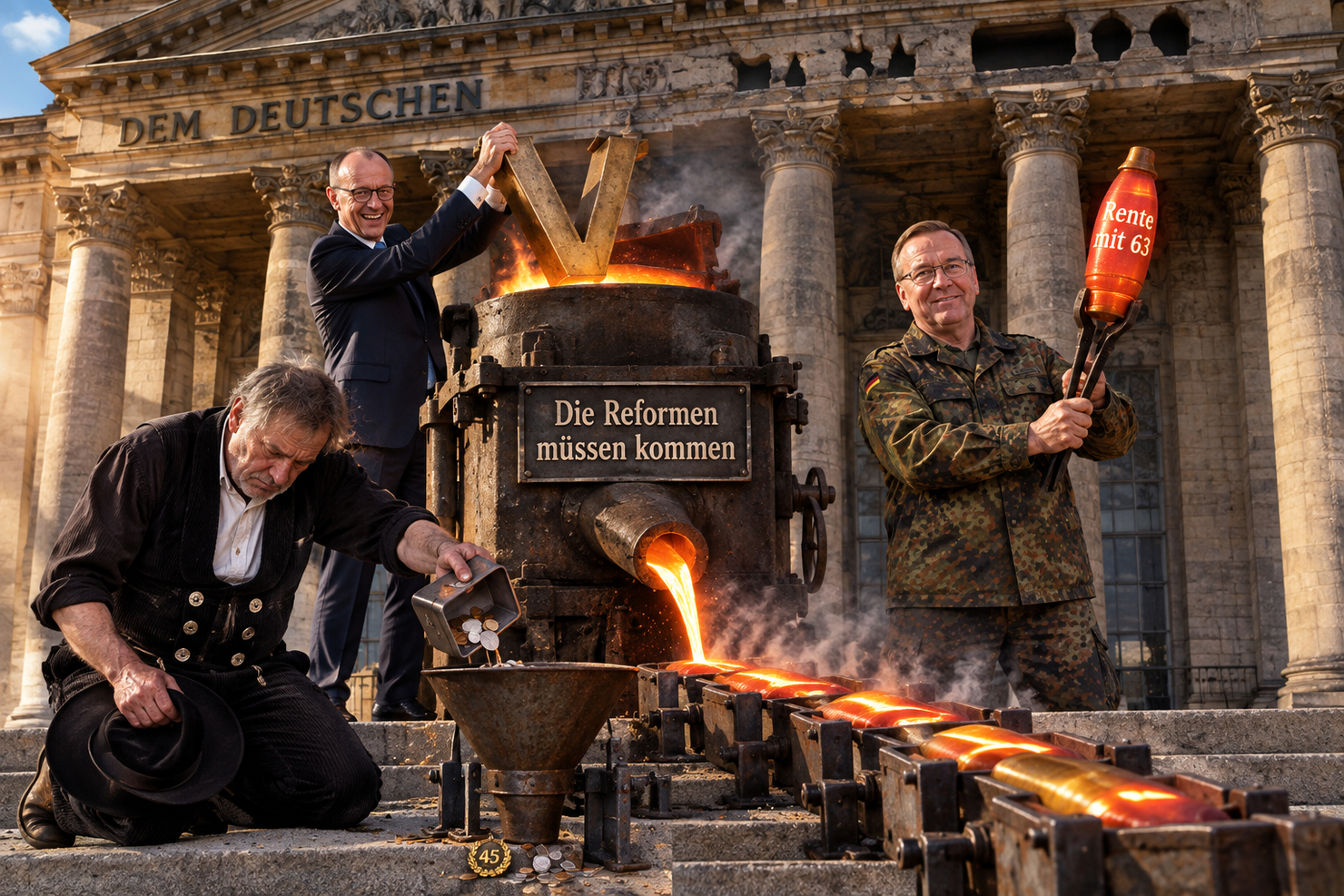
Prime Minister Olaf Lies referred to the security situation and found the appropriate formula: "This is both a responsibility and an economic opportunity." This is the kind of language one gets from an industrial location that can only survive as a supplier to address the threat. The fact that Brussels has long been serving up the same recipe continent-wide is demonstrated by the EUdSSR with its €800 billion investment by 2030.
Fear as a budget item
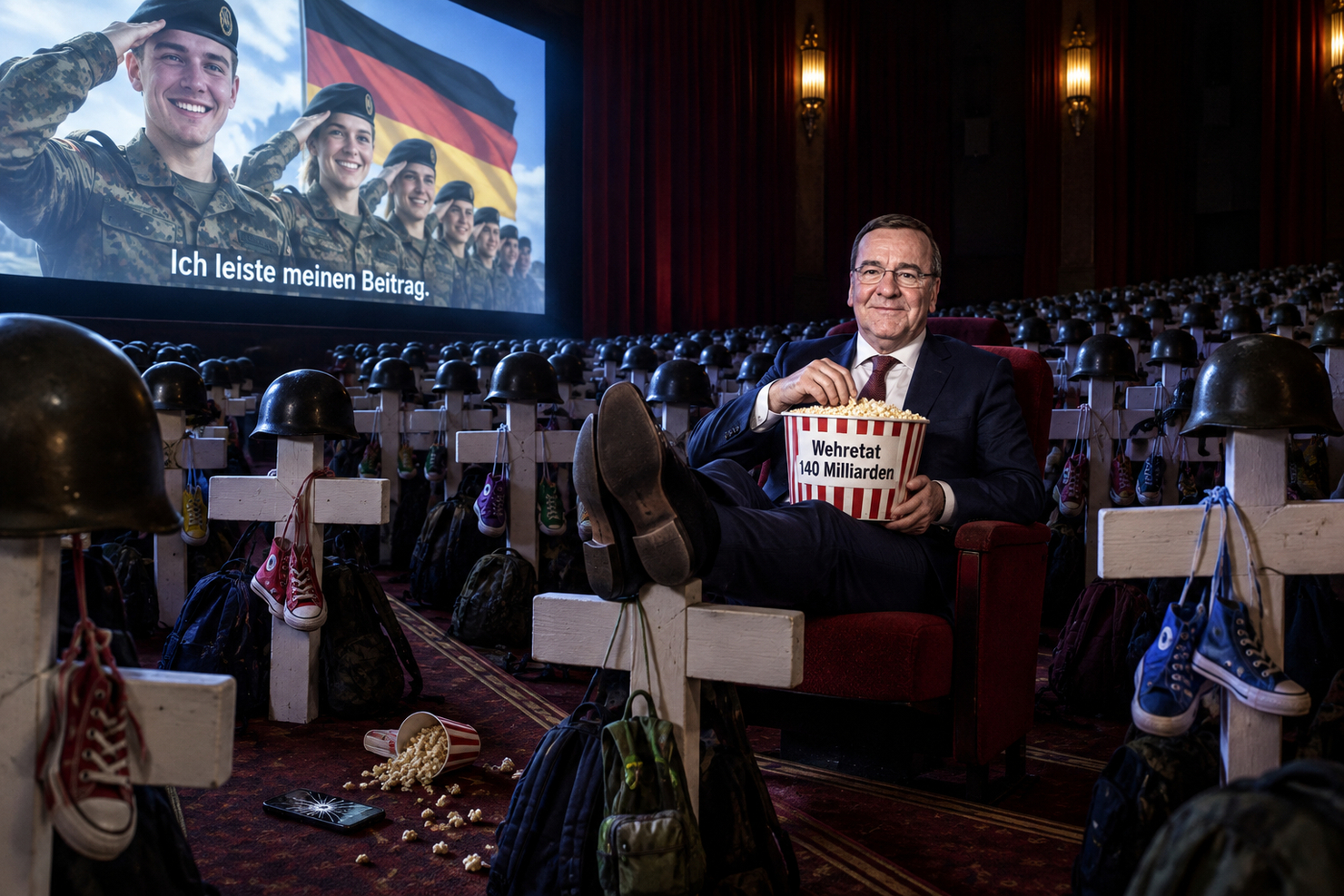
To ensure the opportunity doesn't evaporate, it needs an enemy that never ceases to exist. NATO Secretary General Mark Rutte provided one in Berlin in December: Europe is Russia's next target and must prepare for a war on the scale of what our grandparents and great-grandparents had to endure . Defense Minister Boris Pistorius followed up in September: "We are literally in Moscow's crosshairs." With this statement, he promoted a 2027 defense budget of nearly €140 billion , €31,4 billion more than the previous year, the largest sum since the end of the Cold War, made possible by an exemption from the debt brake. Berlin aims to reach the NATO spending target of 3,5 percent of GDP by 2029, six years earlier than required.
At the same time, following the election defeat in Mecklenburg-Western Pomerania, Chancellor Friedrich Merz declared that reforms were necessary , including the planned abolition of the so-called "retirement at 63." There's money for the howitzer, but not for the roofer after 45 years of work. Whoever ends up wearing the uniform shows who ordered the war, who sends in foreign children.
Moscow calls the warnings nonsense and insists it has no intention of attacking any NATO member state. However, Vladimir Putin added that Russia is prepared should Europe start a war . Assurances from a country that invaded Ukraine in 2022 are no more reassuring than warnings from a government whose budget depends on them.
Five capital cities, one recipe
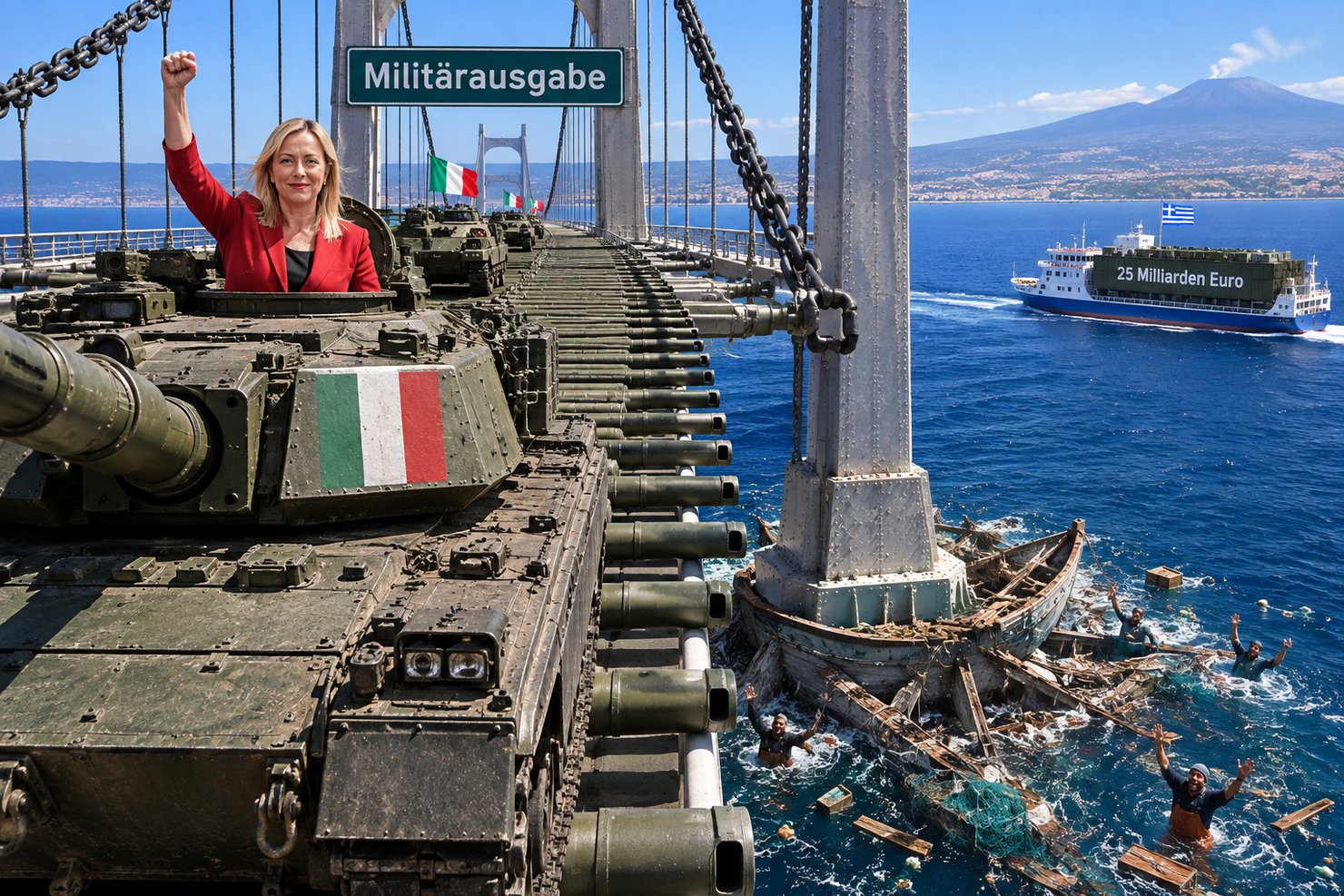
Berlin is not an isolated case, but rather a trendsetter. According to Eurostat, France is sitting on a national debt of 117,6 percent of its economic output , four percentage points more than a year ago; Italy at 138,9 percent, and Greece at 143,5 percent. Despite this, Emmanuel Macron is doubling the defense budget to 64 billion euros by 2027 , two years earlier than planned. He also promised that military spending would become a source of wealth for the gross domestic product. No head of state has ever stated more clearly what the enemy is needed for.
In Rome, they're already short of money for the scenery. Giorgia Meloni wanted to book the €13,5 billion bridge to Sicily as a military expenditure because of the island's bases, until Washington publicly warned against such tricks. Athens is allocating €25 billion for weapons by 2036 , roughly a tenth of its annual economic output, financed through the EU's escape clause. A pensioner there, standing in front of a supermarket shelf, explains that he's happy to tighten his belt on his meager pension, as long as he has strong armed forces. In Athens, however, the enemy is more likely Turkey than Russia, but that doesn't make things any cheaper. London is cutting development aid to its lowest level since 1999 to pay for the rearmament.
And then there's Spain. Pedro Sánchez called NATO's five percent target unreasonable and counterproductive because it was incompatible with the welfare state. He stuck with 2,1 percent. Ironically, Spain grew by 2,7 percent year-on-year in the second quarter, almost three times as much as Germany. This doesn't prove anything, though; Madrid's debt-to-GDP ratio is also over 100 percent. What is truly embarrassing, however, is the claim that there can be no growth without guns.
I am doing my part.
The video currently circulating online begins with the recruitment ad from Paul Verhoeven's 1997 satire "Starship Troopers." Young people enlist, one after the other uttering the line immortalized by the German dubbing : "I'm doing my part." The original ad promised that the service guaranteed civil rights, but the German distributor, fearing any negative connotations, softened it in 1997 to a harmless "fight for the future." Afterward, someone sings that what history teaches is irrelevant, it's too far in the past; what matters is what the television says. Today, the recruitment ad plays in cinemas before the main feature , and the satire has lost the race against reality.
The online prophecy remains unfounded. Elif Eralp won Berlin with 25,7 percent, Ulrich Siegmund Saxony-Anhalt with 43,8 percent . So they haven't failed; the failure only begins once they're in office. Whoever governs inherits the same coffers, the same factory closures, and the same federal budget where military spending takes precedence. Many a politician has confirmed to me off the record that the game is over.
The enemy as the last customer
That's precisely why the war against Russia is needed, not as a battlefield, but as a justification. It justifies rampant debt, factories without cars, and pensions without guarantees. Anyone who questions it is considered a security risk. This late-Roman decadence will have brutal consequences, regardless of which party currently manages the coffers. We can still prevent a third world war on German soil. Everything else is beyond our control. By 2026, there will be a shortage of 210,000 workers; by 2027, an additional 31,4 billion euros will be spent on the armed forces. Madrid is arming itself the least and experiencing the strongest growth, while Paris is doubling its military spending and treating it as wealth. "I'm doing my part," says the taxpayer, failing to realize that he has long since assumed the role of a recruit. Anyone who keeps a dying economy alive with only one enemy will never want to let go of that enemy again…
More for you:

 "Dravens Tales from the Crypt" has been enchanting for over 15 years with a tasteless mixture of humor, serious journalism - for current events and unbalanced reporting in the press politics - and zombies, garnished with lots of art, entertainment and punk rock. Draven has turned his hobby into a popular brand that cannot be classified.
My blog was never designed to spread news, let alone get political, but with current affairs I just can't help but capture information here that is otherwise censored on all other channels. I am aware that the design page may not seem "serious" to many in this regard, but I will not change this to please the "mainstream". Anyone who is open to non-state-compliant information sees the content and not the packaging. I've tried enough to provide people with information over the last 2 years, but quickly noticed that it never matters how it's "packaged", but what the other person's attitude towards it is. I don't want to put honey on anyone's mouth to meet expectations in any way, so I'll keep this design because hopefully at some point I'll be able to stop making these political statements, because it's not my goal to go on like this forever  I leave it up to everyone how they deal with it. However, you are welcome to simply copy and distribute the content, my blog has always been under the WTFPL license.
It's hard for me to describe what I'm actually doing here, DravensTales has become a culture blog, music blog, shock blog, tech blog, horror blog, fun blog, a blog about found items on the internet, internet bizarre, trash blog, art blog, water heater, zeitgeist blog over the years , Scrap blog and grab bag blog called. Everything that is right ... - and yet not. The main focus of the blog is contemporary art, in the broadest sense of the word.
To ensure the continued operation of this site, you are welcome to make a donation via credit card, PayPal, Google Pay, Apple Pay, or direct debit/bank account . Many thanks to all readers and supporters of this blog!