
Or: The Liberation Bomb: How to Kill People to Save Them. Because in these times, there's a sentence that generates a surprising amount of anger: "I'm against war." It actually sounds like something you learn in elementary school. Peace good, war bad. End of lesson. But as soon as you utter this sentence today, something strange happens. Suddenly, you're standing before a moral tribunal. People look at you as if you'd just suggested replacing the fire department with a poetry slam at a fire.
“Naive,” they say. “And what’s your solution?” “Do you want people to continue suffering?” The logic behind it is fascinating. Anyone who opposes war apparently has to immediately present a perfect geopolitical master plan. Otherwise, their objection is invalid. It’s roughly equivalent to only being allowed to oppose murder if you simultaneously offer a better proposal for conflict resolution. The real stroke of genius in the modern war debate lies in the fact that bombs are suddenly being sold as a moral tool. Bombs as therapy. They’re no longer dropped to destroy. No. They’re dropped to liberate. An impressive rhetorical leap forward.
Bombs do not plant justice
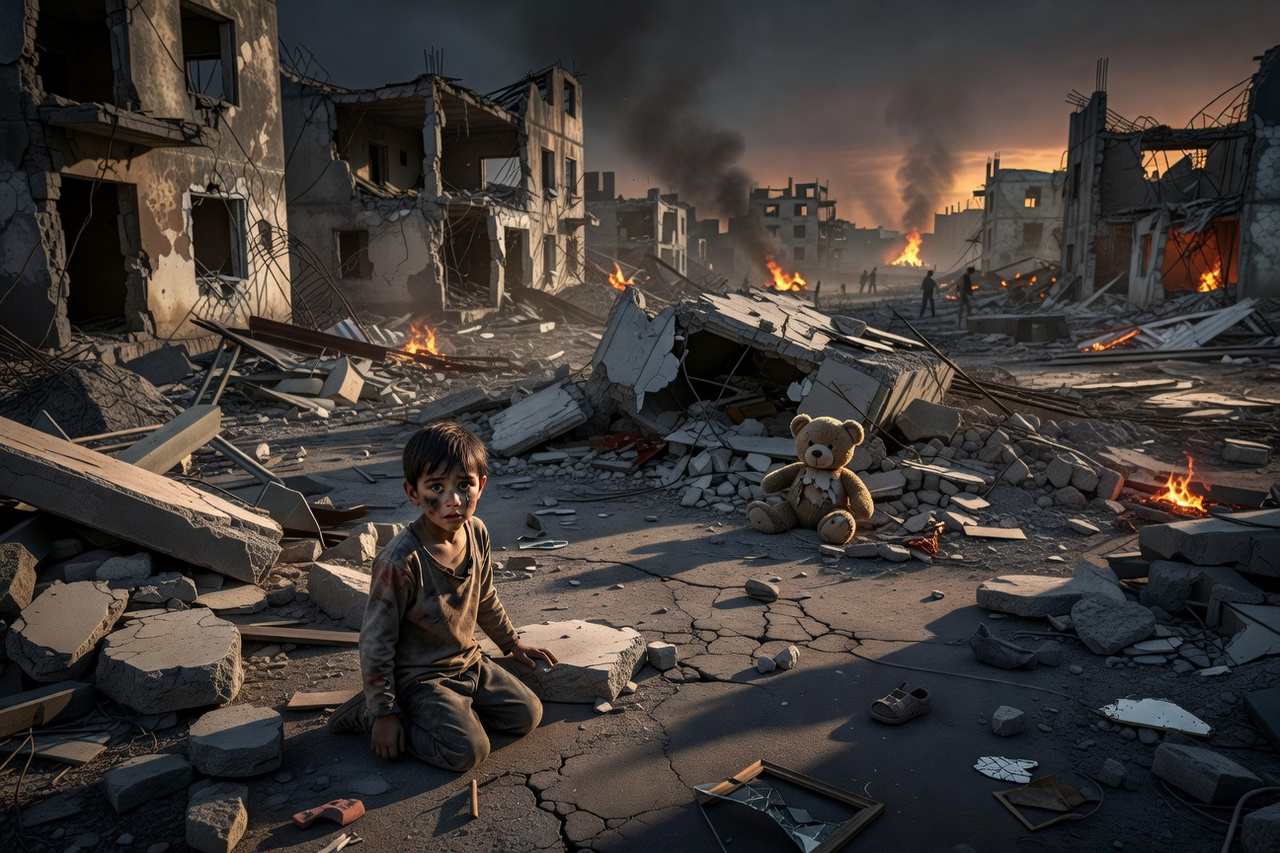
The idea that bombs create justice is one of the most enduring political myths of our time. Bombs do indeed create something. They create landscapes of rubble. They create mass graves. They create generations of people who have learned that somewhere in the world, someone decided their home had to disappear. What bombs don't create is lasting freedom. But that, of course, sounds less heroic. That's why a different story is preferred: the story of liberation.
The mysterious "people" who supposedly want to be freed
A particularly popular argument is: "The people there want to be liberated." A fascinating formulation. Because these "people" are a surprisingly practical bunch. They never speak for themselves. They are always quoted from the outside. Who exactly are these people? An entire nation? A majority? A vocal minority? Nobody really knows. But supposedly, somewhere, there's always someone shouting: "Please bomb us." And that's enough as a moral justification for airstrikes.
A small thought experiment with Germany
To understand how absurd this logic is, you only need a mirror. Take Germany. A significant portion of the population is dissatisfied with the government. Millions of people vote for parties that criticize the political course. Demonstrations, conflict, social division. In short: a country full of dissent. Now imagine some foreign superpower suddenly declaring: "Germany is oppressed. We will intervene and liberate you." Missiles on Berlin. Bombs on Hamburg. Debris in Cologne. And then they kindly explain to us that it's all for our own good. No one would call that liberation. They would call it an attack. Or terrorism against civilians.
But when it happens somewhere far away, the same logic suddenly works as a moral hero's tale. It's strange how flexible ethics can be once the explosions occur on another continent.
The moral wardrobe of war
Wars rarely begin with honest justifications. No one holds a press conference and says, "We're attacking because we want to secure spheres of influence." Instead, every war is given a moral veneer. Human rights. Democracy. Liberation. These are the shiny labels on the packaging. Underneath, you often find the same old ingredients: power, resources, geopolitical rivalry. History is full of it. Iraq. Afghanistan. Libya. The record of these liberation missions reads less like a success story and more like an archaeological collection of modern ruins. Yet, astonishingly, the same method keeps being sold. Perhaps this time it will work.
The atomic limit of morality
If wars were truly fought for moral reasons, the world map would be one giant battlefield. After all, there are plenty of countries with human rights problems: China, North Korea, Pakistan. Strangely enough, these countries are rarely bombed. Why? Quite simply: nuclear weapons.
Suddenly, the moral mission ends precisely where the risk becomes too great. That is the invisible boundary of world politics. It is not morality that decides where intervention occurs, but power. The atomic bomb is the trump card that determines who remains morally unassailable.
The astonishing flexibility of outrage
Another curious phenomenon of modern conflicts is selective outrage. When civilians die, the moral assessment apparently depends heavily on who is dropping the bombs. If it fits one's own political narrative, it's called "liberation." If it doesn't, it's called "barbarism." But a dead child remains a dead child. The flag flying over the battlefield changes surprisingly little about that.
War as a business model of power
The uncomfortable truth is this: most wars don't stem from moral outrage. They stem from interests: spheres of influence, trade routes, resources, and the balance of military power. Once the strategic goal is established, a suitable narrative is sought. Human rights are perfectly suited for this. They sound good, are difficult to criticize, and function superbly as a moral cloak. The only problem is: beneath this cloak, there are usually corpses.
Who actually decides about life and death?
In the end, one question remains, one that is surprisingly rarely asked: Who actually decides that a war is necessary? Not the population of the affected countries. Not the civilians who will later have to live in the ruins. It is political power structures. Alliances. Strategic interests. The people themselves are rarely more than collateral damage. Material in the geopolitical game.
The most dangerous sentence in the world
Almost every war begins with a certain phrase: "This time it's different." This time we're fighting for good. This time the bombs are morally justified. And it's precisely at this point that things become dangerous. Because history shows something quite sobering: those in power almost always believe they are the good guys, while the civilian population pays the price. That's why I'll stick with a phrase that apparently is now considered radical:
I am against war.
Not because I'm naive. But because I've read the story…
More for you:





 "Dravens Tales from the Crypt" has been enchanting for over 15 years with a tasteless mixture of humor, serious journalism - for current events and unbalanced reporting in the press politics - and zombies, garnished with lots of art, entertainment and punk rock. Draven has turned his hobby into a popular brand that cannot be classified.
My blog was never designed to spread news, let alone get political, but with current affairs I just can't help but capture information here that is otherwise censored on all other channels. I am aware that the design page may not seem "serious" to many in this regard, but I will not change this to please the "mainstream". Anyone who is open to non-state-compliant information sees the content and not the packaging. I've tried enough to provide people with information over the last 2 years, but quickly noticed that it never matters how it's "packaged", but what the other person's attitude towards it is. I don't want to put honey on anyone's mouth to meet expectations in any way, so I'll keep this design because hopefully at some point I'll be able to stop making these political statements, because it's not my goal to go on like this forever  I leave it up to everyone how they deal with it. However, you are welcome to simply copy and distribute the content, my blog has always been under the WTFPL license.
It's hard for me to describe what I'm actually doing here, DravensTales has become a culture blog, music blog, shock blog, tech blog, horror blog, fun blog, a blog about found items on the internet, internet bizarre, trash blog, art blog, water heater, zeitgeist blog over the years , Scrap blog and grab bag blog called. Everything that is right ... - and yet not. The main focus of the blog is contemporary art, in the broadest sense of the word.
To ensure the continued operation of this site, you are welcome to make a donation via credit card, PayPal, Google Pay, Apple Pay, or direct debit/bank account . Many thanks to all readers and supporters of this blog!








