
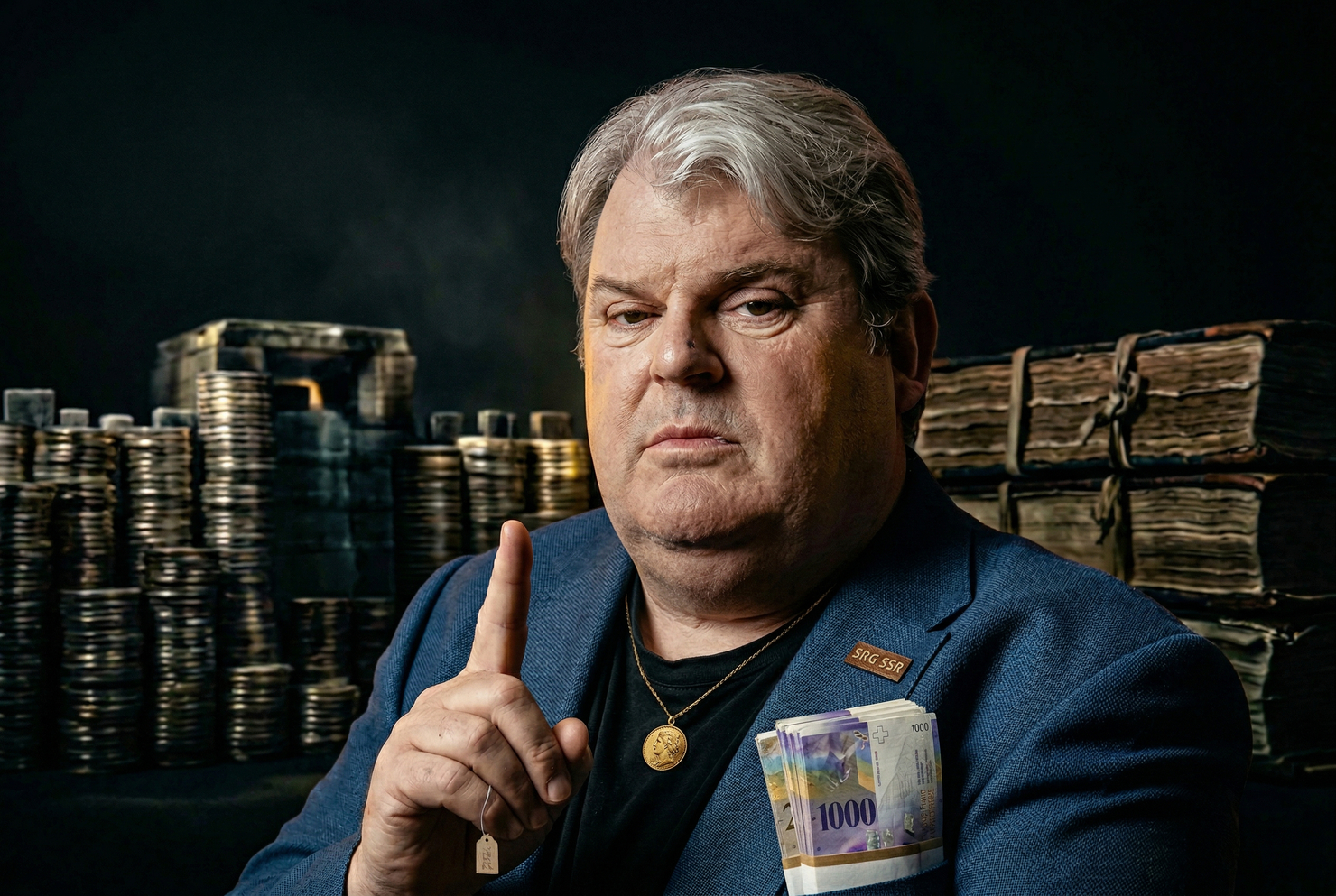
There are people who defend institutions out of conviction. And there are people who defend institutions because these institutions happen to stabilize their bank balance every month. In Mike Müller's work, these two motives blur together in an almost poetic way.
In Pascal Nufer's podcast, Müller, with the composure of a morally superior parent, declares that the initiators of the SRG (Swiss Broadcasting Corporation) halving initiative are "ardent admirers of Donald Trump." End of discussion. Anyone who wants to tweak the license fee is apparently already mentally in Florida, wearing a red cap. Nuance is for cowards. In Müller's world, there are only two categories: defenders of democracy and people with a dangerous outlook.
This "feeling of life" particularly appealed to him. He saw a delight in disruption, in destroying existing structures. Crude, destructive, anti-democratic. And because historical analogies can be so nicely inflated, Müller immediately draws a very broad arc: Orbán here, Putin there, Trump anyway – and in Switzerland, the next attempt at dismantling things is already lurking, disguised as a debate about fees.
The fact that the halving initiative also involves 200 francs per household is, for him, a mere footnote. Anyone who talks about money must be morally deficient. After all, it's about nothing less than the last bastion of enlightenment: the SRG SSR. And anyone who questions this bastion isn't just undermining a budget item, but democracy itself. So far, so pathetic.
Things get interesting where idealism and self-interest collide. Müller isn't just a satirist; he's part of the state-funded cultural scene. For years, he was a prominent figure in SRF's entertainment programming and is now co-director and ensemble member at the Schauspielhaus Zürich. A man who knows what public funds feel like: warm, reliable, and essential.
So when someone openly considers halving the SRG fee, for Müller it's not an abstract political game. It's an encroachment on the ecological niche in which he has thrived for years. One can understand that. Hardly anyone willingly saws off the branch they're sitting on. But perhaps it shouldn't be presented as a selfless act of civic courage.
Online, he's now often called the "state comedian." Müller used to be a thorn in the side, constantly criticizing anyone and everything in power. Today, he defends the system with a fervor that's almost touching. Disruption? Dangerous. Criticism of the system? Suspicious. Cutting fees? The first step toward an authoritarian abyss.
One has to wonder when satire becomes lobbying. When every critic is reflexively labeled as right-wing, it comes across less as subtle irony and more as a defensive reaction. Moralizing replaces argument. Anyone who doesn't support the full fee is against democracy. Worldview interpretation can be that simplistic when you're in a hurry.
The debate could actually be quite simple: How much publicly funded media infrastructure does a country need? How efficiently does it operate? Which services are indispensable, and which are merely a product of historical development? Instead, the whole thing is being blown out of proportion and elevated to a question of civilization. Müller is portraying himself as the last defender against the rising tide of populism – conveniently overlooking the fact that criticism of a fee doesn't automatically equate to enthusiasm for Trump.
Perhaps therein lies the true tragedy: an artist who once questioned systems with wit and bite now defends precisely one of them with missionary zeal. Morality in this game is not an abstract category, but intricately intertwined with budget items and production contracts.
Ultimately, the image that remains is of a man who knows exactly where the wind – and the money – is blowing from. He speaks of disruption as if it were a disease. For many fee payers, it's simply a matter of priorities. 200 francs is peanuts for some, but a considerable sum for others.
Whether the SRG (Swiss Broadcasting Corporation) is halved or not will ultimately be decided by the electorate. But one thing is already certain: should the flow of money ever seriously dry up, it will become clear whether Mike Müller is primarily a satirist – or a very committed defender of his own business model. Until then, he remains the nation's publicly funded conscience. And the nation knows exactly who is funding it.
More for you:





 "Dravens Tales from the Crypt" has been enchanting for over 15 years with a tasteless mixture of humor, serious journalism - for current events and unbalanced reporting in the press politics - and zombies, garnished with lots of art, entertainment and punk rock. Draven has turned his hobby into a popular brand that cannot be classified.
My blog was never designed to spread news, let alone get political, but with current affairs I just can't help but capture information here that is otherwise censored on all other channels. I am aware that the design page may not seem "serious" to many in this regard, but I will not change this to please the "mainstream". Anyone who is open to non-state-compliant information sees the content and not the packaging. I've tried enough to provide people with information over the last 2 years, but quickly noticed that it never matters how it's "packaged", but what the other person's attitude towards it is. I don't want to put honey on anyone's mouth to meet expectations in any way, so I'll keep this design because hopefully at some point I'll be able to stop making these political statements, because it's not my goal to go on like this forever  I leave it up to everyone how they deal with it. However, you are welcome to simply copy and distribute the content, my blog has always been under the WTFPL license.
It's hard for me to describe what I'm actually doing here, DravensTales has become a culture blog, music blog, shock blog, tech blog, horror blog, fun blog, a blog about found items on the internet, internet bizarre, trash blog, art blog, water heater, zeitgeist blog over the years , Scrap blog and grab bag blog called. Everything that is right ... - and yet not. The main focus of the blog is contemporary art, in the broadest sense of the word.
To ensure the continued operation of this site, you are welcome to make a donation via credit card, PayPal, Google Pay, Apple Pay, or direct debit/bank account . Many thanks to all readers and supporters of this blog!








