
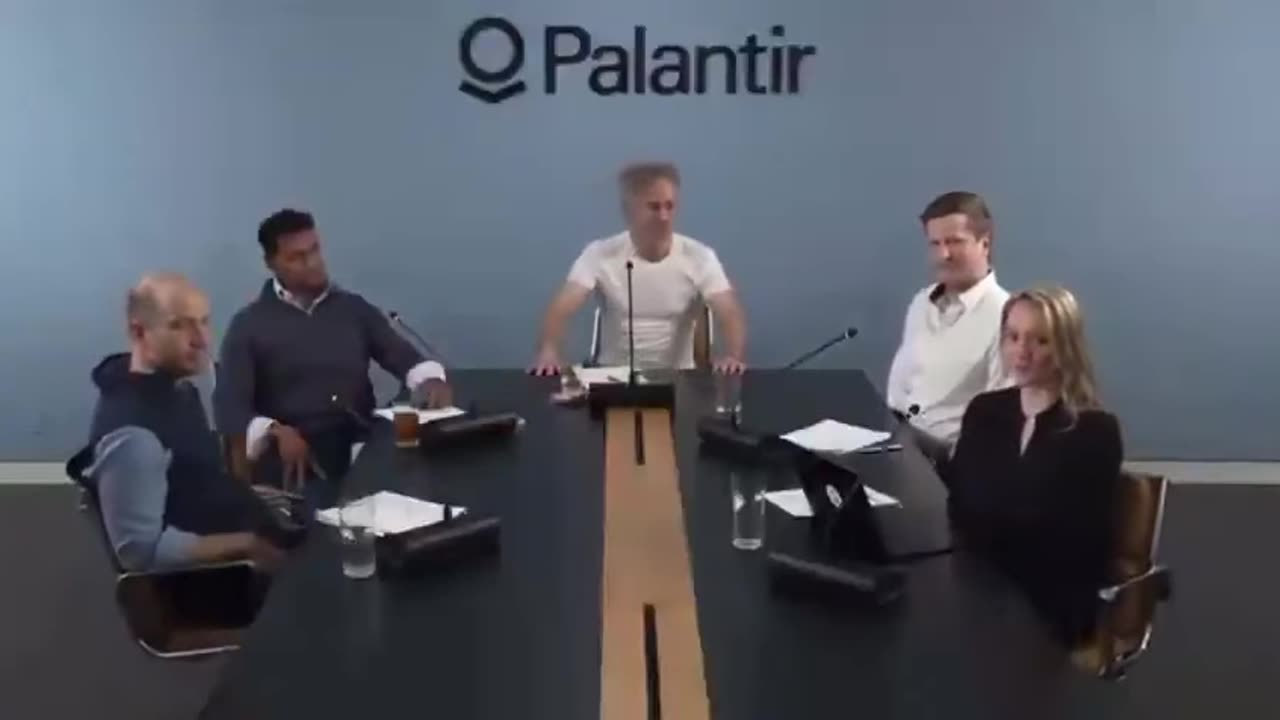
There are CEOs who sell software. And then there's Alex Karp. He sells power. And he sells it with an honesty that is both refreshing and deeply disturbing. Because while other corporations adorn their products with innocuous words like "efficiency," "innovation," or "digital transformation," Karp openly states what Palantir actually does. His company exists to "scare and occasionally kill enemies." And the best part? He hopes the investors enjoy it.
This isn't a quote from a dystopian novel. This isn't dialogue from a Marvel movie where the villain explains his philosophy just before the final battle. This is a CEO. A real CEO. At a real investor conference. In front of people in suits, taking notes and nodding, as a man explains that his company is actively involved in processes that result in the deaths of other people.
Nobody asks whether we may have reached a point where software companies are no longer just analyzing data, but enabling decisions that have irreversible consequences.
Because Palantir is no ordinary technology company. Palantir is a mirror. A mirror reflecting what happens when data, power, and moral distance merge in a single system.
The business model is simple. Governments and authorities supply data. Vast amounts of data. Personal data. Movement profiles. Communication patterns. Behavioral analyses. Palantir organizes this data, links it, analyzes it, and presents results that supposedly help identify threats. Threats. A word so flexible it can mean almost anything. The neighbor. The activist. The journalist. The dissident. The citizen who was in the wrong place at the wrong time.
Palantir sees patterns. And patterns are powerful. Because patterns generate predictions. And predictions generate decisions. Decisions made by people who will never meet the people they are deciding over. Alex Karp speaks about this with remarkable enthusiasm. His words carry no doubt. No hesitation. No moral ambiguity. Instead, he speaks of pride. Of service to the West. Of places one cannot speak of.
Secrecy is, after all, an essential component of such systems. Transparency would be impractical. It would raise questions. And questions are bad for business models based on trust. Especially when that trust is involuntary. Palantir doesn't just collect data from suspects. It collects data from everyone integrated into the systems: government officials, civil servants, citizens. Everyone becomes a point in a network. Everyone becomes an element in an equation. It is the ultimate abstraction of humanity.
Humans as a data set.
Humans as a risk.
Humans as a variable.
Karp himself seems not only to accept this transformation, but to celebrate it. In Davos, he openly stated that his company had played a role in influencing political developments, that its technology had helped to prevent certain political outcomes. It is a remarkable statement, especially in a world officially based on democratic principles, because democracy is based on the idea that people make decisions.
Palantir is based on the idea that data optimizes decisions. And optimization is a dangerous concept when applied to societies. Because optimization doesn't mean justice. Optimization means efficiency. And efficiency is morally neutral. Palantir doesn't decide who lives or dies. It provides the information that enables such decisions. It creates the infrastructure. It builds the tools. It shapes the reality in which decisions are made.
And then it takes a step back. It's the perfect form of irresponsibility. Technology as a moral buffer.
The CEO speaks about it as if it were a video game. As if it were a competition. As if it were a challenge that can be won with enough math and enough computing power. And perhaps that is precisely the most disturbing element of it all. Not the technology itself. Not the data. But the complete emotional detachment. Death becomes a side effect. An inevitable consequence of a system designed to minimize risk and maximize control.
And while investors applaud and governments sign contracts, a new form of power emerges. A power that was not elected. A power that is invisible. A power that exists in server rooms and is implemented in algorithms. Alex Karp calls it service. Others would call it control. But words are flexible. And as long as the right people believe they are on the right side, everything is justified. Even death…
More for you:






 "Dravens Tales from the Crypt" has been enchanting for over 15 years with a tasteless mixture of humor, serious journalism - for current events and unbalanced reporting in the press politics - and zombies, garnished with lots of art, entertainment and punk rock. Draven has turned his hobby into a popular brand that cannot be classified.
My blog was never designed to spread news, let alone get political, but with current affairs I just can't help but capture information here that is otherwise censored on all other channels. I am aware that the design page may not seem "serious" to many in this regard, but I will not change this to please the "mainstream". Anyone who is open to non-state-compliant information sees the content and not the packaging. I've tried enough to provide people with information over the last 2 years, but quickly noticed that it never matters how it's "packaged", but what the other person's attitude towards it is. I don't want to put honey on anyone's mouth to meet expectations in any way, so I'll keep this design because hopefully at some point I'll be able to stop making these political statements, because it's not my goal to go on like this forever  I leave it up to everyone how they deal with it. However, you are welcome to simply copy and distribute the content, my blog has always been under the WTFPL license.
It's hard for me to describe what I'm actually doing here, DravensTales has become a culture blog, music blog, shock blog, tech blog, horror blog, fun blog, a blog about found items on the internet, internet bizarre, trash blog, art blog, water heater, zeitgeist blog over the years , Scrap blog and grab bag blog called. Everything that is right ... - and yet not. The main focus of the blog is contemporary art, in the broadest sense of the word.
To ensure the continued operation of this site, you are welcome to make a donation via credit card, PayPal, Google Pay, Apple Pay, or direct debit/bank account . Many thanks to all readers and supporters of this blog!








