
There's an elegant solution to the troublesome problem of democratic oversight. You create a publicly traded company, fund it with CIA money, name it after a magical object from Lord of the Rings—and then let it quietly devour the entire state apparatus. No one votes it out. No one files Freedom of Information requests. It's a trade secret. Perfect. Welcome to Palantir Technologies.
A former Palantir executive has publicly stated what many have long suspected: The company aimed to take over the US government – and many of his former colleagues are now installed within the federal apparatus. He called it an occupied nation. Not as a metaphor. As a description of the situation.
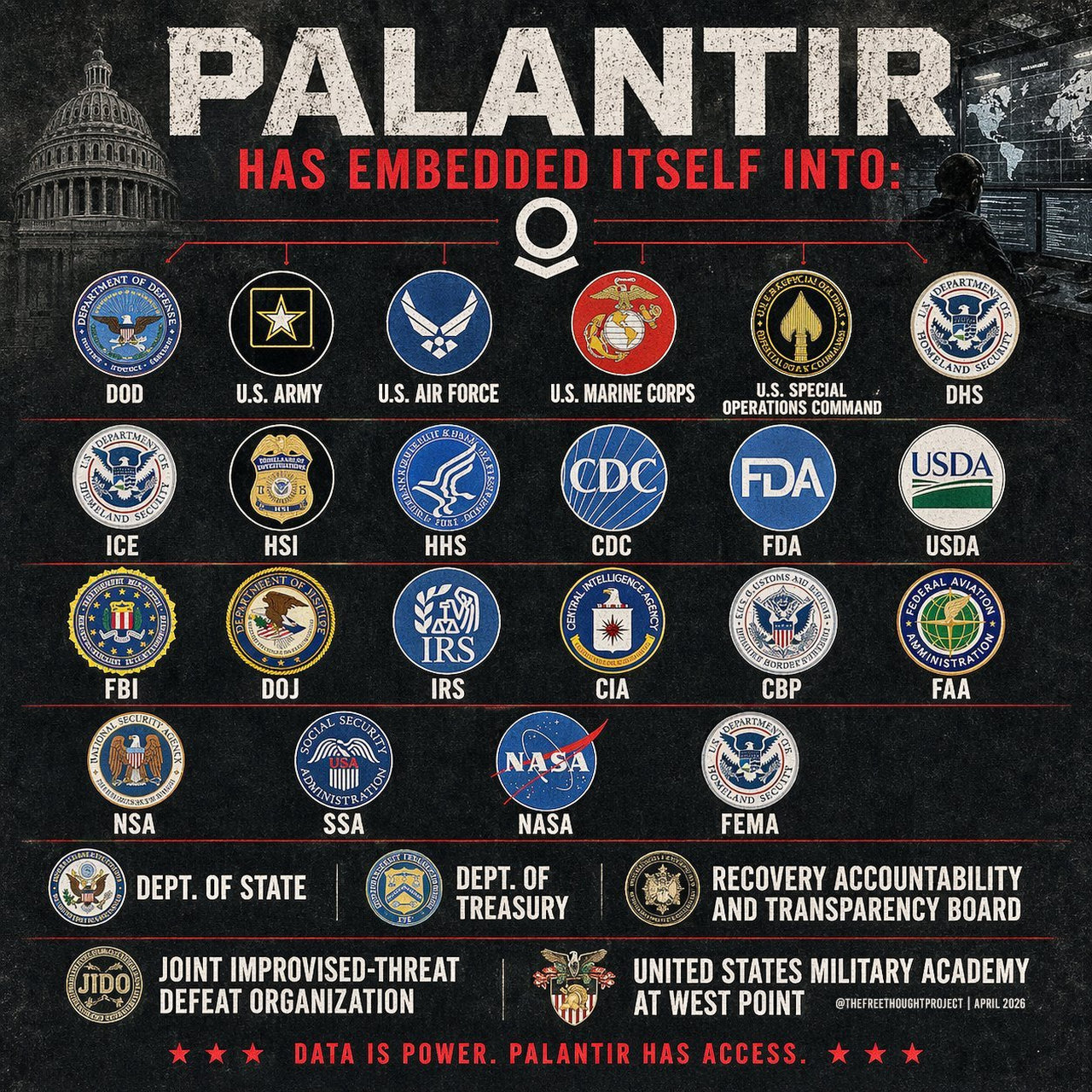
Palantir holds over $10 billion in contracts with the US military alone. The Trump administration contracted Palantir to build a master database of American citizens. The Pentagon expanded its Maven Smart Systems contract by $795 million to deploy AI-powered combat intelligence. And the IRS—the US tax authority—has paid Palantir over $180 million since 2018 under 26 contracts, including case selection and procurement. Twenty-seven agencies in total, and counting. The government as a customer of its own replacement.
The origin story is told so openly that it almost seems brazen. In 2005, Palantir received seed funding from In-Q-Tel, the CIA's venture capital arm, in exchange for company shares. The CIA helped Palantir refine its first software product, Gotham, and became its first major customer. In other words, the intelligence agency uses taxpayer money to found a private company, which then sells its own software back to the agency—at a profit margin. The wheel of history keeps turning, only this time someone is holding shares.
The founding principle was not disguised. Documents from NSA whistleblower Edward Snowden reveal that Palantir was not only financed by In-Q-Tel, but was effectively co-developed over almost three years through close collaboration between Palantir IT specialists and analysts from various intelligence agencies. This was no startup fairytale from a garage. It was a joint venture between surveillance capital and the surveillance state, where ultimately only one side reaps the profits.
Under CEO Alex Karp's leadership, Palantir has relied heavily on the expertise of former members of Israel's cyber intelligence unit 8200. Following a strategic partnership with Israel in January 2024, Palantir significantly expanded its operations in Gaza and the occupied West Bank – and helped create target databases for the Israeli military. The company calls this "defending the West." What lies on the other side of these target databases goes by a different name.
In April 2025, Palantir signed a $30 million contract with U.S. Immigration and Customs Enforcement (ICE) for a platform called ImmigrationOS, designed to "streamline" the identification and deportation of immigrants. Streamline is a nice word. It sounds efficient. It feels different when you're on the wrong side of the algorithm.
Thirteen former Palantir employees—engineers, managers, and a member of the company's data protection team—signed a letter warning that safeguards against discrimination, disinformation, and abuse of power are being violated and rapidly dismantled. From within. By the very people who built the system and now know its purpose.

The business model behind it is strikingly simple. When a government agency monitors its citizens, there are hearings, lawsuits, oversight committees, and parliamentary debates. When a private company monitors the same citizens on behalf of the same government, it's a trade secret. The state outsources its most sensitive activities—and then buys them back, without the control it theoretically has over itself.
In Switzerland, the military refused to cooperate because it could not be technically ruled out that data could leak from Palantir systems. Meanwhile, the state of Baden-Württemberg signed a five-year contract—without the knowledge of its coalition partner. When Palantir became irritated by this Swiss reporting, the company filed a lawsuit against the magazine "Republik." A company that monitors governments takes legal action against journalists who report on it. The logic is perfect.
They are no longer in the service of the empire that created them. They have become the empire. American imperialism, surveillance capitalism, and technofascism fused into a single architecture, operated by a single class, accountable to no one.
The remarkable thing is not that it's happening. The remarkable thing is that it's happening so openly. The contracts are public. The stock market data is accessible. The whistleblower is speaking out. The former employees are writing letters. And the apparatus continues to grow, agency by agency, contract by contract, database by database.
Somewhere a sign still hangs: Democracy. Nobody checked to see if anyone was sitting behind it.
More for you:






 "Dravens Tales from the Crypt" has been enchanting for over 15 years with a tasteless mixture of humor, serious journalism - for current events and unbalanced reporting in the press politics - and zombies, garnished with lots of art, entertainment and punk rock. Draven has turned his hobby into a popular brand that cannot be classified.
My blog was never designed to spread news, let alone get political, but with current affairs I just can't help but capture information here that is otherwise censored on all other channels. I am aware that the design page may not seem "serious" to many in this regard, but I will not change this to please the "mainstream". Anyone who is open to non-state-compliant information sees the content and not the packaging. I've tried enough to provide people with information over the last 2 years, but quickly noticed that it never matters how it's "packaged", but what the other person's attitude towards it is. I don't want to put honey on anyone's mouth to meet expectations in any way, so I'll keep this design because hopefully at some point I'll be able to stop making these political statements, because it's not my goal to go on like this forever  I leave it up to everyone how they deal with it. However, you are welcome to simply copy and distribute the content, my blog has always been under the WTFPL license.
It's hard for me to describe what I'm actually doing here, DravensTales has become a culture blog, music blog, shock blog, tech blog, horror blog, fun blog, a blog about found items on the internet, internet bizarre, trash blog, art blog, water heater, zeitgeist blog over the years , Scrap blog and grab bag blog called. Everything that is right ... - and yet not. The main focus of the blog is contemporary art, in the broadest sense of the word.
To ensure the continued operation of this site, you are welcome to make a donation via credit card, PayPal, Google Pay, Apple Pay, or direct debit/bank account . Many thanks to all readers and supporters of this blog!








