
A little prick. No big deal. Roll up your sleeves, keep quiet, show solidarity. That was the message in 2021 and 2022 – and anyone who didn't toe the line was no longer a concerned citizen, but a blockhead, a spreader of fake news, an enemy of the common good, a Covidiot. This wasn't a misunderstanding. It was deliberate. Because anyone who still claims today that the mRNA preparations against Covid are "vaccinations" in the classic sense is either knowingly lying or simply hasn't understood what was injected into their arm. Both are equally appalling – for different reasons.

What a vaccination is – and what it definitely isn't.
Traditional vaccination works on a principle most people remember from childhood: A weakened or inactivated pathogen – or an isolated antigen from it – is presented to the body. The immune system reacts, produces antibodies, and develops immunological memory. This principle is tried and tested, well understood, and has been in use for decades. We know how it works. We know what can go wrong. We know what it contains.
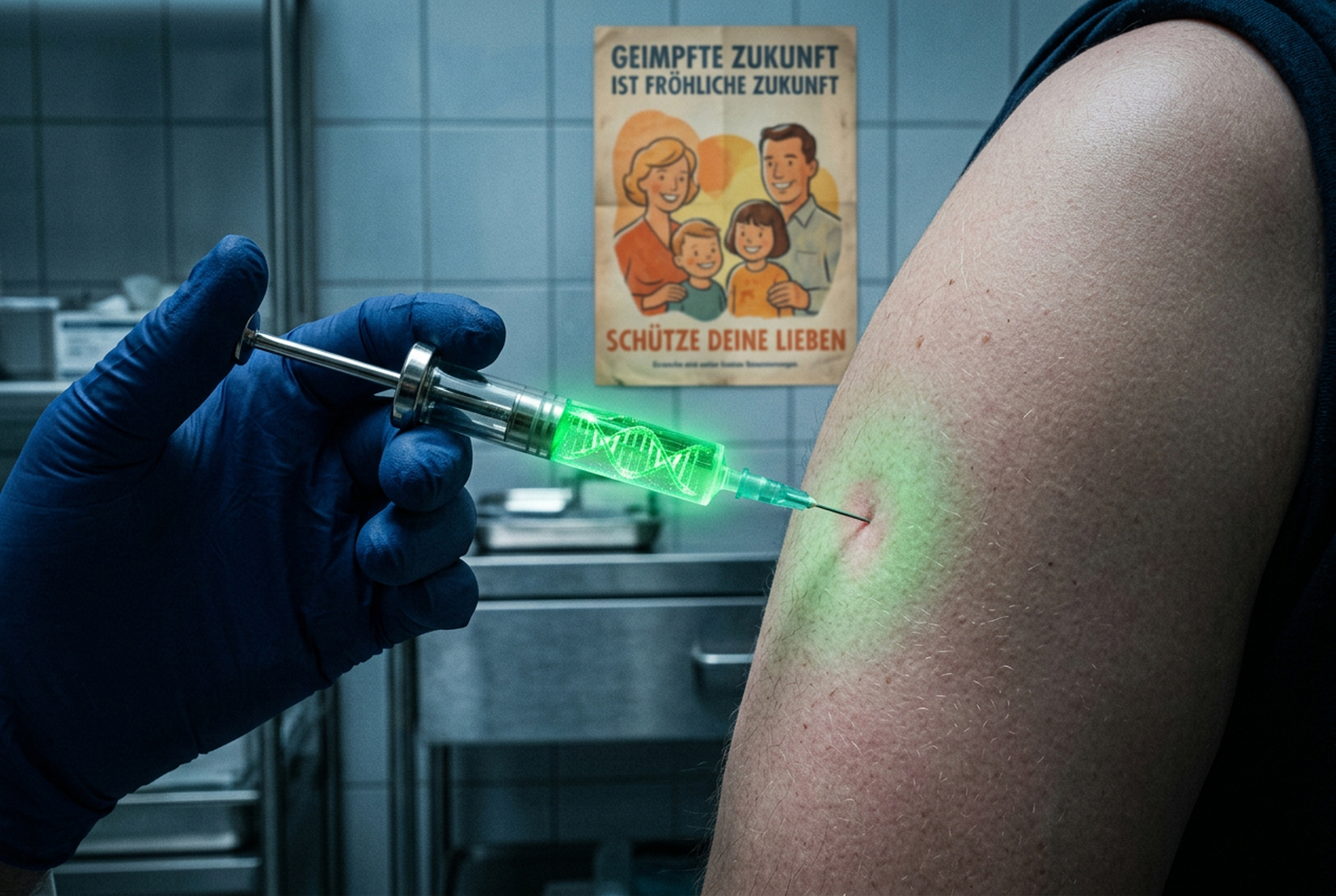
The mRNA products from BioNTech/Pfizer and Moderna are fundamentally different. Instead of administering a classic antigenic substance, the body receives a genetic blueprint – technically speaking, a product of genetic engineering. This blueprint intervenes in the body's own cells, causing them to produce the spike protein of the coronavirus. This is a protein that these cells would never produce without this genetic intervention. It's not a weakened pathogen, not an isolated antigen – but a molecular instruction to repurpose the body's own cellular machinery for the production of foreign proteins.
This is not a "little prick." This is a biotechnological intervention in cellular metabolism—and anyone who considers the term "bioweapon" exaggerated in this context is welcome to explain where exactly the objective line lies between an active ingredient that deliberately manipulates biological processes in the human body and one that does not. Legally and regulatoryly, the whole thing can still be called a "vaccine." The relevant authorities have done so. But there is sometimes a gap between legal classification and factual accuracy—and an entire society has been maneuvered into precisely this gap.
Language control as an instrument of power
Whoever controls concepts controls thought. This is not a conspiracy theory, this is linguistics – and it has been observable in almost real time over the past few years.
"Genetic engineering drug" became "vaccine." "Biotechnological intervention" became "a little prick." Critical questions became "delegitimization." Scientists with dissenting opinions became "Covidiots." And anyone who asked about the mechanism of action and possible long-term side effects was suddenly no longer curious, but dangerous.
The precision of this linguistic strategy is remarkable. The word "vaccination" carries an enormous emotional burden: it stands for childhood, trust, protection, community. It evokes the family doctor, school vaccination day, the smallpox scar of grandparents. Anyone who misappropriates this term for a genetically engineered product of the pharmaceutical industry is exploiting one of the most powerful psychological levers of all – collective memory. This was no communicative accident. This was calculated linguistic manipulation on an industrial scale.
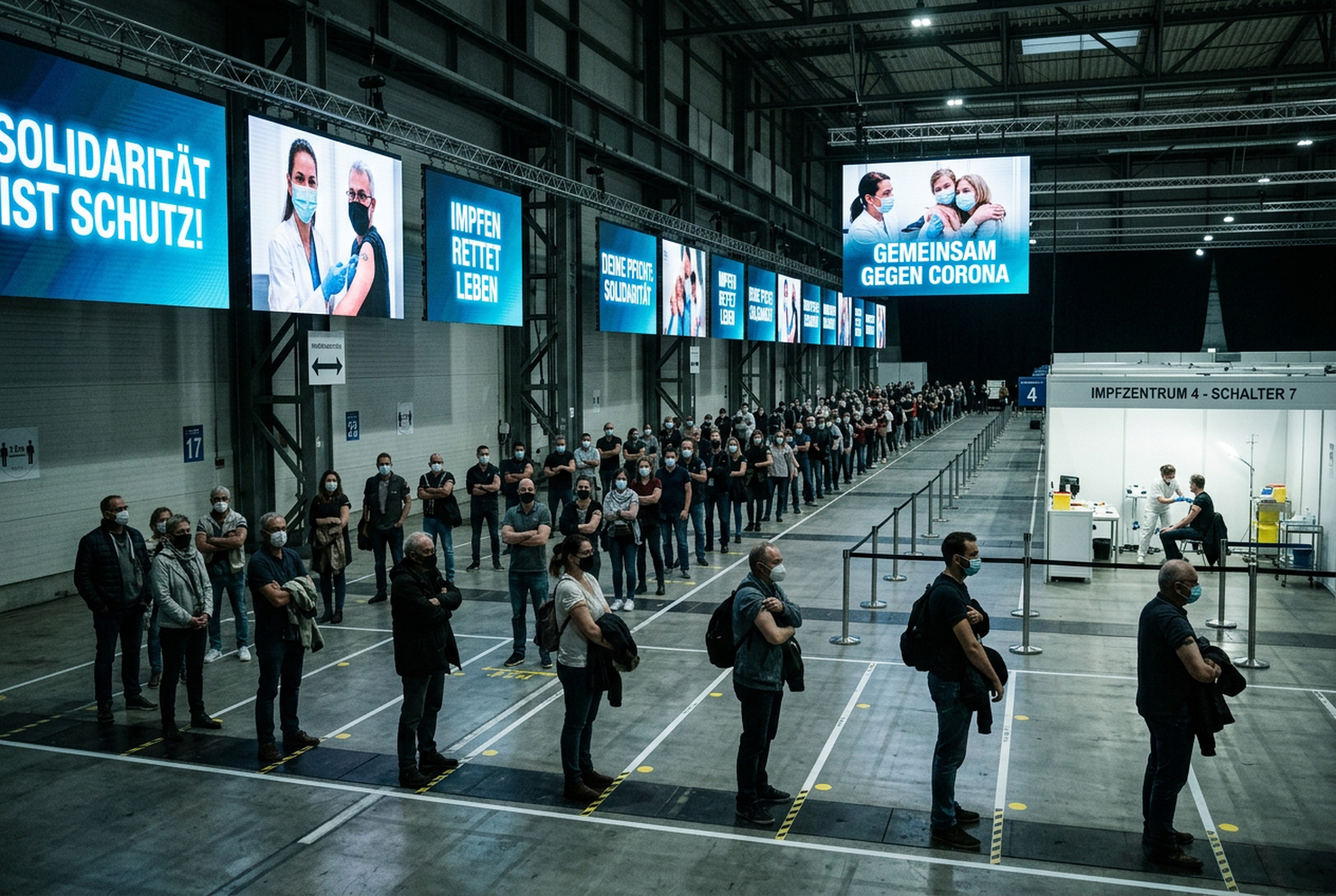
What's particularly striking is this: Strict evidence-based medicine supposedly applies to every dietary supplement. With every medicinal plant, the immediate question is: "Where are the studies?" Every alternative treatment is tested, categorized, and ridiculed. But when a completely novel genetic engineering technique is used millions of times in a very short period, the only mature reaction is supposed to be: Roll up your sleeves, keep quiet, and show solidarity. The double standard could hardly be more blatant.
The immune system of opinion
And how does a successfully programmed society react when it is told that this vaccination was not a vaccination? With gratitude? With curiosity? With questions?
No. With insults. With "empty-headed" and "stupid" and "legal action" and the elegant argument: "Stop whining, that was years ago." There's not even a need to discuss excess mortality, nor side effects, 2G exclusion, or fundamental rights infringements on a scale that many simply couldn't have imagined before. It's enough to merely point out the principle of operation – and the collective defense mechanism kicks in.
This isn't the behavior of people who have formed an opinion. This is the behavior of people whose opinions have been formed. The reflexive "That was years ago" deserves special mention. It's not an argument. It's a polite request to stop thinking about it. Very convenient. But societies don't learn by forgetting. They learn by confronting the past. Those who absolutely refuse to do so usually have a reason.
Because it will be the same next time
Therefore, this discussion is not over. Not because old wounds should be rekindled – but because the same mechanisms will be at work again next time: a new procedure, a familiar word, maximum reach, minimal questions. Sleeves rolled up.
The crucial question isn't whether someone received the product or not. The crucial question is whether they are willing to understand what it was – without Karl Lauterbach personally showing up at their doorstep to apologize.
Anyone who reacts with maximum aggression to the factual information that an mRNA injection is not a conventional vaccine unwittingly provides the best proof of how deeply ingrained this programming is. Clear thinking doesn't begin with rejection – it begins with examining terms and allowing for the uncomfortable possibility that one has been systematically and deliberately lied to.
The needle's long gone – but the programming is still there! Deep, very deep!
More for you:






 "Dravens Tales from the Crypt" has been enchanting for over 15 years with a tasteless mixture of humor, serious journalism - for current events and unbalanced reporting in the press politics - and zombies, garnished with lots of art, entertainment and punk rock. Draven has turned his hobby into a popular brand that cannot be classified.
My blog was never designed to spread news, let alone get political, but with current affairs I just can't help but capture information here that is otherwise censored on all other channels. I am aware that the design page may not seem "serious" to many in this regard, but I will not change this to please the "mainstream". Anyone who is open to non-state-compliant information sees the content and not the packaging. I've tried enough to provide people with information over the last 2 years, but quickly noticed that it never matters how it's "packaged", but what the other person's attitude towards it is. I don't want to put honey on anyone's mouth to meet expectations in any way, so I'll keep this design because hopefully at some point I'll be able to stop making these political statements, because it's not my goal to go on like this forever  I leave it up to everyone how they deal with it. However, you are welcome to simply copy and distribute the content, my blog has always been under the WTFPL license.
It's hard for me to describe what I'm actually doing here, DravensTales has become a culture blog, music blog, shock blog, tech blog, horror blog, fun blog, a blog about found items on the internet, internet bizarre, trash blog, art blog, water heater, zeitgeist blog over the years , Scrap blog and grab bag blog called. Everything that is right ... - and yet not. The main focus of the blog is contemporary art, in the broadest sense of the word.
To ensure the continued operation of this site, you are welcome to make a donation via credit card, PayPal, Google Pay, Apple Pay, or direct debit/bank account . Many thanks to all readers and supporters of this blog!








