
Taking sides in the Israeli-Palestinian conflict means voluntarily entering a vicious cycle with no escape – and then pretending that choosing between two flags is some great moral act. It isn't. It's a failure of imagination, neatly disguised as a stance. Governments thrive on your belief that they are inevitable, on your taking violence, borders, and hierarchies for natural laws like gravity and rain. They aren't. And as long as you feed this lie, you feed the machine that is reducing Gaza to rubble.
Plasters for gunshot wounds
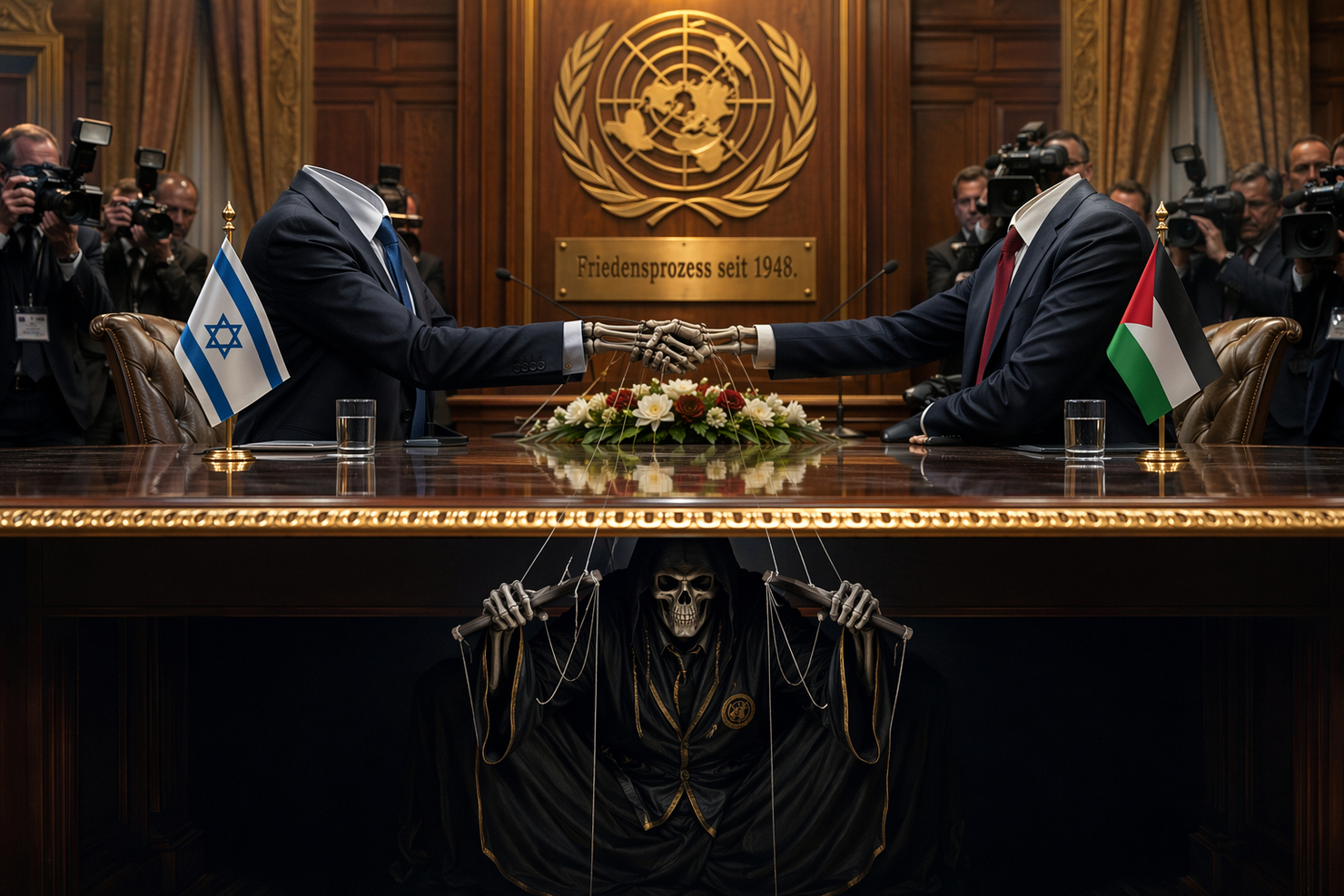
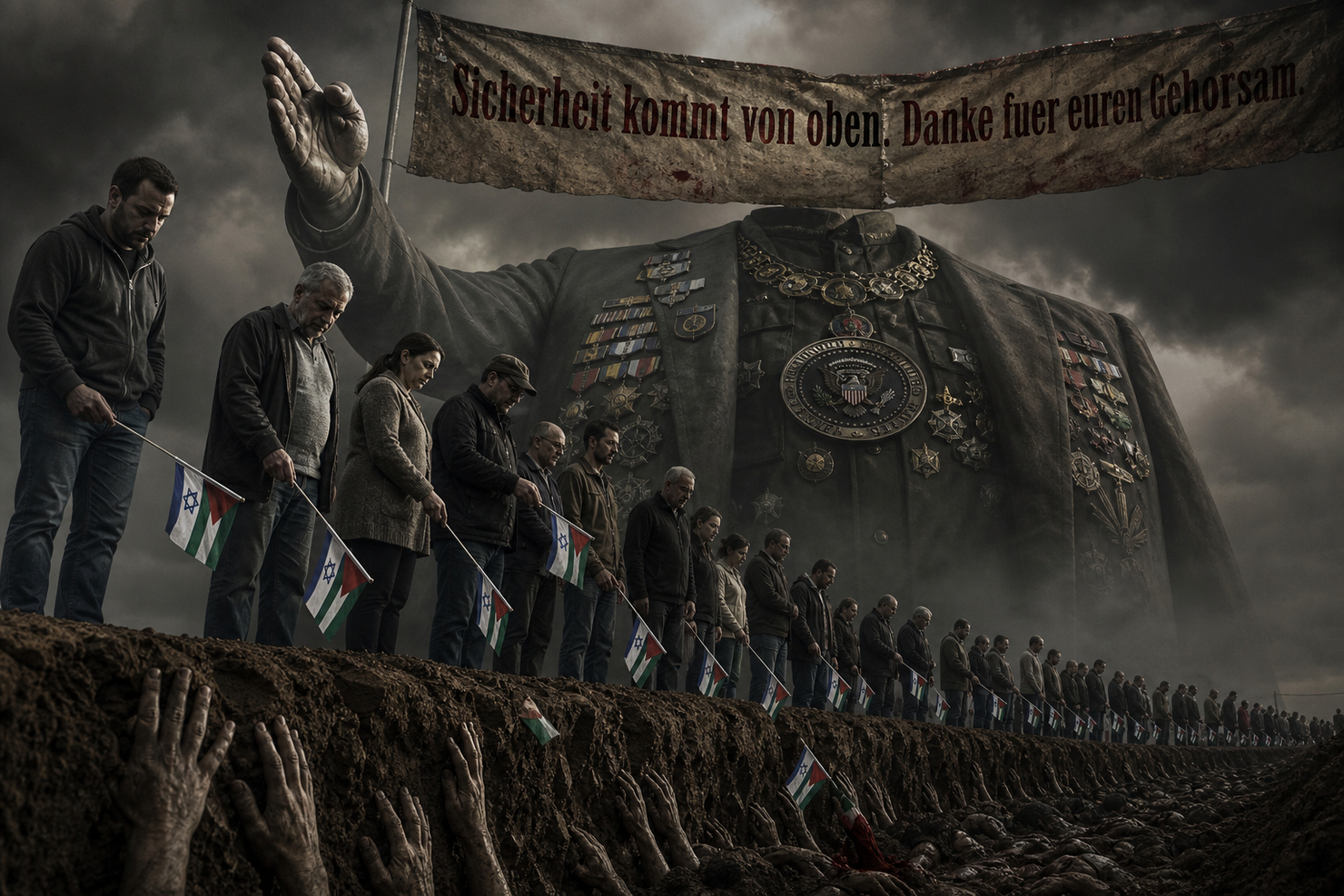
If you demand political intervention, sanctions, a ceasefire, the eternal two-state solution, then you are negotiating with the very systems that set up the slaughter in the first place. You are asking the arsonists to act as firefighters – and then you're surprised when the fires continue to burn. These "solutions" are band-aids for gunshot wounds. They presuppose that governments can be trusted to dismantle the very power structures from which they themselves were built. But genocide is not an accident of statecraft. It is an inherent characteristic. Every bomb dropped on Gaza, every checkpoint in the West Bank conveys the same message: security comes from authority, so keep quiet and be grateful.
The faith that lubricates the machine
Political interventions are short-sighted because they ignore the root cause: humanity's ingrained belief in rulers. You've been taught that without government, chaos will erupt, so you cling to it even as it flattens your world. This very fear keeps the genocidal machine running. And it's profitable: war isn't chaos, but a business model where some die and others reap the rewards – a mechanism this blog has already explored. disassembled elsewhere hat.
Not a political statement, but a rejection.
Anarchy is not a utopia that erupts overnight. It is a slow, multi-generational realignment of your relationship to power. Refusing to take sides in a conflict between states is neither passivity nor the comfortable apathy of the armchair cynic. It is the first spark of an intellectual revolution. Those who refuse the false choice between Israeli and Palestinian statehood create space for the questions no government ever wants to hear: Why must land be controlled by governments at all? What if security arises from collective responsibility instead of armies and police? And why should you obey a stranger simply because they wear a badge, a uniform, or a government title?
Education instead of legislation
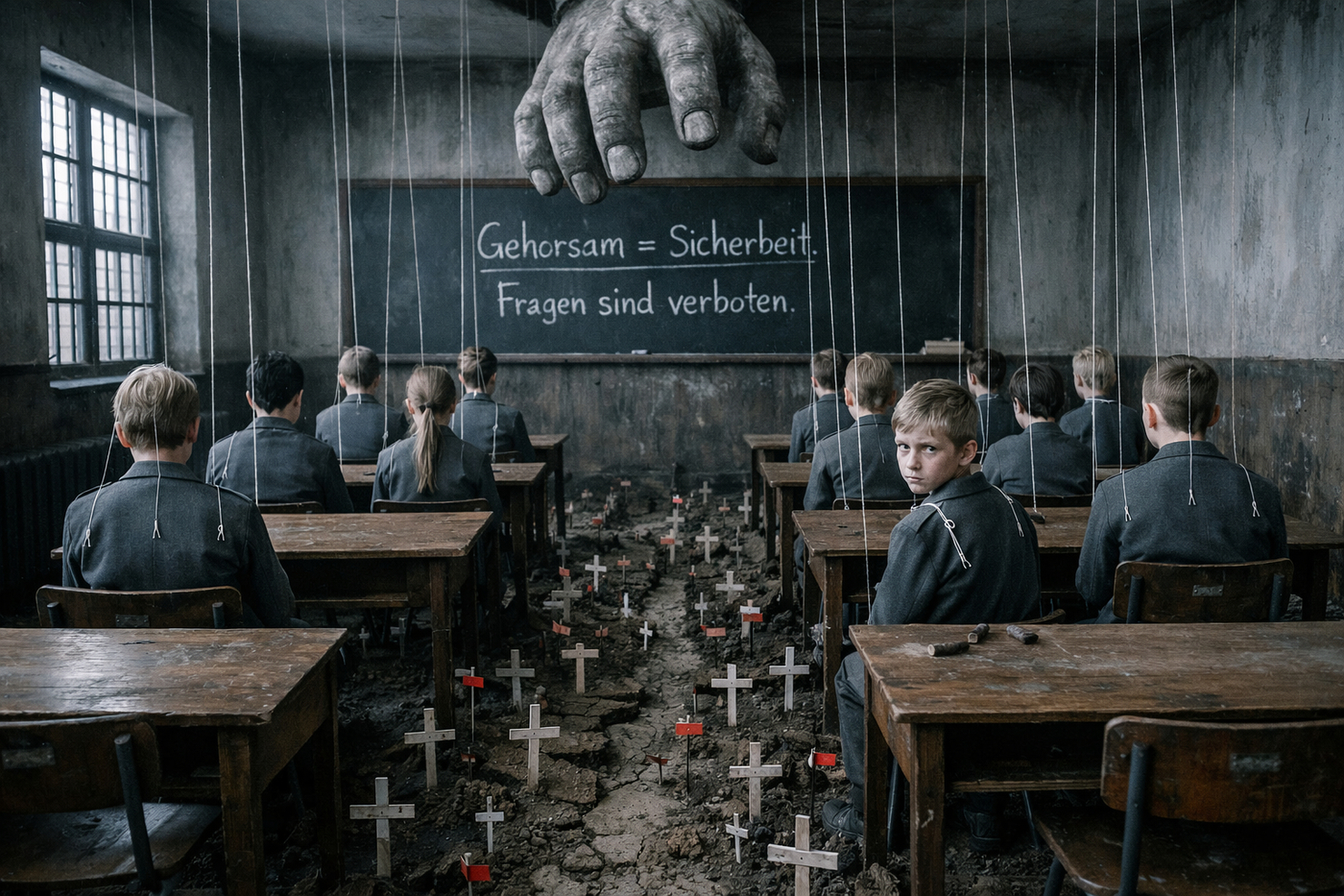
That is the task of education, not legislation. And by education, I don't mean the academic institution, that training ground with a diploma at the end. It's about teaching children cooperation as a matter of course and treating obedience to hierarchies for what it is – absurd. It's about rethinking "security" as a network of mutual aid instead of a military parade. And it requires not only mourning the dead in Palestine, but also the centuries of indoctrination that made it possible in the first place.
Governments are not buildings or laws. They are ideas. They exist because we collectively act as if they are legitimate. The real struggle is to renounce this agreement in our own minds. Those who worship "leaders" and "nations" perpetuate the myth that some people have the inherent right to rule over others.
The DNA of another world
Anarchists don't counter this with manifestos, but with lived autonomy: neighborhood councils that function without politicians, grassroots disaster relief that puts every authority to shame, communities that resolve conflicts through dialogue instead of court. Each of these actions is a lesson. They prove that another world is possible – not through violence, but through setting an example.
Genocide persists because states have a monopoly on the stories we tell ourselves. They call violence "security," occupation "fate," and resistance "terrorism"—the same labeling machine that reflexively turns any criticism of a government into hatred of a religion . To break this cycle, you must take away the states' sharpest weapon: your belief in their necessity.
I'm not on either side. Not Israel's, not Palestine's. I'm on the side of the parents who teach their child that no one has the right to steal a home. On the side of the Israeli teenager who refuses military service. On the side of those in Ramallah who distribute food without permits because an empty stomach doesn't need a stamp. These aren't just nice gestures. This is the DNA of the world we dream of.
I am accused of idealism, as if believing in humanity's capacity for development were quaintly naive. Naivety is something entirely different: trusting that governments whose very existence depends on the division that creates it will be the ones to stop genocide.
Seeds instead of quick fixes
The way out of violence in Palestine—and everywhere else—doesn't lead through a gilded deal and a camera-sealing handshake, but through generations growing up in communities where cooperation takes precedence over control. This means: stopping begging for quick fixes. Starting to sow seeds. Anarchy is not a distant dream, but a daily practice—thinking, teaching, rebuilding. Those who transform ways of thinking instead of waving flags are not merely protesting genocide; they are drying up the very soil in which it grows.
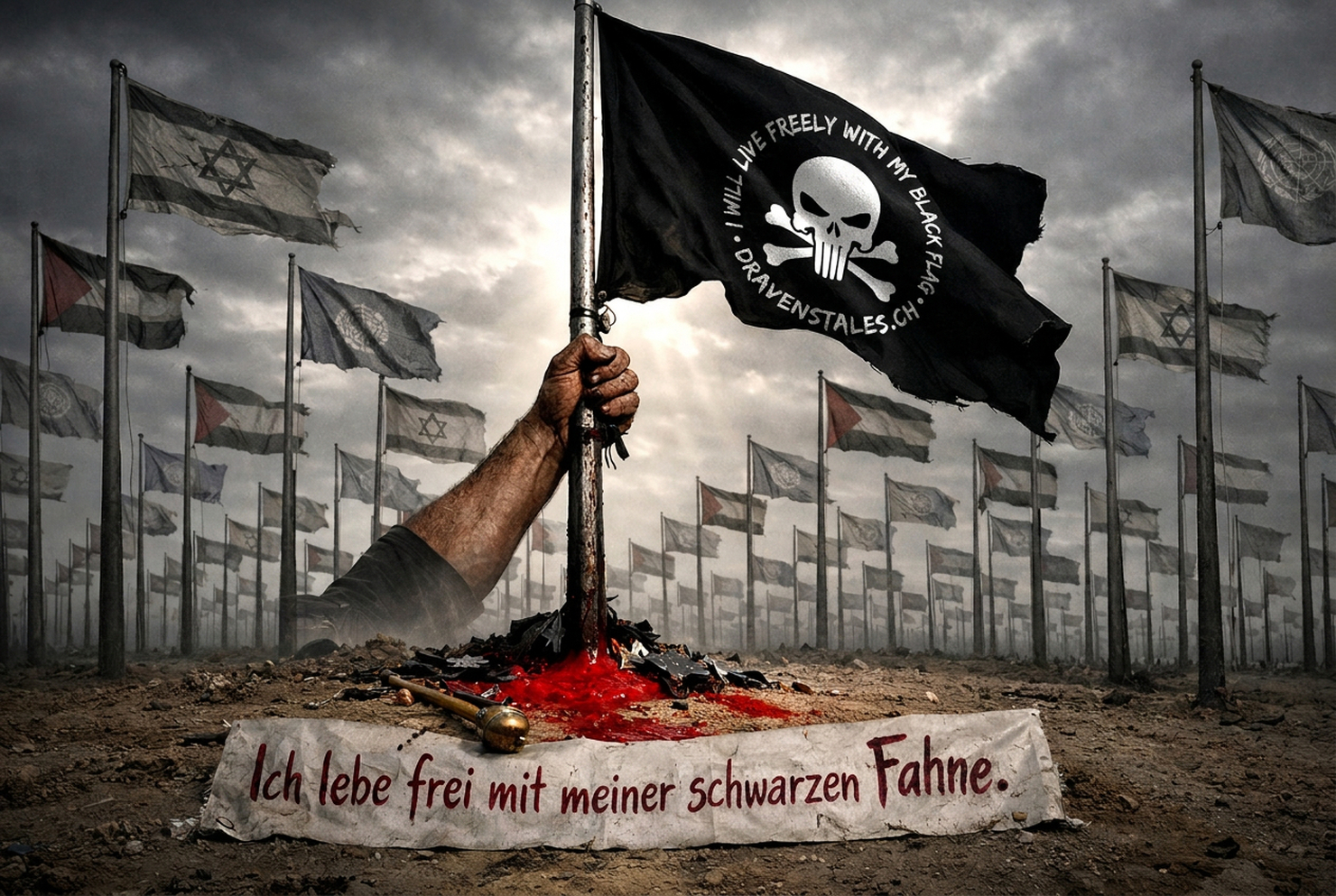
Whoever chooses a flag has lost the fight before it has even begun. Whoever waits for diplomats is waiting for the fire brigade that started the blaze. Whoever teaches their children obedience instead of cooperation is raising the next generation of bystanders for the next massacre – and calls this "education"! We don't need a better government, we need the courage to break the agreement – and live freely, with our black flag!
More for you:






 "Dravens Tales from the Crypt" has been enchanting for over 15 years with a tasteless mixture of humor, serious journalism - for current events and unbalanced reporting in the press politics - and zombies, garnished with lots of art, entertainment and punk rock. Draven has turned his hobby into a popular brand that cannot be classified.
My blog was never designed to spread news, let alone get political, but with current affairs I just can't help but capture information here that is otherwise censored on all other channels. I am aware that the design page may not seem "serious" to many in this regard, but I will not change this to please the "mainstream". Anyone who is open to non-state-compliant information sees the content and not the packaging. I've tried enough to provide people with information over the last 2 years, but quickly noticed that it never matters how it's "packaged", but what the other person's attitude towards it is. I don't want to put honey on anyone's mouth to meet expectations in any way, so I'll keep this design because hopefully at some point I'll be able to stop making these political statements, because it's not my goal to go on like this forever  I leave it up to everyone how they deal with it. However, you are welcome to simply copy and distribute the content, my blog has always been under the WTFPL license.
It's hard for me to describe what I'm actually doing here, DravensTales has become a culture blog, music blog, shock blog, tech blog, horror blog, fun blog, a blog about found items on the internet, internet bizarre, trash blog, art blog, water heater, zeitgeist blog over the years , Scrap blog and grab bag blog called. Everything that is right ... - and yet not. The main focus of the blog is contemporary art, in the broadest sense of the word.
To ensure the continued operation of this site, you are welcome to make a donation via credit card, PayPal, Google Pay, Apple Pay, or direct debit/bank account . Many thanks to all readers and supporters of this blog!








