
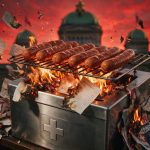
One has to give the SRG credit: hardly anyone sells their own existence as consistently as a civilizational necessity as Switzerland's public broadcaster. Without the "Tagesschau," the subtext goes, the Swiss Confederation would collapse within hours. Without "Arena," the country would descend into an argumentative civil war. And without SRF? Well, presumably the entire Western Hemisphere would collapse. This isn't just overconfidence anymore. This is doomsday marketing.
The dramaturgy is always the same: whenever the budget is in question, doom is proclaimed. The SRG (Swiss Broadcasting Corporation) portrays itself as a moral beacon in a sea of disinformation. Anyone who wants to cut funding is supposedly undermining the democratic order. Anyone who calls for reforms is endangering the nation's cohesion. As if Switzerland were a delicate china set, only saved from disintegration by the news program "10vor10."
The reality, however, is less apocalyptic and considerably more mundane: SRF is a state apparatus with cameras. A well-funded, publicly license fee-based institution that has seen itself as the ultimate educational authority for decades. It explains the world to the people – carefully curated, subtly pre-filtered, and in the correct moral tone. The Matrix calls this narrative control.
Of course there are good articles. Of course there are dedicated journalists. But the problem isn't with individual articles, but with the self-image. SRF doesn't speak like a participant in the discourse, but like its referee. And woe betide anyone who calls back. Then the chorus of concerned editorial writers emerges. The usual voices of the mainstream, who suddenly become quite patriotic when their platform is at stake.
They warn of the information vacuum, the coarsening of discourse, of TikTok becoming the new National Council. One is almost tempted to believe that democracy is a fragile algorithm that only functions stably with sufficient fees. What they don't say: It's also about positions. About airtime. About the comforting certainty of being part of a morally superior institution. "Public service" sounds noble. "Self-preservation instinct" sounds more honest.
Particularly touching is the argument that SRF holds Switzerland together. As if the four language regions were only connected by the shared "Tagesschau" theme song. As if the Swiss Confederation hadn't survived for centuries long before anyone lit up a studio in Leutschenbach. And then there's the almost religious veneration of public broadcasting: Anyone who criticizes it is quickly labeled anti-cultural, anti-democratic, or simply clueless. Criticism of structures is reinterpreted as an attack on values. A classic Matrix move: Conflate institution with principle, and every reform seems like sacrilege.
A sober debate about the scope, mandate, and financing of the SRG would be anything but a threat to the state. Switzerland is not a fragile house of cards. It is a federal entity with a robust sense of civic duty. It will survive a leaner SRG. It could probably even tolerate several opinions simultaneously. The real paradox is this: while SRF portrays itself as a guardian of democracy, any structural criticism is perceived as blasphemy. A system that declares itself an indispensable moral authority has long since ceased to critically examine itself.
Perhaps that's precisely the problem. Not that there is a public broadcaster. But that it considers itself the lifeblood of the nation.
Switzerland has survived banking crises, currency storms, and political infighting. It will also survive a budget cut for SRF (Swiss Radio and Television). And the world? It will keep turning, with or without a special "Arena" broadcast…

More for you:





 "Dravens Tales from the Crypt" has been enchanting for over 15 years with a tasteless mixture of humor, serious journalism - for current events and unbalanced reporting in the press politics - and zombies, garnished with lots of art, entertainment and punk rock. Draven has turned his hobby into a popular brand that cannot be classified.
My blog was never designed to spread news, let alone get political, but with current affairs I just can't help but capture information here that is otherwise censored on all other channels. I am aware that the design page may not seem "serious" to many in this regard, but I will not change this to please the "mainstream". Anyone who is open to non-state-compliant information sees the content and not the packaging. I've tried enough to provide people with information over the last 2 years, but quickly noticed that it never matters how it's "packaged", but what the other person's attitude towards it is. I don't want to put honey on anyone's mouth to meet expectations in any way, so I'll keep this design because hopefully at some point I'll be able to stop making these political statements, because it's not my goal to go on like this forever  I leave it up to everyone how they deal with it. However, you are welcome to simply copy and distribute the content, my blog has always been under the WTFPL license.
It's hard for me to describe what I'm actually doing here, DravensTales has become a culture blog, music blog, shock blog, tech blog, horror blog, fun blog, a blog about found items on the internet, internet bizarre, trash blog, art blog, water heater, zeitgeist blog over the years , Scrap blog and grab bag blog called. Everything that is right ... - and yet not. The main focus of the blog is contemporary art, in the broadest sense of the word.
To ensure the continued operation of this site, you are welcome to make a donation via credit card, PayPal, Google Pay, Apple Pay, or direct debit/bank account . Many thanks to all readers and supporters of this blog!








