
Once upon a time, there was a country that liked to portray itself as a bastion of neutrality, discretion, and solid civic spirit. A country with banking secrecy, direct democracy, and a collective self-image of being somehow better than the rest. Switzerland. Those were the days. Because while you were still basking in this comfortable illusion, Swisscom—partially owned by the state, mind you—quietly began to commercialize the skies above you. With drones. An entire network of them. Nationwide. Automated. And of course: for your safety. You have to give them credit for at least admitting it. Swisscom Broadcast, together with Nokia, is building a nationwide drone network that offers automated drone flights as a service—for infrastructure inspections, police operations, or the protection of large areas. A one-stop shop for aerial surveillance. Practical. Efficient. And written with the reassuring warmth of an IKEA catalog.
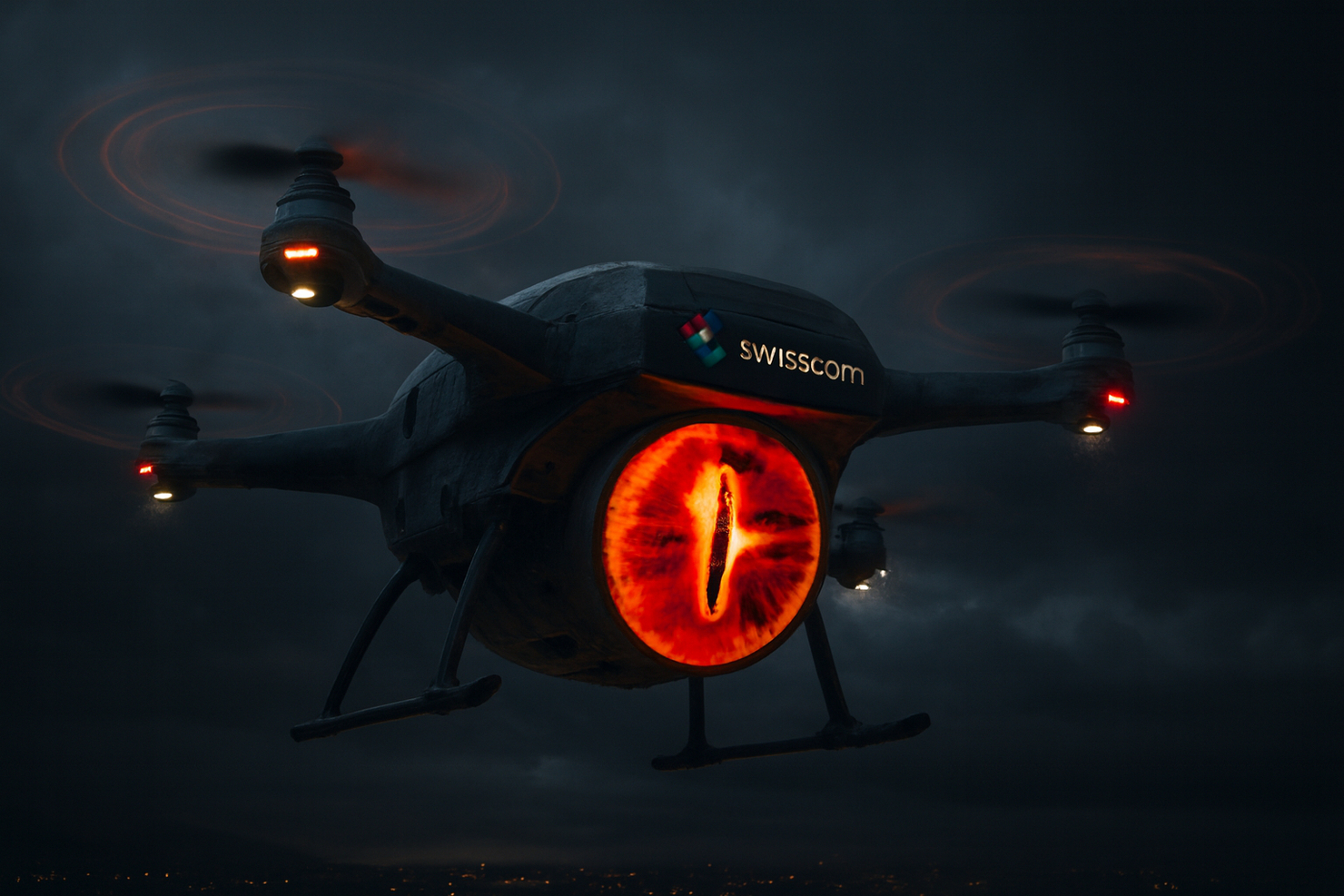
To reassure the public, Swisscom Broadcast CEO Dominik Müller boldly declared that the establishment of the nationwide drone network was a milestone in the development of digital security solutions in Switzerland. A milestone. Imagine that. Milestones used to be things like the invention of the wheel or the abolition of serfdom. Today, it's a telecommunications company sending automated eyes into the sky using Nokia technology. Humanity is advancing.
The business model sounds harmless enough on paper. Swisscom already conducts 3000 automated flights per year – and that number is rising. The service is primarily intended for police and fire departments. Rescue operations, fire protection, infrastructure monitoring. All good. All safe. All within the legal framework. Swisscom emphasizes this with the regularity of a mantra – so often that one inevitably wonders whom they are actually trying to convince. Us? Or themselves?
Let's take a closer look at what this network can actually do. The solution includes the protection of public spaces, prisons, borders, and police and military facilities. Combined with alarm sensors, the security level of facilities requiring protection can be significantly increased. Public spaces. That's you. Your neighborhood, your park, your demonstration, your walk with the dog. All potentially in need of protection. All potentially monitored. By a drone that no one sees, no one hears – but that certainly does see and hear.
The automated drones fly beyond direct visual line of sight – so-called BVLOS flights – generating detailed imagery that is analyzed using artificial intelligence to detect significant changes. Artificial intelligence that detects "significant changes." What constitutes a significant change? A fire? A fight? An unauthorized gathering? Three people with banners? A doctor asking uncomfortable questions? The definition lies – naturally – with the client. And according to Swisscom, the client includes, among others, the police.
This is precisely the bombshell no one wants to hear. Swisscom isn't a private tech startup from Silicon Valley. Swisscom is more than half-owned by the Swiss Confederation. Which means: The state has created a private company that sells it surveillance services – with the convenient side effect of nicely obscuring political responsibility. It's not the state that's monitoring you. A company is monitoring you. On behalf of the state. With state money. And under the guise of security.
The next logical step is undeniable: If the police and fire department are already allowed to use this drone network, it's only a matter of time before the state security service – that political police force that photographs government critics and interrogates inconvenient doctors – also gains access. Or perhaps already does. Anyone who believes there's a clear line between "rescue operations" and "political surveillance" has been living with their eyes closed for the past few years.
And Palantir? Carbyne? The international infrastructure of the digital surveillance state that has quietly infiltrated European parliaments and security apparatuses? Swisscom drones cannot be viewed in isolation. They are another piece of the puzzle in a picture that is becoming increasingly clear: comprehensive surveillance, AI-supported analysis, state access – packaged as innovation, sold as security, accepted as a matter of course.
Swisscom is committed to complying with the legal framework – that's the phrase they trot out whenever a critical question arises. As if "legal framework" were a law of nature and not something governments adjust as needed. As if we haven't seen how quickly laws are rewritten, fundamental rights suspended, and exceptions become the rule in emergencies. As if the last five years aren't a single, comprehensive lesson in what states do when they think they can.
The skies over Switzerland will soon belong to Swisscom. Automated, networked, AI-driven, around the clock. And you? You dutifully pay your subscription so that the infrastructure that monitors you is financed. This isn't a dystopia. This is the 2024 annual report. It's time to say a resounding no. Before the buzzing overhead becomes as normal as the ringing of the telephone…
More for you:






 "Dravens Tales from the Crypt" has been enchanting for over 15 years with a tasteless mixture of humor, serious journalism - for current events and unbalanced reporting in the press politics - and zombies, garnished with lots of art, entertainment and punk rock. Draven has turned his hobby into a popular brand that cannot be classified.
My blog was never designed to spread news, let alone get political, but with current affairs I just can't help but capture information here that is otherwise censored on all other channels. I am aware that the design page may not seem "serious" to many in this regard, but I will not change this to please the "mainstream". Anyone who is open to non-state-compliant information sees the content and not the packaging. I've tried enough to provide people with information over the last 2 years, but quickly noticed that it never matters how it's "packaged", but what the other person's attitude towards it is. I don't want to put honey on anyone's mouth to meet expectations in any way, so I'll keep this design because hopefully at some point I'll be able to stop making these political statements, because it's not my goal to go on like this forever  I leave it up to everyone how they deal with it. However, you are welcome to simply copy and distribute the content, my blog has always been under the WTFPL license.
It's hard for me to describe what I'm actually doing here, DravensTales has become a culture blog, music blog, shock blog, tech blog, horror blog, fun blog, a blog about found items on the internet, internet bizarre, trash blog, art blog, water heater, zeitgeist blog over the years , Scrap blog and grab bag blog called. Everything that is right ... - and yet not. The main focus of the blog is contemporary art, in the broadest sense of the word.
To ensure the continued operation of this site, you are welcome to make a donation via credit card, PayPal, Google Pay, Apple Pay, or direct debit/bank account . Many thanks to all readers and supporters of this blog!








