
On March 3, 2026, humpback whale Timmy was first sighted in the western Baltic Sea. On May 2, he was ceremoniously released into the Danish Skagerrak. Just over two weeks later, his carcass washed up off the Danish island of Anholt . Around sixty days of strandings, four rejected emergency appeals, a Peruvian "whale whisperer," an SPD environment minister constantly taking selfies, a privately funded "rescue mission," and, according to the German Oceanographic Museum, a significantly weakened animal—in the end, the whale was denied precisely what would have been compassion: an undisturbed death.
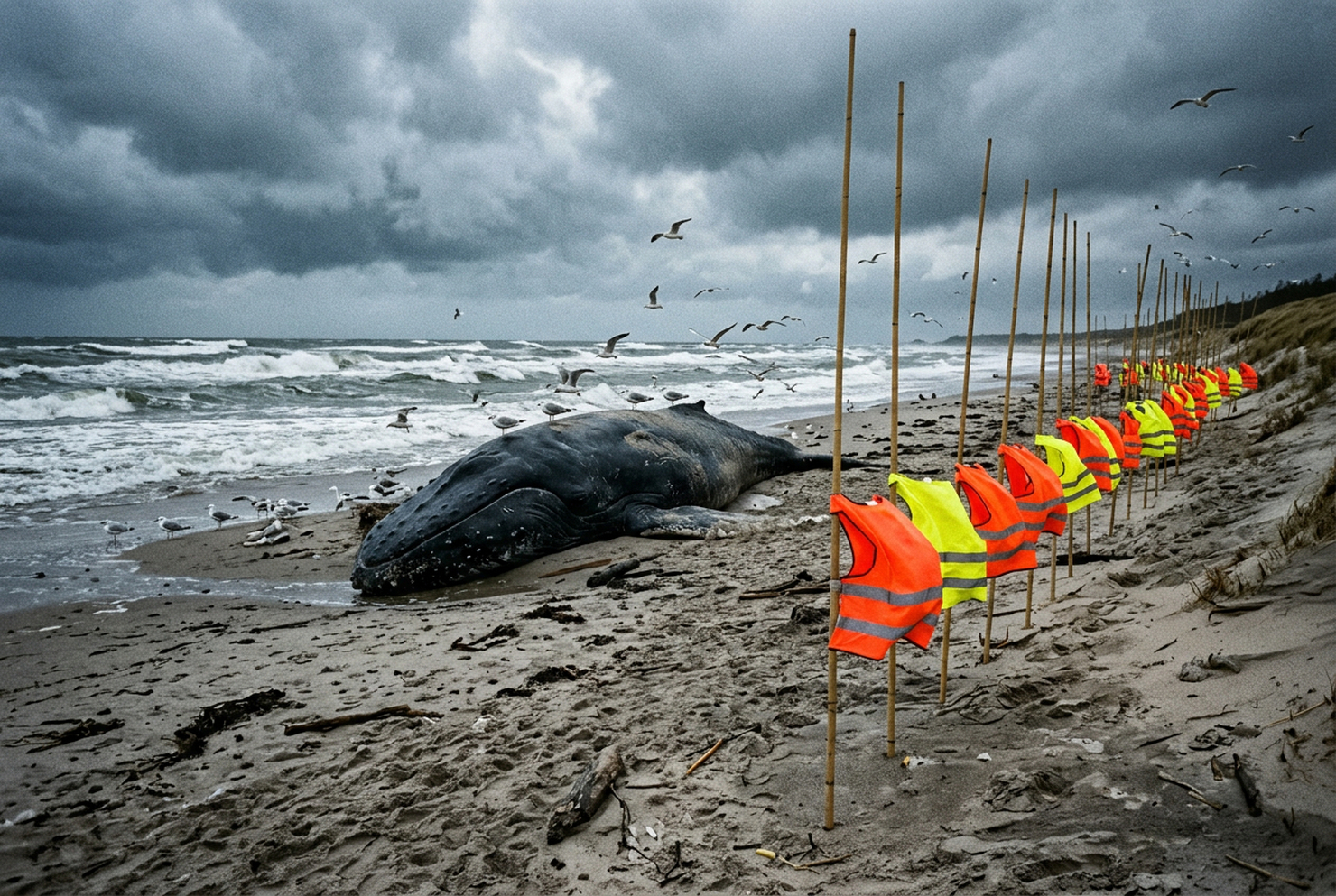
The grand beach production
What began as an ecological tragedy mutated within a few weeks into the most bizarre reality TV show of the German media season. The legendary "Free Willy" team was activated, ARD and NDR broadcast special reports, the Frankfurter Rundschau provided daily updates, a Munich woman jumped from a ferry and swam to the dying animal, demonstrators stormed the cordoned-off area, the police briefly investigated the suspicion of an "illegal whale rescue," while citizens suspected "dark dealings" on Telegram channels. No one asked the whale what he thought of all this. Understandable—he had more important things to do anyway, namely, to die. But the fact that a dying animal can no longer defend itself is not an observation in the 21st century, but a marketing opportunity.
When the minister becomes a whale whisperer
Till Backhaus, Germany's longest-serving environment minister, discovered his second career as an animal chaplain in Timmy. The NZZ dryly headlined about Germany's longest-serving minister, the whale whisperer. CDU parliamentary group leader Daniel Peters articulated to the Nordkurier what should have been a local reporter's job: "Lots of photos of Schwesig's hardest-working man, that was probably the goal." Meanwhile, Sergio Bambarén, a Peruvian-born bestselling author with a pronounced penchant for esotericism, and by his own admission "a very spiritual person," snorkeled up to the weakened animal and, visibly emotional, shared his impressions with the world. Two men, a dying whale, countless photographers. Anyone who misses this spectacle has no place in the attention economy.
Science as a disruptive factor
The German Oceanographic Museum, the IFAW, and virtually every reputable marine biologist consulted all said the same thing, albeit with varying degrees of emphasis: the animal is weakened, further interventions are highly risky, and a rescue in the traditional sense is unrealistic. The Dutch derived a clear protocol from the Texel disaster of 2012: rescue attempts only within the first twelve hours, followed by euthanasia, and for whales over six meters in length, decapitation. Sounds unromantic? It is. Does it work? Yes. Precisely for this reason, it was never established in Germany. Instead, things continued to muddle along, privately funded, with little professional oversight – the level of oversight about as binding as a Bambarén selfie with a snorkel. The response to every expert warning was dutifully: carry on.
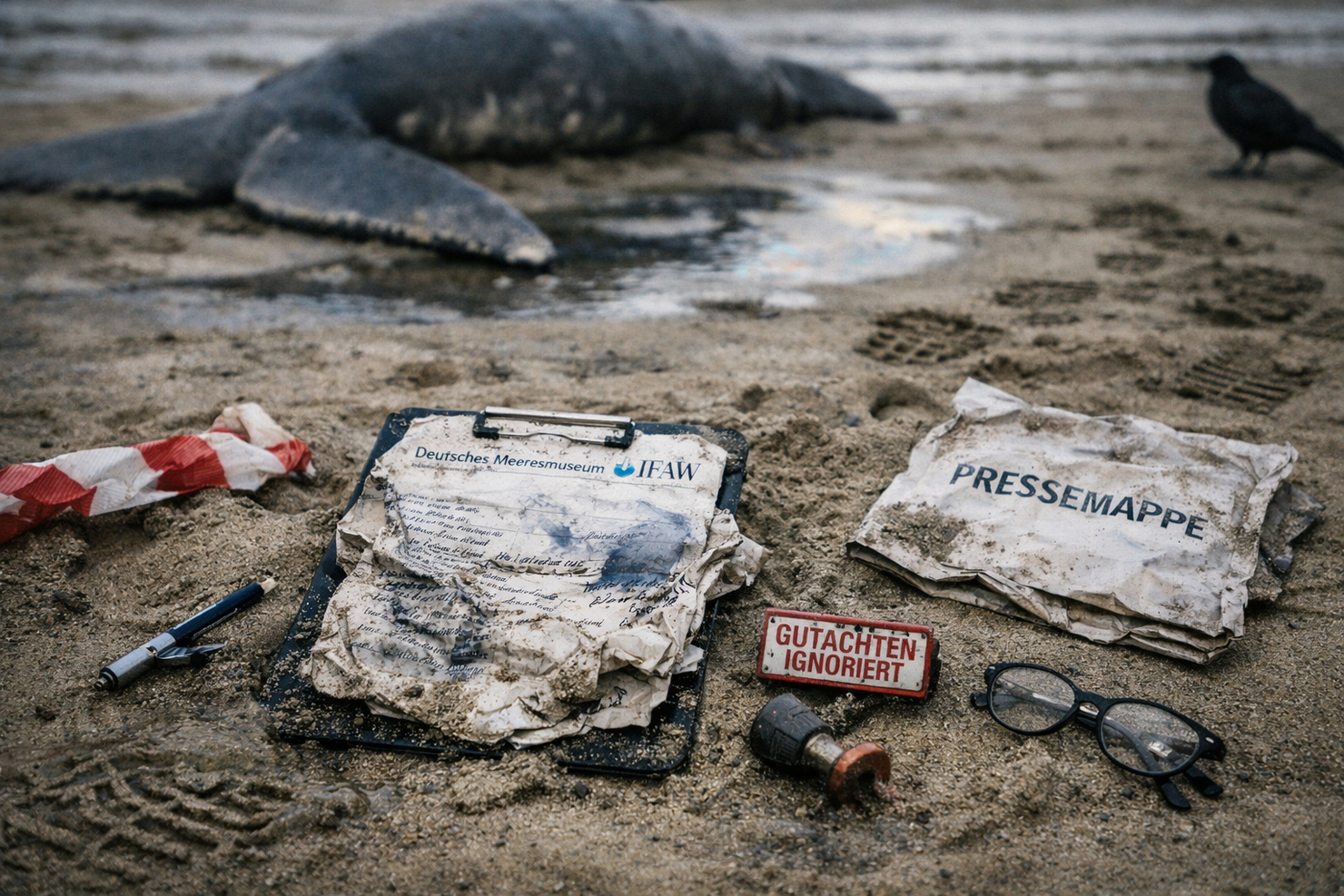
A reflection of a rootless society
Here comes the uncomfortable part. What was demonstrated on the Baltic coast wasn't primarily animal welfare, but rather the self-therapy of a civilization that no longer knows what to do with death and birth. Civilized humans of the late 2020s are so disconnected from the natural rhythms of their own existence that a dying whale serves as a welcome projection screen for everything they can no longer bear in themselves: loss of control, mortality, the sheer audacity of nature not being able to be squeezed into Excel spreadsheets, health apps, and political quarterly reports. So Timmy was repurposed as an ecological projection screen, a vote-getter, a hero's stage, and a tool for self-aggrandizement. Compassion would have meant leaving the animal in peace for its final days or professionally euthanizing it. Instead, it was transported for days across the Jutland peninsula, dumped into the Skagerrak, and two weeks later, its carcass was found off the coast of Anholt. A classic example: What we call help is usually the domestication of our own fear through the suffering of another.
What would have been a rescue
The only ones who were truly saved by this bailout in the end are those involved themselves – ministers, whale whisperers, fundraisers, the shipping company, tabloid newspapers, the entire attention economy. Significantly, even the ReefReporter What was described as a rescue in early May was, in reality, a risky attempt with no guaranteed chance of survival. That says it all – except for the uncomfortable irony that a society that no longer trusts its mothers to bear children and no longer allows its dying to die simply cannot leave a whale in peace. It needs the whale as an extra in its perpetual drama against its own mortality, as proof of its heroism, as a guarantee that death only befalls those whom it hasn't "helped" in time.
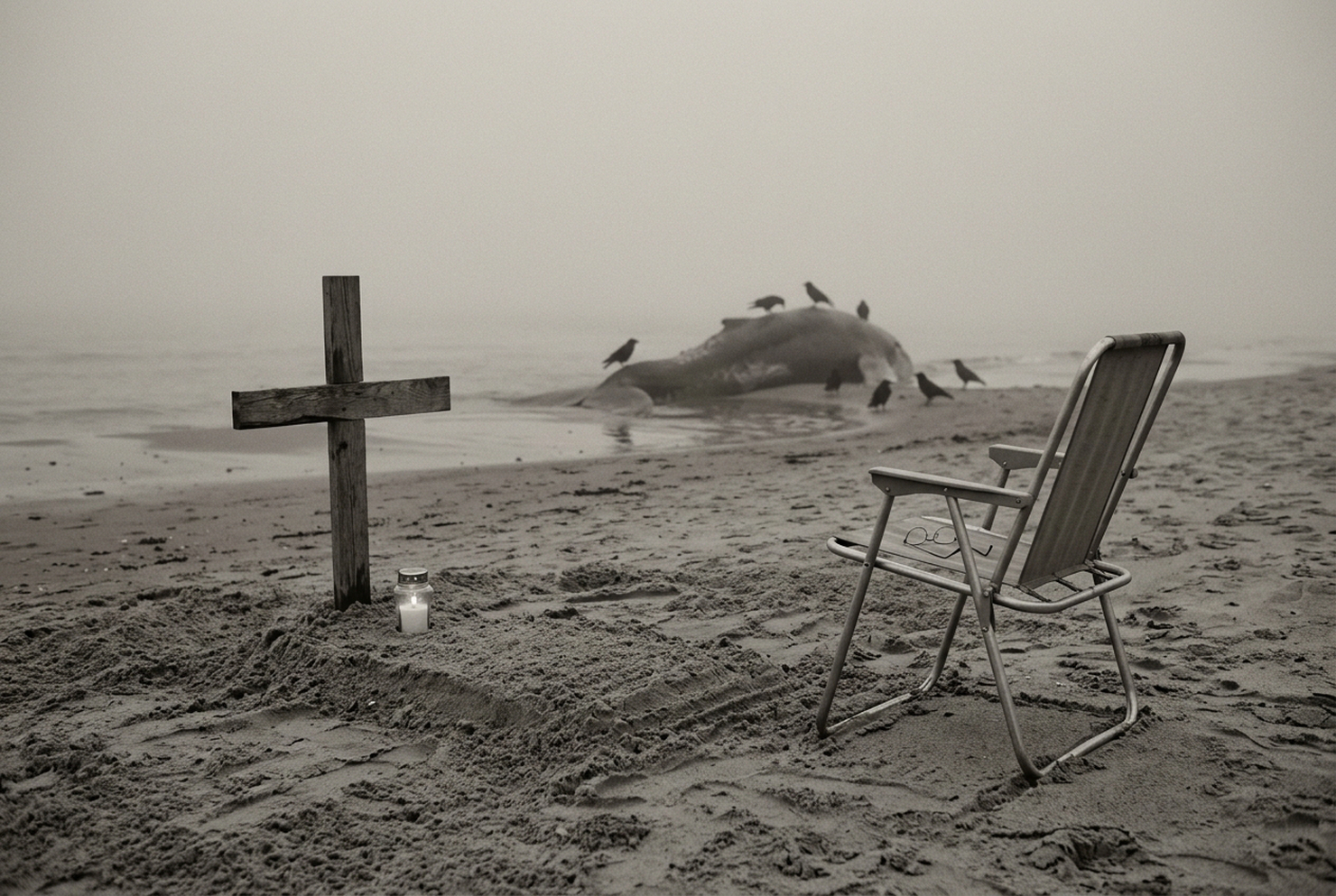
Several weeks of sand, stress, and steel barges later, Timmy is exactly where he would most likely be without human intervention – only in considerably more pain, adrift in a strange sea, and without the possibility of a dignified end! The true rescue would have consisted of a single verb: doing nothing – and that is precisely the one act this human being is no longer capable of in 2026! A civilization that even stages itself as the star of the show for its dying will livestream its own funeral, let people vote for the most beautiful coffin online, comment on the tears of the bereaved in split-screen – and call this "compassion"!
More for you:






 "Dravens Tales from the Crypt" has been enchanting for over 15 years with a tasteless mixture of humor, serious journalism - for current events and unbalanced reporting in the press politics - and zombies, garnished with lots of art, entertainment and punk rock. Draven has turned his hobby into a popular brand that cannot be classified.
My blog was never designed to spread news, let alone get political, but with current affairs I just can't help but capture information here that is otherwise censored on all other channels. I am aware that the design page may not seem "serious" to many in this regard, but I will not change this to please the "mainstream". Anyone who is open to non-state-compliant information sees the content and not the packaging. I've tried enough to provide people with information over the last 2 years, but quickly noticed that it never matters how it's "packaged", but what the other person's attitude towards it is. I don't want to put honey on anyone's mouth to meet expectations in any way, so I'll keep this design because hopefully at some point I'll be able to stop making these political statements, because it's not my goal to go on like this forever  I leave it up to everyone how they deal with it. However, you are welcome to simply copy and distribute the content, my blog has always been under the WTFPL license.
It's hard for me to describe what I'm actually doing here, DravensTales has become a culture blog, music blog, shock blog, tech blog, horror blog, fun blog, a blog about found items on the internet, internet bizarre, trash blog, art blog, water heater, zeitgeist blog over the years , Scrap blog and grab bag blog called. Everything that is right ... - and yet not. The main focus of the blog is contemporary art, in the broadest sense of the word.
To ensure the continued operation of this site, you are welcome to make a donation via credit card, PayPal, Google Pay, Apple Pay, or direct debit/bank account . Many thanks to all readers and supporters of this blog!








