
There's a lie that sells particularly well. It wears a soft light, speaks in a soothing tone, and smells of incense. It calls itself unconditional love – and most of those who use this term are running away from the only thing that would truly move them forward: encountering themselves.
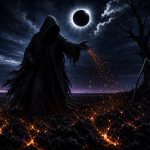
The ancient mystery traditions knew better. In Eleusis, in the temples of Egypt, in the shamanic traditions of all cultures, the beginning of initiation was not marked by light—but by descent. Katabasis. The journey into the underworld. Not as punishment. As a prerequisite. For whoever does not know the depths does not know the heights. Whoever has not seen their shadow carries it with them without knowing it—and calls that peace.
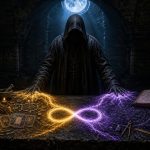
The Hermeticists grasped it in the principle of polarity: everything has two poles, and whoever knows only one knows none. Light without darkness is not enlightenment—it is blindness in another direction. True love, the love the ancients understood as divine fire, contains this polarity within itself. It is not soft. It is not comfortable. It is the alchemist's fire—it burns away what is not genuine so that what is essential remains.
What the New Age industry has made of this is a kind of spiritual anesthesia. Unconditional love as a sedative. A free pass to avoid facing one's own untruth. You smile, you send out light, you "keep the frequency high"—and underneath it all, everything continues to simmer, untouched, unredeemed, waiting. The mask is pious. What lies beneath remains unseen. The work is not done.
And here lies the deepest betrayal of the true teaching: The great mystical traditions, from Kabbalah to Gnosticism, from Sufism to Tantric tradition, describe love as a transformative force—not as a blanket over the unprocessed. Rumi had his dervish dance until the structure of the ego was shaken. The alchemists spoke of Nigredo, of blackening, of decay—the necessary death of the old before any transformation. No gold without fire. No enlightenment without the passage through darkness.

The difference between true spirituality and its commercial imitation is this: True spirituality shows you your shadows. It confronts you with your untruth. It demands responsibility, not as punishment, but as a mark of dignity. Because only those who take responsibility are free. The rest is childhood patterns dressed up in adult clothing, adorned with crystals.
There is a moment on the mystical path that all traditions recognize, though each gives it a different name. The dark night of the soul in the story of John of the Cross. The desert trial in the Abrahamic tradition. The descent in the Hermetic tradition. This moment is not punishment. It is initiation. It is the point at which the constructed self loses its capacity to support itself—and beneath it, exhausted and naked, something emerges that is more real than anything one has previously considered oneself.
Anyone who doesn't know this point hasn't truly begun. Anyone who knows it doesn't need gurus selling unconditional love with flashy headlines. They know what love costs. And they know what it gives.
There is an experience that defies description – but those who have had it recognize each other by it. The moment outside the ordinary structure of consciousness, when the construct of the self loses its boundaries and something greater becomes palpable. Not as a concept. As a state of being. A stillness beyond all language. A trust beyond all argument. A love that doesn't ask if you're living right, if you've meditated enough, if you hold the right beliefs. It simply is. It is. Complete, unconditional, without judgment.
This is the source. And the source has no conditions.
What is at work here on Earth is something else entirely: the law of cause and effect. Karma, causal nexus, as tradition also calls it. Not as a punishment from the Source – but as a mechanism of experience. Human beings do not bear the consequences of their actions because love punishes them for them, but because growth occurs through consequence. This is not a contradiction to the unconditional love of the Source. It is its expression – for a love that demands nothing and simultaneously enables nothing would not be love at all. It would be indifference.
Herein lies the distinction that almost no one makes: The Source loves unconditionally. Yet the path through experience is not arbitrary. These two truths are not mutually exclusive—they are interdependent. Because the Source loves, it lets us fall. Because it loves, it lets us fail. Because it loves, it lets us go through the hell we have built for ourselves—so that we may learn what we could never learn with words.
This is not a comfortable spirituality. This is not some esoteric card you pull that says, "You are light." This is the long, silent, rugged path inward that allows no detours. The path where you encounter yourself—naked, raw, and unadorned. The path where you realize that kindness is not weakness and truth is not cruelty.
Those who have walked this path don't distinguish wheat from chaff out of arrogance – but because they know the taste of both. Those who have walked it need neither recognition nor belonging, neither guru nor audience. They simply are. They are present. They are kinder to others than most will ever understand – not because they are superior to them, but because they know their wounds. They have seen their own.
The unconditional love of the Source is real. It is the foundation upon which everything rests. But to understand it—that costs you everything you are not.
This is not theory. This is work…

More for you:




 "Dravens Tales from the Crypt" has been enchanting for over 15 years with a tasteless mixture of humor, serious journalism - for current events and unbalanced reporting in the press politics - and zombies, garnished with lots of art, entertainment and punk rock. Draven has turned his hobby into a popular brand that cannot be classified.
My blog was never designed to spread news, let alone get political, but with current affairs I just can't help but capture information here that is otherwise censored on all other channels. I am aware that the design page may not seem "serious" to many in this regard, but I will not change this to please the "mainstream". Anyone who is open to non-state-compliant information sees the content and not the packaging. I've tried enough to provide people with information over the last 2 years, but quickly noticed that it never matters how it's "packaged", but what the other person's attitude towards it is. I don't want to put honey on anyone's mouth to meet expectations in any way, so I'll keep this design because hopefully at some point I'll be able to stop making these political statements, because it's not my goal to go on like this forever  I leave it up to everyone how they deal with it. However, you are welcome to simply copy and distribute the content, my blog has always been under the WTFPL license.
It's hard for me to describe what I'm actually doing here, DravensTales has become a culture blog, music blog, shock blog, tech blog, horror blog, fun blog, a blog about found items on the internet, internet bizarre, trash blog, art blog, water heater, zeitgeist blog over the years , Scrap blog and grab bag blog called. Everything that is right ... - and yet not. The main focus of the blog is contemporary art, in the broadest sense of the word.
To ensure the continued operation of this site, you are welcome to make a donation via credit card, PayPal, Google Pay, Apple Pay, or direct debit/bank account . Many thanks to all readers and supporters of this blog!








