
"You will own nothing and be happy." This isn't a poem. This isn't a satirical tweet. This is a vision seriously put forward—with the friendly tone of a wellness guide and the structural force of a silent expropriation. Sounds like a Zen retreat. But it's more like a contract renewal with a recurring debit.
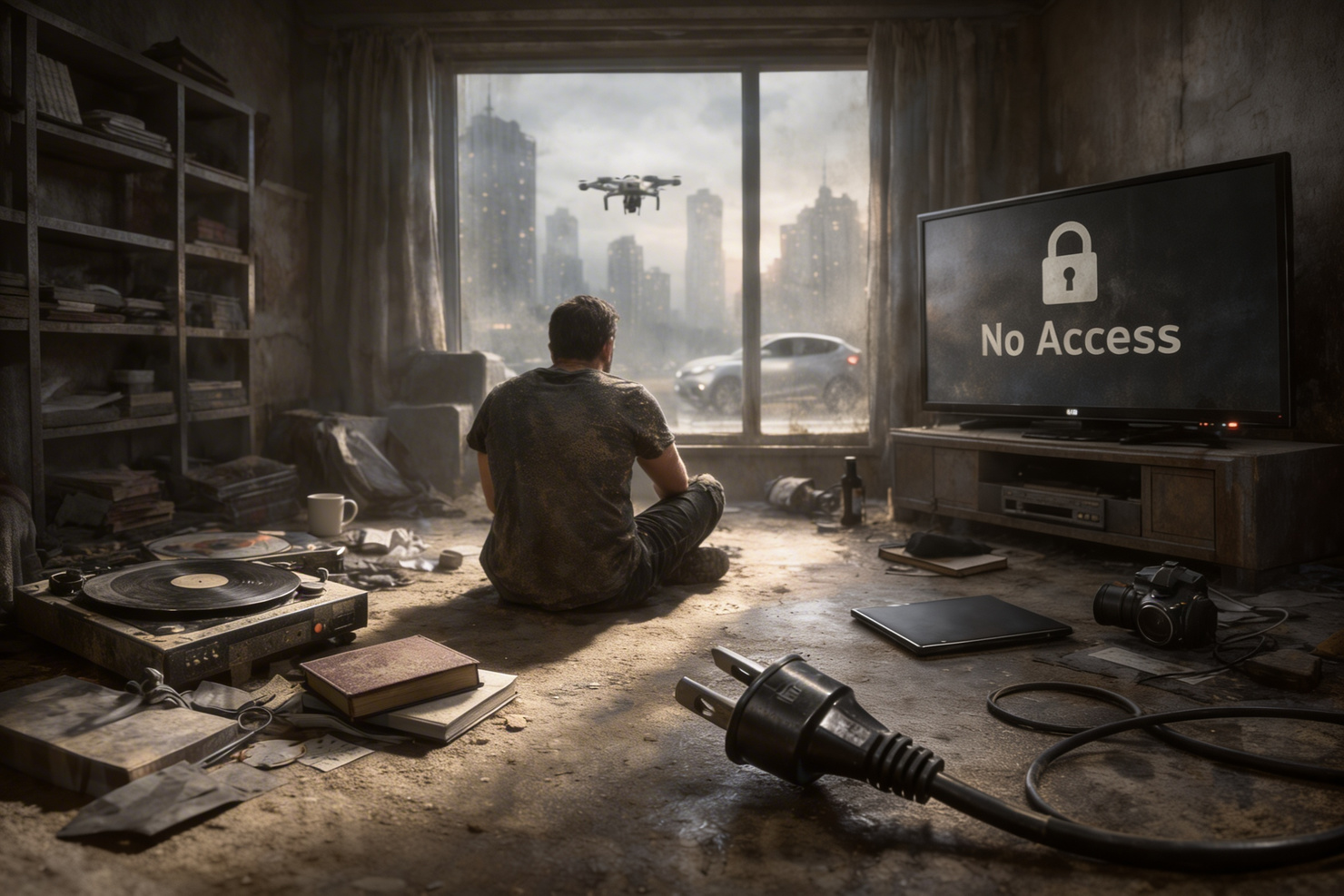
In the past, ownership was simple. You bought a record. It was yours. You bought a book. It sat on the shelf, smelled of paper, had coffee stains, and dog-eared pages. No one could remotely "deactivate" it because they had the wrong opinion or because they'd updated the terms and conditions in their sleep. A software CD was installed and it worked. Period. No login, no cloud service requirements, no "access unavailable" messages.
Ownership meant: This is mine. I decide.
Today it means: Please enter your password.
Netflix. Spotify. Audible. Adobe. Cloud storage. Streaming. Small amounts month after month. Harmless. Almost cute. Until you add them all up and realize you're no longer buying, but renting. Access instead of ownership. License instead of control. And when the payments dry up, your "property" vanishes into digital evaporation. But hey, you'll be happy.
The vision of a world without ownership was prominently articulated in 2016. A future in which no one owns anything because everything is organized as a service. No more private cars, but self-driving taxis on demand. No more things, only access. Sharing instead of holding. Using instead of owning.
This wasn't published on a private blog, but on a platform where heads of state, CEOs, and wealth managers pat each other on the back. When such circles envision the future, it's more than just fantasy. It's a narrative. And narratives are instruments of power. The disturbing part isn't the idea of sharing itself. Sharing can be beneficial. The only question is: Who owns it then?
Because "you will own nothing" logically means: someone else will. Ownership doesn't disappear. It becomes concentrated.
Historically, widespread private property was a means of distributing power. Apartments, tools, machines, vehicles – distributed among many. Those who owned something were less dependent. Property was not just a status symbol, but a buffer. Stability. A refuge.
The new economy reverses this. Providers hold the assets. Users hold contracts.
The subscription is the perfect tool for this. Previously: one-time payment, completed, independent. Today: an ongoing relationship. Predictable cash flows for companies, predictable dependency for you. Investors love that. You're no longer a buyer, but "customer lifetime value."
Adobe is a good example. Photoshop was once a product. You bought it, installed it, used it. Today it's a cloud service. If you stop paying, you lose access. In some cases, even to your own files if they're stored on the system. You no longer own the software. You have a temporary license. But that's progress, they say. Digital. Flexible. Efficient.
Digital goods can be reproduced infinitely. Therefore, one might assume that a traditional logic of ownership is no longer necessary. This sounds clever, but overlooks a simple point: reproducibility doesn't change the question of control.
When music is only available for streaming, it exists under license. Contracts expire. Content disappears. Accounts are blocked. One click – and your access is history. Not because you did anything wrong. But because terms and conditions change. You own nothing. And you're supposed to be happy. Why do we accept this so readily?
Because it works. Because it's convenient. Updates come automatically. Storage problems are solved in the cloud. No shelf space, no dust, no maintenance. Ownership means responsibility. Subscriptions sell relief. Psychologically, it's brilliant. A large one-time payment used to hurt. Then there was peace. Today, it's small, regular payments. Hardly noticeable. Economically sustainable.
And culturally? A private library was biography in paper form. A record collection told of taste, of phases, of identity. Today, algorithms curate. Recommendations replace selection. Your "taste" is a data set, optimized for dwell time. The bookshelf disappears. The person behind it, along with it.
Of course, there are counter-movements. Printed books. Vinyl records. Self-hosted servers. Open-source software. This isn't just nostalgia. It's a need for stability. For "This is truly mine." For something that won't implode with the next change to the terms and conditions. And then there's the point that glossy visions of the future are reluctant to discuss: resilience in times of crisis.
Ownership is not just a legal title. It's a buffer. When platforms fail, when political frameworks collapse, when systems falter, ownership provides substance. Those who own something can draw upon it. Those who only have access depend on that access being granted. The less ownership is distributed, the more stability hinges on a few key nodes: servers, platforms, financial flows. Whoever controls these nodes controls the system.
But of course, it sounds prettier to talk about happiness. "You will own nothing and be happy" is the friendliest way of describing dependency ever invented. A feel-good mantra for an economy in which wealth is concentrated in the hands of a few, while the masses live in long-term contractual relationships.
Perhaps it works. Perhaps we really are more content when we no longer have to maintain anything, store anything, or be responsible for anything. Perhaps relief is the new ownership.
But don't let anyone tell you it's just about comfort. It's about control. About power. About who pulls the plug when push comes to shove.
And at some point, quite simply, you stand there and ask yourself: If access ends – what will remain of your happiness?
More for you:






 "Dravens Tales from the Crypt" has been enchanting for over 15 years with a tasteless mixture of humor, serious journalism - for current events and unbalanced reporting in the press politics - and zombies, garnished with lots of art, entertainment and punk rock. Draven has turned his hobby into a popular brand that cannot be classified.
My blog was never designed to spread news, let alone get political, but with current affairs I just can't help but capture information here that is otherwise censored on all other channels. I am aware that the design page may not seem "serious" to many in this regard, but I will not change this to please the "mainstream". Anyone who is open to non-state-compliant information sees the content and not the packaging. I've tried enough to provide people with information over the last 2 years, but quickly noticed that it never matters how it's "packaged", but what the other person's attitude towards it is. I don't want to put honey on anyone's mouth to meet expectations in any way, so I'll keep this design because hopefully at some point I'll be able to stop making these political statements, because it's not my goal to go on like this forever  I leave it up to everyone how they deal with it. However, you are welcome to simply copy and distribute the content, my blog has always been under the WTFPL license.
It's hard for me to describe what I'm actually doing here, DravensTales has become a culture blog, music blog, shock blog, tech blog, horror blog, fun blog, a blog about found items on the internet, internet bizarre, trash blog, art blog, water heater, zeitgeist blog over the years , Scrap blog and grab bag blog called. Everything that is right ... - and yet not. The main focus of the blog is contemporary art, in the broadest sense of the word.
To ensure the continued operation of this site, you are welcome to make a donation via credit card, PayPal, Google Pay, Apple Pay, or direct debit/bank account . Many thanks to all readers and supporters of this blog!








