
A tick bites you, and months later, your dinner falls flat on your face. Not immediately, but three to six hours later, when you're fast asleep: welts, circulatory collapse, in the worst case, an emergency room visit. Alpha-gal syndrome is considered a clear-cut case – tick in, meat allergy out. Except the math doesn't add up: In five US states, around 24 percent of adults carry the relevant antibodies in their blood , but only 0,14 percent of them are actually ill. To explain the 170-fold difference, you need more than just a tick.
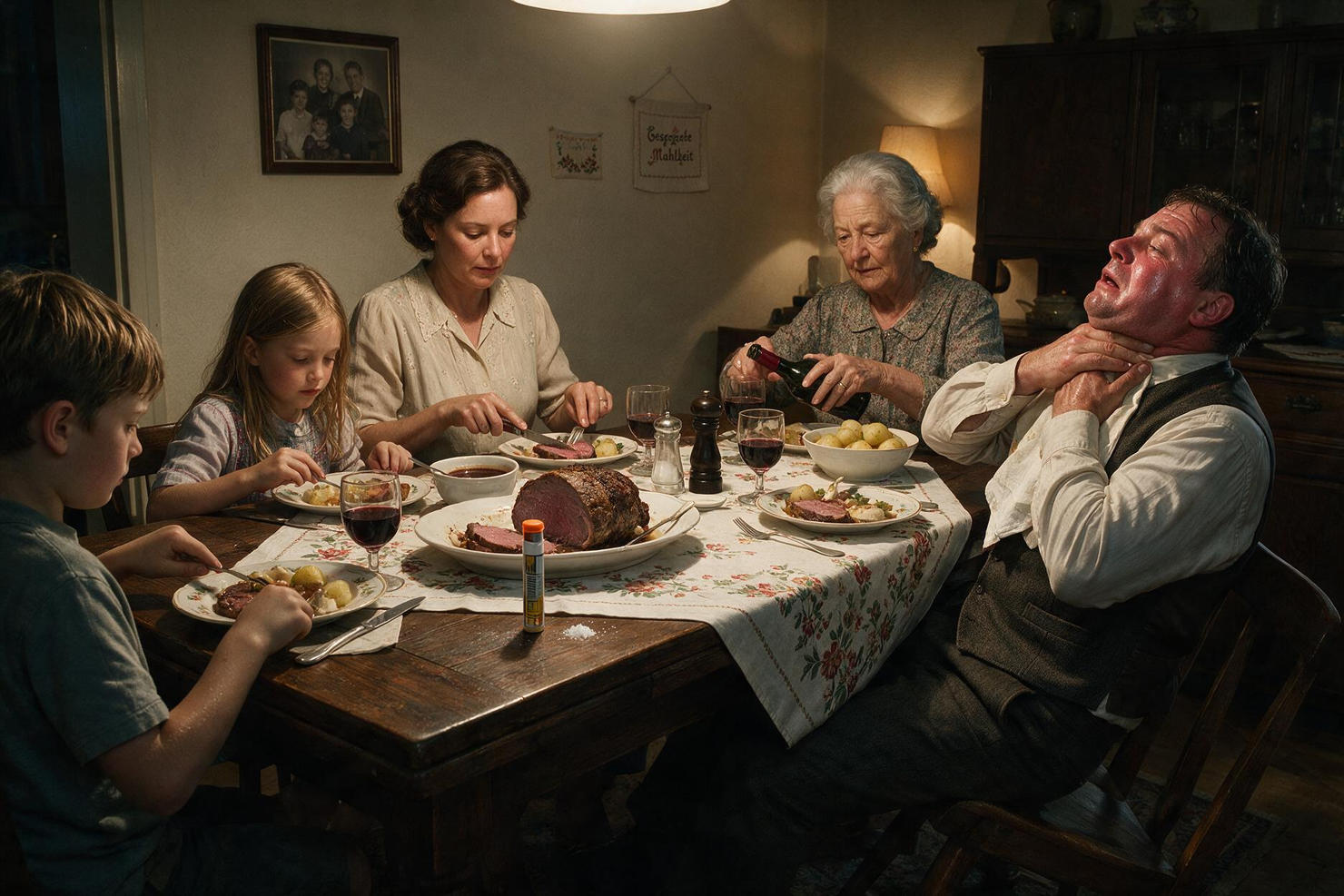
Alpha-gal is a sugar molecule produced by every mammal—except humans and great apes. This is precisely why our immune system can classify it as an enemy. Thanks to the tick, the sugar enters the bloodstream directly through the skin, instead of passing through the intestines as it has for millennia, where the body has learned to tolerate it. Afterward, every steak, every sausage, every piece of cheese becomes a gamble. In the US, the Centers for Disease Control and Prevention (CDC) recorded more than 110,000 suspected cases between 2010 and 2022 and estimates the number of unreported cases to be as high as 450,000. In Switzerland, the common wood tick is sufficient, and the allergist at Inselspital Bern confirms it as a local reality , not an American exotic phenomenon.
The question that nobody wanted to ask for eighteen years
A team of authors led by epidemiologist Nicolas Hulscher published a study in August 2026. published a 104-source overviewThis highlights an uncomfortable observation: More than 90 percent of US children receive an injection of approximately 54 milligrams of mammalian gelatin before starting school, divided between measles, mumps, rubella, and chickenpox. A single MMR dose contains about 14,5 milligrams. Patients with existing MMR syndrome have reacted to doses as low as 2 milligrams. Gelatin is derived from cattle and pigs, both of which carry alpha-gal, and the injection bypasses the same digestive system that breaks down sugars in food.
The paper proposes two pathways. First: Repeated injections cause direct sensitization. Second – and this is the more interesting part: The vaccination merely primes the immune system; the subsequent tick bite triggers the immune response. This would explain why millions are bitten, but only a few become ill. Historical evidence for this comes from Japan, where children received gelatin-containing DTaP and later collapsed after receiving the live vaccine. 79 of these 87 children carried gelatin-derived IgE ; 54 had received gelatin-containing DTaP, and none had received the gelatin-free version. When the manufacturers removed the gelatin, the incidents disappeared. The fact that gelatin-containing vaccines cause basophils to increase in laboratory tests on already infected individuals , while the gelatin-free version has no effect, has also been measured, not merely asserted.

Before the torches are fetched
And now the part that the headline-makers on both sides are skipping. The paper is a preprint without external peer review, and the authors themselves admit that the direct route is plausible but unproven. The infection rates also speak for themselves: In the US data, the antibody rate drops by almost 30 percent with increasing population density by every tenfold – city dwellers are not vaccinated differently than rural residents, they are simply bitten less often. German forest workers and hunters came 35 percent of the population are sensitized, which is 2,48 times the resident population. And over 90 percent of them continued to eat their meat without any problems. The Japanese gelatine disaster, on the other hand, was linked to... strongly influenced by the tissue marker HLA-DR9, which is prevalent there and it was never reproduced with this intensity in the West. And a database analysis found [something] among confirmed cases. An anaphylaxis rate of approximately two percent after gelatin-based vaccination. – increased, but no mass extinction.
And then there's the question that's asked with every study, and must be asked with this one as well: Who wrote it? Six of the seven authors are affiliated with a company that sells dietary supplements. And lo and behold, the study recommends a daily mixture of quercetin, luteolin, apigenin, pine bark extract, and butterbur for testing. It also recommends ear acupuncture with a 96 percent success rate from an uncontrolled retrospective study without a control group—a figure that should raise eyebrows at anyone who rightfully raises an eyebrow at the pharmaceutical industry. Balance doesn't mean casting suspicion in only one direction. The demand, on the other hand, costs nothing and is long overdue: measure antibodies before and after vaccination. No one has done this for eighteen years. This isn't a conspiracy. It's something worse—disinterest.

When ethicists promote the tick to educator
While some are asking whether we are accidentally spreading the allergy, two medical ethicists from Western Michigan University as presented in the journal BioethicsTheir deliberate spread is "strongly justified" if eating meat is immoral. Genetically modified ticks as moral remedial instruction. The gentlemen added that it was a thought experiment, and that's actually true. However, they describe the syndrome as severe but not fatal, while the health authorities speak of life-threatening anaphylaxis. What this looks like in practice when laboratories release their insects was... This topic has already been discussed. and that the phrase "safe and effective" is not a constant of nature, ebenfalls.
The sugar that belongs to no one
What remains is a disease that no one can fully explain, an authority that counts antibodies instead of causes, and an industry that injects ninety percent of all children with bovine gelatin without ever measuring its effects. The experiment has long since been completed; only the analysis is missing. The tick is the only honest participant in this game—it bites, sucks, and disappears without a word about responsibility. Everyone else passes the buck, while the patient's throat swells and the sausage becomes a booby trap. And when someone finally does the math, they'll tell us they couldn't have known—and call it "science"!

More for you:






 "Dravens Tales from the Crypt" has been enchanting for over 15 years with a tasteless mixture of humor, serious journalism - for current events and unbalanced reporting in the press politics - and zombies, garnished with lots of art, entertainment and punk rock. Draven has turned his hobby into a popular brand that cannot be classified.
My blog was never designed to spread news, let alone get political, but with current affairs I just can't help but capture information here that is otherwise censored on all other channels. I am aware that the design page may not seem "serious" to many in this regard, but I will not change this to please the "mainstream". Anyone who is open to non-state-compliant information sees the content and not the packaging. I've tried enough to provide people with information over the last 2 years, but quickly noticed that it never matters how it's "packaged", but what the other person's attitude towards it is. I don't want to put honey on anyone's mouth to meet expectations in any way, so I'll keep this design because hopefully at some point I'll be able to stop making these political statements, because it's not my goal to go on like this forever  I leave it up to everyone how they deal with it. However, you are welcome to simply copy and distribute the content, my blog has always been under the WTFPL license.
It's hard for me to describe what I'm actually doing here, DravensTales has become a culture blog, music blog, shock blog, tech blog, horror blog, fun blog, a blog about found items on the internet, internet bizarre, trash blog, art blog, water heater, zeitgeist blog over the years , Scrap blog and grab bag blog called. Everything that is right ... - and yet not. The main focus of the blog is contemporary art, in the broadest sense of the word.
To ensure the continued operation of this site, you are welcome to make a donation via credit card, PayPal, Google Pay, Apple Pay, or direct debit/bank account . Many thanks to all readers and supporters of this blog!








