
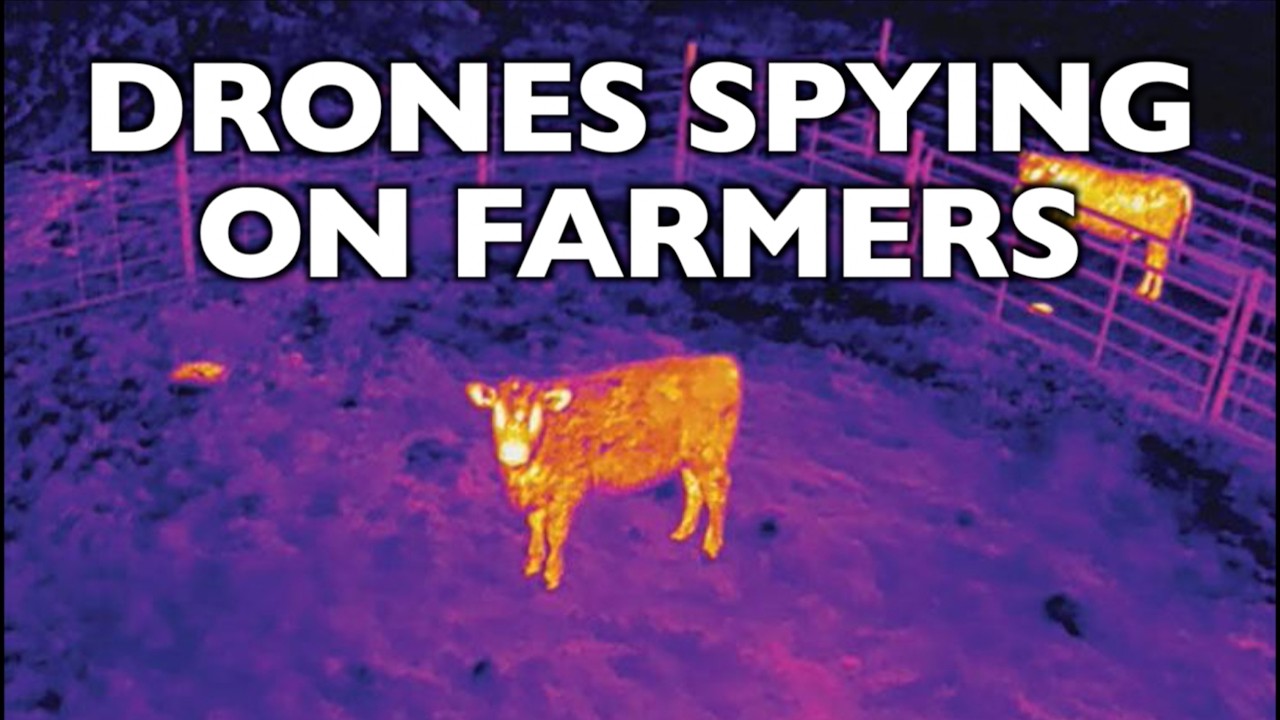
Anyone who thinks food safety is a problem confined to dystopian novels or communist history books needs to wake up: France is sending thermal imaging drones over farms, Russia is slaughtering healthy livestock on suspicion, the US is tracking every cow with a digital chip – all, of course, for our safety. There's probably no more reassuring image than a herd of cattle under complete surveillance.
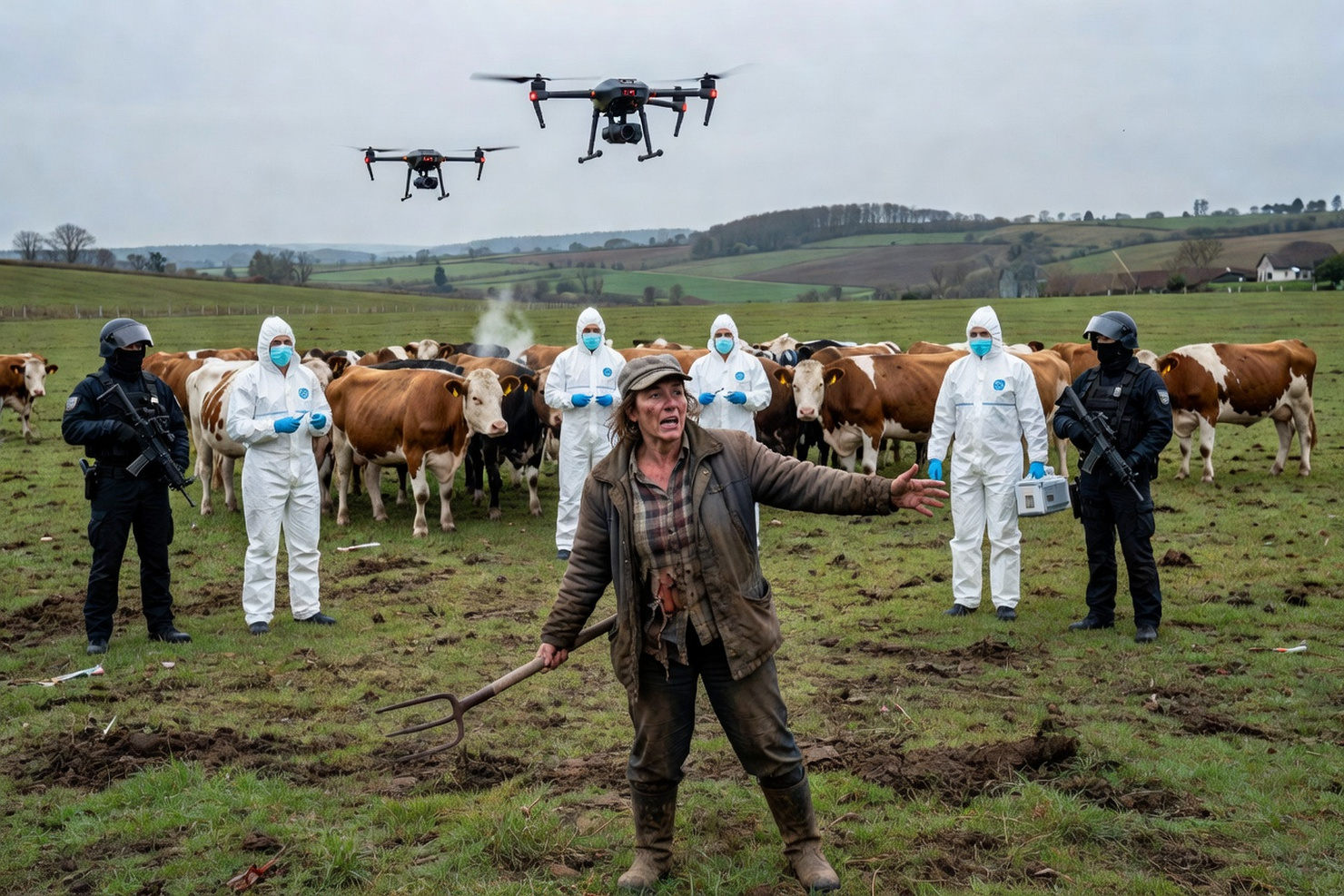
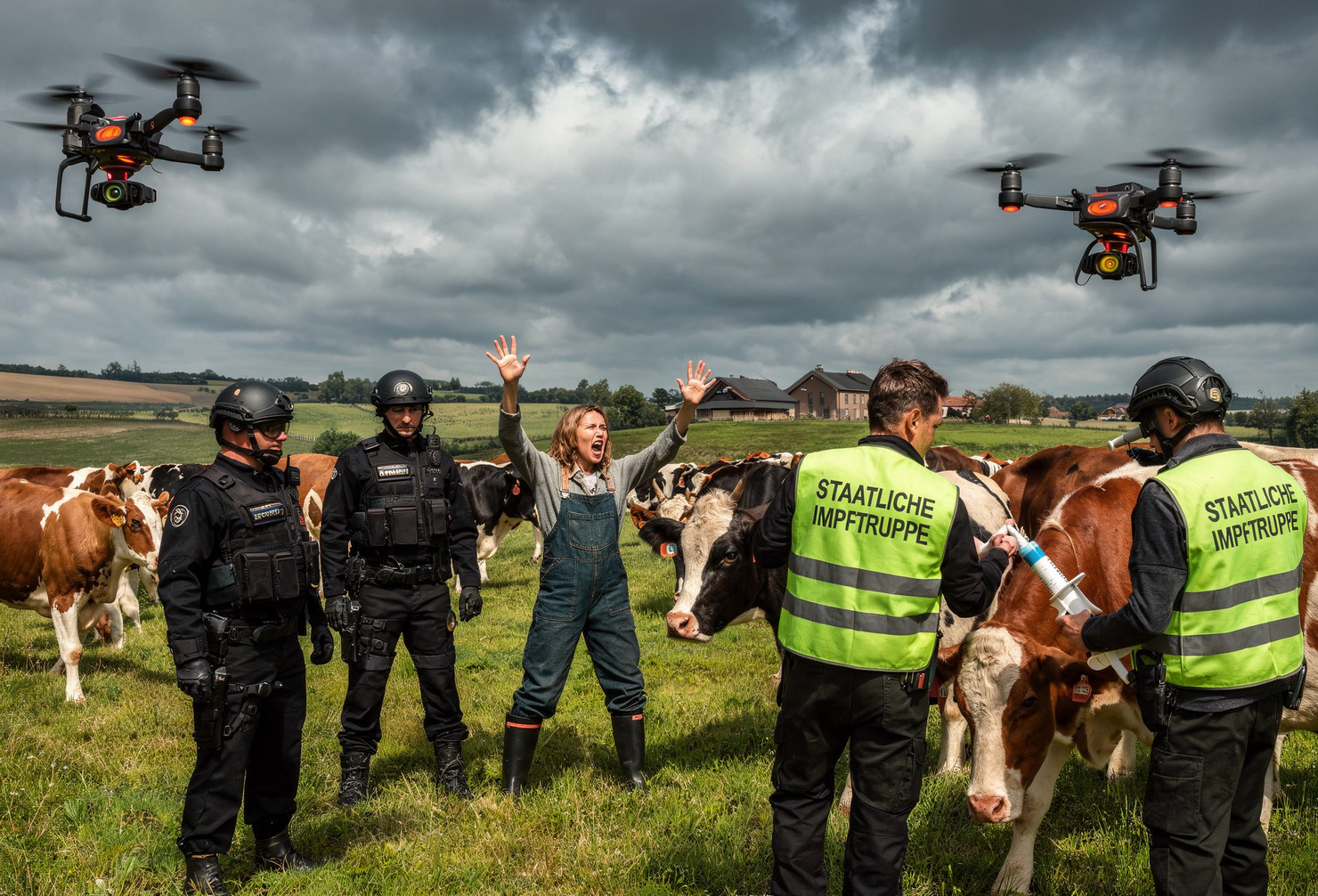
In France, it's already a harsh reality. Thermal imaging drones circle over pastures, searching for unregistered animals. Those found receive a visit: armed police, flanked by state vaccination teams, forcibly vaccinate healthy cows – against the frenzied resistance of the farmer, who desperately declares that her animals are perfectly healthy and that this is madness. Nobody cares. This is not an isolated incident. Enough farmers have been affected that nationwide protests have formed, prompting police to use tear gas. Welcome to the liberal democracy of the 21st century.
From Paris to Palantir
In Russia, state task forces roamed the country slaughtering healthy livestock – mere suspicion of disease was sufficient justification, no proof was required. Only when the protests garnered media attention did the head of the Ministry of Agriculture have to resign. Whether the slaughtering stopped after that is unclear. What is certain is that it took place.
The same program is running in the US, only with a more sophisticated approach. The Animal Disease Traceability Act mandates digital tags for farm animals – $3 per animal, mandatory, no discussion. Livestock farmers protest. It changes nothing. The USDA has simultaneously expanded its drone surveillance and calls it efficiency. The collected data goes directly to Palantir – a $300 million contract, already signed. In the EU, digital animal tagging is culminating in the Digital Product Passport, which is intended to guarantee seamless traceability of every food product along its entire supply chain. Complete knowledge of origin, movement, and consumption – every technocrat's dream, packaged as consumer protection.
The underlying narrative is: avian flu. Robert Redfield, former CDC director, publicly declared in the midst of the COVID hysteria that Covid was merely a dress rehearsal – the real pandemic would be avian flu. Australia recently conducted the "Exercise Convergence," in which authorities simulated a scenario involving an energy crisis, fuel shortages, and an avian flu outbreak spreading to humans. Tabletop exercises of this kind have an unsettling tendency to become reality shortly thereafter.
A screenplay that one knows
The pattern is historically well-known. In the Soviet Union, some 18 million horses were killed between 1929 and 1933. Cattle herds halved from 68 million to 38 million. Nearly 100 million sheep and goats disappeared. First came registration—for statistical purposes, of course; the man in charge has to know what's there, after all. Then came the state itself. The result was the Holodomor—a state-created famine of historic proportions that cost millions of lives. In China, the Great Famine followed the same pattern. And in the USA, in the midst of the Depression, the Roosevelt administration bought farmers to slaughter millions of pigs and plow cotton crops into the ground—while parts of the population starved. Farmer Philburn from Ohio was convicted by the Supreme Court for growing too much wheat for his own use on his own land. The Agricultural Adjustment Act of 1938 didn't allow for that. What a fine state of freedom.
And PG&E in California, after the wildfires, flew a helicopter equipped with ground-penetrating LiDAR technology and systematically mapped every property in the state. The official justification: fire prevention and vegetation control around power lines. The data was immediately sent to authorities – to track down illegal cannabis cultivation areas. No one has yet convincingly explained why this logic should stop at the vegetable patch. Water meters, electricity consumption, satellite images – they already know if you're watering.
The answer is as simple as it is inconvenient.
Anyone who puts all this together arrives at a simple conclusion: grow your own. Gorilla gardening – scattering seeds on unused land, cultivating on someone else's soil, harvesting, no forms, no land registry, no registration. Vertical gardens, camouflaged and discreetly placed. Aquaponic systems that use black soldier flies as fish food, create closed food cycles, and look completely unremarkable from the outside. Mealworms as poultry feed – inexpensive, self-produced, outside any traceable supply chain. And gradually adapting your own diet to what grows locally, unnoticed and without government attention. This isn't a romantic self-sufficiency dream. This is self-preservation made sensible.
Historically, registration has always been the first step towards confiscation – and anyone who thinks this time is different should ask themselves why thermal imaging drones are circling over farms right now.
The centralization of food supply follows a script that has been played out many times before – always with the same ending. Anyone who recognizes this starts digging. Literally.
More for you:




 "Dravens Tales from the Crypt" has been enchanting for over 15 years with a tasteless mixture of humor, serious journalism - for current events and unbalanced reporting in the press politics - and zombies, garnished with lots of art, entertainment and punk rock. Draven has turned his hobby into a popular brand that cannot be classified.
My blog was never designed to spread news, let alone get political, but with current affairs I just can't help but capture information here that is otherwise censored on all other channels. I am aware that the design page may not seem "serious" to many in this regard, but I will not change this to please the "mainstream". Anyone who is open to non-state-compliant information sees the content and not the packaging. I've tried enough to provide people with information over the last 2 years, but quickly noticed that it never matters how it's "packaged", but what the other person's attitude towards it is. I don't want to put honey on anyone's mouth to meet expectations in any way, so I'll keep this design because hopefully at some point I'll be able to stop making these political statements, because it's not my goal to go on like this forever  I leave it up to everyone how they deal with it. However, you are welcome to simply copy and distribute the content, my blog has always been under the WTFPL license.
It's hard for me to describe what I'm actually doing here, DravensTales has become a culture blog, music blog, shock blog, tech blog, horror blog, fun blog, a blog about found items on the internet, internet bizarre, trash blog, art blog, water heater, zeitgeist blog over the years , Scrap blog and grab bag blog called. Everything that is right ... - and yet not. The main focus of the blog is contemporary art, in the broadest sense of the word.
To ensure the continued operation of this site, you are welcome to make a donation via credit card, PayPal, Google Pay, Apple Pay, or direct debit/bank account . Many thanks to all readers and supporters of this blog!








