
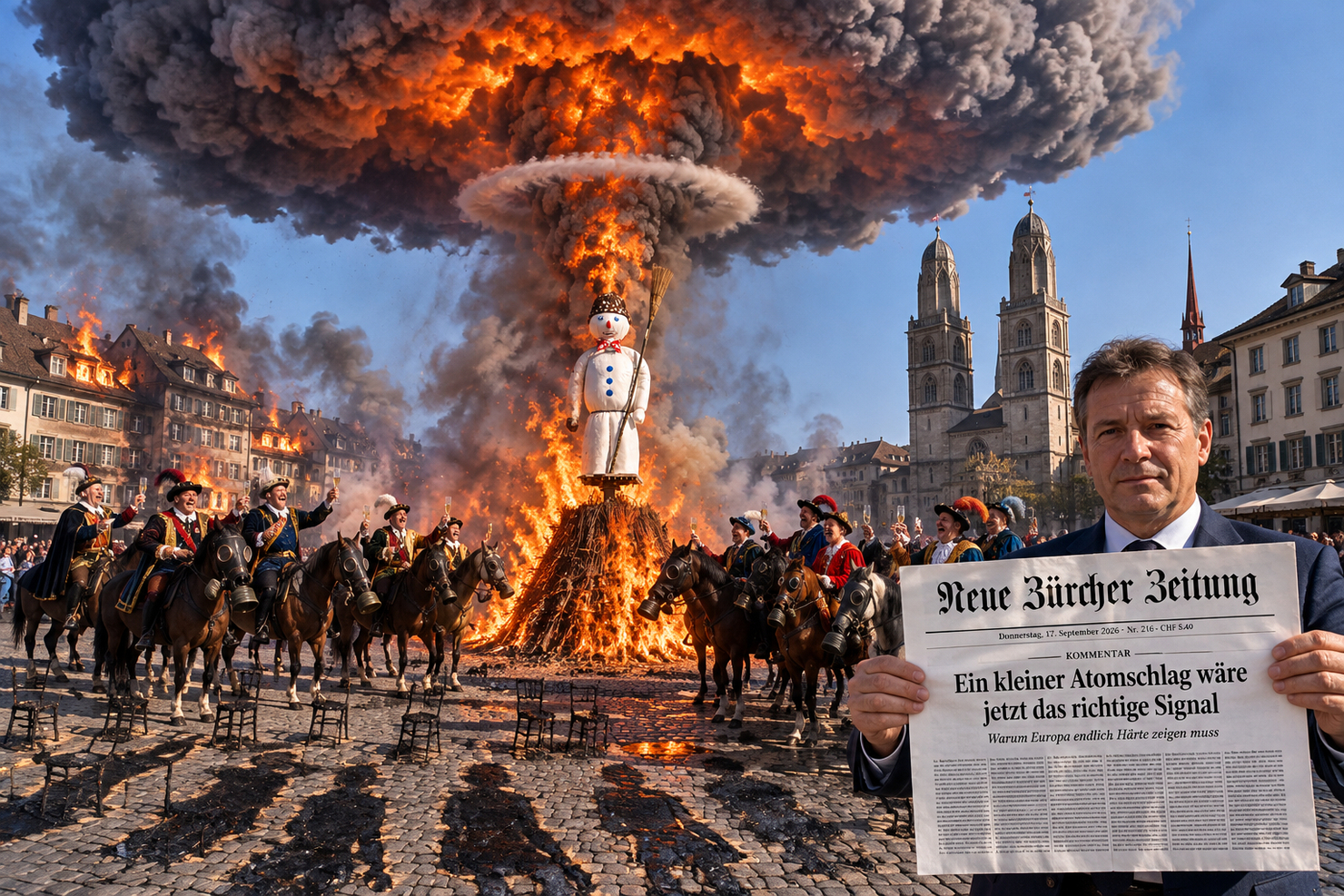
France lost Algeria, the US lost Vietnam, the Soviet Union lost Afghanistan – and none of these losers resorted to bombs. From this list, the NZZ (Neue Zürcher Zeitung) crafts the year's most comforting claim : Moscow will not use nuclear weapons in Ukraine because it wouldn't be worth it. The list itself is accurate. The conclusion drawn from it, however, is the most costly logical fallacy one can construct from a host of correct individual facts.
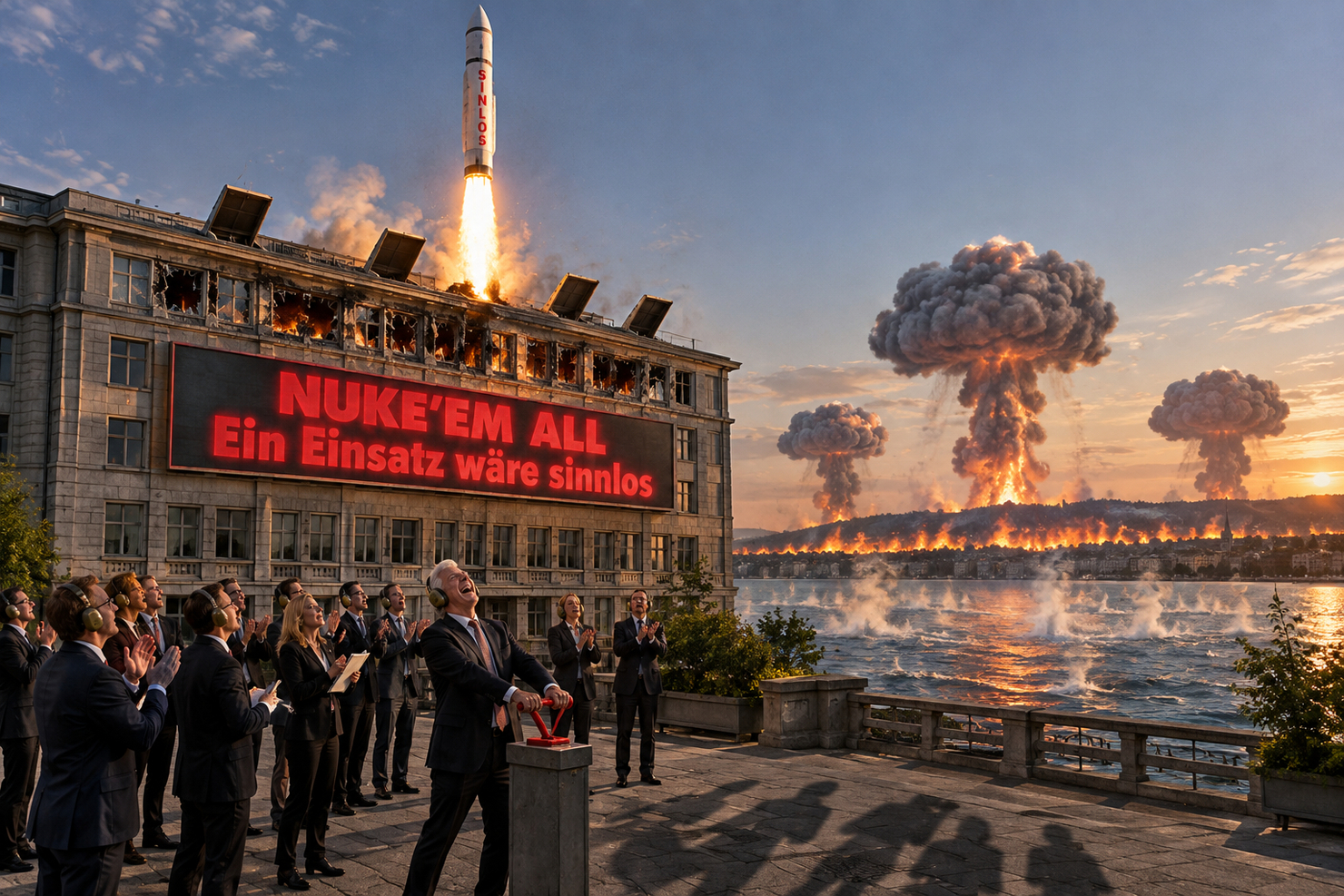
In each of these wars, a nuclear power lost to an opponent without nuclear weapons and without a nuclear-armed protector behind it. This single difference is precisely the case of Ukraine. And it gets worse: If you look up the key witnesses individually, each one of them testifies against the man who called him.
Surviving five times does not mean immortal.
The comparison only holds water as long as it isn't reversed. The Algerian liberation front didn't receive cruise missiles from London, nor did the Viet Cong get targeting data from a NATO headquarters. Ukraine is using Western weapons to strike deep into Russian territory, and the opinion piece cites precisely this as proof that nothing will happen: red lines have been crossed, there has been no response, so there will be none. The fact that Kyiv has been drifting toward this threshold for years is considered in this calculation to be a sign of relief rather than a warning light. This is the line of reasoning of a man who has walked through the same minefield five times unharmed and concludes that there are no mines in it.
The key evidence: In 1973, Egypt and Syria attacked Israel; in 1982, Argentina started a war against Great Britain. Both times, the conflicts involved contested border regions and islands some 12,000 km off the coast of the attacked party, never its core territory. Anyone who derives a taboo from this is mistaking a mechanism for a lucky streak.
And who wrote this? A policy fellow at a Kyiv political institute, whom the newspaper portrays as a dispassionate analyst. A party involved in the proceedings explains to the public that the risk of the trial is being overestimated. Two-thirds of the way through the text, the piece itself takes a turn: there suddenly appears a scenario in which Moscow does indeed resort to bombs—not in the event of defeat, but if it wins anyway, following the example of 1945. The headline says it's pointless, the body of the text says it's worthwhile. You'd have to be a real journalist to consider this a piece of reassurance—but in an industry that has been copying each other for years , an all-clear with built-in counter-evidence simply goes unnoticed.
The key witnesses, looked up individually
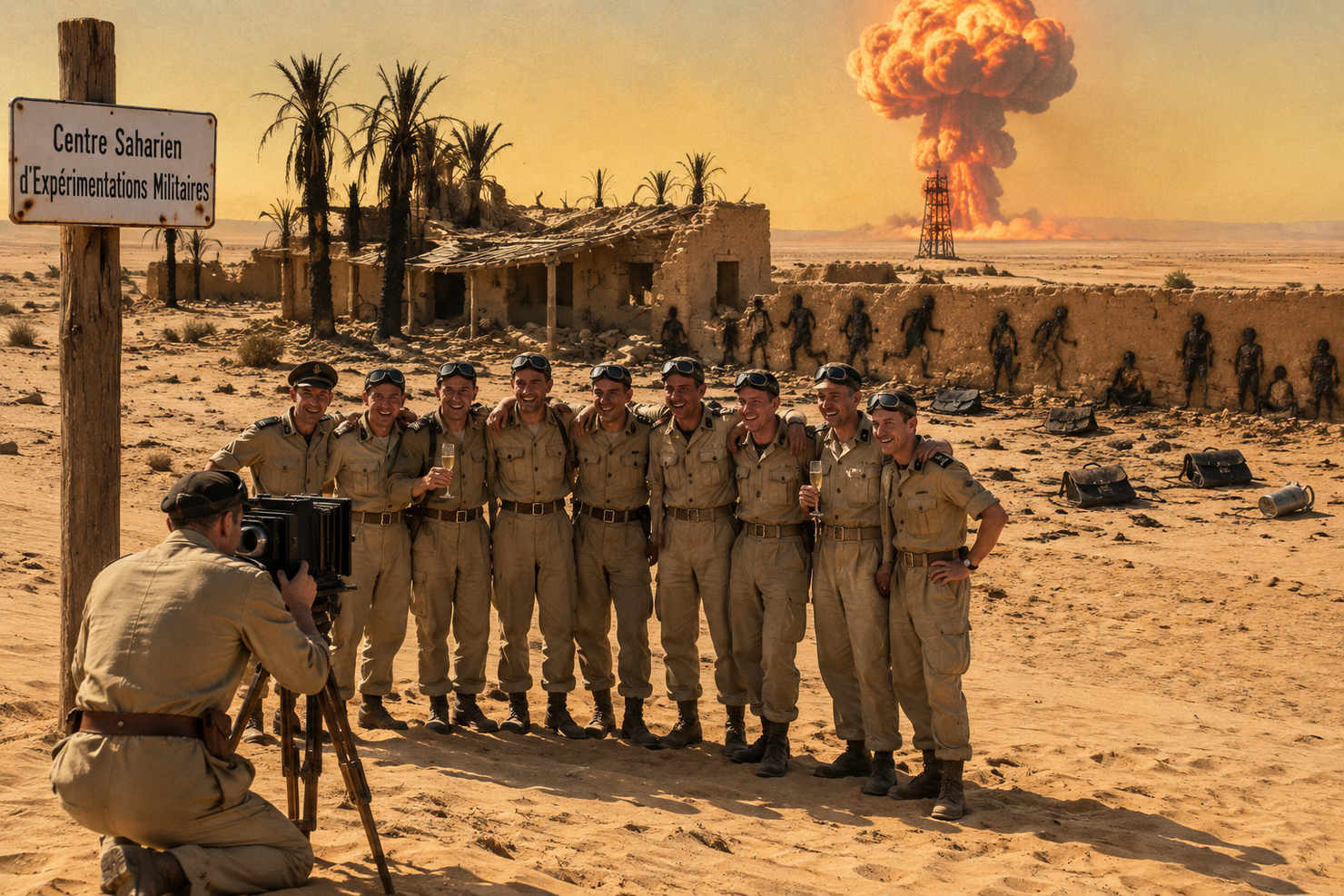
Algeria first. France did indeed detonate nuclear weapons in this war, but on the territory of its colony. On February 13, 1960, Gerboise Bleue , a plutonium bomb with a yield of 60 to 70 kilotons—roughly four times that of Hiroshima—was detonated near Reggane in the Algerian Sahara. This was followed by three more atmospheric and thirteen underground explosions, a total of seventeen between 1960 and 1966, five of them while the war was still ongoing. The text cites Algeria as proof that a nuclear power, even in its final moments, would refrain from using the bomb. In reality, the colony was the very site where this bomb was built in the first place—along with the long-term consequences that France has yet to address.
Next up was Vietnam. In February 1968, the commander-in-chief in Saigon activated a plan called Fracture Jaw : nuclear weapons were to be moved to South Vietnam for immediate use if Khe Sanh was in danger of falling. The Pacific Commander had agreed, and the plan was already underway when the National Security Advisor informed the president. Johnson stopped it and sworn everyone in the know to secrecy. So, "not used" doesn't mean no one had considered it. It means that one man narrowly prevented it.
And threats were made, too. In October 1969, Washington placed its nuclear forces on heightened alert for two weeks; eighteen B-52s carrying thermonuclear weapons flew eighteen-hour loops toward the Arctic. To be fair, the State Department itself later admitted that the available documentation offered no clear explanation—the actions ranged from signaling Moscow and Hanoi to deterring a Soviet strike against China. Even the Chief of Staff never learned the purpose. A nuclear alert whose objective was unknown even to the leadership is anything but evidence of a firmly established taboo.
That leaves the Falklands as the key witness, and it is the most bitter. The British fleet did not sail into the South Atlantic unarmed in 1982: according to a file in the National Archives, marked "Top Secret Atomic," there were thirty-one nuclear weapons – eighteen on the Hermes, twelve on the Invincible, and one on a supply ship, all within the designated exclusion zone. The Ministry of Defence admitted their presence in 2003, after decades of neither confirming nor denying it. Meanwhile, the Foreign Office was concerned about the Treaty of Tlatelolco, which declares precisely these waters a nuclear-weapon-free zone. This, then, is an example of just how much the world trusts the taboo – a nuclear power entering a nuclear-weapon-free zone with thirty-one warheads and remaining silent for twenty-three years.
The trick with the clamp
The masterpiece is contained in a subordinate clause. The question of why there has never been a threat of deployment since 1945 is posed with the caveat that Russian threats since 2014 should be disregarded. This isn't evidence; it's accounting: anyone who removes the only data set that contradicts their argument can support any claim in the world. Two paragraphs later in the same text, it states that Moscow changed its nuclear doctrine in 2024—and then absolutely nothing follows from this.
This is the difficult part. Until 2020, the Russian document linked the use of nuclear weapons to an attack that threatened the very existence of the state . The version of November 19, 2024, lowers this to a critical threat to sovereignty or territorial integrity and clarifies: An attack by a non-nuclear-weapon state with the participation or support of a nuclear power is considered a joint attack. This is not a code word; it is a description of the entity. Furthermore, Moscow treats the annexed territories as its own state territory—meaning that, in this interpretation, reconquest is not a colonial war on the periphery, but precisely the scenario for which the document was written. One doesn't have to agree with this interpretation. One simply needs to be aware of it before giving the all-clear.
Two weeks played, half a billion dead
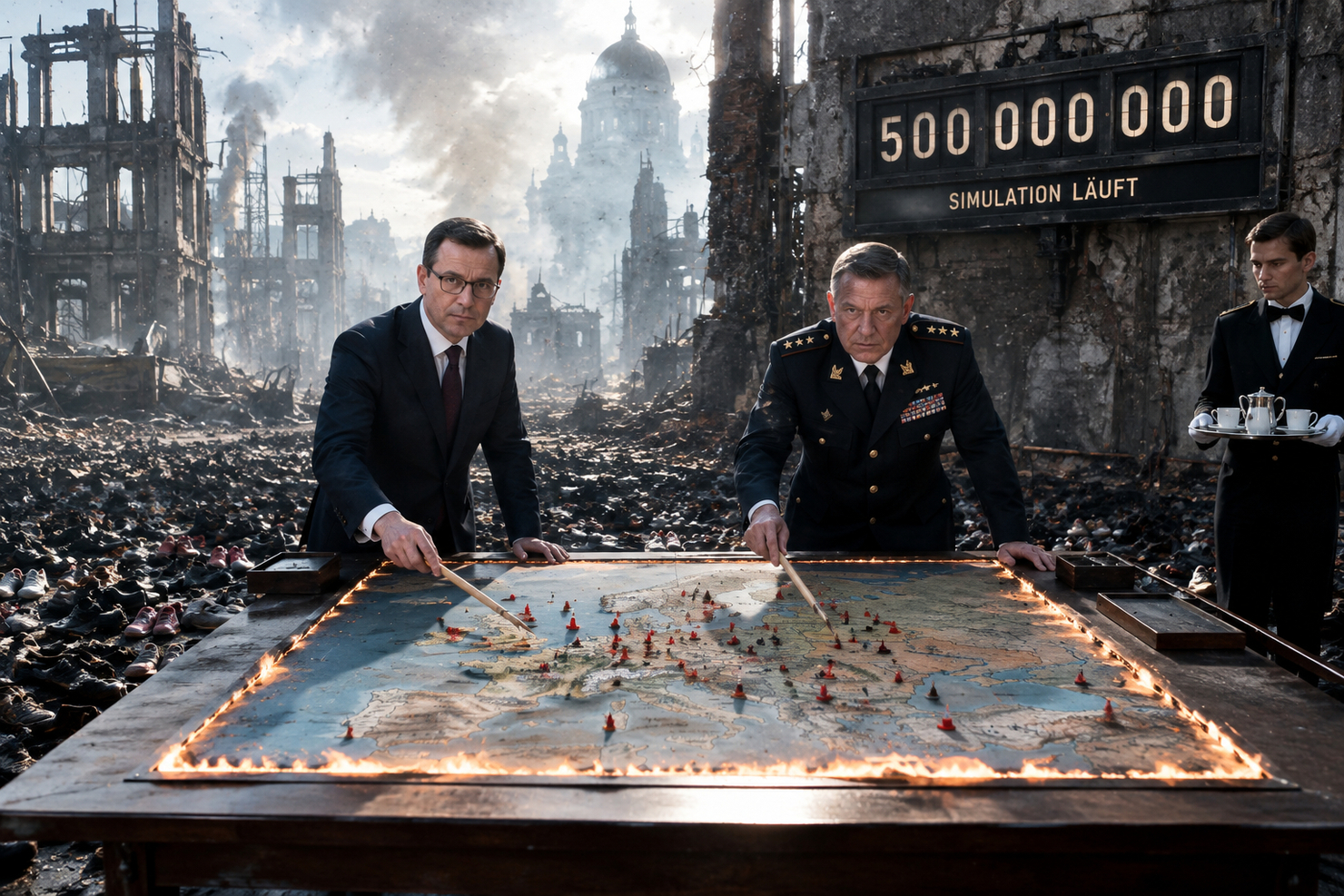
The Pentagon didn't treat this question like a feature article; they played it out in a simulation. Operation Proud Prophet ran around the clock for twelve days, starting on June 13, 1983, with several hundred participants from all branches of the armed forces, the CIA, and the State Department. Defense Secretary Weinberger and Chief of Staff Vessey played themselves, and the simulation used the actual NATO doctrine MC 14/3 and a realistic operational plan. The sequence of events: first, chemical weapons against Bonn, then the breakthrough of the Warsaw Pact, then small-range nuclear artillery shells, then medium-range missiles, then strategic weapons against military targets – and finally the stage known in the manual as "general nuclear response." Half a billion dead.
The decisive finding is not the number of casualties. The American side had assumed the Soviets would accept a ceasefire after a limited strike. They didn't, but responded massively. This very assumption—that the enemy will react rationally, and in the way we hope—is the foundation upon which the all-clear is being built today. The post-match report has been released and redacted. The second lesson carries more weight than the first: The players were consistently subject to the illusion of mirroring; their thought patterns didn't match the reality of the opposing side. The report states that signals one side considers simple and unambiguous are not understood by the other, even during the game. This is precisely the basis for today's theory of the calculating Kremlin, which knows what is worthwhile—and this in a situation where several arenas are simultaneously under tension.
Princeton calculated what this would look like with today's arsenals as Plan A. A Russian warning shot near Kaliningrad, a single tactical response from NATO, then 300 Russian and 180 Western warheads in combat, followed by counterstrikes against the nuclear forces, and finally the 30 largest cities on the opposing side with five to ten warheads per city. 85,3 million victims in 45 minutes, 91,5 million in total, of which 34,1 million are dead – not including fallout. What follows is described in Nature Food : At 150 teragrams of soot in the stratosphere, the calorie production of major grains collapses by around 90 percent in the third and fourth years, and over 5 billion people starve. Even the smallest calculated scenario costs seven percent globally – more than any crop failure since the FAO began recording data in 1961.
The counter-test, because it has to be done.
Only those who also quote the other side remain honest. The largest experimental wargame to date, 425 runs of the SIGNAL platform , found no statistically significant effect of precisely targeted small warheads on the threshold for use: they replace the large ones, they don't open the door. However, this game measures the threshold, not the path beyond it – and it is played by volunteers on a hexagonal grid, not by people with access to an operational plan. Where games were played with real commanders and real plans – in 1983, 2004, and 2018 – the result was always the same. A limited nuclear war has not been achieved in a single realistic simulation to this day. Not one. Furthermore, anyone who talks about decision-making processes today should be aware of how these processes have become automated.
And what if these things don't exist at all?
This brings us to the heretical question that inevitably arises in this context. There is a body of literature that claims the whole arsenal is theater: "Death Object" from 2017 argues that, according to the official narrative, Hiroshima and Nagasaki should be wastelands today, but are in fact major cities; the damage patterns are virtually identical to the firebombing of Dresden and Tokyo; and an aviation expert was unable to distinguish either city from other burned-out cities after the war.
No official authority opposes this, only a measurement. Nine granite samples from within a 1200-meter radius of the zero point in Hiroshima were cross-checked : Europium-152 by gamma spectrometry in the underground laboratory in Ogoya, and Chlorine-36 in parallel at the Technical University of Munich, in Livermore, and in Tsukuba. The ratio of measurement to calculation averaged 0,98. These are activation products from neutron bombardment. Napalm does not produce neutrons, and no firestorm in the world can turn europium in a bridge pier into a radioisotope. Anyone claiming fraud must explain who put the stuff there.
The present day is also a factor: On September 3, 2017, 41 primary and 90 additional seismic stations, plus two hydroacoustic and one infrasound station, registered an event in North Korea. After re-analysis, the magnitude was determined to be 6,1, with an error ellipse of ±6,7 km. The Norwegian NORSAR calculated the impact at approximately 120 kilotons, as did independent Chinese and Swedish institutes. During a 2013 test, radionuclide stations in Takasaki, Japan, and Ussuriysk, Russia, detected xenon isotopes. Three factions, deeply distrustful of one another, are measuring the same hole in the same mountain.
Where the skeptics have a demonstrable point is elsewhere: From 1947 to 1969, the US Air Force operated a secret film studio in Laurel Canyon , complete with a soundstage, editing rooms, film vaults, and a bunker, producing around 6500 classified films for the Department of Defense and the Atomic Energy Commission. The images were indeed staged. The device itself, however, was not. The more uncomfortable conclusion, therefore, is not "all a fake," but rather: It was never necessary to fake the bomb; it was enough to orchestrate the associated feeling—once as panic, now as reassurance.
The bill that no one is paying attention to.
Three key witnesses, three false positives: France detonated its bombs in the colonial war, Washington pushed them toward Khe Sanh, London drove off into the exclusion zone at 31. Since 1983, every realistic analysis has yielded the same result, regardless of the doctrine, the president, or who holds the red phone. The bomb is the only thing in this debate that has never needed to be staged. Anyone who concludes from five lost colonial wars that the sixth superpower will remain silent isn't doing any calculations, but merely counting how often the drum has been empty – and calls this "historical context"!
More for you:






 "Dravens Tales from the Crypt" has been enchanting for over 15 years with a tasteless mixture of humor, serious journalism - for current events and unbalanced reporting in the press politics - and zombies, garnished with lots of art, entertainment and punk rock. Draven has turned his hobby into a popular brand that cannot be classified.
My blog was never designed to spread news, let alone get political, but with current affairs I just can't help but capture information here that is otherwise censored on all other channels. I am aware that the design page may not seem "serious" to many in this regard, but I will not change this to please the "mainstream". Anyone who is open to non-state-compliant information sees the content and not the packaging. I've tried enough to provide people with information over the last 2 years, but quickly noticed that it never matters how it's "packaged", but what the other person's attitude towards it is. I don't want to put honey on anyone's mouth to meet expectations in any way, so I'll keep this design because hopefully at some point I'll be able to stop making these political statements, because it's not my goal to go on like this forever  I leave it up to everyone how they deal with it. However, you are welcome to simply copy and distribute the content, my blog has always been under the WTFPL license.
It's hard for me to describe what I'm actually doing here, DravensTales has become a culture blog, music blog, shock blog, tech blog, horror blog, fun blog, a blog about found items on the internet, internet bizarre, trash blog, art blog, water heater, zeitgeist blog over the years , Scrap blog and grab bag blog called. Everything that is right ... - and yet not. The main focus of the blog is contemporary art, in the broadest sense of the word.
To ensure the continued operation of this site, you are welcome to make a donation via credit card, PayPal, Google Pay, Apple Pay, or direct debit/bank account . Many thanks to all readers and supporters of this blog!









The examples of Algeria, Vietnam, and Afghanistan show that defeats do not automatically lead to the use of nuclear weapons – but they say little about a war in which a nuclear power sees its own existence threatened. It is precisely this overextension of historical analogies that makes the supposed all-clear so dangerous.