
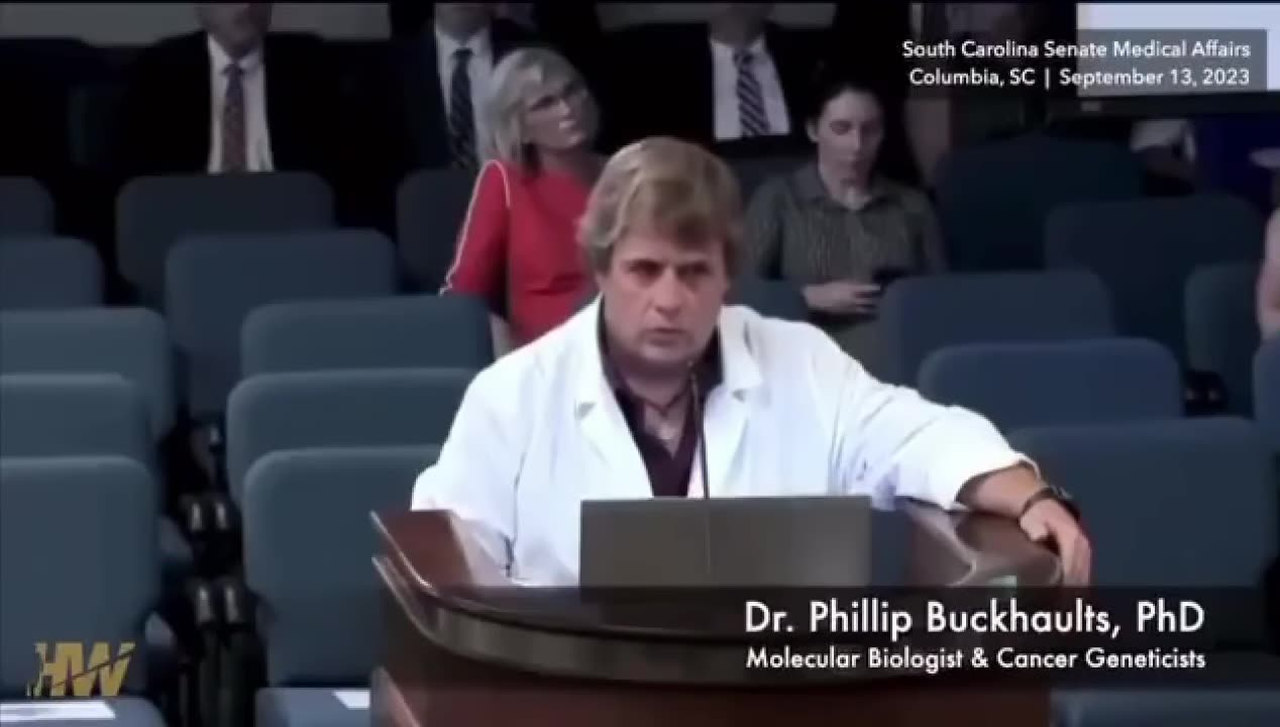
Phillip Buckhaults is no fringe figure. He's a professor of molecular biology and genetics at the University of South Carolina, an expert in cancer genomics—and known for developing the COVID saliva test during the pandemic. A man, then, who was trusted to do useful science. Until he started doing inconvenient science. On September 12, 2023, he testified before the South Carolina Senate's Medical Affairs Ad-Hoc Committee. His testimony was strikingly clear: The Pfizer vaccine is contaminated with plasmid DNA. It's not just mRNA. It contains DNA fragments—and he knows this because he sequenced it in his own lab. Let that sink in for a moment.
What plasmid DNA means – and what it shouldn't be.
mRNA vaccines work on a simple principle: messenger RNA is injected, provides instructions for building a protein, is broken down, and that's it. That was the promise. That was the basis for their approval. That was the difference from traditional vaccines, which was sold to the public as a revolutionary advantage.
What Buckhaults found was something else entirely: plasmid DNA – that is, circular DNA fragments used in the production of the mRNA template, which should actually be completely removed. Not in trace amounts, but in quantities exceeding the limits set by the EMA and FDA.
DNA is more stable than mRNA. DNA can penetrate the cell nucleus. The question of whether and how injected DNA fragments can interact with the human genome is not esoteric speculation—it is a legitimate molecular biological question that would need to be answered before administering a vaccine billions of times. It hasn't been answered. It hasn't been asked. At least not publicly.
The licensing authorities and their blind spots
This is where the real story begins. Pfizer knew about the DNA contamination. This is not speculation – it emerged from documents released in response to FOIA requests. The question is whether the regulatory authorities – FDA, EMA, Swissmedic – paid sufficient attention during their quality control review.
The answer that emerges from Buckhaults' testimony is sobering: apparently not thorough enough. Or the thresholds were set in such a way that the result appeared acceptable from the outset. This is no small detail. Quality control for vaccines doesn't exist as a bureaucratic formality—it exists because injected substances enter the human body and can do things there that cannot be fully predicted. DNA contamination exceeding thresholds in a mass-produced vaccine is a regulatory failure. Period.
The reaction – silence, distraction, carrying on.
Buckhaults' testimony before the South Carolina Senate has been publicly available since September 2023. The major media outlets have covered it with the kind of thoroughness that has become their trademark in science reporting: barely at all. No Spiegel cover story. No ARD special report. No urgent inquiries to Pfizer, the EMA, or the RKI.
Instead, the usual refrain: The man is not representative. The findings are controversial. There's no need to panic. Controversial among whom? Refuted by whom? With what data? These are questions that science journalism should be asking – and isn't, because the answers might be uncomfortable.
Conclusion without a bow
Buckhaults is not an anti-vaxxer. He explicitly emphasized this in his statement. He is a scientist who has identified a problem – and who is describing the institutional response to it: silence, ignoring, carrying on as before.
That's the real scandal. Not the contamination alone – manufacturing problems can happen. But the fact that a recognized expert testifies before a parliamentary committee that he examined an approved mass vaccine for DNA contamination and found it – and the responsible authorities react with the enthusiasm of a city council to a parking lot redesign proposal.
More for you:






 "Dravens Tales from the Crypt" has been enchanting for over 15 years with a tasteless mixture of humor, serious journalism - for current events and unbalanced reporting in the press politics - and zombies, garnished with lots of art, entertainment and punk rock. Draven has turned his hobby into a popular brand that cannot be classified.
My blog was never designed to spread news, let alone get political, but with current affairs I just can't help but capture information here that is otherwise censored on all other channels. I am aware that the design page may not seem "serious" to many in this regard, but I will not change this to please the "mainstream". Anyone who is open to non-state-compliant information sees the content and not the packaging. I've tried enough to provide people with information over the last 2 years, but quickly noticed that it never matters how it's "packaged", but what the other person's attitude towards it is. I don't want to put honey on anyone's mouth to meet expectations in any way, so I'll keep this design because hopefully at some point I'll be able to stop making these political statements, because it's not my goal to go on like this forever  I leave it up to everyone how they deal with it. However, you are welcome to simply copy and distribute the content, my blog has always been under the WTFPL license.
It's hard for me to describe what I'm actually doing here, DravensTales has become a culture blog, music blog, shock blog, tech blog, horror blog, fun blog, a blog about found items on the internet, internet bizarre, trash blog, art blog, water heater, zeitgeist blog over the years , Scrap blog and grab bag blog called. Everything that is right ... - and yet not. The main focus of the blog is contemporary art, in the broadest sense of the word.
To ensure the continued operation of this site, you are welcome to make a donation via credit card, PayPal, Google Pay, Apple Pay, or direct debit/bank account . Many thanks to all readers and supporters of this blog!








