
A doctor prescribes a medication. A court convicts him. Not for medical malpractice. Not for manslaughter. But for an alleged violation of the Medicines Act. Welcome to 2026, where the central question is no longer whether a therapy works – but whether it was approved.
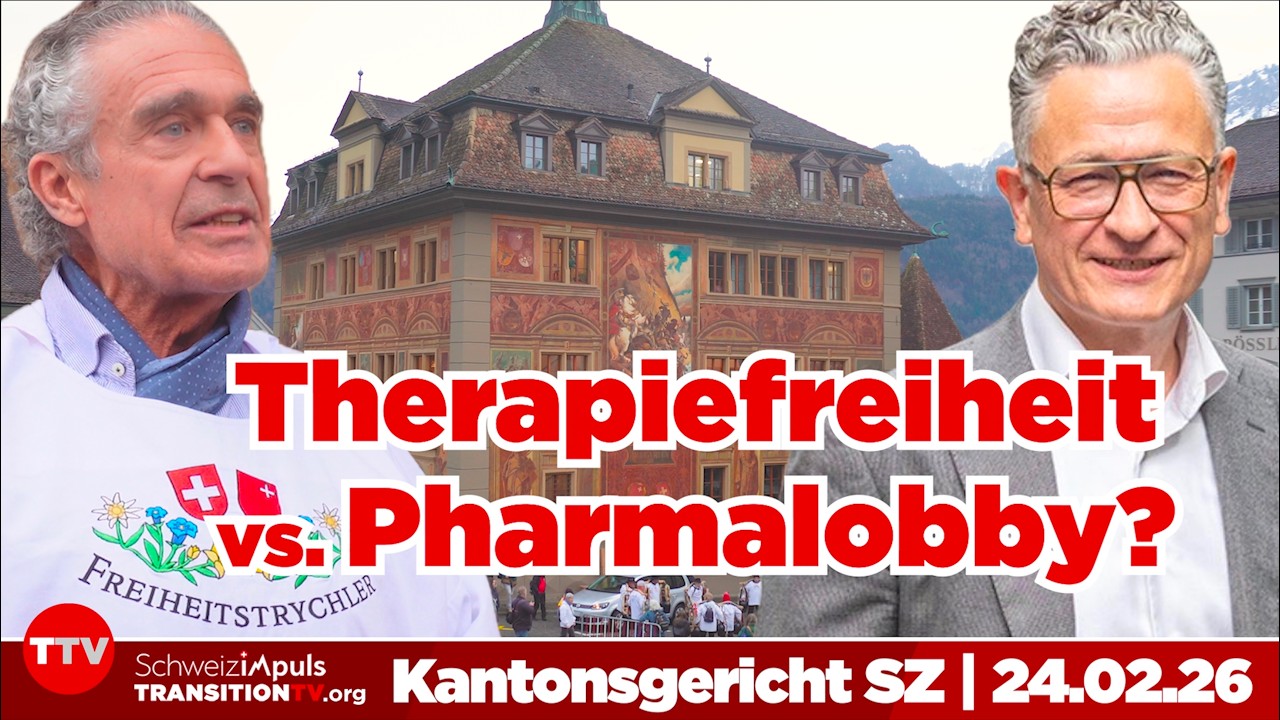
Anesthesiologist Dr. Manuel Albert was charged during the pandemic, among other things, for dispensing ivermectin. He also issued mask exemption certificates, but these charges were later dropped. What remains is the conviction handed down by the Höfe District Court on February 14, 2025. The case is now before the Schwyz Cantonal Court.
One might think this is an isolated case. A doctor who went astray. But this is precisely where the real problem begins. Because for Albert and his lawyer, it's not about sympathies or political affiliations. It's about a fundamental question:
Does freedom of method and therapy still apply to doctors in this country – or will the administration decide on medicine in the future?
The pandemic was a stress test. Not only for intensive care units, but for the relationship between the state and the medical profession. Doctors were suddenly no longer seen as independent experts, but as implementers of a central directive. Deviations were not considered medical judgment, but rather grounds for suspicion.
The Medicines Act, originally created to ensure patient safety, has become an instrument for restricting therapeutic options. One might ask: When was medical decision-making authority effectively transformed into bureaucratic authority?
Dozens of people gathered in front of the courthouse in Schwyz. There were members of the Freedom Party with their bells, banner bearers, and citizens concerned about the autonomy of the medical profession. The defense's request for a larger courtroom to accommodate 100 to 150 trial observers was denied. Transparency, it seems, is being administered in homeopathic doses.
Transition TV spoke with supporters, including a pub owner from Muotathal, a gynecologist, a farmer and cantonal councilor, and co-organizers of the demonstration. One may think what one likes about their positions, but the core question remains: Who defines what is medically permissible?
Swissmedic is acting as a private plaintiff in these proceedings. At the same time, its president heads the SRG German-speaking Switzerland. One could consider this a coincidence. Or a remarkable concentration of influence.
And meanwhile, we are seriously debating whether a doctor should still be allowed to act within the scope of their training, experience, and conscience – or whether any deviation from a central recommendation becomes legally risky.
Methodological freedom is not an anarchistic concept. It reflects the fact that medicine is not an exact engineering science. It is based on evidence, experience, and individual judgment. What is appropriate for one patient may be unsuitable for another. Therefore, medical freedom exists – not out of whim, but out of necessity.
When authorities make binding decisions on medical matters, responsibility shifts. The doctor then becomes an enforcement officer with a stethoscope. Liability, however, remains with the treating physician. A remarkable asymmetry: the decision comes from above, the risk is borne by the doctor at the bottom.
Ivermectin was a loaded term during the pandemic. For some, it represented hope; for others, heresy. Scientific assessments fluctuated, studies contradicted each other, and data was in flux. It is precisely in such situations that discourse is needed – not prosecution.
The question isn't whether ivermectin was a miracle drug. It's whether a doctor, in an exceptional situation, is allowed to act according to their best knowledge and conscience, as long as they are informed, document, and take responsibility. Who ultimately decides what is "right"? The Federal Office of Public Health? Swissmedic? Cantonal health authorities? Five judges? Or the doctor in direct contact with the patient?
The pandemic has created a new dynamic. Dissenting opinions were not only criticized professionally, but also morally delegitimized. Doctors who asked questions or pursued alternative approaches were placed under general suspicion. Freedom of methodology became a risky zone.
If this trend continues, a silent transformation is imminent. Medicine will become a standardized administrative discipline. Innovation, however, rarely arises within standardized frameworks. It emerges at the margins, in controversies, and through questioning.
The irony is obvious: For decades, doctors were accused of acting too autonomously. Now, autonomy itself seems to have become the problem. Of course, rules are necessary. Of course, standards are necessary. But standards are guardrails, not handcuffs. Criminalizing every deviation creates conformity—not quality.
The verdict from the five-member panel of judges is still pending. It will be more than a personal decision regarding Manuel Albert. It will send a signal. A signal about whether Switzerland will continue to trust in the professional autonomy of its doctors – or whether medical therapy will become an administrative service requiring approval.
Freedom of method and therapy is not a luxury. It is the prerequisite for medicine to remain individualized. If it is restricted, the relationship between doctor, patient, and state changes fundamentally.
The question is not whether one likes Manuel Albert.
The question is whether one can trust a medical system that only does what has been previously approved.
In the next few days, a decision will be made as to whether the doctor will be allowed to continue practicing medicine – or primarily be an enforcer of medical guidelines.
More for you:






 "Dravens Tales from the Crypt" has been enchanting for over 15 years with a tasteless mixture of humor, serious journalism - for current events and unbalanced reporting in the press politics - and zombies, garnished with lots of art, entertainment and punk rock. Draven has turned his hobby into a popular brand that cannot be classified.
My blog was never designed to spread news, let alone get political, but with current affairs I just can't help but capture information here that is otherwise censored on all other channels. I am aware that the design page may not seem "serious" to many in this regard, but I will not change this to please the "mainstream". Anyone who is open to non-state-compliant information sees the content and not the packaging. I've tried enough to provide people with information over the last 2 years, but quickly noticed that it never matters how it's "packaged", but what the other person's attitude towards it is. I don't want to put honey on anyone's mouth to meet expectations in any way, so I'll keep this design because hopefully at some point I'll be able to stop making these political statements, because it's not my goal to go on like this forever  I leave it up to everyone how they deal with it. However, you are welcome to simply copy and distribute the content, my blog has always been under the WTFPL license.
It's hard for me to describe what I'm actually doing here, DravensTales has become a culture blog, music blog, shock blog, tech blog, horror blog, fun blog, a blog about found items on the internet, internet bizarre, trash blog, art blog, water heater, zeitgeist blog over the years , Scrap blog and grab bag blog called. Everything that is right ... - and yet not. The main focus of the blog is contemporary art, in the broadest sense of the word.
To ensure the continued operation of this site, you are welcome to make a donation via credit card, PayPal, Google Pay, Apple Pay, or direct debit/bank account . Many thanks to all readers and supporters of this blog!








