
Bill Gates knows what's coming. He knows it so well that he already wrote it down in 2022 – complete with page numbers, a timeline, and a personnel list. And those who stood in the way last time – the critics, the truth-seekers, the persistent troublemakers – won't be allowed to cause any trouble next time.
On February 4, 2025, philanthropist, vaccine investor, and self-proclaimed world health expert Bill Gates appeared on the US talk show "The View" and announced with the relaxed self-assurance of a man who knows the answers before the questions are even asked: Corona was not the last pandemic. The next one could be far worse. We should be better prepared. Applause. Thank you, Bill. Very enlightening.
What "better prepared" means, he already clearly outlined in his 2022 book, "How We Can Prevent the Next Pandemic." The agenda is clear: global coordination via the WHO, digitization of all relevant infrastructures, and—you guessed it—accelerated vaccine development. All three are currently being implemented. On schedule. As if the pandemic weren't an unforeseen natural event, but a project with milestones, responsibilities, and deadlines.

A tsunami has been forecast
In 2022, Moderna's then Chief Scientific Officer, Melissa Moore, dropped the mask with rare candor: "A tsunami of mRNA drugs is coming." No ifs, ands, or buts, no reassurances from the communications department. A clear announcement. And Moderna is ready: The mRNA injection against the hantavirus has been poised for launch since 2025. All that's missing is funding for human trials and an approval process. Note the order: First the product, then proof of its safety. The business model of the 21st century – lean, efficient, and entirely investor-friendly.
Hantavirus, for those who haven't Googled it: a virus transmitted through rodent excrement with a mortality rate ranging from 5 to 40 percent, depending on the subtype. Not a widespread phenomenon. Not yet a global emergency. But Moderna has taken precautions. After all, they didn't get up in the morning the day after tomorrow.
What no one wants to say out loud is that the WHO lists hantavirus infection as a reported side effect of the Covid mRNA "vaccines" in its own VigiAccess database – buried deep, but accessible nonetheless. Not as a footnote, not as a curiosity – but as a recorded entry in an official WHO adverse event database, on par with hantavirus lung infection. So Moderna is developing an mRNA vaccine against a disease that, according to the WHO's own data, can be triggered by an mRNA vaccine. In the pharmaceutical industry, that's what they call a growth market.
Yesterday's enemies – tomorrow's enemies
This is where it gets interesting – in a truly stomach-churning way. According to the collective wisdom gleaned from planning offices, think tanks, and WHO conference rooms, during the next pandemic, vaccine skeptics and those seeking to educate the public are to be "brutally silenced." The official justification: they ruined the COVID-19 narrative. This statement contains a confession, if one has the audacity to actually read it: it was a narrative. And it didn't quite work out because too many people asked too many questions.
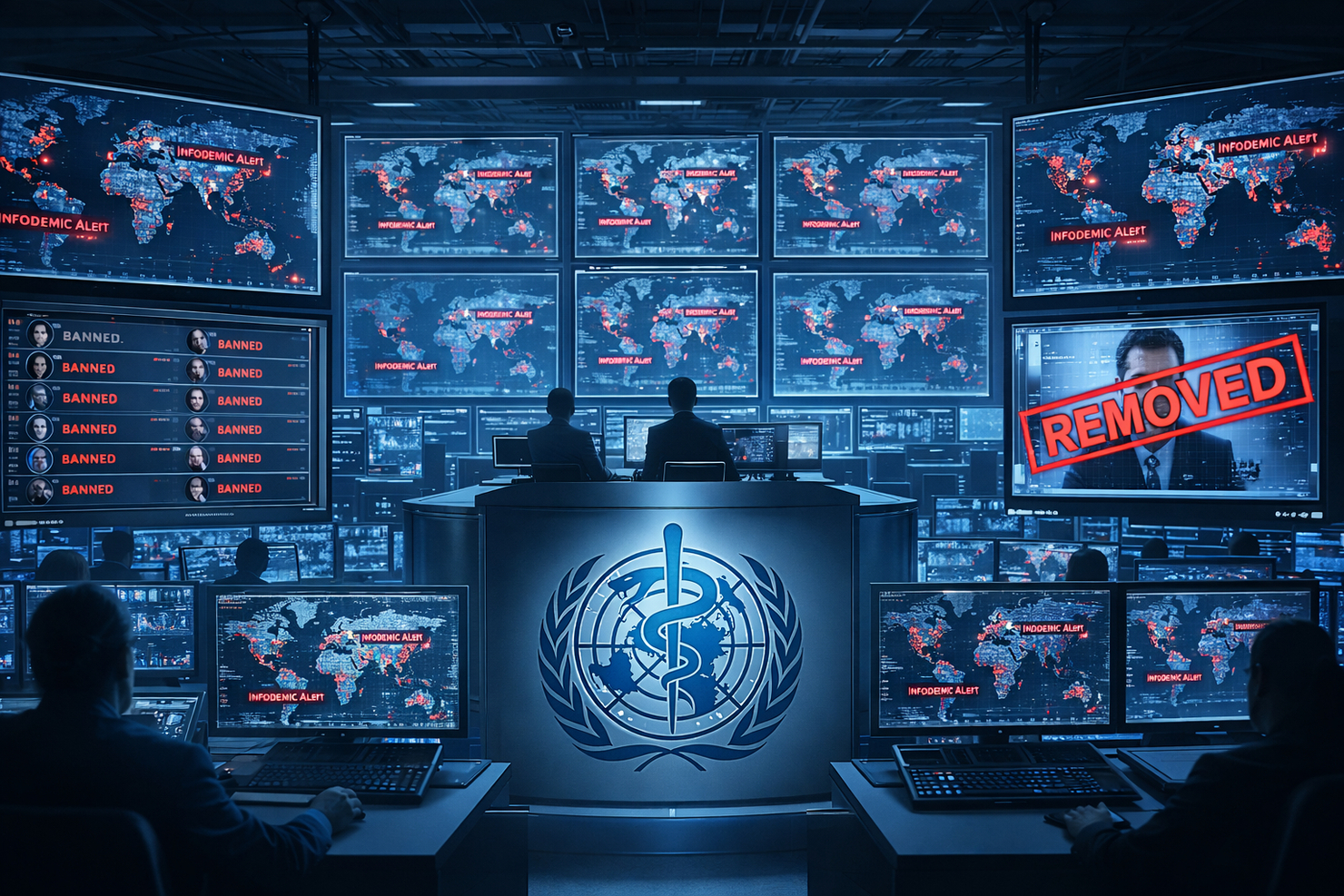
The EU has now found its own terminology for this problem: "infodemic." Critical opinions are no longer opinions; they are a plague. A health hazard. Not the experimental injections with three years' worth of safety data. Not state-mandated censorship. Not the systematic exclusion of people from social life. The questions themselves are the problem. The WHO goes even further: "Anti-vaxxers are more deadly than terrorists." That's their exact words. Not satire. Let that sink in.
Catastrophic Contagion: The simulation game with the real plan
In 2022, the same year Melissa Moore announced her tsunami, the WHO's "Catastrophic Contagion" simulation took place. In attendance were Bill Gates, a number of high-ranking health officials, and decision-makers from around the world. The exercise, which simulated a new pandemic with a pathogen that particularly kills children, resulted in anti-vaccine advocates being defined as enemies who would have to be swiftly eliminated in the next pandemic.
"Eliminated." The word is out there. No one made a mistake. It was written down. It was part of the exercise. Those present listened, nodded, and flew home—in private jets, of course, because the climate can only be saved if the right people fly.
Imagine this scenario: A billionaire with no medical training, who has invested more money in the WHO than most member states, sits in a room discussing how to "eliminate" critics of his business models. No journalist finds this odd. No prosecutor. Not a single member of parliament who stands up and asks if they just heard that correctly.
The logic of the next round
What is emerging here is no longer a conspiracy narrative spun by someone. It is a publicly communicated plan with a timeline, targets, and a fully developed set of rhetoric. The establishment of WHO power via the pandemic agreement is underway. The digital surveillance infrastructure is expanding. The mRNA pipeline is filling up. And societal discourse is shifting in a direction where dissenting opinions are no longer debated but must be "eliminated."
Those who got away with a blocked account or suspended platform presence last time shouldn't expect to be so lenient this time. The lesson learned from the pandemic isn't: "We were too harsh." It's: "We were too slow. And too disorganized." The infrastructure for next time is already in place. And it's not for the virus.
Next time, the machinery will be in place before the first critic can even finish writing his first sentence – and it will be called "pandemic protection"!

More for you:






 "Dravens Tales from the Crypt" has been enchanting for over 15 years with a tasteless mixture of humor, serious journalism - for current events and unbalanced reporting in the press politics - and zombies, garnished with lots of art, entertainment and punk rock. Draven has turned his hobby into a popular brand that cannot be classified.
My blog was never designed to spread news, let alone get political, but with current affairs I just can't help but capture information here that is otherwise censored on all other channels. I am aware that the design page may not seem "serious" to many in this regard, but I will not change this to please the "mainstream". Anyone who is open to non-state-compliant information sees the content and not the packaging. I've tried enough to provide people with information over the last 2 years, but quickly noticed that it never matters how it's "packaged", but what the other person's attitude towards it is. I don't want to put honey on anyone's mouth to meet expectations in any way, so I'll keep this design because hopefully at some point I'll be able to stop making these political statements, because it's not my goal to go on like this forever  I leave it up to everyone how they deal with it. However, you are welcome to simply copy and distribute the content, my blog has always been under the WTFPL license.
It's hard for me to describe what I'm actually doing here, DravensTales has become a culture blog, music blog, shock blog, tech blog, horror blog, fun blog, a blog about found items on the internet, internet bizarre, trash blog, art blog, water heater, zeitgeist blog over the years , Scrap blog and grab bag blog called. Everything that is right ... - and yet not. The main focus of the blog is contemporary art, in the broadest sense of the word.
To ensure the continued operation of this site, you are welcome to make a donation via credit card, PayPal, Google Pay, Apple Pay, or direct debit/bank account . Many thanks to all readers and supporters of this blog!








