
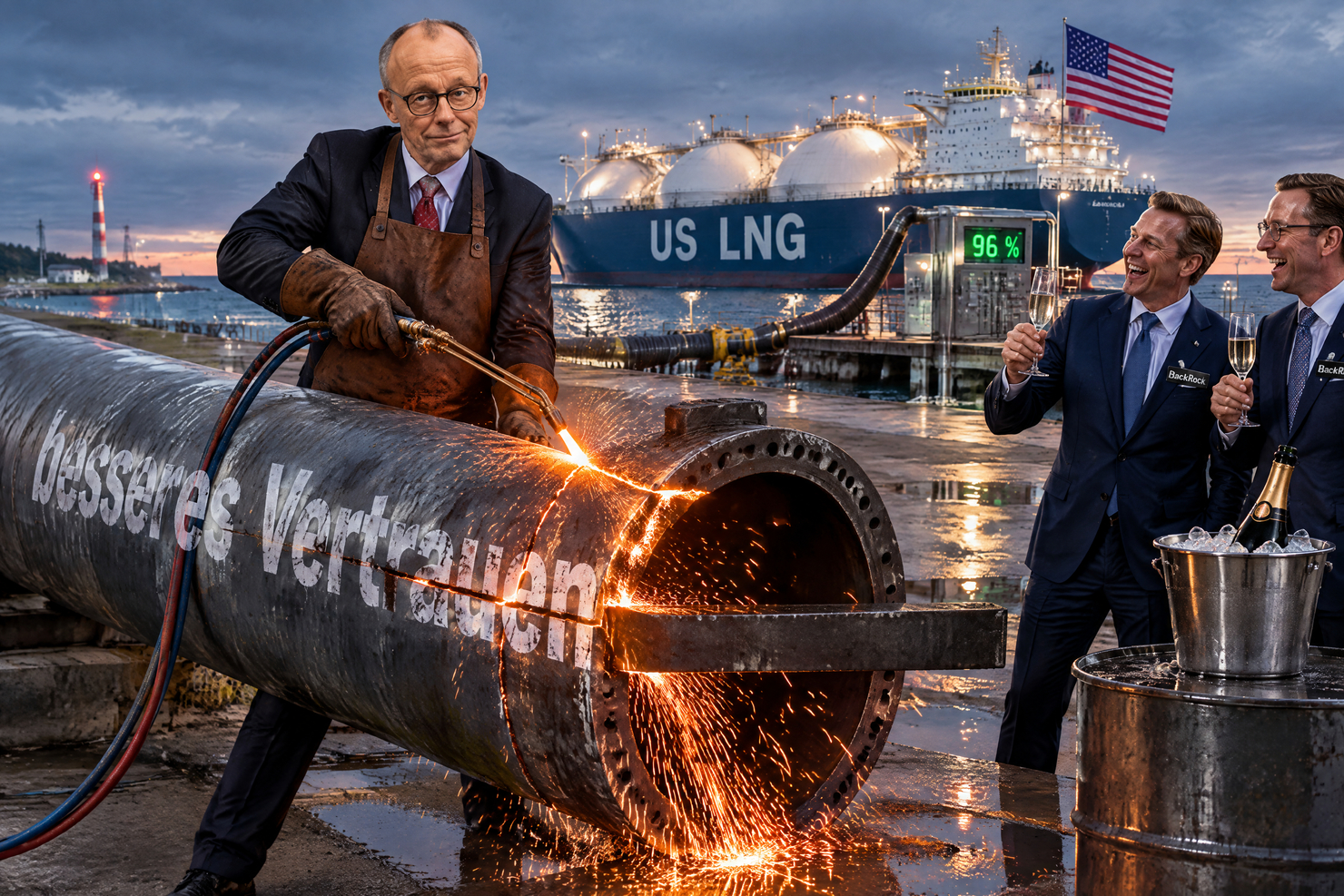
“What the Americans are doing is an absolute outrage,” Friedrich Merz thundered to the CDU in Central Saxony in the summer of 2020, adding that better exchange, better cooperation, and better trust with Russia were essential. Today, the same man who defended the very same pipe he once defended against Washington is now also closing it off to potential American buyers. The question isn't whether Merz lied. The only question is, in which year?
Summer 2020: The Pipeline Patriot
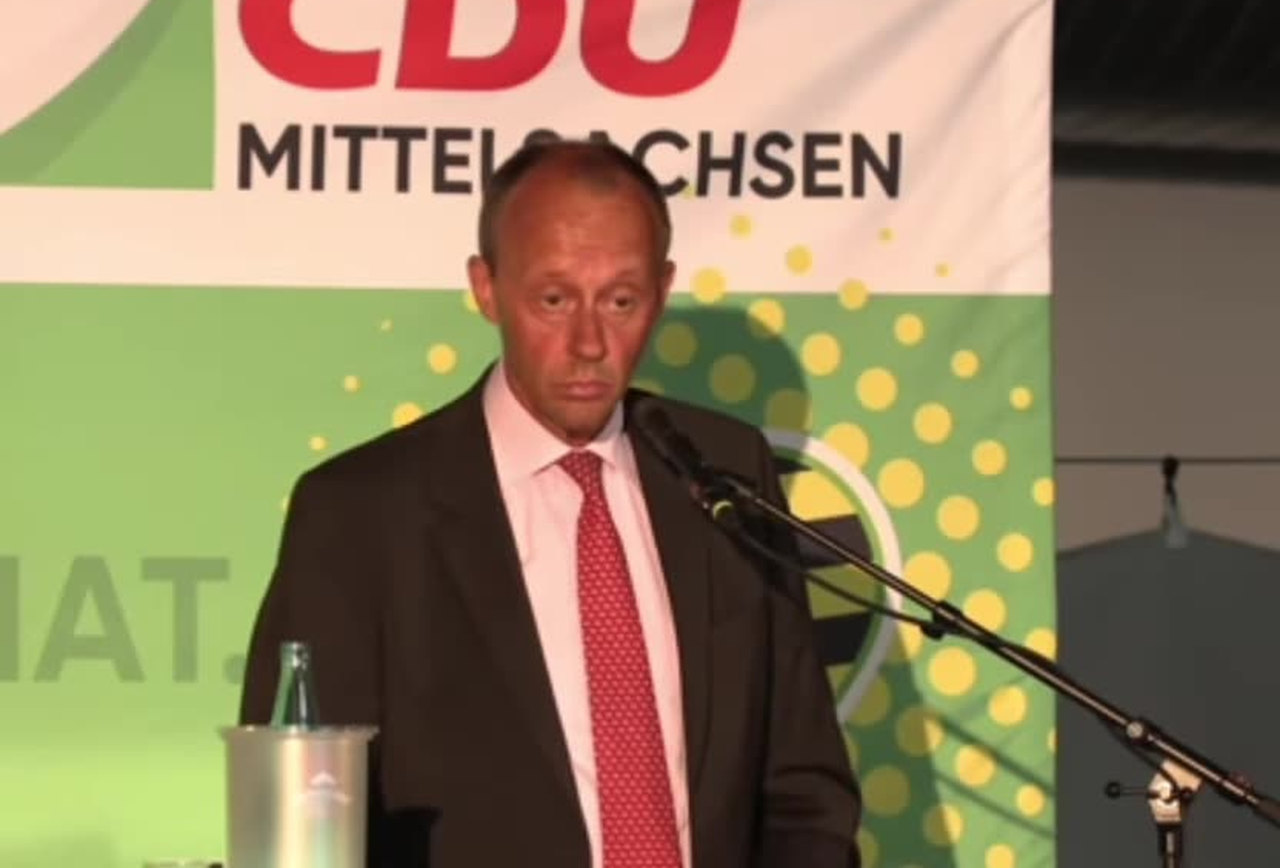
The scene is 52 seconds long and disarmingly clear – you can see for yourselves at the end of the article. Merz at the lectern, red tie, CDU banner behind him. Threatening Europeans with sanctions against all persons, companies, and countries over a project that has nothing to do with America, citing the extraterritoriality of US law, is an attitude that cannot be tolerated. A European peace order without, or even against, Russia is simply impossible.
The background was real. On August 5, 2020, US Senators Ted Cruz, Tom Cotton, and Ron Johnson threatened the Sassnitz ferry port with economic ruin in writing if it continued to supply ships for Nord Stream 2. They threatened entry bans for board members, frozen assets, and sanctions down to shareholders and employees of a Baltic Sea port. Merz played the defender of sovereignty from the Sauerland region. He was assured of applause in Saxony.
Minimum shelf life of a few weeks
Then came the poisoning of Alexei Navalny. On September 4, 2020, Merz suddenly demanded an immediate two-year construction halt for Nord Stream 2 and even admitted that he had "previously been in favor of continuing the pipeline's construction." This blatant outrage, therefore, didn't just land "today," but a few weeks later on the compost heap of his own speech. Coincidentally, Merz was running for the CDU chairmanship at the time, and his rival Norbert Röttgen had already called for the halt days earlier, while Chancellor Merkel still wanted to complete the pipeline. Conviction based on the prevailing political climate, delivered right to your door.

Has BlackRock changed its mind?
The question naturally arises, since Merz chaired the supervisory board of BlackRock Germany, a subsidiary that at the time managed around $120 billion for German clients, from 2016 onwards. However, the chronology is a spoilsport. Merz left his position at the end of March 2020. During his time at BlackRock, he claimed to have been in favor of further expansion, but he delivered his speech against Washington after leaving the company, and he justified his about-face with the Navalny case. There is no evidence of any directive from New York. Anyone claiming otherwise is fabricating information.
This doesn't make the matter harmless. At the beginning of 2023, BlackRock held an 8,6 percent stake in Cheniere, the largest US exporter of liquefied natural gas , and by 2025, around 96 percent of Germany's LNG imports came from the US . You don't need to assume orders to see the pattern. The former regulator's actions perfectly align with the coffers of his former employer. To be fair, Vanguard and Blackstone also have a stake in Cheniere; these index giants are invested in almost every energy company. BlackRock wins regardless of who's in charge. That's the real scandal.
Today: The barrier on the Baltic Sea
As Chancellor, Merz announced in May 2025 that he would do everything in his power to prevent Nord Stream 2 from becoming operational and supported Brussels' plans for sanctions against the operators. Ironically, at the same time, reports surfaced about American investors as potential buyers of the pipeline . In 2020, sanctions against the pipeline were considered an outrage; in 2025, Merz himself was calling for them. In September 2026, he declared Russia's responsibility for the drone attack at Leipzig/Halle Airport legally sound and emphasized that they had taken four weeks to determine responsibility. For his about-face in 2020, he had needed fewer weeks. No one was talking about "greater trust" anymore.
The Baltic Sea turnaround is not an isolated case. The CDU and CSU wrote in their election manifesto that they would adhere to the debt brake, yet just a few days after the election, a special fund of 500 billion euros , financed by loans, was established, approved with the outgoing Bundestag. How this backbone against Washington then became is well known.

The competition in the word-breaking contest
Anyone who reflexively runs to the competition now is just running into the next shop window displaying the same product. In December 2021, SPD Chancellor Olaf Scholz called Nord Stream 2 a "private-sector project" over which a government agency would make a completely apolitical decision. Around two months later, it was suddenly highly political. In 2021, the Green Party campaigned against putting up posters against sending weapons to war zones and later removed the term "war zones" from their platform, because, according to their own party resolution, this position was no longer relevant since the war in Ukraine . Pacifism with an expiration date.
And the supposed alternative? In 2018, Alice Weidel demanded, "Let's take back our country!" accompanied by a hiking photo taken in Switzerland , where she lives with her family in Einsiedeln with a residence permit. She doesn't maintain a constituency office in Überlingen, and residents there tell reporters they've never even seen the candidate. Take back the homeland, but please, from Lake Sihl. A side-by-side comparison of their platforms reveals the same agenda in different packaging.
One tube, two opinions, zero backbone
Merz hasn't changed his mind; he's simply rented it out to whatever fancies the loudest voice of the moment. No other party is in a better position; they only differ in the speed at which they discard their promises. The CDU burned its Nord Stream commitment in a matter of weeks and the debt brake in a matter of days. The SPD needed two months, the Greens a war. Those who accused Washington of outrageous behavior in 2020 now govern a country that buys 96 percent of its liquefied natural gas from America—and call this "sovereignty"!
More for you:






 "Dravens Tales from the Crypt" has been enchanting for over 15 years with a tasteless mixture of humor, serious journalism - for current events and unbalanced reporting in the press politics - and zombies, garnished with lots of art, entertainment and punk rock. Draven has turned his hobby into a popular brand that cannot be classified.
My blog was never designed to spread news, let alone get political, but with current affairs I just can't help but capture information here that is otherwise censored on all other channels. I am aware that the design page may not seem "serious" to many in this regard, but I will not change this to please the "mainstream". Anyone who is open to non-state-compliant information sees the content and not the packaging. I've tried enough to provide people with information over the last 2 years, but quickly noticed that it never matters how it's "packaged", but what the other person's attitude towards it is. I don't want to put honey on anyone's mouth to meet expectations in any way, so I'll keep this design because hopefully at some point I'll be able to stop making these political statements, because it's not my goal to go on like this forever  I leave it up to everyone how they deal with it. However, you are welcome to simply copy and distribute the content, my blog has always been under the WTFPL license.
It's hard for me to describe what I'm actually doing here, DravensTales has become a culture blog, music blog, shock blog, tech blog, horror blog, fun blog, a blog about found items on the internet, internet bizarre, trash blog, art blog, water heater, zeitgeist blog over the years , Scrap blog and grab bag blog called. Everything that is right ... - and yet not. The main focus of the blog is contemporary art, in the broadest sense of the word.
To ensure the continued operation of this site, you are welcome to make a donation via credit card, PayPal, Google Pay, Apple Pay, or direct debit/bank account . Many thanks to all readers and supporters of this blog!








